
News
India aims for enhanced trilateral cooperation with Japan and Lanka

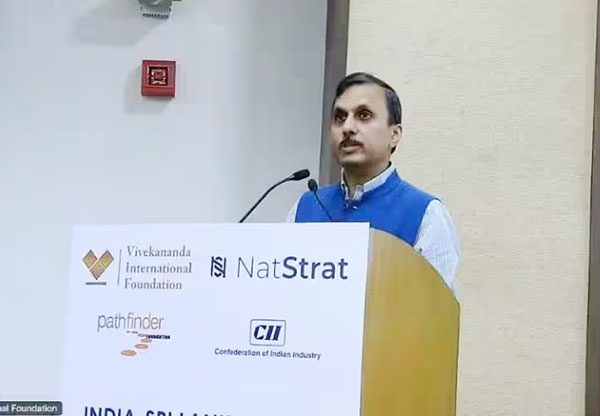
India is hoping to strengthen trilateral cooperation with Japan and Sri Lanka, focusing on new avenues of collaboration while jointly working on debt restructuring for Colombo.
Speaking at the India-Sri Lanka-Japan Trilateral Cooperation Event, co-hosted by NatStrat, VIF, Pathfinder, and CII, Puneet Agrawal in New Delhi, Joint Secretary of the Indian Ocean Region in the Ministry of External Affairs, highlighted the shared interests and potential for synergistic partnerships among the three nations.
Agrawal, who is the key person in handling all matters relating to Comoros, Madagascar, Maldives, Mauritius, Seychelles, Sri Lanka and Indian Ocean Region in India’s foreign ministry, expressed optimism about the prospects of joint endeavours despite past challenges.
“Some projects in Sri Lanka which were to be executed jointly by India and Japan did not progress due to several reasons, but that should not deter us in exploring new cooperation,” he affirmed. In the past, both Delhi and Tokyo burnt fingers after a tripartite deal with Colombo was scrapped for the development of Colombo Port’s eastern container terminal in 2021.
The diplomat emphasised that India and Japan, as reliable partners, could collectively contribute more than the sum of their parts, leveraging their strengths in areas such as locational advantage, economic opportunities, technical advancement, manufacturing, and industrial expansion.
The trilateral cooperation, aimed at enhancing the Indo-Pacific region’s development, has become increasingly relevant as all three countries share a vision of an open, free, and inclusive Indo-Pacific.
Addressing Sri Lanka’s need for trustworthy partners to support its economic revival, Agrawal stated, “India and Japan bring in investments that are transparent and process-oriented.”
He underscored the importance of connectivity in this process, encompassing maritime connectivity, energy and power trade, financial and digital connectivity, and people engagement.
Regarding digital connectivity, India’s advanced IT sector is set to foster economic growth in Sri Lanka, he said.
“This will not only boost e-commerce and financial inclusion but also empower Sri Lanka’s youth with skills for the Digital Age,” Agrawal added.
An agreement between NPCI International and Lanka Pay on UPI-based digital payments is poised to revolutionise the financial landscape, enhancing tourism and public infrastructure.
In addition to economic collaboration, cultural ties between India and Sri Lanka were highlighted as pivotal in fostering regional solidarity.
“Promotion of the Buddhist circuit and the Ramayana trail, exchange programs between educational institutions, scholarships, and cultural events have not only strengthened the bonds between our nations but also promoted a sense of regional solidarity,” the Indian diplomat noted. (WION)

News
Establishment of an Institutional Framework to Inagurate Upper Hydro Catchment Areas Management Authority

Policy approval of the Cabinet of Ministers was granted at their meeting held on 08.06.2026 to establish the Upper Hydro Catchment Areas Management Authority for identification and
execution of a formal and long – lasting remedy to secure the central hills including the upper hydro catchment areas enabling them to sustain amidst extreme weather conditions
due to natural calamities and human activities as well as to be used for the sustainable development of the country.
Accordingly, a concept paper has been prepared including
institutional structure, activities, powers, active subject area as well as administrative and coordination mechanism for the proposed authority by an expert technical committee appointed by the Secretary to the President.
Based on the said concept paper, the Cabinet of Ministers granted approval to the resolution furnished by the President to instruct the Legal Draftsman to prepare a draft bill including legal provisions required for the establishment of Upper Hydro Catchment Areas Management Authority.
News
Introduction of Flora and Fauna (Regulation of actions of the Indigenous Community within the nominated areas) Regulations
With the objective of securing the traditional livelihood and the eco system of the indigenous community, it has been recognized the necessity of introducing a formal regulation methodology to secure their engagement in livelihood activities by being more sensitive to the existing laws.
Thereby, the Fauna and Flora (regularizing) regulations under the Fauna and Flora Protection Ordinance (Authority 469) have been prepared so that nominated activities within the prescribed area to a member of the indigenous community
who has been registered for securing the rights acquired from law or custom or usage or traditional stance to execute an act within a certain state land that is fundamental to the survival of the indigenous community permission can be granted
Accordingly, the Cabinet of Ministers granted approval to the resolution furnished by the Minister of Environment to publish the said regulations in the government gazette notification and thereby submit to the Parliament for its concurrence.
Latest News
M. M. D. J. Senarathne, appointed Director General of the Department of National Botanical Gardens
The Cabinet of Ministers approved the resolution furnished by the Minister of Environment to appoint M. M. D. J. Senarathne, who is the senior most officer in Grade I of Sri Lanka Scientific Service se

Establishment of an Institutional Framework to Inagurate Upper Hydro Catchment Areas Management Authority
Introduction of Flora and Fauna (Regulation of actions of the Indigenous Community within the nominated areas) Regulations
M. M. D. J. Senarathne, appointed Director General of the Department of National Botanical Gardens

Harmanpreet Kaur steps down as India captain

Turkiye, Pakistan agree Saudi Arabia military deployment under Mecca pact

Rumesh Tharanga among nominees announced for World Athlete of the Year 2026

‘Dates have the highest sugar content to fight Coronavirus’

Sunday Island 27 December – Headlines

#SundayIsland 17th December – Headlines

Sunday Island – 28th March

Sunday Island Headlines – 21 March

Sunday Island – 21st February – Headlines
-

 Latest News7 days ago
Gold winner Tharanga gets brand-new Honda Vezel from SLAAJ
-

 News6 days ago
US-assisted ‘Ice’ detection: NPC to examine IGP’s move to transfer drug-busting team
-

 Features7 days ago
Why Sri Lanka needs an Inclusive Civic Nationalism – urgently
-

 Editorial5 days ago
Colombo Port drug bust: The plot thickens
-

 News7 days ago
Civil society activist accuses govt. of favouring Ven. Gnanasara
-
 Midweek Review7 days ago
Dappula’s Easter Sunday ‘grand conspiracy’ claim demolished
-

 Editorial7 days ago
When crime bosses rise above law and shrines
-
Editorial6 days ago
Drug busting, transfers and trust deficit