
Business
Income Tax, Professionals and Migration


by Naomal Goonewardena
I am a lawyer by profession who also happens to have an interest in the subject of tax. My tax liability and income tax payments for the year of assessment 2023/2024 would be more than 300% of that in 2021/2022. Not great by any means.
I have been watching in silence the continuous agitation by professionals in particular with regard to the Inland Revenue (Amendment) Act No.45 of 2022 (“2022 Amendment”) and the additional tax which is payable thereunder by individuals. Almost all of the arguments against the increased tax is accompanied by an implied threat that the high tax rates would accelerate the rate of migration of professionals from the country and the dire consequences which would arise therefrom.
It would be pertinent to analyze the marginal tax rates which have been applicable for individuals from the year 2000 to present and the level of income at which the highest marginal rate would have become applicable. The last column set out above is indicative of the level of income which a person should have on a monthly basis after which he would be liable to pay income tax at the maximum rate specified in the table.
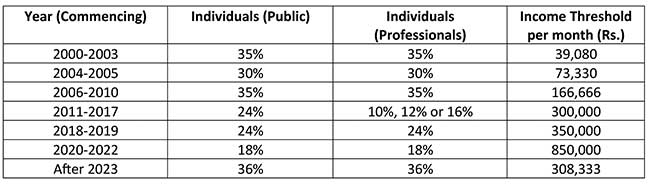
The aforesaid table is clearly indicative that for the period 2000 -2010 the marginal rates of tax were relatively high and therefore, largely comparable to what is going to apply from 2023 onwards. The real problem seems to be that from 2011 onwards, the rate of tax for professionals in particular has fallen down dramatically (other than for 2018/2019) with the result that professionals for all intents and purposes have “forgotten” to pay tax.
The enhanced threshold at which the maximum tax was applicable even at the lower rate increased dramatically from 2020 – 2022 and that seems to be the starting point for any entitlements which are now being spoken of. For example, during this period a person with an income of Rs. 500,000 per month would have only paid about Rs. 10,000 per month as income tax (i.e 2% of income). This is clearly unacceptable. The aforesaid table is clearly indicative that society in general has borne the brunt of this for the benefit of professionals at large very specially between 2011-2017. In my view there is absolutely no justification for professionals to be given any tax concessions which are not available to the other tax paying persons in this country.
I am well aware that in view of inflation in particular, affordability of the tax is in question. The personal reliefs and the level at which the maximum marginal tax rate would apply are also debatable. The real question is as to whether a person having an income of approximately Rs. 300,000 per month should or should not be contributing tax at the rate of 36% on his excess income in the context of large segments of our society being unable to eke out a bare existence for their very survival.
It is easy to say that a large part of government revenue is either wasted or subject to corrupt practices. However, the reality seems to be that major part of government revenue goes towards debt service (i.e interest expenses on borrowing) for which we are all responsible, government salaries and pensions. It is also ironic that persons who are the beneficiaries of these expenses or who have failed miserably in their basic obligation to ensure price stability are also among those who are agitating for a reduction in revenue by way of reduced tax.
It is a fallacy for employees who are subject to Pay-As-You-Earn (PAYE) tax to think that in view of the automatic deduction that they are subject to more tax than others or that other individuals in society who are liable to tax do not pay their tax. The latter pay their tax through the quarterly payment mechanism under the Inland Revenue Act of No.24 of 2017 (“IRA”). The often quoted reason for being reluctant to pay tax is that large parts of society are evading tax and therefore, one should not pay taxes. This in my view is too simple a presumption and it is for any person who says that there are other tax evaders to take the necessary steps to report them specifically to the authorities in a manner that they could share the tax burden of all. However, based on my professional training, pointing to other tax evaders and providing that as a justification for not paying your own taxes is an argument unworthy of a professional.
With regard to migration, the following table illustrates the marginal tax rates for individuals in the countries which are often mentioned as being attractive for migration by professionals.
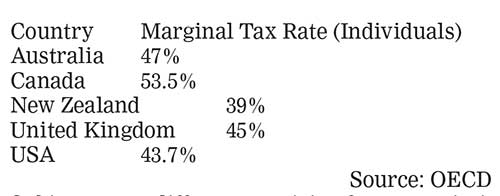
Subject to any differences arising from permissibility of expenses in computing the taxable income, it is clear that any migrant would walk into higher taxes. The migrant would not dare to evade tax in those countries either since the migrant will be summarily thrown out or put behind bars. If a professional wishes to migrate, please do so but do not cite excessive tax in your home country or insufficiency of personal reliefs in computing your taxable income, since any reasonable man in those countries would think that such arguments are hollow to say the least.
We are a Highly Indebted Poor Country (HIPC) and each of us must understand the implications of this. Whichever political party is in power, the government needs revenue. We have exercised our franchise and elected idiots in the past. In 2015 we voted for public sector salary increases which were totally unrealistic which drained the public coffers. In 2019, we the professionals voted for tax cuts, pocketed the additional monies and deprived the State of its due share of revenue. It is now pay-back time for the professionals. In the short term, the increased tax rates should be bearable and in the medium and long term will become palatable.
Increased government revenue is a necessity with current VAT rate of 15% and the marginal income tax rates for individuals and corporates of 36% and 30% being reasonable in a global sense. If any politicians seek your vote or mine on the basis of reducing these tax rates in the absence of alternative concrete revenue generating proposals, let us classify them appropriately as mentioned above and treat them with the contempt which they deserve.


HNB FINANCE PLC has strengthened its Board with the appointment of four Independent Non-Executive Directors, effective September 8, 2026.
The new directors are Renuke Wijayawardhane, Shanti Gnanapragasam, Nabiha Mohamed and Dr. Thisuri Wanniarachchi, who collectively bring extensive experience in financial regulation, banking, risk management, corporate finance, investment strategy, development finance and public policy.
Wijayawardhane, an Attorney-at-Law and capital market professional, retired in July 2025 as Chief Regulatory Officer of the Colombo Stock Exchange after more than 31 years with the Exchange. His experience covers securities regulation, corporate governance, market infrastructure and compliance.
Gnanapragasam has over four decades of banking experience spanning treasury, risk management, credit and trade finance. She currently serves as an Independent Non-Executive Director of Cargills Bank, Wealth Trust and Vision Fund Lanka.
Mohamed is a corporate finance and investment professional who previously served as Lead Transaction Advisor at the State-Owned Enterprise Restructuring Unit of the Ministry of Finance, where she led five divestiture transactions worth over US$600 million.
Dr. Wanniarachchi brings over a decade of experience in development finance, institutional reform and social protection, including work with the World Bank and the Government of Sri Lanka.

Prime Lands Residencies PLC has completed and officially handed over The Palace Gampaha, described as the largest planned gated residential community in Gampaha, to its homeowners.
The development, which commenced construction in 2021, is located two kilometres from Gampaha town and 100 metres from the Colombo-Kandy main road.
Spread across 13.5 acres, The Palace Gampaha comprises 480 two- and three-bedroom apartments in a ground-plus-three-floor development, with prices starting from Rs. 27.5 million.
The project allocates about 80% of its land to landscaped areas and common facilities, while the remaining 20% is used for apartment development. Facilities include a swimming pool, gymnasium, clubhouse, library, community kitchen, laundry, mini-mart and a daycare centre managed by the Lyceum Group.
The fully gated community also incorporates solar power for common areas, underground electricity cabling and a sewage treatment plant with water recycling facilities.
Prime Residencies said all statutory approvals required for the handover had been secured, including certifications from the Condominium Management Authority and registration of the Condominium Plan and Deed of Declaration.
Prime Group Chairman Premalal Brahmanage said the project reflected the company’s vision of creating large-scale residential communities designed to enhance the quality of life of Sri Lankan families.
The project is the latest addition to Prime Group’s portfolio of more than 70 gated community and apartment developments.

Sri Lanka’s Non-Vessel Operating Common Carrier (NVOCC) sector is losing ground despite the expansion of the industry in several regional markets, Sri Lanka Association of NVOCC Agents (SLANA) Chairperson Swabha Wickramasinghe said.
Wickramasinghe, re-elected for a third consecutive term at SLANA’s ninth Annual General Meeting last week said the continued difficulty in collecting Colombo Terminal Handling Charges (THC) as a separate land-based cost was among the key challenges facing the industry.
She said the practice placed Sri Lanka at a competitive disadvantage as principals consider the overall economics of operating through Colombo.
“When Sri Lanka becomes less commercially attractive compared with other regional destinations, the consequences eventually reach our members,” she said.
Wickramasinghe said a committee had been proposed at a recent meeting with the Minister and Deputy Minister to evaluate the THC issue, urging the authorities to expedite its appointment and review.
She also called for an early solution to the problem of uncleared salt containers at the Port of Colombo, which has resulted in delays in releasing empty containers.
With more than 75 NVOCC lines operating in Sri Lanka, she stressed the sector’s importance to regional trade, particularly links with India and China.
Ports Minister Anura Karunathilaka said Sri Lanka should expand regional business while exploring areas such as bunkering, freight forwarding and e-commerce logistics.

Death toll from Philippines ferry fire rises to 76, with more still missing

Anthropic boss Dario Amodei calls for AI development to slow down

It’s spin vs spin as India and Sri Lanka battle for Asia Cup title

Atmospheric conditions are favorable for afternoon thundershowers in most parts of the Island today [13]

Gnanasara Thero absconding after SC ruling

House to debate 22A, Judicature Bill next week

‘Dates have the highest sugar content to fight Coronavirus’

Sunday Island 27 December – Headlines

#SundayIsland 17th December – Headlines

Sunday Island – 28th March

Sunday Island Headlines – 21 March

Sunday Island – 21st February – Headlines
-

 Sports2 days ago
DDS set to lose Test captaincy
-

 Features6 days ago
After the parade: What a traffic OIC’s walk-out tells us
-

 Editorial6 days ago
Arrests as theatre
-

 News5 days ago
Thailand shuts door on undesirables from Sri Lanka
-

 Latest News6 days ago
Harshitha’s composed knock seals Sri Lanka’s semi-final berth
-

 News6 days ago
‘Choka Malli’ slips out of country before travel ban
-
 Business5 days ago
CEB successor company breaks into top three in competitive BESS tender
-

 News2 days ago
Sri Lanka faces new grid challenge as rooftop solar surges: former CEB GM