
Foreign News
‘Inch by inch’: Myanmar rebels close in on key military base in Chin State

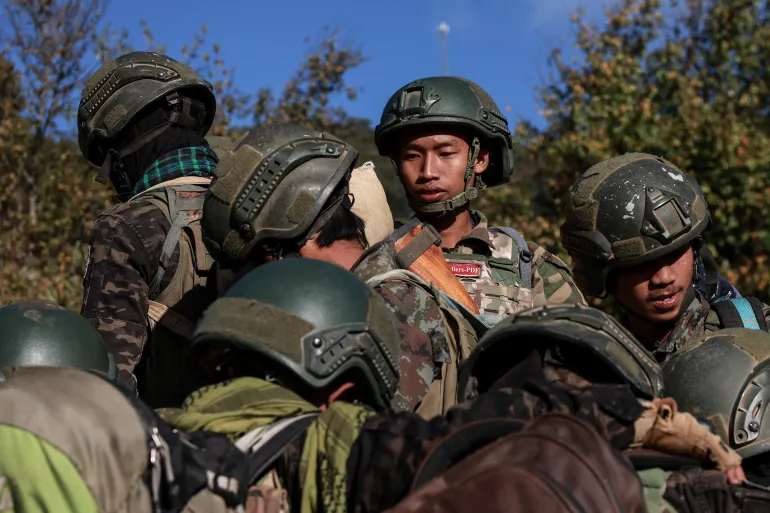
In the mountains of western Myanmar, photographs of fallen fighters line a wall of a rebel headquarters – an honour roll of some 80 young men, beginning with 28-year-old Salai Cung Naw Piang, who was killed in May 2021.
The true toll on the Chin National Defence Force (CNDF) extends beyond this hall and grows as war against Myanmar’s military grinds on in Chin State – a Christian region of the country bordering India where ethnic Chin fighters have expelled the military from most of their territory.
“Even if they don’t surrender, we will go till the end, inch by inch,” CNDF Vice President Peter Thang told Al Jazeera in a recent interview.
Launched in mid-November, the Chin offensive to capture the town of Falam – codenamed “Mission Jerusalem” – has come at a heavy cost. About 50 CNDF and allied fighters were killed in the first six weeks, some buried alive after direct air strikes by jet fighters of Myanmar’s military regime on earthen bunkers, Thang said.
Thang estimated similar casualties among Myanmar’s military, and more than 100 government soldiers captured, in the continuing operation.
Formed by civilians to fight the military after the 2021 coup in Myanmar, the CNDF has encircled the regime’s last garrison in a hilltop base in Falam.
“We are facing a difficult time,” Thang admitted.
“If God is willing to hand over the enemy, we will take it,” he said of Mission Jerusalem’s ultimate objective.
Taking and holding Falam – Chin State’s former capital – would also mark the first district centre captured by the country’s new rebel forces without support from established ethnic armies, according to Thang, who ran a travel agency in Myanmar’s commercial capital Yangon before the coup.
“We have more challenges than others,” he said.
“The military has so much technology. We have limited weapons, and even some of them we can’t operate,” he added.
![Peter Thang, Chin National Defence Force (CNDF) vice president, sits in front of the CNDF flag during an interview in a village at the frontline in Falam, Chin State, Myanmar, January 2, 2025. [Valeria Mongelli/Al Jazeera]](https://www.aljazeera.com/wp-content/uploads/2025/03/AB5A6226-1742020482.jpg?w=770&resize=770%2C513&quality=80)
With the CNDF supported by fighters from 15 newly formed armed groups, including from Myanmar’s ethnic Bamar majority, about 600 rebels have besieged Falam and the roughly 120 government soldiers who, confined to their hilltop base, depend on supplies dropped by helicopter for their survival.
Unlike established ethnic armies who are fighting to gain more territory for themselves, the rebel forces massed in Chin State said they aim to overthrow Myanmar’s military regime entirely.
While the CNDF and allies in the Chin Brotherhood (CB) coalition scored previous victories against the military with help from the powerful Arkan Army [AA] to thesouth in Rakhine State, seizing Falam independently would represent a new phase in Myanmar’s revolution.
But the biggest challenge in the battle remains aerial attacks by the military.
Operations against the hilltop base in Falam trigger bombardments from the military’s Russian and Chinese fighter jets, along with rocket-propelled grenades, artillery, sniper and machinegun fire from troops defending the outpost.
![A Chin National Defence Force (CNDF) fighter points to the Myanmar military's base in Falam, Chin State, Myanmar, December 31, 2024. Peter Thang, Chin National Defence Force (CNDF) vice president, sits in front of the CNDF flag during an interview in a village at the frontline in Falam, Chin State, Myanmar, January 2, 2025. [Valeria Mongelli/Al Jazeera]](https://www.aljazeera.com/wp-content/uploads/2025/03/0H1A3676-1742020649.jpg?w=770&resize=770%2C513&quality=80)
CNDF commanders told how the besieged soldiers once chatted freely with locals and some had even married local Chin women. But that all changed when Myanmar’s security forces shot peaceful protesters demonstrating against the military’s ousting of Aung San Suu Kyi’s elected government in 2021.
Demonstrators fought back, and an uprising was born that has become steeped in blood and the lore of many martyrs.
Mya Thwe Thwe Khaing, a 19-year-old protester, was the first victim – shot in the head by police on February 9, 2021 in the country’s capital, Naypyidaw.
In April 2021, armed with hunting rifles, the Chin launched the first significant battle of Myanmar’s uprising in Mindat town, which has since been liberated.
Now the rebels are equipped with assault rifles and grenade launchers. They control most of the countryside and several towns, but remain outgunned, as the military entrenches itself in urban centres. Unable to launch ground offensives from their depleted ranks, the regime’s generals have turned to forced conscription and indiscriminate air strikes nationwide.
According to rights group the Assistance Association for Political Prisoners, the military has killed at least 6,533 civilians since the coup. With at least 3.5 million people displaced inside the country, according to the United Nations, observers predict even fiercer fighting this year.

In Falam, CNDF defence secretary Olivia Thawng Luai said spouses live with some of the soldiers in the surrounded hilltop holdout.
“Most soldiers want to leave their base but they are under the commander’s control,” said Olivia Thawng Luai, a former national karate champion. “They aren’t allowed to leave the base or use their phones,” she said.
Another senior CNDF figure, Timmy Htut, said the commander in the besieged base still has his own phone – and the rebels call his number regularly.
“One day he will pick up,” he said. “When he’s ready.”
Attempts by the military to send reinforcements to Falam have failed. Helicopters, facing sheets of gunfire, have dropped conscripted airborne recruits on Falam’s outskirts, ordering them to fight their way into the town. None has succeeded.
![Olivia Thawng Luai, Chin National Defence Force (CNDF)'s defence secretary, is portrayed in a village at the frontline in Falam, Chin State, Myanmar, January 1, 2025. [Olivia Thawng Luai, Chin National Defence Force (CNDF)'s defence secretary, sits in front of the CNDF flag during an interview in a village at the frontline in Falam, Chin State, Myanmar, January 1, 2025 A Chin National Defence Force (CNDF) fighter stands on the ruins of a church bombed by a Myanmar military jet in Falam township, Chin State, Myanmar, December 31, 2024. [Valeria Mongelli/Al Jazeera]](https://www.aljazeera.com/wp-content/uploads/2025/03/AB5A6023-1742020999.jpg?w=770&resize=770%2C513&quality=80)
A captured soldier said his unit was dropped in without a plan, and, under heavy fire and pursued by resistance fighters, they scattered in chaos.
“Some died, others ran in all directions,” the soldier told Al Jazeera.
“The headquarters said they couldn’t waste their jet sorties for just a few of us,” he said. The military, he continued, has lost “many skilful, valuable” soldiers since the coup.
“They gave their lives for nothing,” he said.
“In the end, the military leaders will offer peace talks, and there will probably be democracy.”
Among the people displaced by fighting in Falam, and who are forced to shelter under bridges and tarpaulins, a new generation prepares to fight.
Junior, 15, who assists at a Chin hospital camp, spoke from an air raid shelter within earshot of jets dropping bombs.
“I’ll do whatever I can,” Junior said. “There’s no way to study in Myanmar. I don’t want future generations to face this,” she said.

But the Chin resistance is also grappling with internal division. It has split into two factions: one led by the Chin National Front (CNF), established in 1988, along with its allies, and the other, the Chin Brotherhood, comprising six post-coup resistance groups, including the CNDF.
Their dispute centres on who shapes Chin’s future – the CNF favouring a dialect-based governance structure, the CB preferring the governing of townships. This distinction between language and land determines the distribution of power, and, coupled with tribal rivalries and traditional mistrust, has led to occasional violent clashes among the Chin groups.
Myanmar analyst R Lakher described the divide as “serious”, though mediation efforts by northeast India’s Mizoram authorities show progress.
On February 26, the two rival factions announced they would merge to form the Chin National Council, with a goal of uniting different armed groups under one military leadership and administration.
While welcoming the development, Lakher stressed the process must be “very systematic” and include key political leaders from either side, not only advocacy groups.
“Chin civilians have suffered most,” he said. “Despite liberation, some cannot return home because of this internal conflict.”
Capturing Falam would be “significant”, he said, as nearby Tedim town would then present an easier target, potentially freeing up more territory for the CB and strengthening their negotiating position with the CNF coalition.
Lakher estimated more than 70 percent of Chin State has been liberated.
“We’ve seen the junta being defeated across Myanmar,” he said. “But pro-democracy forces need unity.”
He said the onus was on the National Unity Government – described as Myanmar’s shadow government – to “bring all democratic forces together”.
“With so many armed groups, there’s concern they’ll fight each other without strong leadership,” he said. “Ethnic areas are being liberated while Bamar lands remain under military control. The revolution’s pace now depends on the Bamar people.”

Along the road leading out of Falam town, two trucks loaded with captured regime soldiers drove past Chin’s bombed churches, gardens of mustard leaf, and mothers cradling babies under heavy shawls. As the trucks crossed paths with resistance fighters heading to the front, the nervous prisoners of war claimed they had been forced into military service.
“You were conscripted five months ago,” a rebel fighter remonstrated with prisoners in the truck. “What were you doing before then? he asked. He then added: “We’ve been fighting the revolution.”
Another rebel joined in the rebuke.
“Count yourselves lucky to be captured here,” he said – and not in the country’s harsh central drylands, where rebel units roam unchecked.
“None of you would be alive there,” he added.
[Aljazeera]

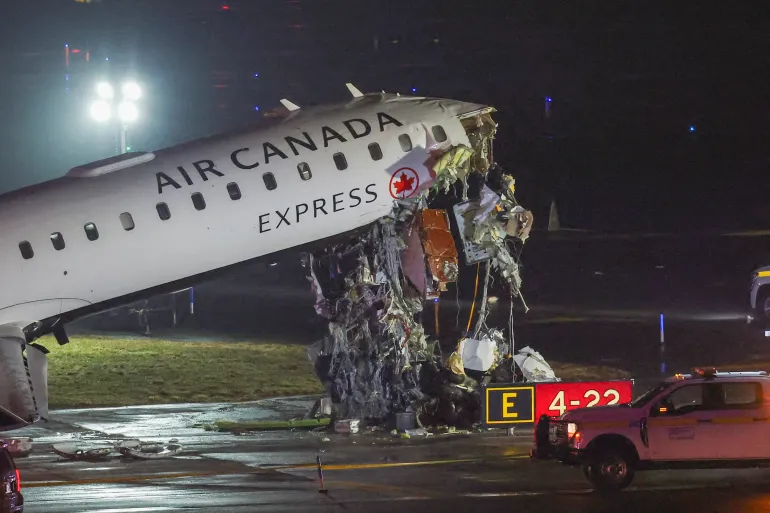
At least two people have been killed when an Air Canada Express flight from Montreal struck a ground vehicle while landing at New York’s LaGuardia Airport, according to several United States media outlets. The airport has been closed and flights diverted.
Kathryn Garcia, the executive director of the Port Authority of New York and New Jersey, said 32 of the 41 people who were injured had been released on Monday while nine remained in hospital with “serious injuries”. Those injured included passengers, crew members and the two officers on the fire truck. Both officers remained hospitalised with non-life-threatening injuries.
The aircraft, operated by Jazz Aviation, a regional partner of Air Canada, struck a firefighting truck on Runway 4 about 11:40pm on Sunday (03:40 GMT on Monday) as the vehicle drove to a separate incident, the Port Authority said.
A preliminary passenger list showed 76 people on board Flight AC8646, including four crew members, Jazz Aviation said in a statement.
The CRJ-900 aircraft struck the vehicle at a speed of 39 kilometres per hour (24 miles per hour), the flight tracking website Flightradar24 said.
“The airport is currently closed to facilitate the response and allow for a thorough investigation,” the Port Authority said in a statement to the AFP news agency.
Emergency response protocols were “immediately activated”, it said.

The US Federal Aviation Administration (FAA) issued a ground stop for all departures to LaGuardia due to the aircraft emergency with the airport closure in effect until 05:30 GMT. The probability of an extension was listed as high.
[Aljazeera]

Along Beirut’s downtown waterfront, Alaa is looking for somewhere to rest his head.
The Syrian refugee, originally from the occupied Golan Heights, is now homeless. He explained that he had already spent the day wandering around the Lebanese capital trying to find shelter.
He used to live in Dahiyeh – the southern suburbs of Beirut that have been pummelled by Israeli attacks, which have now killed MORE THAN 1,000 across Lebanon.
Now, he’s just looking for somewhere he can be safe. And in that context, Eid al-Fitr, the Muslim festival that began on Friday, is far from his mind.
When asked if he had any plans for Eid, he replied in the negative. Instead, his focus was on getting a tent.
“I got rejected from staying in a school, then I went to sleep on the corniche,” Alaa said. “Then people from the municipality told me to come here to downtown Beirut’s waterfront.”
Alaa wasn’t able to find a tent and is sleeping in the open air for now. But others in the area have, transforming a downtown more famous for its expensive restaurants and bars into a tent city for those displaced by the fighting. Across Lebanon, more than a million people have been displaced.
Lebanese are uncertain when this war will end, particularly as they have barely recovered from the conflict with Israel that ran between October 2023 and November 2024.
It makes celebrations difficult – a common theme across the countries affected by the current conflict.
In Iran, now in its third week of US-Israeli attacks – with no sign of an immediate end and an economic crisis that preceded the conflict, people are struggling to afford any of the items typically bought during the holiday season.
And it is potentially dangerous for people to shop at places like Tehran’s grand bazaar, which has been damaged by the bombing.
The religious element of Eid adds an extra sensitivity for antigovernment Iranians, some of whom now see any sign of religiosity as support for the Islamic Republic. The fact that Nowruz – the Persian New Year – falls on Friday this year means that some in the antigovernment camp will be focused on that celebration instead, and eschewing any events to mark Eid.
[Aljazeera]

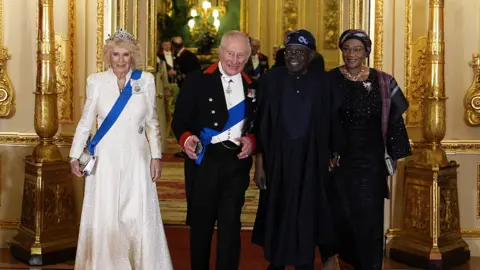
King Charles has hosted a spectacular state banquet for the president and first lady of Nigeria, praising the strengths of Nigeria’s partnership with the UK.
After greeting the 160 guests in the Yoruba language, the King spoke of the “living bridge” of the Nigerian community in the UK, in a speech in St George’s Hall at Windsor Castle.
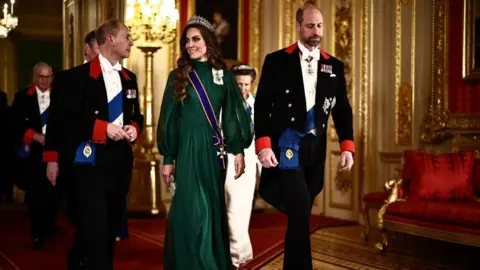
Famous figures at the banquet included England rugby union captain, Maro Itoje, Olympic athlete Christine Ohuruogu and poet Sir Ben Okri, alongside senior royals including Queen Camilla and the Prince and Princess of Wales.
There were special adaptations for Muslims, with the banquet taking place in the fasting month of Ramadan.
A prayer room was set aside in Windsor Castle and the usual lunch hosted by the King on such state visits did not take place.
It’s become a tradition to invent a cocktail for state visits – and in this case the “crimson bloom” was made from non-alcoholic ingredients, combining the Nigerian drink Zobo with English rose soda and hibiscus and ginger syrup.
There were also alcoholic drinks available for guests in St George’s Hall, including fine red and white wines, port and whisky.
The King’s speech reflected on the importance of religious tolerance, in which “people of different faiths can, do, and must live alongside one another in peace”.
He also told President Bola Ahmed Tinubu and First Lady Oluremi Tinubu of the importance of partners such as Nigeria and the UK standing together in difficult times “when rain clouds gather”.
As well as diplomatic ties, King Charles spoke of “Afrobeats filling our concert halls and Nollywood captivating our screens”.
There was also a reflection by the King on the “painful marks” of a shared history, in a reference to colonialism.
“I do not seek to offer words that dissolve the past, for no words can,” said the King, but he hoped for a more optimistic future “worthy of those who bore the pains of the past”.
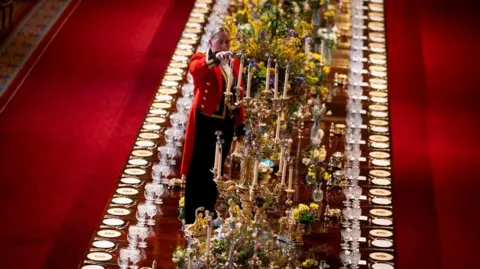
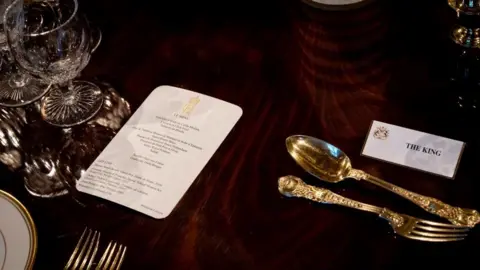
The banquet, on an elaborately decorated table filled with spring flowers, saw a meat-free menu.
It included:
- Soft boiled quail egg tartlet with watercress and kale and a basil sabayon
- Fillet of turbot, lobster mousse wrapped in spinach, beurre blanc sauce, sprouting broccoli with hollandaise sauce, fricassee of peas and broad beans, Jersey Royal potatoes
- Iced blackcurrant souffle with red fruit coulis
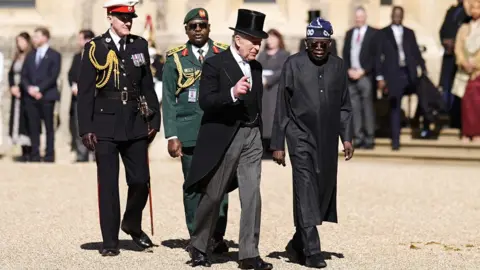
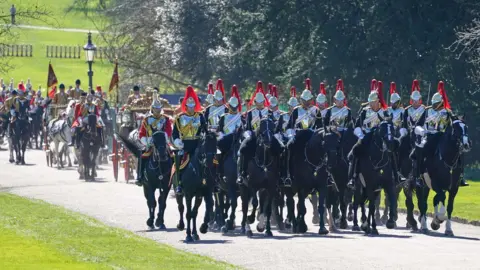
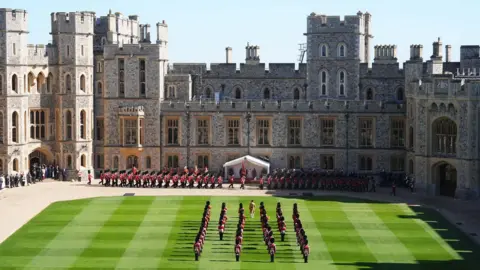
The two-day state visit began on Wednesday morning with a ceremonial welcome at Windsor.
In warm spring sunshine, the president and first lady – wearing traditional robes – were given the ceremonial grandeur of a royal welcome.
There was a carriage procession, bringing the Nigerian visitors into the quadrangle inside Windsor Castle, where a military band, with careful symmetry, paraded on the chequerboard lawn.
There was a gun salute, national anthems were played, guards were inspected and the Household Cavalry kicked up dust as they paraded inside the castle, in front of a viewing stand for the King and Queen and their visitors.
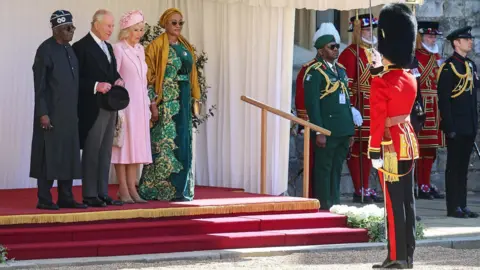
Official gifts were exchanged. The president and Mrs Tinubu were given hand-crafted pottery, a silver photo frame containing a picture of the King and Queen and a silver and enamel bowl.
In return, the King and Queen were given a traditional Yoruba statuette and a jewellery box featuring the faces of important Nigerian women.
President Tinubu is a Muslim and his wife is a Christian and the couple attended an interfaith event at Windsor Castle, designed to build bridges between religions.
It’s at a time of tensions within Nigeria, with a series of suspected suicide bombings this week in the north-eastern state of Borno, in which at least 23 people were killed and 108 injured in attacks blamed on hard-line Islamist militants from the Boko Haram group.
This is Nigeria’s first state visit to the UK for 37 years and such visits are a way of building relationships with international partners.
The Nigeria visit will see a strengthening of business links, including financial services. And there are personal and family connections, with more than 270,000 Nigerian-born people living in the UK.
“This state visit is about turning a historic relationship into a modern economic partnership – transforming trust into opportunity,” said Nigeria’s government spokesman Mohammed Idris.
“Nigeria’s economic reforms are unlocking the potential of Africa’s largest consumer market. The United Kingdom is a natural partner in what comes next.”

Referendum defeat leaves Italy’s Meloni looking more vulnerable

Pakistan T20 cricket league to be held in empty stadiums amid oil crisis

Showers expected in the Western, Southern, Uva and Sabaragamuwa provinces and in Kandy and Nuwara-Eliya districts after 2.00 pm.

Tehran says Trump’s peace talk claims are ‘fake news’

SJB: China, India taking advantage of Lanka’s unregulated oil market

SL to redevelop Trinco tank farm expeditiously

‘Dates have the highest sugar content to fight Coronavirus’

Sunday Island 27 December – Headlines

#SundayIsland 17th December – Headlines

Sunday Island – 28th March

Sunday Island Headlines – 21 March

Sunday Island – 21st February – Headlines
-

 News6 days ago
CIABOC questions Ex-President GR on house for CJ’s maid
-
 News5 days ago
Bailey Bridge inaugurated at Chilaw
-

 News5 days ago
Pay hike demand: CEB workers climb down from 40 % to 15–20%
-
 News4 days ago
CIABOC tells court Kapila gave Rs 60 mn to MR and Rs. 20 mn to Priyankara
-

 Features1 day ago
Trincomalee oil tank farm: An engineering marvel
-

 Editorial6 days ago
Couple QR-based quota with odd-even rationing
-

 Features4 days ago
Science and diplomacy in a changing world
-

 News3 days ago
Colombo, Oslo steps up efforts to strengthen bilateral cooperation in key environmental priority areas