
Features
‘In the political arena’

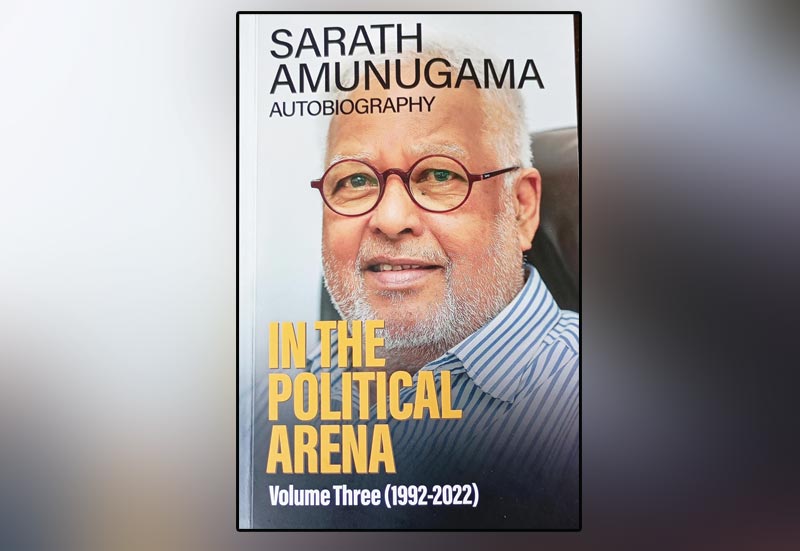
Sarath Amunugama Autobiography
Volume Three (1992 – 2022)
Reviewed by Nigel Hatch, P.C.
Dr. Sarath Amunugama in the final volume of his autobiographical trilogy entitled “In the Political Arena” covers the period 1992 to 2022 which is the contemporary period of politics in Sri Lanka and his frontline role in it.
This memoir covers the presidency of R. Premadasa, the abortive impeachment process against him, the rupture in the UNP and the formation of the DUNF by Lalith Athulatmudali (LA) and Gamini Dissanayake (GD), the author’s sidelining by Ranil Wickremasinghe (RW) in the UNP and his support of Chandika Bandaranaike Kumaratunga (CBK), his Ministerial roles under her presidency and that of Mahinda Rajapaksa and Maithripala Sirisena.
Amunugama in his Introduction observes that as “the modern history of Sri Lanka is full of paradoxes,” asks how did Sri Lanka which at independence had surplus sterling reserves, and one of the most promising States in Asia year marked for modernization and economic growth, end at the bottom of the pile? How is it that a country predominantly Theravada Buddhist could be engaged in fratricidal warfare for almost half the years since independence; and despite a high literacy rate and vibrant intellectual life become reduced to a second rate cultural backwater? One recalls even Lee Kwan Yew trenchantly remarking how we as the envy of Asia had squandered all the positives we had at Independence
The author goes on to explore these tragedies as a failure of a process of modernization and that Sri Lanka 75 years after independence has yet to discover the growth model that suits us. He quotes David Riesman, “The hatred sown by anti-colonialism is harvested in the rejection of every appearance of foreign tutelage. Wanted are modern institutions but not modern ideologies, modern power but not modern purposes, modern wealth but not modern wisdom”.
The failure of economic development is attributed to statist nationalization after 1956 primarily by the SLFP and its “toadies in the left”, the welfare measures commencing from 1933 and rapid population growth which cast an enormous burden on the national exchequer. This led Joan Robinson to sardonically comment “Sri Lanka is trying to taste the fruit of the tree without growing it”.
We are now witnessing the present NPP/JVP Government which has at its core a Marxist orientation, continuing at present with the open economy and the IMF framework for economic stability after the economic meltdown during the Gotabaya Rajapaksa (GR) presidency. The present Government’s continuation of these policies may prove to be more significant than the PA/SLFP’s rejection of the statist model under the leadership of CBK.
Amunugama’s Chapter on R. Premadasa is fittingly entitled “Premadasa Rex (1988 to 1993)”. Although admiring his discipline and his rise to the leadership of the elite dominated UNP, he refers to his “disdainful treatment of Ministers and MPs”. The sidelining of LA and GD, which led to the formation of the DUNF, and the abortive impeachment motion is the subject of a separate chapter.
The abduction and murder of Richard de Zoyza immortalized in the recent film “Rani”, the terror unleashed by the JVP despite Premadasa’s initial sympathy towards them, the testy relationship between Premadasa and Rajiv Gandhi and the withdrawal of the IPKF are discussed.
GD’s return to the UNP under the leadership of President Wijetunga despite obstacles placed within, and the difficulty in finding a place for him on the national list to enter parliament is recounted. Amunugama who had excellent relations with Wijetunga played a seminal role in this endeavor. He states, at first those national list members were unwilling to resign “for love or money”. But persistence prevailed and GD entered parliament and was inducted into the cabinet. GD was assassinated by the LTTE whilst campaigning on the final night for the presidency against CBK. This reviewer accompanied Amunugama and Wickreme Weerasooriya to the President’s House for the meeting with Wijetunga and CBK to discuss funeral arrangements. Amunugama notes that the latter who was PM was extremely gracious, in contrast to her mother’s approach with regard to the funeral arrangements of Dudley Senanayake.
This was a bloody period in Sri Lankan politics, which claimed the lives of Premadasa, Lalith and Gamini and many others , all of whom were assassinated by the LTTE.
Amunugama whose political career commenced as an elected Member of the Provincial Council from the Kandy , and his subsequent election to Parliament in 1994 from the UNP is perhaps the last man standing who could recount with personal knowledge and as an insider and participant to the momentous events of that period which were unparallelled in Sri Lanka’s political history.
The author’s political career as a Minister commenced with the decision that he, Wijayapala Mendis, Susil Moonasinghe, Nanda Mathew and a few others took to support CBK over Ranil Wickremasinghe at the Presidential Election of 2000. Their purported expulsion from the UNP under Ranil Wickremasinghe led to the constitutionally significant decision of the Supreme Court which held that expulsion unlawful is of personal significance to the reviewer whose role as Junior Counsel to the late Elanga Wikramanayake is recounted in this memoir in some detail.
The author’s first portfolio was as Minister of Northern Rehabilitation under the CBK presidency. He records how the Government funded and maintained the infrastructure of the Northern Province, despite the LTTE controlling large swaths of territory. This is perhaps unparalleled, in that, despite the separatist war waged by the LTTE, the GOSL continued to ensure that food, medicines, fuel and other essential supplies reached the citizens of those areas under LTTE control.
The reviewer recalls Amunugama telling him that when he visited New Delhi as an emissary of the former President J.R. Jayewardene, he was told that India would remain indifferent if the Government decided to accelerate its military campaign and bomb strongholds of the LTTE even in built up areas of the northern province. This strategy was never pursued, and the fratricidal warfare continued until the military defeat of the LTTE in 2009 under the leadership of Mahinda Rajapaksa.
Amunugama recounts his subsequent portfolios. His tenure as Minister of Irrigation reflects his love for the land and the people, which undoubtedly commenced when he was a civil servant and served in several parts of the country which is brought out also in Volume 1. His sense of humour is replete even in this volume. Anuruddha Ratwatte, who held this portfolio earlier, was unhappy that CBK did not appoint him to this Ministry. He told the author that he had “looked forward while returning from the war zone to landing his helicopter near the NCP tanks and enjoying a country rice meal wrapped in a lotus leaf. He lost both the war and his lotus leaf wrapped lunch.” (pg. 251).
Sri Lanka experienced the politics of cohabitation between CBK as President, and RW as Prime Minister with a cabinet of his choice, when the latter’s coalition secured the largest number of seats in Parliament at the 2001 elections. She faced a torrid time at some cabinet meetings particularly from those who were at one time trusted lieutenants and had defected from her party and joined the UNP.
Politically these were trying times and CBK who made the mistake of conceding the defense portfolio to a UNP Minister, had to seek the first ever opinion from the Supreme Court under Article 129 as regards these powers. The reviewer appeared for her with the late HL de Silva PC and Raja Goonesekere (RKW) and succeeded in that case. The court held that defense was an integral part of the powers of the President.
Events swiftly ensued and CBK exercised her powers and removed some UNP Ministers and dissolved parliament. The reviewer was involved in strategizing these events and recalls a weekend at the President’s house in Nuwara Eliya where Lakshman Kadiragmar (LK) and Mangala Samaraweera were also present.
Amunugama was one of CBK’s representatives in talks between the SLFP and the JVP represented by Tilwin Silva, Anura Kumara Dissanayake (AKD), Bimal Rathnayake and Sunil Handunetti. He states, “very often I was the only one from our side while all JVPers diligently attended discussions”, exemplified by AKD once attending a meeting after coming from Ampara after skipping his meals to be on time (282).
At the ensuing general elections in 2004, CBK’s party in coalition with the JVP secured power and formed a government. Amunugama became the Minister of Finance, a portfolio which had been the domain of several former presidents. He recounts his experience in this portfolio with extensive references to the challenges faced and negotiations with international lending agencies. He comments positively on the four Ministers from the JVP.
He states that the alliance with the JVP ended when CBK, persuaded by the World Bank and the IMF, negotiated a power sharing arrangement with the LTTE for the rehabilitation of the North and East after the devastating Tsunami of 2004 called the P-TOMS. This initiative was challenged in Court, and this reviewer and RKW led for CBK’s government in separate related cases, whilst HL de Silva, a friend and confidante of CBK, led for the JVP. CBK’s genuine desire for a peaceful negotiated settlement of the ethnic conflict is indisputable. Nevertheless, she had no hesitation on several occasions of directing the navy to blow up LTTE cargo vessels that attempted surreptitiously to smuggle arms during that cease fire.
Amunugama refers to the significant contribution made by Lakshman Kadirgamar PC who was an outstanding foreign minister, and at one point a serious contender to be PM backed by the JVP. The reviewer worked closely with LK on several legal issues including the Ceasefire Agreement that RW as PM unilaterally agreed with the LTTE, difficulties arising from the Norwegian facilitation and required constitutional amendments. LK too was assassinated by the LTTE.
Amunugama unflinchingly refers to the politics of the judiciary when the mercurial Sarath N Silva (SNS), was Chief Justice. He refers to the “Helping Hambantota” controversy, which was a fund set up by MR to collect money in the aftermath of the Tsunami, for the rehabilitation of, “presumably, as its name indicates, the Hambantota district”. He states, “The UNP which worked hand in glove with Mahinda to embarrass CBK, now discovered that their favorite SLPer (MR) whom they nurtured could become a formidable candidate” at the forthcoming presidential election “(p-319).
Kabir Hashim, a UNP MP, challenged the legality of this Fund. Sarath Silva, the then Chief Justice who clipped a year off the term of office that CBK enjoyed in her second term, a decision which he states “was tailor made for his friend Mahinda Rajapaksa”, dismissed that case. Silva subsequently expressed remorse for this decision after he left office, noting that if MR was found guilty, he could have faced imprisonment. Amunugama to his credit admitted in Parliament that the Fund was not properly constituted.
The political ascendancy of Mahinda Rajapaksa, first as the SLFP candidate, and then victorious in the 2005 presidential election by the narrowest of margins over RW, also makes fascinating reading. This was the closest that RW had ever come when he contested the presidency reminiscent of R. Premadasa’s narrow win over Sirimavo Bandaranaike in 1988. This writer recalls Amunugama’s prescient prognostication that with MR’s nomination “CBK had signed her political death warrant”. Relations between the two (CBK and MR) had deteriorated over a period of time, and when The UNP had commenced a long march from the South demanding a presidential election which presaged SN Silva’s judgment on her term of office, she appointed RKW and this reviewer to meet with MR at President’s House. At this meeting MR rightly pressed that a delay in nominating the party candidate would be prejudicial and we duly communicated that to her.
Amunugama was appointed Minister of Public Administration by MR, a portfolio he was happy to get due to his antecedents as a public servant and working with Felix Dias Bandaranaike earlier in that ministry, recounted in Volume 1.
He recounts succinctly the inner politics of the MR administration during that period, including the disaffection of Mangala Samaraweera, his indefatigable campaign manager, due to not being appointed PM, and CBK’s efforts to cause problems for MR. MR faced a potential revolt orchestrated by Anura B and Mangala ostensibly with JVP support, but at the last moment unbeknownst to Anura the JVP pulled out of the arrangement, leaving Anura who crossed over in Parliament, with egg on his face. MR removed Mangala and Anura from their posts and Amunugama notes that Anura never returned to parliament and it was “an ignominious end to a career tailor made to take him to the top.” (348)
His knowledge and experience in economics and finance served him well in his next portfolio, Investment Promotion. As with his other portfolios, Amunugama takes the reader through important events and initiatives that he introduced, including meetings with foreign dignitaries.
The high point of MR’s second term (2009-2015) was the military defeat of the LTTE. He rightly identifies MR as a national hero. The ensuing rift with General Sarath Fonseka, part of the troika with MR and his brother Gotabaya that strategized that victory, could have arisen due to Fonseka’s own plans for the military to bolster his image. Fonseka was wooed by the opposition as a presidential opponent to MR but went on to lose that election in 2010. Instead, he was elected to parliament, and was unsuccessful at the recently concluded presidential election, where he cut a forlorn figure at rallies which were poorly attended.
Amunugama notes that after the war there was a commendable level of economic growth under MR, attributable as in most countries that come out of a long war to budgetary realignments to development projects and donor funding agencies being more receptive and forthcoming. “Accordingly, several highway projects, work on ports and airports, transport and power were undertaken adding to a rapid growth of GDP.” (p-387). Amunugama was given the additional responsibility as Deputy Minister of Finance, and after the parliamentary elections of 2010, was appointed Senior Minister and resumed his role as chief interlocutor with the global financial institutions.
But the decline in MR’s popularity due to the “shenanigans of his relatives” manifested itself in the results of the presidential election of 2015, where he ill-advisedly ran for a third term and lost to Maithripala Sirisena who was nominated by the joint opposition. As a precursor to this maneuver, MR sought an opinion in 2014 from the Supreme Court as to whether he was eligible to run for a third term. A full Bench of the Supreme Court presided over by Mohan Pieris, CJ determined that he was so entitled. Amunugama ruefully states that as regards the removal of the two term limit for a president by the earlier 18th amendment by MR that “however we have to admit that our reluctant vote for this aberration is an unforgivable black mark in our parliamentary record.” (p-416)
Amunugama deals with “The One Term President Maithripala Sirisena (2015-2020)” in the penultimate chapter. The deterioration in the relations between Sirisena, described as an “unreconstructed Marxist with strong socialist views” and RW due to the bond scam, and RW’s sacking as PM, MR’s reinduction as PM for a short period and the ill-advised dissolution of Parliament which was struck down by the Supreme Court are recounted.
This memoir concludes with an Epilogue which covers the political ascendancy of Gotabaya Rajapaksa (GR) , the split in the UNP and formation of the SJB under Sajith Premadasa, and a succinct analysis of the economic debacle under the GR presidency and the resulting Aragalaya . GR was forced into exile due to that popular and peaceful uprising and the “bargain basement sale” of the office of PM, which RW ultimately secured. This catapulted him as the unelected president for the remainder of GR’s term by a vote in Parliament with the backing of MR and his party. The Supreme Court has now held by a majority that the Emergency Regulations he used to end the Aragalaya were violative of Fundamental Rights.
This three-volume memoir is an indispensable reference for the post-independence socio-economic and political history of Sri Lanka and is a rich tapestry of the life and times of a brilliant and now preeminent elder statesman whose sagacity and involvement in national affairs is sorely missed.
Amunugama has spent his adult life in the service of the nation. He has brought into public life, at the highest levels, Minister of inter alia Finance, Irrigation, Education and briefly Foreign Affairs, integrity, intellectual rigor and pragmatism. As with the earlier two volumes, Amunugama writes with clarity and effortless style. His love for culture and the arts- books, and theatre are manifest in this volume as well, which are spliced with lovely images from his personal collection of George Keyt’s art.

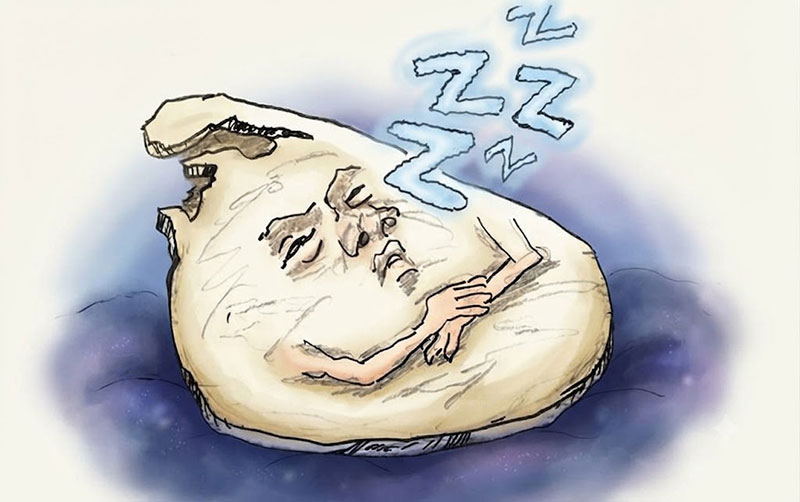
“We are rather respectable in Colombo. We go to bed fairly early, and we remain there till morning. “
According to Sri Lanka’s diplomatic folklore, the late S.W. R. D. Bandaranaike uttered these words while explaining the reasons for Sri Lanka’s abstention on the UN resolution condemning the Soviet invasion of Hungary. Apparently, SWRD’s foreign ministry officials were asleep at home when the diplomatic cable seeking instructions was received from New York. In those days, there were no cell phones, Internet, or even fax or telex machines. The diplomatic cables were sent through post offices. Decoding them was a slow and time-consuming process. Thus, the government could not provide appropriate instructions to our mission in New York in time, and the Sri Lankan delegation abstained on that sensitive UN vote.
Sri Lanka’s Absence from Section 301 Consultations
But then, how does one explain Sri Lanka’s absence from the crucial bilateral consultation held in Washington by the Office of the United States Trade Representative (USTR) during March-April on “Forced Labour” under the Section 301 of the US Trade Act of 1974? Didn’t our foreign and trade ministries send appropriate instructions to Washington in time? Even if the instructions from the foreign ministry were transmitted to our embassy in Washington by pigeon carriers, there was enough time for Sri Lanka to participate in those meetings.
In March, the USTR initiated these 301 investigations on 60 trading partners, and invited all of them for confidential consultations. Out of the 60, 46 participated in these consultations. Sri Lanka was not one of them. Other countries that didn’t participate in these consultations included China, Russia, and Venezuela! In addition to that, the Section 301 Committee conducted a public hearing with interested parties on April 28 and 29. Washington-based diplomats, representatives from few trade ministries as well as representatives from many foreign trade associations and chambers participated in these hearings. Sri Lanka was once again conspicuously absent.
As a result, when the USTR published the proposed forced labour tariffs on June 2nd, Sri Lanka ended up with a 12.5% duty. Pakistani and Indonesian diplomats participated in these consultations and took appropriate follow-up measures, and managed to enter the 10% duty category. As even a threat of a modest tariff hike could disrupt supply chains and reduce competitiveness, particularly in an industry such as garments, I discussed this issue on 15 June and underscored the importance of Sri Lanka’s participation at the next hearing, which was scheduled to be held from July 7th .
Awakening from Diplomatic Slumber and AKD’s Gazette
Fortunately, Sri Lanka finally awoke from weeks of diplomatic slumber, and Ambassador Mahinda Samarasinghe participated in the public hearing on 9 July, and promised, “…. · We have agreed to the text in our negotiations with the USTR on forced labour, …. The gazette as we speak is being printed and I’m getting the gazette tomorrow morning, and the gazette will be shared with USTR as I get it“.
As promised, President Anura Kumara Dissanayake issued a gazette on 10 July banning the imports of goods produced by forced labour. These new regulations are very similar to what Pakistan and Indonesia enacted in April, after their consultations with USTR in March. Why couldn’t we do it in April? Why did we wait till the very last minute?
Challenges ahead
“War is too important to be left to generals alone,” is a famous saying attributed to former French Premier Georges Clemenceau. Similarly, monitoring our main markets is too important to be left to diplomats alone. The United States is the largest single-country market for Sri Lanka. Therefore, Sri Lankan trade chambers and associations should become more proactive in these markets and participate in these events. For example, the chairman of the Pakistani apparel exporters association participated in the April hearings. Similarly, representatives from the Indian Agricultural and Processed Food Products Export Development Authority, the Federation of Indian Chambers of Commerce and Industry, the Confederation of Indian Industry, and Reliance Industries also participated in July hearings. At an event where each speaker is given only five minutes (strictly enforced), having a number of speakers from a country is an advantage. The presence of industry representatives in these kinds of events also help them understand the market dynamics and the future challenges. This is important, particularly because there will be many more challenges with Trump’s tariffs.
With the gazette issued on 10 July, Sri Lanka has imposed a prohibition on the importation of goods produced with forced labour. Now, the challenge will be to effectively enforce the prohibition. And what are the goods produced with forced labour? The USTR list only focuses on aluminum, cotton, electronics, lithium-ion batteries, rice, and tobacco. However, according to the U.S. Department of Labour, the list is much longer. Hence, this list may change continuously during the next two years and tariffs may fluctuate once again.
So, this is definitely not the time to slumber.
(The writer, a retired public servant, can be reached at senadhiragomi@gmail.com)
by Gomi Senadhira ✍️
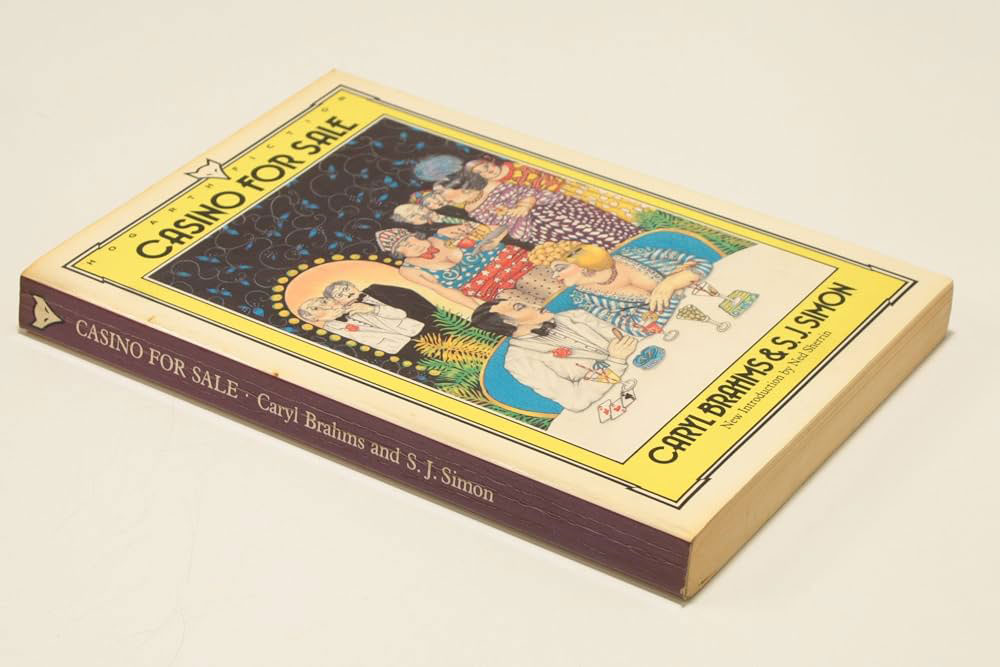
After the overwhelming grotesquerie of J K Rowling’s latest Cormoran Strike novel (written, I should have noted, as the others were, under the pseudonym Robert Galbraith), I thought I should return to the world of fun, and also a much shorter description since this thriller moves quickly without the layers of detail that Rowling engages in.
I then move to the second comic thriller by Caryl Brahms and S J Simon. This, their second story to feature Vladimir Stroganoff and Adam Quill, was Casino for Sale, as lunatic a romp as the first, though without the emphasis on the ballet that characterized A Bullet in the Ballet.
This one begins with the impresario Stroganoff buying a casino cheap from Baron Sam de Rabinovich, only to find that it was a rundown place, not the grand casino of La Bazouche, a resort on the Frenc+h Riviera, as he had initially thought. The grand one belonged to Lord Buttonhooke, and Stroganoff could not compete, until he thought of bringing the Ballet Stroganoff to the casino – which of course leads to Buttonhooke deciding to have ballet performances in his Casino too.
Stroganoff invites Quill to visit him, which Quill decides to do since he has left Scotland Yard, having come into a legacy. No one believes this, and he has to face questions as to what he did to have been sacked, with sympathy for having been found out.
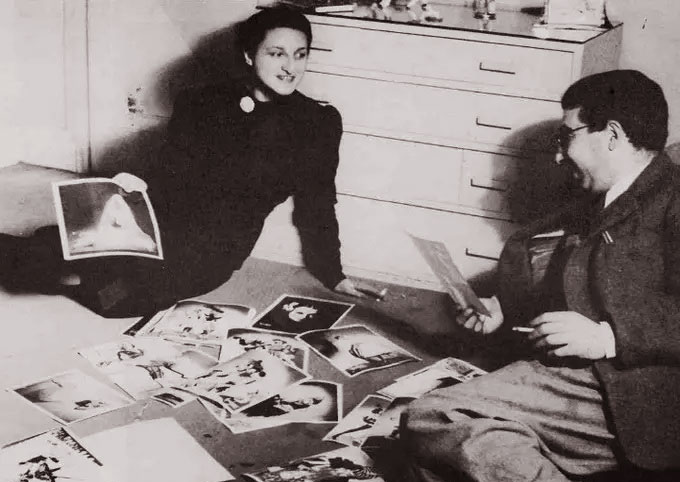
Caryl and Simon
The day he arrives in La Bazouche there is a murder, of a vitriolic critic called Citrolo, in Stroganoff’s office. He had been going to write a damning review of the opening night of the ballet and Stroganoff, when he realizes Citrolo cannot be swayed, drugs him and dictates the review himself to the papers. He leaves Citrolo sleeping and finds him shot the next morning, whereupon he decides to muddy the waters and leave a suicide note and lots of other murder weapons. So much overkill, as it were, of course ensures that he is arrested.
But the excitable French detective who makes the arrest follows up his suggestion that Buttonhooke was also involved, and so the two casino owners find themselves in cells next door to each other, with the detective Gustave quite happy to provide creature comforts for a fee.
Quill decides he must investigate, and finds Gustave most cooperative, since he has a laid back attitude to work. So it is Quill that finds a notebook which makes it clear Citrolo is an accomplished blackmailer, and that there are lots of possible murderers, including Stroganoff’s croupier, who was crooked, Rabinovich, who was now working for Buttonhooke, a confidence trickster called Kurt Kukumber, whose prospectus for a dud gold mine was found in the office and Prince Alexis Artishok who was engaged in a deal to buy diamonds from the ballerina Dyra Dyrakova.
Stroganoff had been trying to get Dyrakova to dance for him, but having done so previously she had refused. But then to Stroganoff’s chagrin she agreed to dance for Buttonhooke. The clearly crooked Artishok had told Buttonhooke’s mistress Sadie Souse, who was not very bright, that Dyrakova possessed diamonds she was willing to sell cheap, and Sadie was determined to have them.
Quill meanwhile finds out that there was a secret passage to Stroganoff’s office, the obvious solution to what had begun as a locked room mystery, and that this was known by almost everyone apart from Stroganoff himself. And then Rabinovich is murdered, just after Gustave had released his two original suspects, leading him to blame Quill for having insisted on that and thus allowing them to kill again.
Soon afterwards Dyrakova arrives, and the town is full of posters announcing that she will appear in the casinos, elaborate posters for either one, since Stroganoff is determined that she will dance for him, and if she does not come willingly, he has devised a scheme to make her do so unwillingly. So, though Buttonhooke has her taken off to his yacht immediately she arrives at the station, Quill along with Arenskaya gets her into a launch and to Stroganoff’s casino, where she performs to tumultuous applause, not knowing for whom she is dancing.
When Quill asked her about the diamonds, she said she had sold them long ago, and that gave Quill the solution to the mystery. Rabinovich had known about this, and Artishok had killed him to prevent Sadie learning it from him, he had killed Citrolo who had recognized him for an accomplished card sharper, not a Russian prince at all. But before he is arrested, he gets away in a boat, and the police launch that pursues him is on the point of catching him up when it runs out of petrol.
Again, lots of excitement, and entertaining references – Gustave grows marrows – and if not quite as brilliant as its predecessor, Casino was certainly a delightful read.

 It was a few years back that a former President of Sri Lanka took it on himself to pronounce SAARC ‘dead’. Since then there have been other sections of Sri Lankan opinion that have joined the critics of SAARC and taken the solemn stance that SAARC has indeed died what may be called a natural death.
Their fatalism is understandable. SAARC has failed to meet at heads of government or state level for the past several years to take the SAARC process notably forward. Regional cooperation has more or less been only an appealing idea. No substantive concrete projects have taken off to make the idea a hard reality. ‘Inner paralysis’ seems to be SAARC’s lot. Hence the fatalism in these circles.
However, being one of the worst cash-strapped regions of the world and a teemingly populated one with people virtually left to their devices, what choices do the ‘SAARC Eight’ have other than to try their best to band together and continue with their cooperation efforts, however small they may be?
There is no escaping the mounting debt trap for many of these countries and bankrupt Sri Lanka is a glaring example, but ‘throwing in the towel’ and abandoning themselves entirely to the diktats of the strongest economies and their agencies will prove a ‘living death’ for many countries in the SAARC fold.
The gains may be meagre but giving-up on SAARC cooperation in full would prove self-defeating for the organization and South Asia. Right now, the collective intention ought to be to salvage what the region could from the tenuous cooperative efforts. Moreover, such initiatives could go some distance to generate a degree of goodwill among the Eight and help in sustaining a dialogue process.
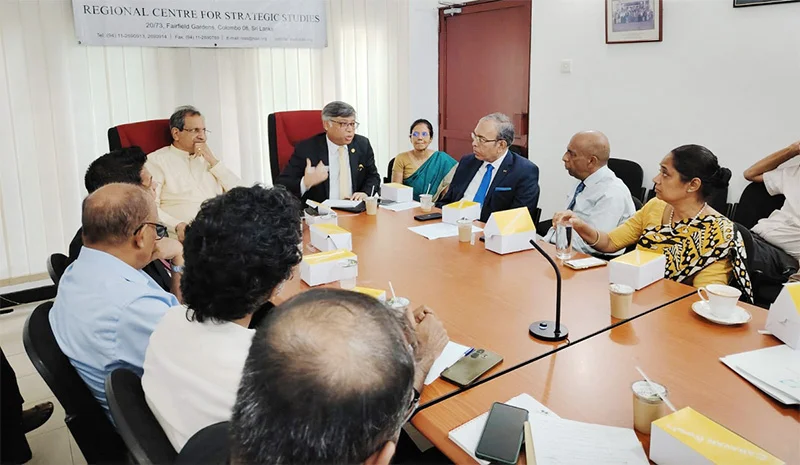
Given this backdrop it proved ‘a stich in time’ for the Regional Centre for Strategic Studies (RCSS), Colombo, to recently host the SAARC Secretary General Ambassador Md. Golam Sarwar to a round table discussion on the unifying potential of SAARC and its future possibilities, besides other related issue areas.
Held on June 24th and moderated by RCSS Executive Director and former ambassador Ravinatha Aryasinha, the forum brought together a vibrant, wide ranging audience comprising academicians, diplomats, senior public servants, civil society activists and many others. Following the presentation by Ambassador Golam Sarwar titled, ‘Reigniting SAARC: Achievements, Challenges and the Way Ahead’, a lively Q&A followed.
The above forum could be described as an act of lighting the proverbial ‘candle’ rather than ‘cursing the darkness.’ It surely is a ‘darkness’ that could be seen as daunting considering that the region’s pivotal powers, India and Pakistan, are failing to act in a spirit of accord but are engaged in bitter finger-pointing on a number of questions of vital importance to SAARC.
On the other hand, what is the rest of the region doing to bring the above sides together? It is disappointing that to date the rest of SAARC has failed to launch a major diplomatic drive to bring peace between the feuding regional heavyweights. It needs to act without delay and establish its earnestness and this effort would need to prove SAARC’s staying power in the unfolding months and even years.
In assessing SAARC’s seeming failure local opinion in particular has failed to factor in what could be described as weak leadership. Since Sheikh Mujibur Rahman of Bangladesh, the founding father of SAARC, the region has failed to produce a visionary leader who could advance the SAARC cause with charisma and drive.
Among other reasons, weak leadership accounts considerably for the faltering and stuttering status, as it were, of SAARC. Badly needed are leaders who could go the extra mile, think less of narrow national interests and work diligently towards the collective well being of the region but SAARC’s millions of ordinary people have been made to wait in vain for leaders of such stature. Instead, they have been burdened with politicians who seem to be relishing the apparently moribund state of SAARC.
Looking back, it could be said that it was the dynamic leadership factor that led to the launching of the Non-Aligned Movement and for its sustenance for a few decades. True, it could be seen in some quarters that NAM is no more, but as in the case of SAARC, the former too has been unfortunate to be burdened over the years with politicians who lack the vision and drive to unflaggingly advance the fortunes of the South. NAM and SAARC lack the dynamism and vision of leaders of the stature of Jawaharlal Nehru, for example, to give them the required guidance and intellectual depth.
The reasons are complex for there not being among us currently political leaders with the vision and the steadfast commitment to advance the legitimate interests of the South. However, it could be stated with conviction that the majority of Southern leaders have too easily caved in to the demands of the global North and its financial agencies.
These leaders have failed to see, for instance, that the largely market economy oriented Northern governments would not view with favour a centrist economic model that attaches priority to the interests of the dis-empowered publics of the South. This realization ought to have dawned on the current government in Sri Lanka, for instance, some while ago but it has no choice but to abide by IMF dictates since economic survival at present is unthinkable without the latter’s succour.
Accordingly for SAARC this should be the time for some soul-searching. Priority needs to be attached to ending the feuding between India and Pakistan since at present the material fortunes of the region hinge largely on these regional giants giving peaceful relations among them a try. This is no easy challenge to meet but some daring, visionary diplomacy needs to take hold among the rest of SAARC.
There is some sense in SAARC bringing the peoples of the region together through programs that address their best collective interests. A meeting of minds among SAARC nations could enable SAARC and its agencies to build a region-wide people’s movement for progressive political and economic change that could in turn lead to the region’s political leaders sensitizing themselves more to the neglected needs of their publics.
However, the time is ‘now’ for the initiation of these progressive changes and the voice of SAARC well wishers would need to drown out those of their critics.

Venezuela earthquake: Number of known dead rises to nearly 5,000 victims

A few showers may occur in the Western, Sabaragamuwa and North-western provinces and in Kandy, Nuwara-Eliya, Galle and Matara districts

Harmer, Markram and Wolvaardt win top honours at CSA awards

War of words erupts between Minister Chandrasekar and Archchuna in North

Cardinal seeks dismissal of Sallay’s petition

Money laundering case against Yoshitha, fixed for pre-trial conference

‘Dates have the highest sugar content to fight Coronavirus’

Sunday Island 27 December – Headlines

#SundayIsland 17th December – Headlines

Sunday Island – 28th March

Sunday Island Headlines – 21 March

Sunday Island – 21st February – Headlines
-
 Features5 days ago
Prison riots and politics: NPP’s biggest challenge and Sri Lanka’s biggest opportunity
-

 Editorial6 days ago
What’s the world coming to?
-
 Features2 days ago
Dirty Money
-

 Editorial5 days ago
Much ado about crime: Fish or cut bait
-
 Features5 days ago
More on Saudi Arabia: ARAMCO and beyond
-
 Latest News3 days ago
Oil prices hit 1-month high as US-Iran attacks dim Strait of Hormuz outlook
-
 Midweek Review2 days ago
The sordid tale of theft and tragedy at Finance Ministry
-

 Features4 days ago
Deepening Democracy – Constitutions and Constitutionalism