
Features
Imthiaz’s Parliamentary speeches – a reflection of the man, his politics, and his principles


Imthiaz Bakeer Markar’s latest publication Hardha Sakshiya is a collection of his speeches made in Parliament over the years on diverse topics ranging from democracy, media, governance and so on. His passionate espousal of the Palestinian cause too is very well reflected in his Parliamentary contributions.
What distinguishes him from many other politicians however, is not just his political role but the integrity and consistency with which he has upheld democratic values, pluralism, and civility in public discourse, often in contrast to the prevailing political culture. Additionally in his political conduct he has striven to successfully reflect the values and principles he has espoused in his Parliamentary Speeches unlike many of his contemporaries.
Born into a politically engaged family—his father M.A. Bakeer Markar rose to Cabinet rank, was the Speaker of Parliament and later Governor – he took to politics like a duck taking to water.
Imthiaz’s political journey reflects a rare commitment to conscience over convenience. His early political involvement was within the United National Party (UNP), where he rose to become Minister of Media and Parliamentary Affairs during the Ranil Wickremesinghe administration (2001–2004). He also served as Deputy Minister of Housing and as a long-serving Parliamentarian representing Kalutara District.
However, even within the UNP, he consistently spoke out against authoritarianism, erosion of democratic institutions and the subversion of principled politics. In pursuit of such actions he has not hesitated to differ even with the Party Leadership whenever he deemed it necessary. One such instance was when he offered his resignation from the position of Media Minister to Prime Minister Ranil Wickremesinghe during the 2001 to 2004 period.
More recently he stepped down from the position of Chairman of the Samagi Jana Balavegayas over differences he had with Opposition Leader Sajit Premadasa over the way the SJB should be reorganised following the SJB’s poor showing at the Presidential and Parliamentary Elections.
Even when he differed from the Party Leadership he has not resorted to grandstanding and preferred to play the role of a disciplined party man and give expression to his views within the internal forums of the party.
His disillusionment with the UNP’s direction, particularly its compromises with corruption and its drift away from liberal democratic values, led him to part ways with it. He joined the Samagi Jana Balawegaya, the breakaway reformist group led by Sajith Premadasa, drawn by its potential to provide a clean break from the past.
Such decisions underscore the essence of Imthiaz’s politics—grounded in principle, not position. He has never sought high office at the expense of principled politics and this detachment from the trappings of power has given him moral authority in an otherwise transactional political culture. One example of not compromising his principles was when he turned down an invitation by President Mahinda Rajapakse to be appointed as Ambassador to Saudi Arabia when the UNP was in the doldrums and languishing in the Opposition.
A Voice of Decency in Parliament
Throughout his Parliamentary career, spanning several decades, Imthiaz has been known for his measured, articulate, and inclusive speeches. He has used his Parliamentary voice not to score points or inflame tensions, but to appeal to conscience, law, and common humanity. His interventions during debates were often marked by clarity, calmness, and a rejection of the coarsening and tribalistic tone that has come to define Parliamentary discourse in recent times. His speeches and conduct in Parliament has shown that it is possible to disagree without being disagreeable.
This is an example that other Parliamentarians including novice MPs as well as other budding politicians could emulate.
In times of national crisis—whether the anti-Muslim violence of Aluthgama and Digana, the post-Easter Sunday polarisation, or the rise of extremist narratives – Imthiaz has consistently stood against hate. He has emphasised the need for reconciliation, truth, and equal citizenship. He has called for strengthening democratic institutions, protecting minorities, and building an inclusive Sri Lankan identity. Even when his community was being vilified or scapegoated, his responses were not defensive or communal, but statesmanlike and bridge-building.
His remarks during the debate on the obnoxious 20th Amendment to the Constitution are worth recalling – “All those who vote in favour of the 20th Amendment to the Constitution will one day face the consequences of what they voted for … If Sri Lanka continues to pass legislation in such a manner, the island nation would be shunned from the rest of the world.”
His Parliamentary Contributions and Reformist Vision
As a Minister and Parliamentarian, Bakeer Markar was also an advocate for media freedom, democratic reform, and the de-politicisation of public institutions. As Minister of Media, he worked to reduce state control of information, attempted to push for a freer and more responsible media environment, and argued that media pluralism was essential for democracy.
Imthiaz’s thinking in relation to the Media is valid today as never before. “We must understand that … the media has a responsibility to report the truth. … If media institutions give up on their responsibilities … then people would select their representatives based on wrong information.”
He has often argued in Parliament and in public fora that Sri Lanka’s central problem is the weakening of institutions due to politicisation, nepotism, and impunity. His consistent call has been for the reestablishment of the rule of law, the independence of the judiciary, and a national policy framework that transcends party cycles.
Even during the Aragalaya protests, while not taking a populist tone, Bakeer Markar expressed his understanding of the frustrations of the youth and emphasised that this was a moment for a new political culture to emerge. He urged political parties to move away from parochialism and corruption and towards a platform that is inclusive, transparent, and meritocratic.
A prolific speaker with extraordinary versatility in the Sinhala language, Imthiaz’s speeches reflect a deep engagement with Sri Lanka’s post-independence journey, especially the challenges of forging a united national identity out of its rich diversity. His speeches combine historical insight with moral clarity, and they reflect a yearning for a Sri Lanka that is plural, tolerant, and just.
In his outpourings, he often invokes the pluralist vision of leaders like D.S. Senanayake , while cautioning against the ethnic majoritarianism that tore the country apart. He has often argued that peace cannot come without truth, and that reconciliation must be underpinned by justice, accountability, and honest dialogue.
Political Conduct: A Rare Decency
Perhaps most remarkable in the Sri Lankan context is Imthiaz’s personal and political conduct. He has never used Parliament to engage in mudslinging or abusive rhetoric. He has never been associated with corruption or the misuse of office. He rarely interrupts or heckles in Parliament. These may seem like small virtues, but in Sri Lanka’s debased political culture, they mark him as an exception.
The disappointment he shares with discerning citizens about the decline of Parliamentary standards is reflected in a media interview in 2022 – “When you look at the Parliament then and now, in a way I feel sad. The parliament then had depth. It was a respectable place. Parliament was a place where there was principled politics… There could be different political views and principles, but there was respect among the MPs then.”
He is known to maintain cordial relations with MPs across the political spectrum and is often called upon as a mediator or wise counsel in moments of impasse. He continues to be respected across political and communal lines not because of any power he wields, but because of the authenticity and consistency of his political life.
Legacy and Relevance
The relevance of Imthiaz ’s speeches and political conduct is currently more urgent than ever. As Sri Lanka grapples with an economic collapse, democratic backsliding, and societal fragmentation, the need for political figures who embody integrity, compassion, and intelligence is acute. Bakeer Markar offers a vision of politics that is both principled and pragmatic, ethical and effective.
He may not be the loudest voice or the most visible figure in social media age politics. But he represents a moral compass—one that points to the possibility of a cleaner, more civil, and more inclusive political culture in Sri Lanka.
In a country where political survival often trumps public service, Imthiaz Bakeer Markar is a reminder that politics, at its best, is a form of moral leadership. His life and work continue to inspire not only those within his party but also many outside it—young activists, journalists, civil servants, and ordinary citizens who still believe in the redemptive promise of democracy.
by Javid Yusuf


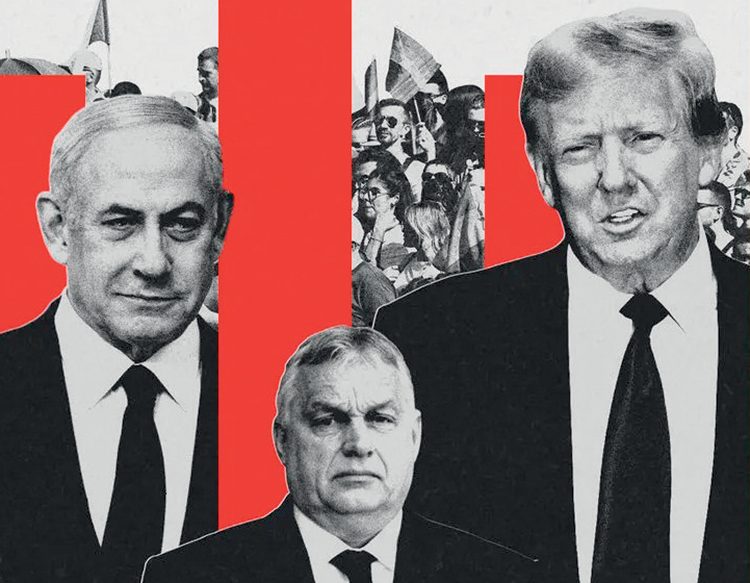
In the autumn of 1956, Hungary staged the first uprising against the 20th century Soviet behemoth. Seventy years later, in the spring of 2026 Hungary has delivered the first electoral thrashing against 21st century right wing populism in Europe. The 1956 uprising was crushed after seven days. But the opposition scored a landslide victory in Hungary’s parliamentary election held on Sunday, April 12 and. Viktor Orban, Prime Minister since 2010 and the architect of what he proudly called “the illiberal state”, was resoundingly defeated. Orban who has been a pain in the neck for the European Union was a close ally of US President Donald Trump and Israeli Prime Minister Benjamin Netanyahu.
Trump even dispatched his Vice President JD Vance to Budapest to campaign for Orban. After Orban’s defeat, Trump and his MAGA followers may be having nightmares about the US midterm elections in November. Similarly, Orban’s defeat has reportedly caused “great concern in the halls of power in Jerusalem.” Netanyahu has lost his only ally in the European Union and the opposition victory in Hungary does not augur well for his own electoral prospects in the Israeli elections due in October.
Ceasefire Hopes
Trump and Netanyahu have bigger things to worry about in the Middle East and among their own political bases. Trump is going bonkers, blasphemously imitating Christ and badmouthing the Pope, launching a blockade in the Strait of Hormuz and strong arming more talks in Islamabad. Netanyahu has been forced to sit on his hands, pausing his fight against Iran while pursuing peace talks with Lebanon. The leaders and diplomats from Pakistan, Egypt and Turkey are shuttling around drumming up support for another round of talks in Islamabad and a prolonged extension of the ceasefire.
Further talks in Islamabad and potential extension of the ceasefire received a new boost by Trump’s announcement of a new 10-day ceasefire between Israel and Lebanon. The background to this development appears to be Iran’s insistence on having this secondary ceasefire, and Trump insisting on ceasefire abidance by Hezbollah in return for his ordering Netanyahu to stop his brutal ‘lawn mowing’ in Lebanon. All of this might seem to augur well for a potential extension of the primary ceasefire between the US and Iran. There are also reports of the narrowing of gap between the two parties – involving a potential moratorium on Iran’s uranium enrichment, the opening of the Strait of Hormuz, and Iran’s access to its frozen assets estimated to be $100 billion.
Meanwhile the IMF has released its latest World Economic Outlook with a grim forecast. “Once again, says the report, “the global economy is threatened with being thrown off the course – this time by the outbreak of war in the Middle East.” Before the war, the IMF was expected to upgrade its growth forecasts for the global economy. Now it is going to be weaker growth and higher inflation with oil price optimistically stabilizing around $100 a barrel in 2026 and $75 a barrel in 2027. In a worst case scenario, if the oil prices were to hit $110 in 2026 and $125 in 2027, growth everywhere will further weaken and inflation will go further up in countries big and small.
In a joint statement on the Middle East, the Finance Ministers of the United Kingdom, Australia, Japan, Sweden, Netherlands, Finland, Spain, Norway, Republic of Ireland, Poland and New Zealand have called on the IMF and World Bank “to provide a coordinated emergency support offer for countries in need, tailored to country circumstances and drawing on the full range and flexibility of their tool kits.” They have also welcomed “advice on domestic responses that are temporary, targeted, and effective, and encourage work to identify steps needed to protect long-term growth.”
Subversion from the Right
The two men, Trump and Netanyahu, who started the war and precipitated the current crisis are not being held accountable by anyone and they are still free to do what they want and as they please. The third man, Victor Orban, who did not have anything to do with the war but extended wholehearted ideological and political support as a faithful apprentice to the two older sorcerers, has been democratically defeated. Together, they formed the terrible threes of the 21st century, spearheading a subversion from the right of the emerging liberal status quo of the post Cold War world. Orban’s defeat is a significant setback to the illiberal right, but it is not the end of it.
The three emerged in the specific historical contexts of their own polities that are both vastly different and yet share powerful ingredients that have proved to be politically potent. The broader context has been the end of the Cold War and the removal of the perceived external threat which opened up the domestic political space in the US, for locking horns over primarily cultural standpoints and climate politics. This era began with the Clinton presidency in 1992 and the election of Barack Obama 16 years later, in 2008, created the illusion of a post-racial America.
In reality, the right was able to push back – first with the younger Bush presidency (2000-2008) pursuing compassionate conservatism, and later with the foray of Trump (2016-2020) threatening to end what he called the “American Carnage.” Of the 32 years since the election of Bill Clinton, Democrats have controlled the White House for 20 years over five presidential terms (Clinton – two, Obama – two, and Biden -one), while the Republicans won three terms (Bush – two, Trump – one) spanning 12 years.
Trump has since won a second term for another four years, but already in his five+ years in office he has issued executive orders to roll back almost all of the liberal advancements in the realms of civil rights, equality, diversity and inclusion. All that the celebrated acronym DEI (Diversity, Equality and Inclusion) stands for has been executively ordered to be banished from the state, its agencies and its programs.
In Europe, the European Union became the champion and bulwark of liberalism and subsidiarity, which in turn provoked the rise of right wing populism in every member country. Brexit was the loudest manifestation against what was considered to be EU’s overreach, but after Britain’s bitter Brexit experience the populists in the European countries gave up on demanding their own exit and limited themselves to fighting the EU from their national bases.
Viktor Orban became the face and voice of anti-EU nationalists. But he and his political party, the Christian Nationalist Fidesz – Hungarian Civic Alliance, are not the only one. Nigel Farage’s Reform UK in Britain and Marine Le Pen’s National Rally Party in France are becoming real electoral contenders, while right wing presidents have been elected in Argentina and Chile.
The rise and fall of Viktor Orban
Of the three terribles, Orban is the youngest but with the longest involvement in politics. Born in 1963, Viktor Orban became a political activist as a 15-year old high schooler, becoming secretary of a Young Communist League local. He continued his activism while studying law in Budapest, visiting Poland and writing his thesis on the Polish Solidarity movement, giving lectures in West Germany and the US as a potential future Hungarian leader, and undertaking research on European civil society at Pembroke College, Oxford.
At the age of 26, Orban gained national prominence with a speech he delivered on June 16, 1989 in Budapest’s Heroes’ Square to mark the reburial of Imre Nagy and other Hungarians killed in the 1956 uprising. Imre Nagy was the leader of the 1956 Hungarian uprising against the puppet Soviet Union outpost in Budapest.
To digress and make a local connection – the pages of Sri Lanka’s parliamentary Hansard of 1956, contain an impressive record of the political debate in Sri Lanka over the events in Hungary. The LSSP’s Colvin R de Silva eloquently led the Trotskyite prosecution of the Soviet invasion of Hungary and the suppression of its freedoms. Pieter Keuneman of the Communist Party used his wit and debating skills to defend the indefensible. GG Ponnambalam, the unrepentant anti-communist, used the opportunity to take swipes on both sides. Finally, for the government, Prime Minister SWRD Bandaranaike deployed his own oratorical skills to empathize with the uprising without condemning the USSR. The four men were Sri Lanka’s foremost verbal gladiators and they used the occasion to put on quite a display of their talents.
Back to Hungary, where Orban began his political vocation identifying himself with Imre Nagy and demanding the withdrawal of the Soviet army from Hungary and calling for free elections in that country to elect a new government. That same year in 1989, Fidesz was recognized as a political party; Orban became its leader four years later in 1993 and led the party and its allies to their first victory and formed a new government in 1998. At age 35 Orban became the second youngest Prime Minister in Hungary’s history.
During his first term, Orban started well on the economy, reducing inflation and the budget deficit, was welcomed to the White House by President George W. Bush, and led Hungary to join NATO overruling Russian objections. But the slide into authoritarianism and corruption was just as quick, including the attempt to replace the two-thirds parliamentary majority requirement by a simple majority. By the end of the term the ruling coalition disintegrated and Orban lost the 2002 election and became the leader of the opposition over the next two terms till 2010.
Orban returned to power with a two-thirds majority in 2010 and immediately introduced a new constitution that set the stage for ushering in the illiberal state. What had been previously a communist state now became a Christian state where ‘traditional values’ of gender rights, sexuality, and exclusive nationalism were constitutionally enshrined. The electoral system was changed reducing the number parliamentarians from 386 to 199 – with 103 of them directly elected and 93 assigned proportionately. Orban went on to win three more elections over 16 years – in 2014, 2018 and 2022 – each with a two-thirds majority, and used the time and power to transform Hungary into a conservative fortress in Europe.
The new constitution and its frequent amendments were used to centralize legislative and executive power, curb civil liberties, restrict freedom of speech and the media, and to weaken the constitutional court and judiciary. It was his opposition to non-white immigration that made him “the talisman of Europe’s mainstream right”. He described immigration as the West’s answer to its declining population and flatly rejected it as a solution for Hungary. Instead, he told his compatriots, “we need Hungarian children.” His ‘Orbanomics’ policies restricted abortion and encouraged family formation – forgiving student debt for female students having or adopting children, life-long tax holiday for women with four or more children, and sponsoring fixed-rate mortgages for married couples.
Orban wanted to make Hungary an “ideological center for … an international conservative movement”. Orban heaped praise on Jair Bolsonaro for making Brazil the best example of a “modern Christian democracy.” He endorsed Trump in every one of Trump’s three presidential elections, the only European leader to do so. In return, Orban has been described by US MAGA ideologue Steve Bannon as “Trump before Trump.” Orban’s attack on universities for being the citadels of liberalism have found their echoes in Trump’s America and Modi’s India.
For all his efforts in making Hungary a conservative ideological centre, Viktor Orban’s undoing came about because of Hungary’s growing economic crises and the depth of corruption and systemic nepotism that engulfed the government. The economy has tanked over the last three years with rising prices and the national debt reaching 75% of the GDP – the highest among East European countries. Orban’s critics have exposed and the people have experienced systemic corruption that enabled the siphoning of public wealth into private accounts, the creation of a ‘neo-feudal capitalist class’, and the enrichment of family and friends. Orban’s corruption became the central plank of the opposition platform that Peter Magyar and his Tisza Party presented to the voters and caused his ouster after 16 years.
The Prime Minister elect is not a dyed in the wool liberal, but a member of a conservative Budapest family, and a politician cut from the old Orban cloth. Magyar (literally meaning “Hungarian”) was once a “powerful insider” in the Fidesz government – notably active in foreign affairs, while his ex-wife was once the Minister of Justice in Orban’s cabinet. Mr. Magyar may not fully roll back all of Orban’s illiberalism, but he has committed himself to eliminating corruption, increasing social welfare spending, limiting the prime ministerial tenure to two terms, and being more pro-European, EU and NATO.
EU and European leaders have openly welcomed the change in Hungary, and may be looking for the new government to change Orban’s vetoing of a number of EU initiatives, especially those involving assistance to Ukraine. In return, the new government in Hungary will be expecting the unfreezing of as much as $33 billion funds that the EU extraordinarily chose to freeze as punishment for Orban’s illiberal initiatives in Hungary. For Trump and Netanyahu, the defeat of Viktor Orban removes their only ally and supporter in all of Europe.
by Rajan Philips
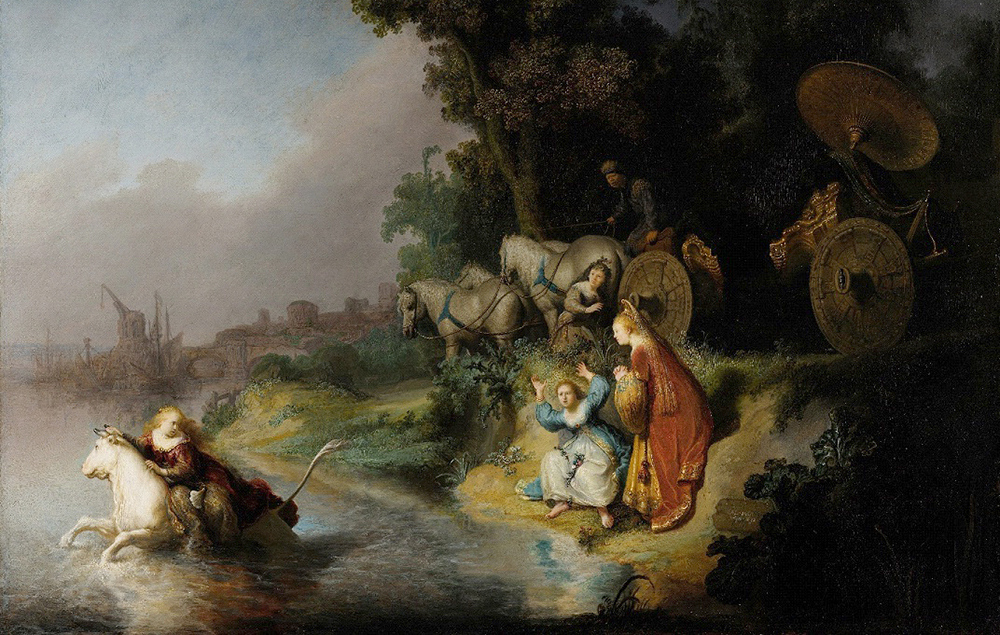
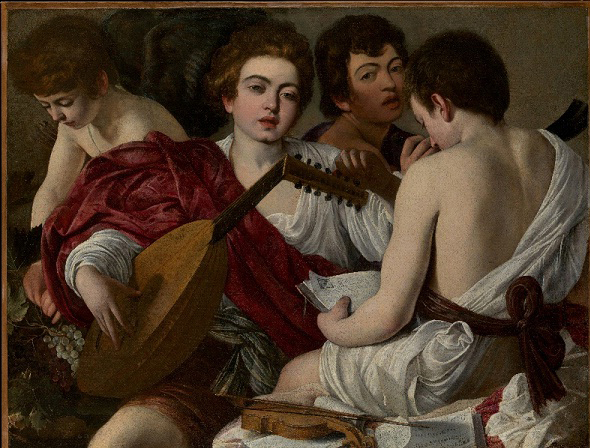
Sky Gallery of the Fareed Uduman Art Forum is dedicated to bringing audiences, cultures, and time periods together through meaningful and accessible art experiences to create the closest possible encounters with the world’s greatest paintings. Previous exhibitions include, Gustav Klimt, Frida Kahlo, Paul Gauguin, Vincent Van Gogh, Salvador Dali.
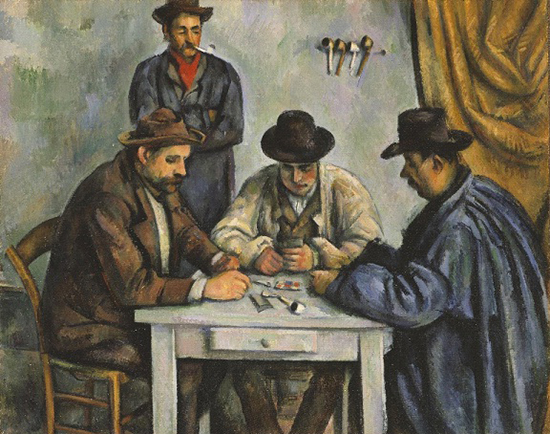
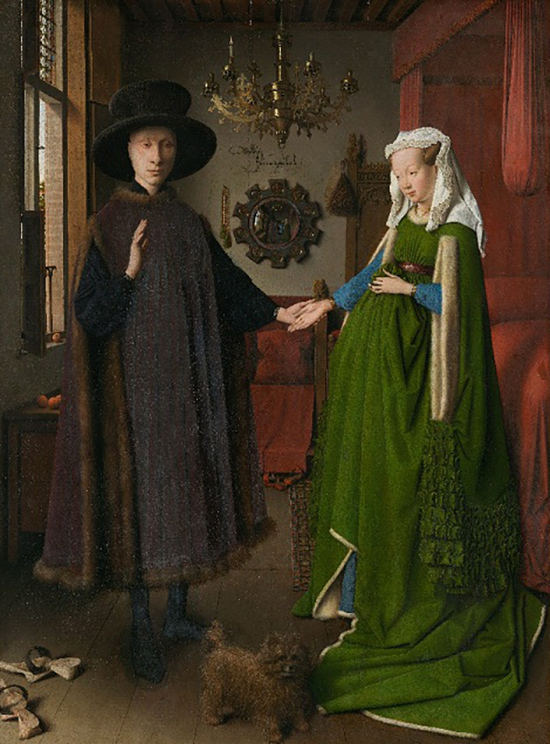
ICONS is conceived as “a dialogue across centuries” bringing together over a dozen artistic geniuses whose works span the Renaissance to the modern era. These works at their original scales of creation changes the conversation. You can finally stand in front of a life-size Vermeer or a monumental Monet and feel the dialogue between artists who never met but shaped each other across time. Each exhibit is meticulously presented on canvas, hand-framed, and finished at the exact dimensions of the original masterpieces, preserving the integrity of composition, texture, brushwork, color and scale.
At the heart of the exhibition is Jan van Eyck’s ‘Arnolfini Portrait’, a work that epitomizes the detail, symbolism, and human intimacy that have inspired generations of artists. Alongside it, visitors will encounter paintings that shaped the renaissance, impressionism, modernism, and the evolution of visual storytelling by Munch, Matisse, Monet, Degas, Da Vinci, Renoir, Vermeer, Rembrandt, Cézanne, Caravaggio, and more. The exhibition invites audiences to experience a rare conversation across centuries of artistic brilliance.
By bringing together works that are geographically and historically dispersed, ICONS creates a compelling space for comparison, reflection, and discovery. Visitors are invited to move beyond passive viewing into a more engaged encounter—tracing artistic influence, identifying stylistic shifts, and uncovering unexpected connections between artists who never shared the same physical space, yet remain deeply interconnected across time.
Designed and curated for both seasoned art enthusiasts and first-time visitors, ICONS offers an experience that is at once educational, immersive, and accessible—removing many of the traditional barriers associated with global museum-going.


Exhibition Details:
Dates: April 24 – May 3
Time: 10:00 AM – 5:00 PM (Monday – Sunday)
Venue: Sky Gallery Colombo 5
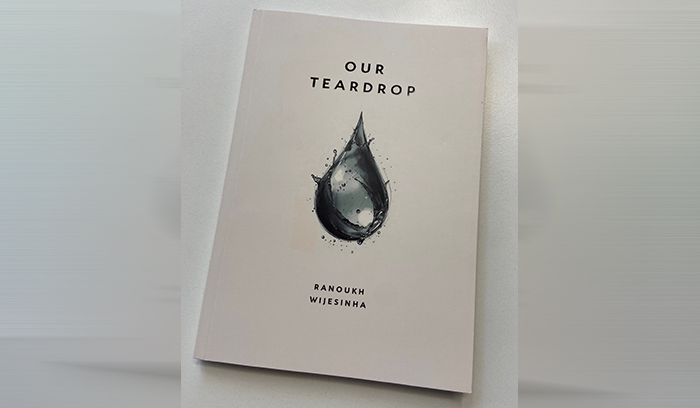
BOOK REVIEW
Ranoukh Wijesinha (2026)
Published by Jam Fruit Tree Publications.
82 pages. Softcover. ISBN 978-624-6633-81-3
The author is a graduate teacher at St. Thomas’ College, Mount Lavinia; his alma mater. On leaving school he read for a Bachelor of Arts Degree in English Language and English Literature at the University of Nottingham (Malaysia). On graduating, in 2024, he went back to his old school to teach these same disciplines. There seems to be a historic logic to this as his grandfather, a notable Thomian of his day, also started his working career as a teacher at the College before moving on to the world of publishing; as a newspaper journalist and sub-editor.
On his maternal side, Wijesinha’s grandfather was an accomplished journalist, thespian and playwright of his day, and his mother is also a much sought after teacher of English and English Literature and, as acknowledged by him, his first, and foremost, English teacher.
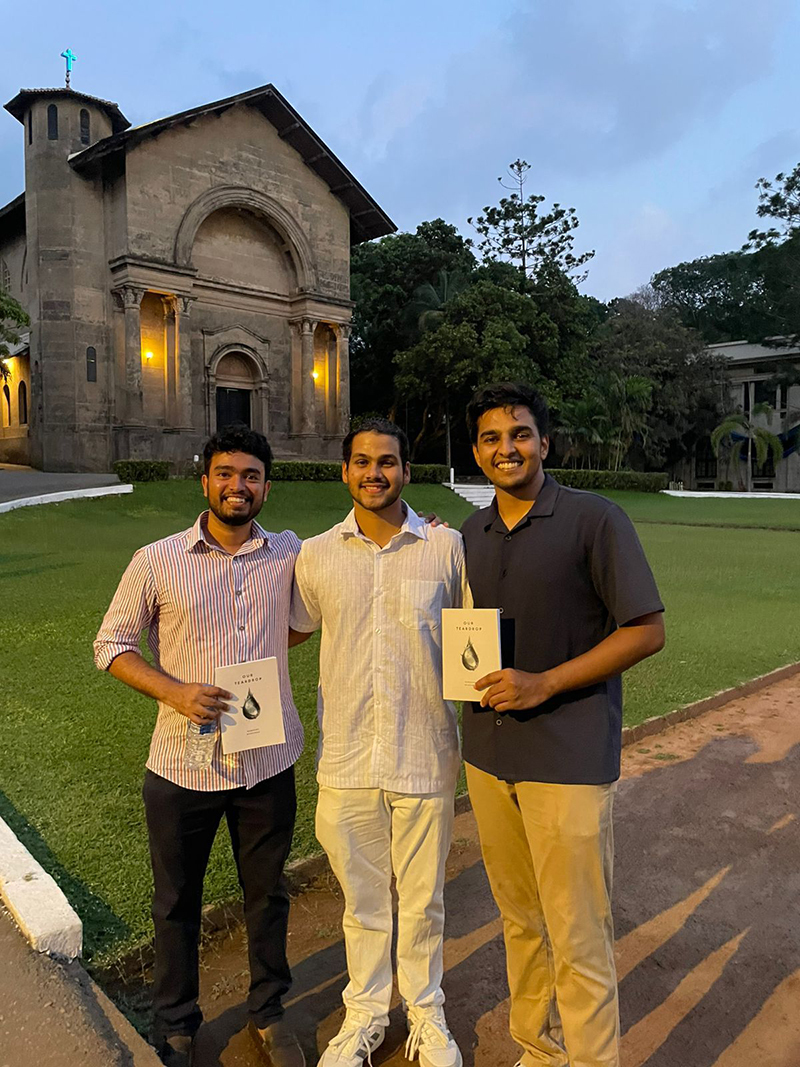
Ranoukh Wijesinha and friends at STC
Though there are some well-written, almost lyrical, pieces of prose in this publication, it is the poetry that dominates. Written with a sensitivity to people and events he has either observed himself, or as described to him by those who did, it also encompasses all genres of poetic verse, from the classical to the modern, including sonnets, acrostics, haiku to free and blank verse, the latter more in vogue today. All in all, it presents as a celebration of English poetry and its ability to, sometimes, express depth of thought and feeling far better than prose.
Dedicated to his mentor at St. Thomas’, his Drama and Singing Master had been a great influence on Wijesinha His sudden, premature, death understandably came as a shock to the still developing student under his tutelage. The poems “The Man who Made Me” and “The Curtain Called” best demonstrate this. In addition, it is apparent that Wijesinha has endured much mental trauma in his young life. Spending much time on his own, the questions these moments have raised are expressed in “When No One is Listening”, “There was a Time”, “Midnight Walks” and the prose “A Ramble through Colombo”.
However, the majority of the poems concern ‘Our Teardrop’, Sri Lanka, for whom the writer has a great love. He explores its history, its natural wonders, its people, its tragedies, its corruption and the hope that things will get better for all its people. “Bala’ and “Dicky” address a time of violence from days gone by when there were few glories, just victims. “Easter Sunday” brings this almost to the present time.
There also is humour. “Ado, Machang, Bro, Dude” celebrates his friends and friendships in a way that will reverberate with all the present and previous generations of those who are, or were once, in their late teens and early twenties.
There is little to criticise in this first of the writer’s forays into published works except, as referred to previously, to re-state that the prose quails in the face of the power of the poetry. It is all well written, filled with passion and compassion, and gives comfort that there still are young Sri Lankan writers who can be this brave, and write so powerfully, and profoundly, in English. It is hoped that this is just the first of many from the pen of this young writer.
L S M Pillai

Bodies of 50 infants dumped at Trinidad graveyard

Indonesian Navy Sailing Ship KRI BIMA SUCI – 945 concludes official goodwill visit to Sri Lanka

Malinga, Reddy sink Chennai Super Kings chase to defend under-par 194 in Hyderabad

Stubbs, Miller win Delhi Capitals a thriller against Royal Challengers Bengaluru

Showers predicted in the Western, Central, Sabaragamuwa, Uva, North-western, North-central and Southern provinces after 1.00 pm.

After dark in Sri Lanka: Tiny wild cats step into the spotlight

‘Dates have the highest sugar content to fight Coronavirus’

Sunday Island 27 December – Headlines

#SundayIsland 17th December – Headlines

Sunday Island – 28th March

Sunday Island Headlines – 21 March

Sunday Island – 21st February – Headlines
-
 Latest News7 days ago
PNS TAIMUR & ASLAT arrive in Colombo
-

 Latest News7 days ago
Prasidh, Buttler set up comfortable win for Gujarat Titans
-

 News4 days ago
PNS TAIMUR & ASLAT set sail from Colombo
-

 Latest News6 days ago
“I extend my heartfelt wishes to all Sri Lankans for a peaceful and joyous Sinhala and Tamil New Year!” – President
-

 Business2 days ago
Harnessing nature’s wisdom: Experts highlight “Resist–Align” path to resilience
-
 Latest News7 days ago
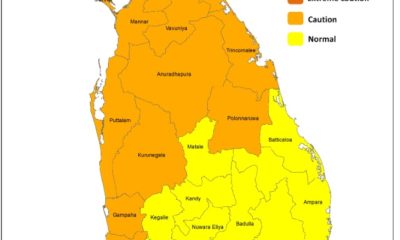
Heat Index at Caution level’ in the Northern, North-central, North-western, Western and Southern provinces and in Trincomalee district.
-

 News2 days ago
Gratiaen Trust announces longlist for the 33rd Annual Gratiaen Prize
-

 News2 days ago
Heroin haul transported on 50-million-rupee contract