
Opinion
Immediate and short-term interventions proposed to mitigate impact of current economic crisis on food and nutritional security

Current status
Agriculture currently occupies around 40% of the land and consumes over 80% of the fresh water resources of the country. There are about two million farmers, who account for 25% of the workforce of the country; yet, they contribute only around 6% of the GDP, which shows the low productivity of both land and labour and the poor value addition in agriculture. According to the last census of agriculture (2002), of the 3.3 million land holdings, 45% were less than 0.1 ha (quarter of an acre) and over 90% of the production units were less than 2 ha (5 acres). The situation may have been further exacerbated since, owing to fragmentation. Smallholder farmers who constitute the overwhelming majority of the farming population of the country are mainly engaged in primary production and contribute nearly 80% of the total annual crop production. Moreover, the bulk of land, over 80%, especially in rural areas, is owned by the government which has leased it in small lots to landless farmers. Owing to the scattered nature and small size of the holdings, they are difficult to consolidate, making it difficult to use machinery and achieve economies of scale. Besides, owing to non-ownership of land, farmers face difficulty in obtaining bank loans or investing in development, which constrains productivity improvement, value addition and the linking of rural agriculture to the global value chain.
In addition, the agriculture sector is beset with a myriad of other issues, including poor resource use efficiency, i.e., land, water and fertiliser, irregular use of pesticides, uncoordinated and unregulated production leading to unpredictable gluts and scarcities that cause drastic price fluctuations, unsatisfactory and inadequate extension service, lack of innovative business models and poor integration of agriculture with national, regional and global value chains. These issues have been exacerbated by the lack of a rational, coherent and consistent national policy with a clear sense of direction and depth, particularly in agriculture, land and trade. The recent abrupt ban of the import of chemical fertilisers, pesticides and weedicides in order to make Sri Lankan agriculture exclusively organic, is a poignant example.
Malnutrition and under-nutrition in children have already assumed alarming proportions with around 20% of children being underweight and about 15% suffering from chronic malnutrition and wasting disease. This will be further aggravated by the current food crisis, marked by scarcities, unavailability and/or price escalations of essential food items which will have far-reaching social, health economic and political implications. The crisis has led to growing unrest, tension and aggressiveness of the people affected. Therefore, while pursuing medium and long-term plans and programmes to develop robust sustainable agricultural systems, it is of prime importance to identify immediate and short-term actionable interventions to mitigate the impact of the economic crisis on food and nutritional security.
It is against this backdrop that the National Science Foundation, the premier national institution mandated to promote S&T for national development, assembled a galaxy of high-profile renowned scientists, professionals, academics and community leaders in agriculture, as well as representatives from leading agro-based enterprises and farmer organisations in the country, to identify immediate and short-term interventions to minimize the impact of the economic crisis on food security. Recommendations that emanated from the deliberations are given below for the attention of and early action by the relevant authorities:
Immediate and short-term interventions recommended to mitigate the impact of the economic crisis on food and nutritional security
1. Determination of the food and feed requirement, food production and food deficit/surplus in respect of the major food crops at district and national levels. This is required to understand the magnitude and gravity of food and nutritional insecurity and its spatial variation. For instance, only about 10% of the food requirement of the Western Province is produced within the Province and the deficit, i.e. 90%, is met by food produced in other areas and imports. On the other hand, the agriculturally active North-Central Province faces significantly far less food insecurity issues. Such information is vital to make effective interventions that will minimize the impact of the food crisis on the health and wellbeing of the people of the country and to ensure equitable distribution of the limited food supplies.
2. Identification of food crops and their varieties, i.e., cereals, pulses, yams, vegetables and fruits, that are most essential to food and nutritional security and import substitution.
Here, it becomes pertinent to identify crop varieties that are adaptable to low-external input sustainable agriculture (LEISA), and are relatively less affected by the shortage and/or prohibitive prices of inputs, i.e. planting material, fertilizers, pesticides, fuel for machinery (for land preparation, harvesting, etc.) based on past experience.
3.Determination of agro-climatically and edaphically most suitable areas for cultivation of the crops and their varieties identified under (2), to enable matching of crop and land for optimum yield. This can also be done based on the past experience and observations of farmers and officers of relevant institutions including Department of Agriculture and Department of Agrarian Development to meet the urgent need. Presently, farming is done in an unscientific and indiscriminate manner and many crops are grown under suboptimal and marginal conditions, thus producing far below their potential.
4. A rapid multiplication programme of high-quality planting material to meet the increased demand.
This is extremely important for paddy and due attention should be paid to collect adequate seed paddy from this Yala season harvest to meet the need in the coming Maha season which is about 80,000 metric tons. This should be done as an emergency programme to make sure that the seed paddy produced from this Yala harvest will not be consumed. As there is a Faculty of Agriculture in practically every province, and about a dozen Schools of Agriculture under the Department of Agriculture (DoA), their students can achieve rapid multiplication of other planting materials as part of their training programme under the guidance of the staff with little additional funding to meet provincial needs. Agrarian Service Centres, farmer organisations, Community-based organisations and such like should also be empowered and supported in this regard. The planting material produced must be sold at a fair price.
5. Cultivation of the 3rd season (between Yala and Maha) and 2022/23 Maha season to maximize production.
Production in high potential areas in the dry zone should be maximized as the wet zone has a lower yield potential and its farmers are predominantly part-time. Island-wide awareness programmes should also be conducted with the support of outstanding farmers and relevant institutions to achieve the highest yield potential with prudent use of inputs such as fertiliser, pesticides, water and fuel.
6. Identification of outstanding enterprising farmers in each AGA division who have consistently produced relatively high yields, particularly those who adopt good agricultural practices (GAPs), including integrated farming and integrated nutrient management.
The Dept. of Agrarian Development (DAD), DoA, Mahaweli Authority, SANASA, Sarvodaya, etc., can further assist in this regard. As there are 565 Agrarian Service Centres (ASCs) in the country, with links to farmers and institutions related to agriculture, ASCs may play a leading role in this connection. However, in order to avoid possible conflicts, the whole process should be conducted transparently and credibly with the participation of key stakeholders, i.e. representatives from the divisional secretariat, DoA , DAD/ASC, farmer organisations etc.
7. Making available the expensive limited inputs, i.e. chemical fertilisers, pesticides, weedicides, fuel for machinery etc., to the most outstanding selected farmers in areas with high agricultural potential for the crops/varieties in each district.
This will ensure maximum return on investment (ROI) and minimize unregulated, uncoordinated, ad hoc crop production for commercial purposes under sub-optimal and marginal conditions.
For instance, paddy is grown in 22 districts in the country with the average yield ranging from about 2.5 to around 6 metric tons/ha. However, in all the districts, more or less comparable quantities of water, fertilisers and pesticides are used per hectare. Therefore, the use of the limited fertilizers, agrochemicals and fuel in the most effective and productive manner will produce the highest possible yield so as to mitigate food shortages and nutritional insecurity. Thus, Sri Lanka should be able to maintain the same level of national production, with about one million farmers working about half of the extent cultivated now, if farming is done scientifically through matching of crop and land with proper planning and management. This will save a lot of water – at present, about 2500-5000 litres are required to produce one kilogram of rice depending on where it is grown – which can then be used for other purposes including generation of hydropower and reduce the need for agrochemicals. This will help to minimize the environmental and health hazards associated with agriculture and reduce the drain of foreign exchange.
8. Augmenting the production of organic manure for food crop production and inoculum for the production of pulses such as cowpea, mungbean, and soybean.
The former can be achieved with support from the garbage disposal unit of each UC and MC. In addition, immediate action should be taken to increase the production Single Super Phosphate (SSP) from Eppawala Rock Phosphate and produce ash from paddy husk and other suitable material as a source of potassium. Community-based organizations and the private sector can assist in these initiatives.
9. Cultivation of lands available in government institutions, religious institutions, schools etc. with assistance of the staff of the DoA, DAD, Mahaweli Authority, Faculties of Agriculture, Schools of Agriculture, and outstanding farmers in the area.
School children and public sector employees can be mobilized as necessary for cultivating crops in their respective premises for a few hours every week on a rotational basis during the crisis period. Moreover, agricultural lands with high potential should be leased to outstanding farmers and private sector for cultivation with attractive incentives/benefits offered to landowners. Polyculture should be promoted over monoculture wherever possible.
10. Launch of an accelerated programme for increasing the productivity and extent cultivated of home gardens, which hitherto have remained under-exploited.
There are over 4.46 million home gardens in the country with a total extent of 835,000 ha spread over the 25 districts. They operate far below their potential and their productivity can be considerably increased through intensification and improved management with minimal additional external inputs or expenditure. There are around 40 types of green leaves, and over 50 types of traditional and indigenous yams and tuber crops in Sri Lanka, which are not well known and hence under-exploited. They are a valuable source of minerals, vitamins, and energy.
11. Promotion of urban agriculture (vertical farming, rooftop farming, window gardening, balcony gardening etc.) and edible landscaping in suitable common urban areas.
This will be of great relevance to the Western Province where only about 10% of its food requirement is produced within the province. This should be facilitated by conducting appropriate awareness and training programmes and providing the requisite planting material, know-how and show-how which can easily be done by the staff of the DoA, Hector Kobbekaduwa Agrarian Research and Training Institute (HARTI), Faculties of Agriculture, etc.
12. Use of lands unsuitable for cultivating food crops to establish pasture or pasture/legume mixtures for increasing milk production, and of paddy fields which are not cultivated owing to shortage of fertilizer, pesticides and machinery to cultivate crops and vegetables that need a minimum of inputs.
Besides, mushroom production which requires no agricultural inputs such as fertilizer and agrochemicals should be promoted as a cottage industry.
13. Setting up of economic centres in each agriculturally important district for the purchase and distribution of agricultural produce mainly within the district, thereby reducing not only fuel consumption and carbon footprint, but also postharvest losses, i.e. 30-40%, and quality deterioration.
Presently what is produced in Angunukolapalassa is transported to the Dambulla Economic Centre from where it is distributed to other districts including Hambantota. In addition, cottage industries should be developed in agriculturally important areas for value addition, reduction of postharvest losses, and coping with gluts.
14.
Development of innovative business models with the engagement of appropriate private sector institutions in order to increase productivity and profitability of agricultural enterprises with linkages to local (i.e. supermarket chains), regional and global markets. For instance, “Polos” has a global market exceeding $ 30 billion and Sri Lanka has a great potential to export polos to the West, where there is a growing demand for meat substitutes. Cultivation of non-narcotic cannabis is another plant with an immense global market. These can also earn much needed foreign exchange for the country.
15. Upgrading and integrating the digital platforms in operation to provide the requisite information and services to farmers and stakeholders, including weather data, market dynamics (price fluctuations and supply and demand), recommendations for the control of pest and diseases, early warning against disease outbreaks, natural hazards etc.
This will ensure a fair price for the farmers and reduce exploitation by the middlemen.
16. Putting in place price controls to prevent the exploitation of farmers by the vendors of agrochemicals who are presently the main suppliers, as well as the prescribers, of agrochemicals to the farming community.
Therefore, like medicine, sale of pesticides and weedicides should be subject to strict guidelines by the relevant authorities.
17. Making use of existing, home-grown, low-cost technologies for the preservation of crops such as jak, breadfruit and manioc and fruits such as wood apple, mango, papaya, sweet melon, “waraka” and ‘belli”.
Establishment of small scale processing centers in the relevant districts or DS divisions will be useful to reduce post-harvest losses and add value to such produce. In addition, cultivation of sugarcane in small holdings can be developed as a cottage industry to produce cane jaggery and cane treacle; they can be used as a substitute for sugar which is currently imported at a cost exceeding Rs 40 billion per annum.
18. Conduct of appropriate educational and awareness programmes, electronic and otherwise, aimed at enhancing food and nutrition literacy (FNL).
This will significantly contribute to the ability of people, especially the economically disadvantaged, to overcome the misplaced fear and apprehension due to media hype that causes panic buying, hoarding, scarcities and price escalations. Such programmes are of great relevance as young children and youth are lured into buying unhealthy, junk food and fizzy beverages by the aggressive and attractive advertising campaigns conducted by some commercial concerns.
Nutrition is especially important during pregnancy and infancy, which are crucial periods for the formation of the brain, laying the foundation for the development of cognitive, motor, and socio-emotional skills throughout childhood and adulthood. Therefore, it is imperative to identify the vulnerable segments of the population in the country and develop a mechanism to provide assistance, food and otherwise, to minimize impact of the food and nutritional insecurity on cognitive and physical development in particular and health in general, paying attention to the elderly as well who account for 12.3% of the population, i.e. about 3.3 million.
19. Introduction of an encouragement award scheme, with attractive incentives and a befitting title, in order to motivate, recognize and felicitate the TOP 10 exemplary farmers at the divisional, district and national levels.
Gramasevaka Niladhari (14,002), Samurdhi recipients (3.3 million), Development Officers (c. 100,000) , Vidatha Resource Centre Officers (260), Agricultural Research and Production Assistants (>8,000) etc. should be mobilized and harnessed as required for the above interventions at the Divisional Secretariat (331) or Agrarian Service Centre level (565) as appropriate.
This report constitutes recommendations pertaining to only the Food Crop sub-sector. Fisheries & Aquaculture and Livestock & Poultry sub-sectors also contribute greatly to improve food security. Similar reports for those two sub-sectors are in preparation. Implementation of the above proposed interventions through a holistic approach with the participation of the relevant public and private sector institutions, and community-based and farmer organisations will contribute in no small measure to mitigating the impact of the current economic crisis on food and nutritional security of the people of the country.
Prof. Ranjith Senaratne
, Chairman, National Science Foundation and Professor Emeritus, Department of Crop Science, University of Ruhuna
Dr. Sepalika Sudasinghe, Director General, National Science Foundation
Prof. Gamini Senanayake
, Chairman, Council for Agricultural Research Policy and Professor Emeritus, Department of Agricultural Biology, University of Ruhuna
Rizvi Zaheed
, Chairman, Steering Committee on Agriculture, NSF and Chairman, Agripreneurs Forum
Dr. W.M.W. Weerakoon
, former Director General, Department of Agriculture
A.H.M.L. Abeyrathna
, Commissioner General, Department of Agrarian Development
Dr. Sirimal Premakumara
, Chairman, Industrial Technology Institute
Dr. Vinya Ariyaratne
, President, Sarvodaya Shramadana Movement
Samadanie Kiriwandeniya
, Managing Director, SANASA International (Pvt) Ltd.
Prof. Asha Karunaratne
, Dean, Faculty of Agricultural Sciences, Sabaragamuwa University
Prof. S. Subasinghe
, former Dean, Faculty of Agriculture and Senior Professor, Department of Crop Science, University of Ruhuna
Prof. Jeewika Weerahewa
, Senior Professor in Agricultural Economics and Business Management, University of Peradeniya
Prof. S. Sutharsan
, Professor in Crop Science, Faculty of Agriculture, Eastern University.

The world’s most theatrical stage
Welcome to the Grand Circus
 If global geopolitics were a TV show, it would be cancelled after the first season for being too unbelievable. Consider the plot: the world’s largest arms exporter lectures others about peace; a government that executed over 500 people in a single year tells its citizens it governs by divine law; and international bodies created to enforce rules seem to apply those rules with remarkable … flexibility. Welcome to the real world of international relations, where the rules are made up and the principles don’t matter.
This analysis examines two of the most consequential actors shaping global instability today: the United States of America, a democracy that can’t quite decide whether it believes in democracy, and the Islamic Republic of Iran, a theocracy that has perfected the art of punishing its own people for simply existing.
Episode I: The United States, ‘Do as I Say, Not as I Do’
The Democracy Export Business
The United States has, for decades, positioned itself as the global guardian of democracy, freedom, and human rights. It is a noble brand. The marketing budget alone, in the form of military expenditure at $886 billion in 2023, is staggering. And yet, the product being sold and the product being delivered have often been … different things.
The CIA-backed coup of 1953, codenamed Operation Ajax, removed Iran’s democratically elected Prime Minister Mohammad Mosaddegh and reinstated the autocratic Shah Mohammad Reza Pahlavi, primarily to protect Anglo-American oil interests.
Nuclear Exceptionalism: The World’s Worst-Kept Secret
The United States currently holds approximately 5,044–5,177 nuclear warheads (depending on the source and year), while Russia being the largest with a stockpile estimated at approximately 5,580 warheads. yet it leads international campaigns demanding that other nations not develop nuclear weapons. This is a bit like the world’s most heavily armed person standing at the door of a gun shop, telling customers they cannot purchase firearms.
Furthermore, Israel is widely believed to possess 80–90 nuclear warheads. The United States has never imposed sanctions on Israel for this. India and Pakistan, both outside the NPT, were rewarded with nuclear cooperation deals after the tested nuclear weapons.
The Saudi Arabia Paradox
Perhaps, no relationship illustrates U.S. foreign policy hypocrisy more vividly than Washington’s alliance with Saudi Arabia. The Kingdom is an absolute monarchy with no elections, no free press, where women were legally barred from driving until 2018, and where the murder of journalist Jamal Khashoggi, carried out, according to U.S. intelligence, on orders from Crown Prince Mohammed bin Salman, resulted in … arms sales continuing and diplomatic ties intact.
The United States sold Saudi Arabia over $37 billion in arms between 2015 and 2020, weapons used in a Yemen war that the United Nations described as one of the world’s worst humanitarian catastrophes. Yet the U.S. simultaneously held press conferences about human rights. The cognitive dissonance is not a bug. It is the feature.
Iraq: The Weapons of Mass Distraction
In 2003, the United States invaded Iraq on the basis of alleged weapons of mass destruction (WMD) that did not exist. The invasion resulted in an estimated 150,000–1,000,000 Iraqi civilian deaths depending on methodology, the displacement of millions, the destabilization of an entire region, and the rise of the Islamic State, none of which appeared in the original brochure. The officials responsible for this foreign policy catastrophe faced no international tribunal. No sanctions were imposed on the United States. Several architects of the war are today respected media commentators.
Meanwhile, the International Criminal Court (ICC), an institution the United States has never ratified, is expected to hold others to account for far lesser offenses. As of 2024, the U.S. has actively sanctioned ICC officials who attempted to investigate American personnel for potential war crimes in Afghanistan.
Episode II: Iran, The People’s Nightmare
Iran’s political system is built on the concept of Velayat-e Faqih, the Guardianship of the Islamic Jurist, a political-theological doctrine holding that a senior Islamic cleric should govern society. In practice, this means that Supreme Leader Ali Khamenei, unelected by the general public, holds veto power over all branches of government, controls the military, the judiciary, state media, and the powerful Islamic Revolutionary Guard Corps (IRGC).
The elected president, whether ‘moderate’ or ‘hardliner’, operates within a system where real power resides with the Supreme Leader and an unelected Guardian Council that vets all candidates and can disqualify anyone it deems insufficiently Islamic. In the 2021 presidential election, the Guardian Council disqualified over 590 candidates out of 592 who applied. The word ‘election’ is being used loosely here.
Women’s Rights: A Systematic Dismantling
Since the 1979 Islamic Revolution, Iranian women have endured one of the most comprehensive rollbacks of rights in modern history. Within weeks of the revolution, mandatory hijab laws were imposed, women were barred from serving as judges, and the minimum marriage age for girls was reduced to 9 years (later revised to 13 in 1982). This was not incidental policy; it was ideological architecture.
Today, Iranian women face legal discrimination across virtually every domain. Under the Iranian Civil Code, a woman’s testimony in court counts as half that of a man’s. Women cannot travel abroad without the written permission of their husband or male guardian. Married women cannot work without spousal consent in many circumstances. The diyeh (blood money) for a woman’s life is legally valued at half that of a man.
In September 2022, 22-year-old Mahsa (Zhina) Amini died in the custody of Iran’s Morality Police, after being arrested for allegedly wearing her hijab improperly. Her death triggered the Woman, Life, Freedom uprising, one of the largest protest movements in Iranian history. The government’s response was to kill over 500 protesters, arrest more than 19,000, and execute at least four people in connection with the protests by early 2023.
The IRGC and State-Sponsored Repression
The Islamic Revolutionary Guard Corps is a military-economic-political entity unlike any other in the region. It controls an estimated 20–40% of Iran’s economy through businesses, construction contracts, and import monopolies. It commands proxy militias across Iraq, Syria, Lebanon, and Yemen. And it suppresses domestic dissent with a ruthlessness that has drawn consistent condemnation from United Nations human rights bodies.
Amnesty International’s 2022-2023 annual report documented the IRGC and security forces using live ammunition, birdshot, and metal pellets against protesters, deliberately targeting eyes, resulting in hundreds being blinded. The UN Special Rapporteur on Iran documented ‘serious, widespread and systematic human rights violations’ constituting potential crimes against humanity.
Episode III: Where the Two Hypocrisies Meet
The relationship between the United States and Iran is, in many ways, a story of two entities who deserve each other in the sense that the behavUior of each government has fed the domestic narrative of the other for decades.
Washington uses Iran as justification for its military presence in the Gulf, its arms sales to autocratic Gulf states, and its general posture as indispensable regional hegemon. Tehran uses American hostility and sanctions as justification for economic failure, political repression, and nuclear advancement. Both governments’ hard-liners need each other to remain in power.
The Iranian people, 85 million of them, majority under 35, highly educated, and overwhelmingly wanting engagement with the world, are trapped between a government that treats them as subjects and an international sanctions regime that punishes them for their government’s choices. The American people, meanwhile, continue paying for a foreign policy architecture that serves arms manufacturers, defense contractors, and geopolitical abstractions more than it serves democratic values or human security.
Some Uncomfortable Truths
The United States is not the villain of every story, nor is Iran irredeemably authoritarian in the hearts of its people. What is consistent, and what this analysis has documented, is that both governments operate by standards they refuse to apply to themselves.
Tehran’s theocratic governance has failed its population economically, politically, and most visibly in its treatment of women and dissidents. The Woman, Life, Freedom movement showed the world what Iranian society wants. The government’s violent response showed the world what the Islamic Republic fears.
The lesson, uncomfortable as it is, is that powerful states, whether wielding aircraft carriers or theology, tend to exempt themselves from the rules they want others to follow. The only antidote is an informed public that refuses to accept these double standards as the natural order of things. Read critically. Follow the money. And remember: when a government tells you it acts in the name of God or democracy.
(The writer, a senior Chartered Accountant and professional banker, is Professor at SLIIT, Malabe. The views and opinions expressed in this article are personal.)
The scale and manner of grant distributions underscore the urgent need to rectify the weaknesses identified by the Auditor General. Remarkably, the accounts for the years 2024 and 2025 are still not published and only the 2023 accounts are available for public scrutiny.
Grants to clubs and associations increased from LKR 1.30 billion in the prior year to LKR 2.46 billion in 2023, representing an escalation of over LKR 1.15 billion year-on-year. These grants were distributed among 36 recipient clubs and associations, with individual allocations ranging from approximately LKR 1.5 million to almost LKR 300 million. Such wide variation and substantial growth warrant clear public disclosure of the allocation framework, the approval processes, and the beneficiary criteria.
While it is understandable that higher profitability enables greater financial support to clubs, the absence of a transparent, rule-based grant policy gives rise to governance concerns, and unless properly explained, leaves room for malicious or unfounded allegations that grant allocations may be used to influence voting behaviour or entrench existing officials. Robust disclosure and effective oversight are therefore essential to safeguard institutional credibility. The precise immediate need for high funding and their monitoring processes need to be divulged.
A case in point is Colombo Cricket Club (CCC), which received LKR 279,531,827 in 2023, making it the highest individual club recipient. As disclosed under the related-party notes to the financial statements, the President of Sri Lanka Cricket is also the President of Colombo Cricket Club, resulting in this transaction being classified as a related-party transaction.
In contrast to several grant recipient entities reporting profits, Sri Lanka Cricket recorded a deficit of approximately Rs. 2 billion in its Statement of Financial Performance for 2023.
It is also noteworthy from the cash flow statement that cash and fund balances declined sharply, from approximately LKR 10.8 billion in the previous year to around LKR 5.6 billion in 2023, representing a significant depletion of liquid resources within a single financial year.
A more meaningful and complete evaluation of these developments—particularly the position of funds available as at 31 December 2024 and 31 December 2025—will only be possible once the financial statements for 2024 and 2025 are released and subjected to public scrutiny.
A cricket enthusiast – Moratuwa
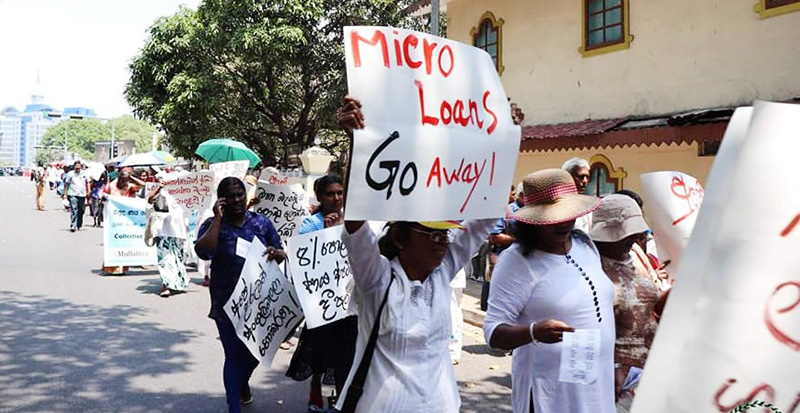
The Microfinance and Credit Regulatory Authority Bill was passed into law by the Parliament of Sri Lanka on 4 March. According to Deputy Minister of Finance and Planning Dr. Anil Jayantha, the main object of the Act is to establish an Authority to “license and supervise the under-regulated microfinance and moneylending sector, aiming to protect borrowers from exploitation and ensure financial stability”.
However, the Yukthi Collective is saddened and disappointed that a government which pledged to take “measures to alleviate the burden of predatory microfinance loans with high interest rates on women” (NPP Manifesto, 2024: Page no. 44), will now add to their unbearable weight.
The new Act, as virtually all legislation enacted by Anura Kumara Dissanayake’s government, is a legacy of the anti-working class Ranil Wickremesinghe regime. It evades the root causes of the microfinance trap, and ignores debt justice for women borrowers.
It fails in understanding the connections between household debt and public debt. The vicious cycle of national debt is sustained by lack of growth in economic activity because of poor access to affordable credit.
It fails to make equal representation of women mandatory in the new Authority. If representatives of women borrowers and their self-run organisations are not present in the regulatory body, how will its members know of their lived experiences and make decisions that value women’s unpaid and paid contributions to sustaining life?
System Change
Millions of indebted households voted for the NPP with hope and expectation of ‘system change’. But instead of honouring its manifesto promise to them, the government has let them down in the law-making process; as well as the focus and substance of the new Act.
It is appalling that NPP parliamentarians, including some of its women members, appear not to have read and understood the bill they enacted into law, nor spoke to the rural credit community providers in their electorates for their views.
Predatory lending exists in the formal and informal sectors. Within this ecosystem, the Act fails to understand, identify, and prohibit predatory lending and recovery practices. It is a cover for the Central Bank’s failure to properly regulate ‘Licensed Finance Companies’ in the interests of citizens.
The biggest offenders are the big finance companies, in which some parliamentarians are deposit-holders. Therefore, some lawmakers benefit from excess profitmaking through exploitative practices, at the expense of poor mostly rural women.
Where law reform should discipline the bullies and thugs in credit delivery, it will instead wipe out, through over-regulation, community-based and managed lenders such as death donation societies, farmer associations, and urban and rural women’s collectives, which have been a lifeline for vulnerable working-class women and a defence from harmful recovery practices.
Structural Adjustment Programmes
The motivation for this new law are the market- and capital- friendly structural reforms insisted by International Financial Institutions; not the concerns and needs of those at the mercy of predatory lenders.
From the Microfinance Act 2016, to the 2023 version of the Ranil Wickremesinghe regime, the Asian Development Bank (ADB) through its loans has been a promoter of these regressive reforms.
The 2026 Act, with some changes suggested by the Supreme Court in 2024 and hardly any of the changes demanded by affected communities, has been moved forward by the NPP government in line with ADB loan conditionalities.
The path of de-regulation for banking, finance, trade, and investment; and over-regulation of poor people’s savings and credit institutions, smacks of the bias to big capital, which the NPP in opposition once criticised.
Reforms needed
The financial and banking reforms we want to see are to make credit from state banks and public funds accessible and affordable to women producers in agriculture and micro and small business operators; with decent wages and social protection for workers; that improve household opportunity for a dignified livelihood and decent lives.
Yukthi is a forum supporting working people’s movements and people’s struggles for democracy and justice in Sri Lanka.
by Yukthi Collective

EU-approved sterile pharma facility launched

Prime Minister Holds Bilateral Meetings with ADB Leadership and Participates in education policy dialogue in Manila

Nahid Rana and Tanzid Hasan complete Pakistan’s demolition in opening ODI

Prime Minister highlights the importance of recognising Women’s Unpaid Care Work

Australia grants asylum to 2 more members of Iranian women’s football team

Showers are likely in the Northern, Eastern, Sabaragamuwa, Southern and Uva provinces and in Kandy and Nuwara-Eliya districts

‘Dates have the highest sugar content to fight Coronavirus’

Sunday Island 27 December – Headlines

#SundayIsland 17th December – Headlines

Sunday Island – 28th March

Sunday Island Headlines – 21 March

Sunday Island – 21st February – Headlines
-
 News6 days ago
University of Wolverhampton confirms Ranil was officially invited
-

 News7 days ago
Legal experts decry move to demolish STC dining hall
-

 News5 days ago
Peradeniya Uni issues alert over leopards in its premises
-

 News6 days ago
Female lawyer given 12 years RI for preparing forged deeds for Borella land
-

 News3 days ago
Repatriation of Iranian naval personnel Sri Lanka’s call: Washington
-

 News6 days ago
Library crisis hits Pera university
-

 News5 days ago
Wife raises alarm over Sallay’s detention under PTA
-

 News6 days ago
‘IRIS Dena was Indian Navy guest, hit without warning’, Iran warns US of bitter regret