
Business
IMF reserves could help rebuild emerging debt markets, UN says

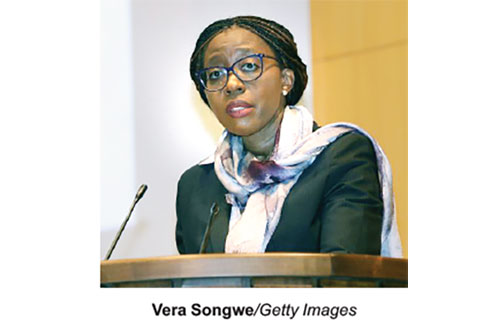
A record injection of International Monetary Fund resources this year could fund a facility to lower the costs for developing economies selling sovereign debt abroad, according to the head of the United Nations Economic Commission for Africa.
Uneca’s Vera Songwe said she’s proposed a facility to bolster the liquidity of the secondary market for emerging and frontier-market debt, reducing the premium some issuers are charged by investors that can’t immediately trade their bonds. The liquidity and sustainability facility, which would replicate repo transactions that have helped central banks lower borrowing costs in developed countries, could be bankrolled by the upcoming allocation of $650 billion of IMF reserve assets, known as special drawing rights.
“We are not asking for any special treatment for frontier and emerging market economies. We are actually trying to perfect the market,” Songwe said in an interview at the Qatar Economic Forum. “We can reduce the cost of the bond or give an additional premium if you are going to invest the resources in sustainability or green growth, renewable energy, better infrastructure.”
IMF Managing Director Kristalina Georgieva expects the fund’s board of governors to vote on the proposed new SDRs by mid-August. The more than $33 billion in reserves that has been earmarked for Africa is not enough to shore up the continent’s economy, South African President Cyril Ramaphosa said recently.
Higher liquidity is key to unlocking the financing needed for Africa to speed up its recovery from the pandemic, which resulted in the continent’s worst economic contraction on record last year, Songwe said.
Some African sovereigns have returned to international debt markets this year after staying away most of 2020 when yields surged during the pandemic. Still, a slower economic recovery and dwindling revenue have raised concerns that some countries in the continent may struggle to repay their external loans in coming years. (Bloomberg)


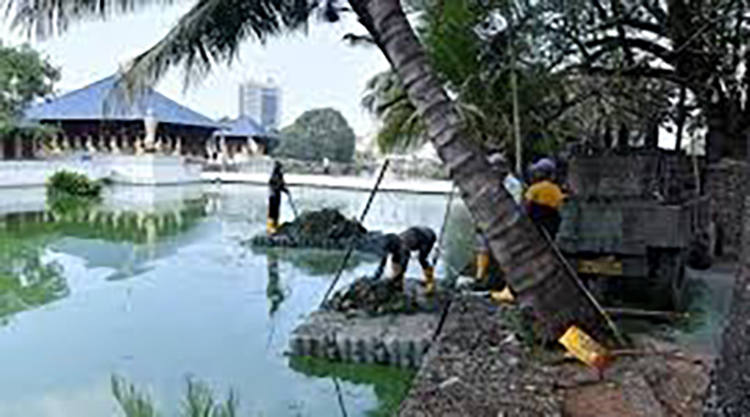
Sri Lanka’s decision to invest Rs. 2.5 billion in restoring the heavily polluted Beira Lake marks one of the most significant urban environmental interventions in recent years, underscoring a growing recognition that ecological rehabilitation is also an economic imperative.
The multi-pronged project—covering the closure of illegal sewage discharge points, large-scale dredging, and the installation of aeration systems—is expected to not only revive aquatic life but also unlock commercial, tourism and real estate value in the heart of Colombo.
Officials say the initiative is designed to transform Beira Lake from a long-neglected liability into a productive urban asset.
A senior official from the Ministry of Environment told The Island Financial Review that untreated wastewater and illegal sewer connections had been the primary contributors to the lake’s degradation for decades. “Closing these illegal sewage points is the most critical intervention. Without that, any dredging or aeration would only offer temporary relief, the official said, adding that enforcement will be carried out in coordination with the Colombo Municipal Council (CMC) and other regulatory agencies.
From a business perspective, the clean-up is being viewed as a catalyst for urban regeneration. Urban Development Authority (UDA) sources noted that a healthier Beira Lake would significantly enhance the attractiveness of surrounding commercial developments, hospitality projects and public spaces. “Environmental remediation directly impacts land values and investor confidence. A clean, living lake changes the entire economic profile of the area, an UDA official said.
The dredging component of the project is aimed at removing decades of accumulated sludge, which has reduced water depth and contributed to foul odours and fish die-offs. According to officials involved in project planning, the dredged material will be disposed of following environmental guidelines to avoid secondary pollution risks—an issue that has undermined similar efforts in the past.
Meanwhile, the installation of modern aerators is expected to improve dissolved oxygen levels, a key requirement for sustaining fish and other aquatic organisms. “Restoring aquatic life is not just about biodiversity; it is about creating a water body that can safely support recreational activities and public engagement, a senior CMC engineer explained.
Economists point out that the Rs. 2.5 billion allocation, while substantial, should be seen against the long-term cost savings and revenue potential. Reduced public health risks, lower water treatment costs downstream, increased tourism activity and higher commercial footfall could deliver returns that far exceed the initial outlay.
By Ifham Nizam

CSE activities kicked off on a negative note initially but later experienced some recovery yesterday because most investors were anticipating positive third quarter result shortly, market analysts said.
Amid those developments, the market indicated mixed reactions. The All Share Price Index went down by 4.13 points, while the S and P SL20 rose by 14.02 points. Turnover stood at Rs 5.17 billion with 11 crossings.
Top seven crossings were reported in Renuka Holdings where eight million shares crossed to the tune of Rs 324 million; its shares traded at Rs 40.50, Tokyo Cement one million shares crossed to the tune of Rs 113 million; its shares traded at Rs 113, Distilleries 1.85 million shares crossed for Rs 111 million; its shares traded at Rs 60, ACL Cables 500,000 shares crossed for Rs 51.5 million, its shares sold at Rs 103 Chevron Lubricants 250,000 shares crossed for Rs 47.5 million; its shares traded at Rs 190, Ambeon Capital 738600 shares crossed at Rs 40.50 each and Melstacope 150,000 shares crossed for Rs 27 million; its shares traded at Rs 180.
In the retail market top seven companies that mainly contributed to the turnover were; Colombo Dockyard Rs 1.26 billion (12 million shares traded), ACL Cables Rs 348 million (3.3 million shares traded), HNB (Non-Voting) Rs 152 million (425,000 shares traded), Hayleys Rs 109 million (507,000 shares traded), Tokyo Cement (Non-Voting) Rs 94 million (989,000 shares traded) Lanka Realty Investments Rs 80 million (1.6 million shares traded) and Sampath Bank Rs 77 million (498,000 shares traded). During the day 135 million share volumes changed hands in 38398 transactions.
It is said that manufacturing sector counters, especially Tokyo Cement and ACL Cables, performed well. Further, Colombo Dockyard became the most preferred share for investors. The Banking sector also performed well.
Browns Beach Hotels said that the company will delist from the CSE, having made arrangements with majority shareholders Melstacope and Aitken Spence Hotel Holdings to buy back shares from minority shareholders at an exit offer price of Rs 30.
Yesterday the rupee was quoted at Rs 309.75/85 to the US dollar in the spot market, from Rs 309.72/77 the previous day, having depreciated in recent weeks, dealers said, while bond yields were down.
A bond maturing on 15.05.2026 was quoted at 8.25/35 percent.
A bond maturing on 15.02.2028 was quoted at 9.00/10 percent, down from 9.05/10 percent.
A bond maturing on 15.12.2029 was quoted at 9.65/70 percent, up from 9.65/69 percent.
A bond maturing on 01.03.2030 was quoted at 9.72/75 percent, from 9.70/76 percent.
A bond maturing on 15.03.2031 was quoted at 9.95/10.00 percent, down from 10.00/10 percent.
A bond maturing on 01.10.2032 was quoted at 10.30/50 percent.
A bond maturing on 01.06.2033 was quoted at 10.72/75 percent, down from 10.70/80 percent.
A bond maturing on 15.06.2035 closed at 11.05/10 percent, down from 11.07/11 percent.
The telegraphic transfer rates for the American dollar were 306.2500 buying, 313.2500 selling; the British pound was 409.9898 buying, and 421.3080 selling, and the euro was 354.1773 buying, 365.5655 selling.
By Hiran H Senewiratne

Ceylon Theatres Limited, in partnership with British Council, is proud to present the first ever screening of National Theatre (NT) Live’s Hamlet starring Hiran Abeysekara in Asia. The first screening will happen at Regal Cinema in Dematagoda (Colombo 9) at 5:30 pm on Sunday, 25 January. Sri Lankan actor Hiran Abeysekera stars in the title role—the first Asian actor to play Hamlet in a National Theatre production.
For Sri Lankan audiences, this screening is both a celebration and a homecoming. It reflects the British Council’s long-standing commitment to nurturing creative talent, widening access to world-class culture, and building deep, people-to-people connections between Sri Lanka and the United Kingdom through theatre and the creative arts. To celebrate the inaugural screening, the British Council is inviting winners and runners-up of the All-Island Inter-School Shakespeare Drama Competition, alongside drama teachers and university actors, to attend the premiere.
Further details on screening dates, venues, and ticketing can be found at: https://ceylontheatres.com/ and on the British Council Instagram page https://www.instagram.com/britishcouncilsrilanka/ or call: 0766192370

Second lady Usha Vance announces she is pregnant with fourth child

Plans for 2026 on the journey towards a digital economy Under President’s review

Dry weather will prevail in most parts of the island.

Power sector reforms: CEB trade unions threaten strike

Dumbara Prison being expanded to accommodate nearly 30,000

Two Lankans involved in fisticuffs at Maldivian Airport remanded

‘Dates have the highest sugar content to fight Coronavirus’

Sunday Island 27 December – Headlines

#SundayIsland 17th December – Headlines

Sunday Island – 28th March

Sunday Island Headlines – 21 March

Sunday Island – 21st February – Headlines
-

 Editorial3 days ago
Illusory rule of law
-

 News4 days ago
UNDP’s assessment confirms widespread economic fallout from Cyclone Ditwah
-

 Business6 days ago
Koaloo.Fi and Stredge forge strategic partnership to offer businesses sustainable supply chain solutions
-

 Editorial4 days ago
Crime and cops
-

 Features3 days ago
Daydreams on a winter’s day
-

 Editorial5 days ago
The Chakka Clash
-
 Features3 days ago
Surprise move of both the Minister and myself from Agriculture to Education
-

 Features2 days ago
Extended mind thesis:A Buddhist perspective