
Business
IMF or no IMF, Sri Lanka needs Economic Analysis and Plan going forward: Verité Research

BY SANATH NANAYAKKARE
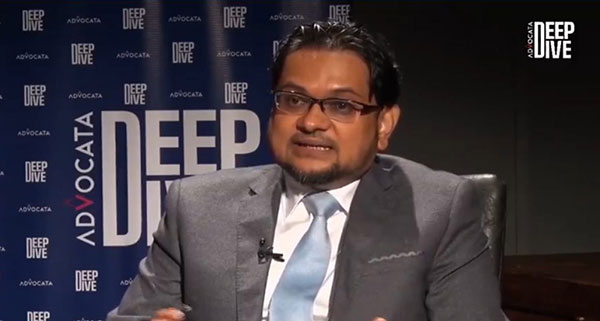
Whatever Sri Lanka decides about dealing with its debt and paying its way through the world, the country needs to formulate a very good economic analysis and a publicly-backed plan that will establishc credibility of the world in its economy going forward, Dr. Nishan De Mel, Executive Director of Verité Research said recently.
He made this remark at a virtual forum conducted by Advocata Institute on ‘How to Resolve Sri Lanka’s Debt Crisis Without Seeking Assistance from the International monetary Fund (IMF)’.
Further speaking he said:
“Such an analysis needs to be thorough and well-structured with the focus on the real economic activity and the financial conditions in the economy. That would be the first step to build credibility of the world about the Sri Lankan economy. It is actually credibility that we lack rather than foreign reserves. If we can build that credibility about us in the countries that we deal with, we may not need assistance from the IMF to resolve our liquidity issue. When such a favourable environment is created and other countries repose their trust in Sri Lanka’s economy, its sovereign credit ratings would see an upgrade and Sri Lanka would be able to raise funds at the international capital market at reasonable interest rates, The skill we need for this is to present an analysis and a plan and then demonstrate our commitment to stick to it. Our concern is whether the government has such a plan and if it does have one, why it is not publicized”.
“I am not recommending that Sri Lanka should or shouldn’t go to IMF. The central question is not that. The central question is whether we can present and adopt an analytical approach to building credibility in the relevant parties about our economy. On the other hand, in the event we decide to go to the IMF at some point, we will still have to have an analysis and a plan.”
Responding to a question on whether Sri Lanka could boost its reserves by building global confidence in that manner, he replied,” When we have a very good policy document, we will need to demonstrate that we are serious about implementing it. Not only IMF, no country would support us without a well-crafted policy document and a frank commitment to actually implement it”
“We started raising funds from the international capital market via international sovereign bonds (ISBs) in 2007-2008. Those loans boosted our reserves. Then we started repayments from 2012. Before that we had not taken that type of loans from the international capital market. As those sovereign bonds increased, our reserves also increased. Before that we had taken concessional loans from foreign countries and lending institutions at low interest rates.”
“Thus we took loans from the international capital market and repaid them maintaining our foreign reserves at stable levels. Such a situation remained in the past 3-5 years. However, that equilibrium unsettled when Sri Lanka substantially reduced its taxes in the fourth quarter of 2019. Due to this substantial change, government taxes fell by about 25%. With Covid the decline was even deeper. Even without Covid, there was the 25% decline in taxes. Our global lenders were stunned by this development as it would further increase the budget deficit making our loan repayments unsustainable. I think that they had some anxiety about it”.
“This tax subsidy was given without an analysis as to whether it would help increase the country’s GDP, government’s income or how it would affect debt dynamics etc. We think that there should have been a rationale for it, but we didn’t see any such thing from the government. At that time, Sri Lanka was on an IMF programme and they probably thought that their facility’s last tranche could not be completed as the economy would not be managed sustainably. Thus the IMF got out of the picture. Then the rating agencies downgraded Sri Lanka according to their analyses. This had an impact on us. In 2019 December, the third downgrade of Sri Lanka took place. Earlier also we had been downgraded in two instances. But the latest rating made it impossible for us to raise funds in the international capital market. This situation complicated the debt- dynamics balance which had been maintained earlier. What has happened now is; we service our loans from the reserves and we can’t refill it like before. This is how this issue actually cropped up in the first place although it is said that it happened due to Covid. Actually Covid exacerbated it as there has been no Tourism receipts. But we have been able to offset that with import restrictions that have been in place. If we didn’t have to service our foreign loans from the reserves, there would not be a crisis at this point. The fact that funds can’t be added to the reserves can be shown as the cause for the current debt crisis.”
“When there is a substantial tax policy change, can we just make an oral statement and justify it? Don’t we need an analysis as to which tax should be reduced and which one shouldn’t, in order to sustainably manage our economy? Here the reality is; when there is no analysis, there is no credibility.”
“The collapse of confidence is the main reason for our economic problem and the decline in reserves. Government says that it won’t borrow from the international capital market and that there is no need to do so. This is heard as a decision made by the government. But it is not a decision. It is a Hobson’s choice. Even if we really want to borrow, we can’t borrow at reasonable interest rates. That’s the issue.”
“Confidence could collapse not only in the absence of an economic analysis. We have gone back on our pledges made to international bodies a number of times. Sad to say that this has become a tradition. So, if we had managed the economy well in the past year, we would have been able to raise loans without help from the IMF. Now we should manage our economy well, before our reserves hit near zero levels or zero.”
“The Central Bank had a medium term debt management strategy for 10 years, and they had published a written document about it three years ago. But now it has been changed and a new strategy is not in place as yet. In the absence of one, you can’t build confidence by making oral statements. People need to have an awareness not only on inflows but also on outflows.”
“Reserves won’t hit zero this year. In 2021, reserves may reach zero sooner or at a later stage. Even if we manage to protract it. it will spill over into the next year and the next year. It will only aggravate. It won’t be resolved. The speed of going towards zero reserves could be faster or slower, but it won’t deviate from where it’s heading. International parties analyse Sri Lanka and they have not changed their analyses. But the government has often changed its policy. For example, the foreign exchange policy was changed many times. This shows that the economy is not moving as the government expects it to. Verité Research has done an economic analysis on Sri Lanka considering its economic activities, GDP, inflows, debt obligations etc. Our predictions have remained valid but the government is not taking them into account. That’s the problem.”
“The government has presented its expectations, not a plan. The difference between a gamble and a plan is analysis. Expectations are not considered as an analysis”.
“If reserves come to zero at one point, we will have to tell our creditors that we will pay only the interest and pay the principal later. We need to sort things out before we face a disorderly default. Such a situation will affect the economy even more. Our banks, our private sector won’t be able to deal with their parties in the international arena. So we need to negotiate well before such an eventuality happens and resolve the crisis in an orderly manner.”
When asked, in such a scenario could Sri Lanka negotiate with the creditors on its own, he said,” We may need help from the IMF to talk to the creditors being these are bond sales involving hundreds of people. The IMF has a service for this sort of structural help – not reserves help – in order to negotiate with creditors and arrive at an agreement. In the event of making an orderly default, help of the IMF would be needed,” Dr. Nishan De Mel said.

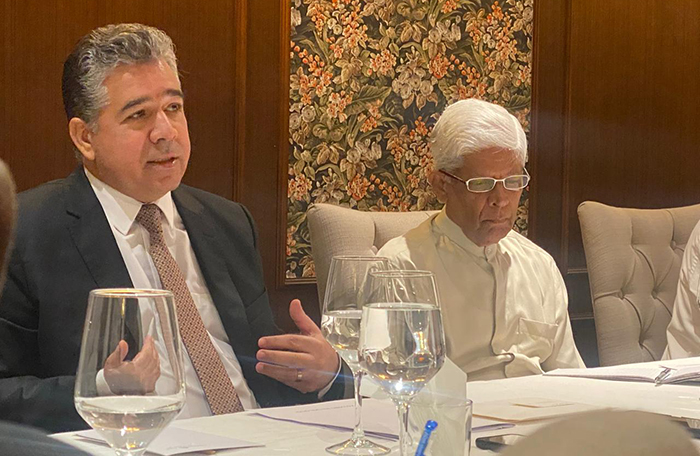
The Turkish government’s foreign policy priorities in a period of heightened global turbulence, stressing diplomacy, dialogue, and cooperation are essential tools for navigating an increasingly unstable international environment, Turkey’s Ambassador to Sri Lanka Dr. Semih Lütfü Turgut said.
‘The turbulence and uncertainty of recent years have carried forward into 2026, with unresolved conflicts, shifting power balances and declining respect for a rules-based international order, Dr. Turgut explained at a foreign policy round table conducted recently by the Pathfinder Foundation Sri Lanka at the Colombo Club, Hotel Taj Samudra. It was presided over by Pathfinder Foundation Chairman, retired Ambassador Dr. Bernard Goonatilleke.
The Turkish ambassador stressed that while geography may separate Türkiye and Sri Lanka, both countries share a common aspiration for peace, stability and sustainable development at regional and global levels and emphasised the importance of strengthening bilateral, regional and multilateral cooperation at a time when collaboration is of the utmost importance.
Dr. Turgut added: ‘International relations are increasingly shaped by differing perspectives and interpretations of geography, history, and power.
‘Conflicts in seemingly distant regions can have significant ripple effects worldwide, reinforcing the need for informed and flexible foreign policy approaches.
‘The ongoing wars in Ukraine and Gaza are defining crises of the present era.
‘These conflicts demonstrate both the limits of military power and the deep humanitarian costs of war, while also exposing a certain duplicity in the international system. The fragile nature of ceasefire efforts, particularly in Gaza, called for sustained international engagement to prevent further escalation and human suffering.
‘Of considerable note is the continued instability in the Middle East, including developments in Yemen, Iran and the Horn of Africa, as well as rising tensions in Europe and East Asia.
‘Increasing militarisation, proxy rivalries and geopolitical competition risk further erosion of global stability, while economic pressures and austerity measures could fuel political extremism in many regions.
‘Ankara’s approach is anchored in regional peace, stability, and independence. Türkiye continues efforts to mediate between Russia and Ukraine, emphasising the importance of securing the Black Sea for global food security.
‘Full membership of the European Union remains a strategic priority for Türkiye and its engagement in Central Asia through the Organization of Turkic States with its focus on economic cooperation in energy along with transport corridors is important. Diplomacy remains the most effective and least costly instrument of foreign policy, particularly at a time of resource constraints and global uncertainty.
‘The international community needs to prioritise dialogue over confrontation and should uphold the principles of sovereignty, non-interference and cooperation in the pursuit of lasting peace.’
By Hiran H Senewiratne ✍️
Business
Local entrepreneurs propose high-quality saree manufacturing in Sri Lanka to curb forex outflow

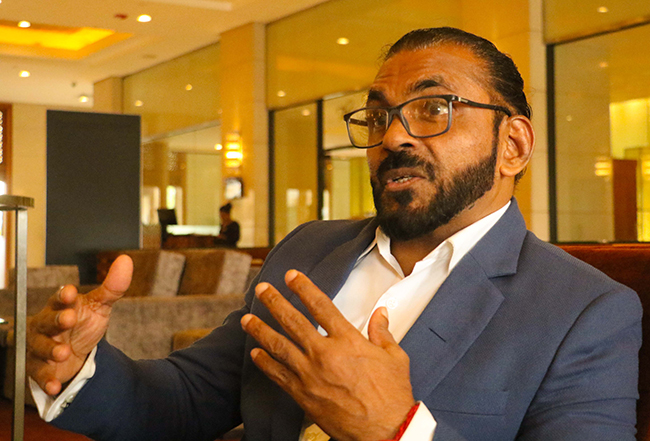
A group of local entrepreneurs is urging the government to overhaul the nation’s textile import policy, proposing a bold shift toward domestic saree manufacturing to stem the critical outflow of foreign exchange.
Sidambaram Karunanithi, a Pettah-based entrepreneur with deep roots in India and the textile trade, told The Island Financial Review that approximately 100,000 sarees are sold daily across Sri Lanka. He argued that the total reliance on Indian imports for this high-volume commodity represents an “unnecessary drain” on the country’s precarious dollar reserves.
The consortium, led by Karunanithi, has drafted a comprehensive roadmap to achieve self-sufficiency in the sector. The plan envisions the establishment of nine specialised factories – one in each province – to decentralize the industry.
“Our strategy is to import raw materials, specifically high-quality yarn, from India and conduct the entire manufacturing process locally,” Karunanithi explained. “By producing within the provinces, we eliminate significant freight costs as well as the need for regional dealers to travel to Pettah. These logistical savings will be passed directly to the end-consumer.”
The entrepreneurs intend to utilize advanced industrial multi-head systems sourced from leading Chinese manufacturers, capable of producing high-speed air-jet and jacquard weaves. Karunanithi emphasised that this technology would allow the local industry to reach a 50% value-addition threshold – more than the 35% standard often requested by the government for other sectors.
“India achieved global manufacturing status through partnerships like Hero Honda and Maruti Suzuki. There is no reason we cannot do the same with sarees. If there is a will, there is a way,” he noted.
Addressing the technical gap, the group plans to initially import skilled labor from India to facilitate a year-long technology and skills transfer. “Within 12 to 18 months, these foreign workers will be entirely replaced by a trained Sri Lankan workforce,” he said.
The proposal includes a request for the government to restrict Indian saree imports over one year to provide the necessary market protection for local startups. Karunanithi stressed that the group is not seeking concessional bank facilities, stating they are prepared to invest in private lands if state land is unavailable.
The entrepreneurs are calling for a meeting with President Anura Kumara Dissanayake and the Ministry of Industries to present their financial profiles and technical capacity.
“We urge the authorities not to make half-hearted or inconsistent policy decisions. If the country allows the manufacture of alcohol, why not sarees?” Karunanithi asked, adding that the foreign currency saved could be vital for the health and education sectors.
By Sanath Nanayakkare ✍️
Business
LOLC Holdings, PickMe and Browns EV collaborate to accelerate Sri Lanka’s transition to inclusive electric mobility
LOLC Holdings PLC has entered into a strategic mobility collaboration with PickMe, to accelerate the adoption of electric vehicles (EVs) while creating an inclusive and sustainable vehicle ownership pathway for independent ride-hailing drivers across the country. Anchored by Browns EV, the LOLC Group’s latest electric mobility venture marks a significant step towards redefining access to clean, affordable, and future-ready transportation in Sri Lanka.
At the centre of this initiative is a direct rent-to-own facility offered by LOLC to independent third- party drivers that engage with the PickMe platform. Under this model, LOLC provides Browns EV vehicles directly to these independent drivers. The programme allows the drivers to choose to operate EVs by committing to a daily rental structured by LOLC, with the full ownership transferred at the end of a six-year tenure, which is managed solely by LOLC. For the convenience of the drivers, daily rental payments are remitted through the PickMe platform’s digital interface based on driver authorization, assisting them in managing their personal financial obligations while enabling long-term asset creation.
A key milestone of the collaboration was marked with the official opening of the Browns EV Experience Centre on 09th of January 2026 at the Browns EV Showroom premises. Designed as a dedicated resource hub, for independent drivers that engage with the PickMe platform, the Centre allows these entrepreneurs to explore a variety of electric vehicle options and engage directly with LOLC representatives. At the Centre, drivers can independently evaluate LOLC ’s daily rental model, assess their individual eligibility, and complete their registration process directly with LOLC. This streamlined environment provides a one-stop location for drivers managing their own independent business growth.
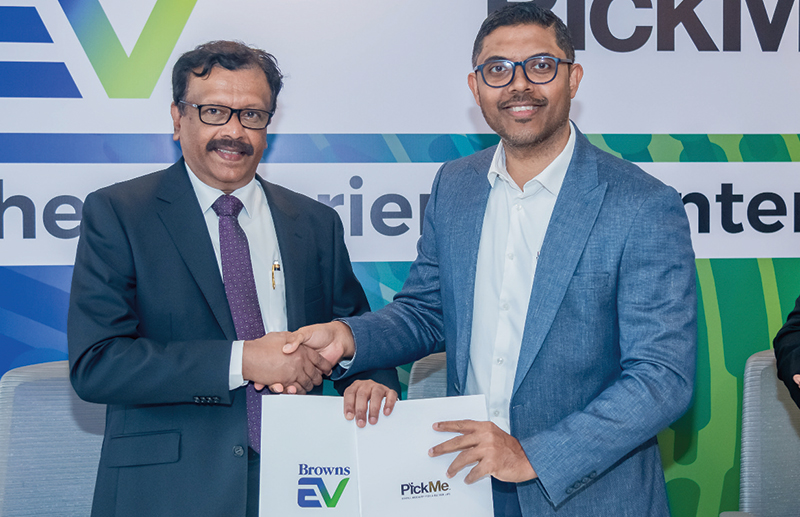
The launch event also featured the formal signing of a strategic collaboration agreement between Kapila Jayawardena, Group Managing Director/CEO of LOLC Holdings PLC, and Jiffry Zulfer, Founder and Chief Executive Officer of PickMe Sri Lanka.
Commenting on the initiative, Kapila Jayawardena stated, “At LOLC, we believe that meaningful progress is achieved by empowering people through access, opportunity, and innovation. This strategic collaboration with PickMe, supported by Browns EV, brings together financial innovation, responsible asset ownership, and affordable electric mobility to strengthen livelihoods while advancing Sri Lanka’s national sustainability priorities. Following years of import restrictions that limited access to vehicle ownership, this initiative responds directly to pent-up demand by making high-quality, future-ready electric vehicles genuinely accessible to independent entrepreneurs who depend on mobility for their livelihoods.”
Browns EV recently launched a line-up of electric vehicles positioned to expand affordable mobility across Sri Lanka. In partnership with global automotive leaders SAIC-GM-Wuling Automobile (SGMW) and Beijing Auto Works (BAW), Browns EV has introduced models designed to cater to diverse consumer and commercial segments. Wuling, the world’s second-largest EV brand, has produced over three million units globally, while Beijing Auto Works is among China’s oldest and largest automotive manufacturers. Their expertise, combined with Browns’ 150-year legacy in Sri Lanka, ensures quality, safety, and long-term value for consumers.
Drivers exploring options through the Browns EV Experience Centre can view a diverse portfolio of Browns EV models, including the BAW E6, BAW E7, BAW E7 Pro, Wuling Binguo, and Wuling Cloud.
Emphasising the synergy unlocked through the collaboration, the CEO of PickMe stated, “Collaborating with LOLC Holdings, an institution defined by scale, credibility and long-term value creation, marks a significant milestone in PickMe’s journey. Alongside Browns EV, this collaboration integrates finance, technology and sustainable mobility into a unified ecosystem. By combining PickMe’s digital platform with LOLC’s financial strength and Browns EV’s electric vehicle expertise, we are not only accelerating the adoption of clean mobility but also empowering independent mobility entrepreneurs across Sri Lanka with access, opportunity and long-term economic resilience”.
Together, the collaboration between LOLC Holdings, PickMe, and Browns EV establishes a scalable and future-focused model for electric mobility in Sri Lanka, one that seamlessly integrates financing, technology, and vehicle access within a unified ecosystem. By lowering barriers to EV adoption and facilitating long-term asset ownership for independent drivers, the initiative supports national sustainability goals while strengthening livelihoods and entrepreneurship.

PM returns to the island

Navy divers restore sluice gate of Bomburuella Reservoir

Gujarat Giants comfortably overcome sloppy UP Warriorz

After fall from grace, Asalanka aims to bat on for Sri Lanka

PM holds High-Level meetings with EU, UNDP, and corporate leadership at World Economic Forum

Trump withdraws Canada’s invite to join Board of Peace

‘Dates have the highest sugar content to fight Coronavirus’

Sunday Island 27 December – Headlines

#SundayIsland 17th December – Headlines

Sunday Island – 28th March

Sunday Island Headlines – 21 March

Sunday Island – 21st February – Headlines
-

 Editorial6 days ago
Illusory rule of law
-
 News7 days ago
UNDP’s assessment confirms widespread economic fallout from Cyclone Ditwah
-
 Editorial7 days ago
Crime and cops
-
 Features6 days ago
Daydreams on a winter’s day
-
 Features6 days ago
Surprise move of both the Minister and myself from Agriculture to Education
-

 Features5 days ago
Extended mind thesis:A Buddhist perspective
-
 Features6 days ago
The Story of Furniture in Sri Lanka
-
 Opinion4 days ago
American rulers’ hatred for Venezuela and its leaders