
News
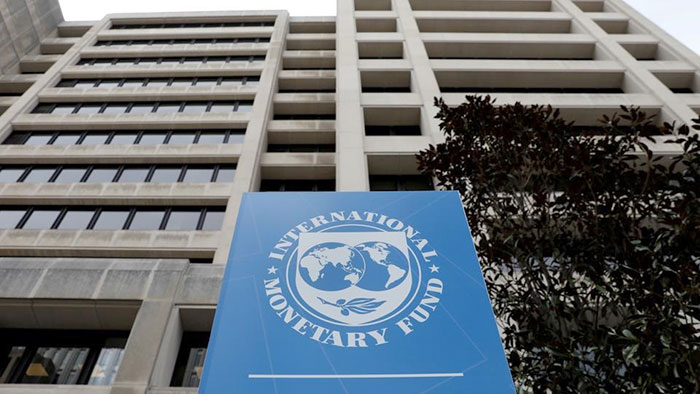
IMF extends helping hand to SL, but warns of worse crisis unless …

By Sanath Nanayakkare
The Staff-Level Agreement on an Extended Fund Facility (EFF) arrangement worth USD 2.9 billion for Sri Lanka would serve as a credible device in its negotiations with multiple creditors for receiving financing assurances to make its debt restructuring process a success, but the country had to move expeditiously with all other good-faith moves to avoid the crisis becoming worse, Peter Breuer, Senior IMF Mission Chief for Sri Lanka said in Colombo, yesterday.
“The IMF staff-level agreement is a signal from the Sri Lankan authorities of their commitment to implement comprehensive economic reforms; a package now they have committed to the IMF, which will be monitored by the IMF going forward, once the programme is in place. So, this is a credible device for Sri Lanka to show to its creditors that Sri Lanka is serious about engaging in reforms and the country is preparing the ground for economic recovery and is promoting sustainable and inclusive growth,” he said.
” The country can, in fact, refer to the IMF’s EFF programme in its discussions with its creditors because it will show them that Sri Lanka is doing everything it needs to be doing to restore its payment capacity to the international community, through this programme,” he noted.
Breur observed that Sri Lanka was in a special situation because much of its official debt is outside of the Paris Club which is a well-established process that has evolved over many years, and has routines in terms of how to deal with a situation where one sovereign defaults on its debt to other sovereigns.
“However, in the case of Sri Lanka, all of its creditors are not from the Paris Club, and therefore, one needs to think about how to deal with the rest of the debt. A common framework was put in place by the IMF during the course of the Covid crisis because it was thought there would be more defaults in situations like that, but it was limited to low-income countries and Sri Lanka, being a middle-income country, didn’t belong to that common framework. This is why Sri Lanka is a special case to some extent. So solutions appropriate to this situation need to be found. From our perspective, it’s important to move expeditiously from this point onwards. That’s the key here because we want to avoid the crisis becoming worse. So having some kind of forum is important where the debtor and creditors can discuss where the debtor can explain how it got into this situation, and what it is doing to get out of it. At such a forum, creditors would be able to listen and see how other creditors are being treated in the process of debt restructuring. That really is an important step in moving forward and we encourage that process to move forward expeditiously.”
Responding to a question from the media, the IMF said that it had prescribed Sri Lankan authorities to implement major tax reforms including higher personal Income tax and a Wealth Tax – which is generally levied from wealthy asset owners, based on the market value of their assets, minus liabilities.
IMF’s tax prescription includes broadening the tax base for corporate income tax and VAT to reach a primary surplus of 2.3 percent of GDP by 2024. The IMF highlighted the critical need for implementing and expediting major tax reforms to raise fiscal revenue to support fiscal consolidation, Sri Lanka being a country with one of the lowest revenue levels in the world. The IMF said it was looking forward to continuing their engagement in support of Sri Lanka and its people.

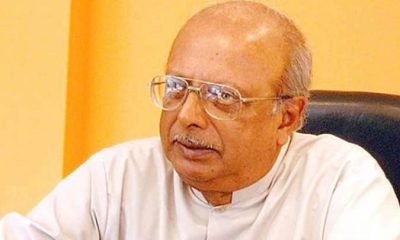

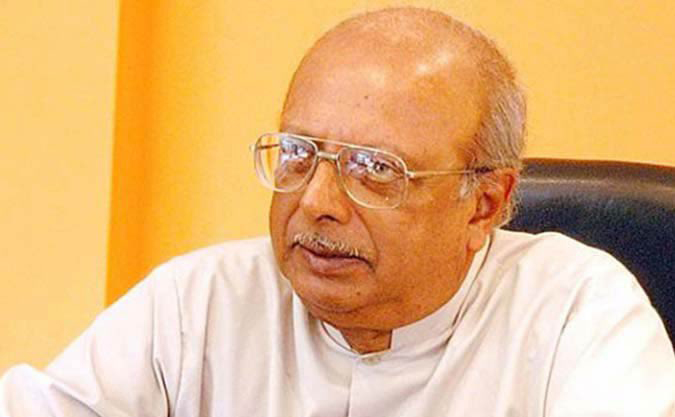
Veteran leftist politician and former Minister Professor Tissa Vitarana (92) passed away on Friday morning at his home in Kotte following a prolonged illness, bis family confirmed.Vitarana enjoyed a long and distinguished public career spanning several decades, serving as the Director of the MRI, a Member of Parliament, Cabinet Minister and Provincial Governor. The nephew (sister’s son) of Dr. NM Perera, he was the leader of the Lanka Sama Samaja Party (LSSP), one of the country’s oldest political parties.
He worked hard to keep Dr. Perera’s memory alive with annual orations as well as other left oriented activities at the NM Perera Center located in Dr. Perera’s former home in Borella.Entering active politics with the LSSP in 1974, Prof. Vitarana later emerged as a key figure within leftist political circles. Following the 2004 General Election, he was appointed to Parliament as a United People’s Freedom Alliance (UPFA) National List MP and was subsequently sworn in as Minister of Science and Technology.
He was re-appointed to Parliament via the UPFA National List after the 2010 General Election. Although he initially did not retain a Cabinet portfolio, he was appointed Minister of Technology and Research in May 2010. In November the same year, he was elevated to the position of Senior Minister of Scientific Affairs.
Prof. Vitarana lost his Cabinet portfolio following the 2015 Presidential Election. At the subsequent Parliamentary Election in 2015, he was included in the UPFA’s National List nominations but was not appointed to Parliament.
In recognition of his significant contributions to the fields of science and technology, he was conferred the prestigious Vidya Jyothi title in 2017.
On December 4, 2019, he was appointed Governor of the North Central Province and was sworn in before then President Gotabaya Rajapaksa. He served in that capacity until 2020.
Prof. Vitarana’s passing marks the end of an era in leftist politics in Sri Lanka. Funeral arrangements are yet to be announced.
His remains lay at the N. M. Perera Centre, 106 N. M. Perera Mawatha (Cotta Road) from 8 am yesterday (14). The funeral will take place at the New Crematorium, General Cemetery, Borella at 4.30 pm on Monday, February 16.
Prof. Vitarana leaves his children Menika, Ranmal, and Ranil, and brother Nihal. He was predeceased by his wife, Kamini.

Sri Lanka and Thailand have concluded negotiations on a landmark labour cooperation framework that will pave the way for the recruitment of 10,000 Sri Lankan workers under a pilot project approved by the Thai Cabinet.
The development follows a series of virtual negotiations between officials of both countries to finalise two key bilateral instruments — a Memorandum of Understanding on Labour Cooperation and an Agreement on the Employment of Sri Lankan Workers in Thailand.
The discussions were facilitated by Sri Lanka’s Embassy and Permanent Mission in Bangkok, with the participation of Ambassador and Permanent Representative Wijayanthi Edirisinghe and officials from the Ministry of Labour and the Sri Lanka Bureau of Foreign Employment (SLBFE), alongside their Thai counterparts.
According to officials, the Thai Cabinet has already granted approval to recruit 10,000 Sri Lankan workers to address labour shortages in several sectors of the Thai economy. The pilot initiative is expected to generate structured and gainful employment opportunities for Sri Lankans in fields including construction, agriculture and livestock, food and beverage, industry, educational institutions, aquatic animal processing and mining.
Following comprehensive discussions, both sides finalised the draft texts of the two agreements.
The documents will now be submitted to the respective Governments for formal approval prior to signing. The signing ceremony is expected to take place at ministerial level in the first quarter of 2026.
Officials described the conclusion of negotiations as a significant milestone in bilateral relations, noting that the framework is designed to ensure safe, orderly and regular labour mobility while safeguarding the rights and welfare of Sri Lankan workers under a transparent and regulated mechanism.
The initiative comes amid ongoing efforts by Sri Lanka to expand overseas employment opportunities and enhance foreign remittance inflows, while ensuring stronger protection for migrant workers through government-to-government arrangements.
Officials from the Digital Economy Ministry state that there are plans to provide every person in the country with High-Speed Broadband connectivity by 2029, parliament sources said on Friday.The announcement was made during a meeting of the Sectoral Oversight Committee on Science, Technology and Digital Transformation held in Parliament on February 6, chaired by MP Dr. Janaka Senarathne, where the allocation of 2026 budget provisions for the Ministry of Digital Economy and the Ministry of Science and Technology was discussed.
During the session, Dr. Hans Wijayasuriya, Senior Advisor to the President, presented details of the nationwide High-Speed Broadband programme. He confirmed that 100 new telecommunication towers will be installed this year as part of the initiative, with a total of 600 to 1,000 towers planned to meet national requirements, to be rolled out in stages.
Dr. Wijayasuriya noted that while current internet coverage stands at approximately 98%, it falls short of High-Speed Broadband standards. He emphasized that existing capacity must be increased by around 25% to ensure that every citizen, including schoolchildren, has access to high-speed internet.
He also stated that a commercial model will be developed for the telecommunication towers, allowing private sector participation through a bidding process.
The Committee additionally highlighted the importance of digital literacy initiatives in areas outside Colombo, proposing programmes to be coordinated through District Secretariat offices.
The meeting further covered the allocation of 2026 budget provisions for the Ministry of Science and Technology, with several annual and performance reports of affiliated institutions approved.The session was attended by Deputy Minister Chathuranga Abeysinghe and MPs Chandima Hettiarachchi, Lasith Bhashana Gamage, Chathura Galappaththi, Aboobucker Athambawa, and Ruwan Wijeweera.

Death of Prof. Tissa Vitarana, funeral Monday

Thailand to recruit 10,000 Lankans under new labour pact

Lanka aims for nationwide high-speed broadband by 2029

Big Brother coming?

Reconciliation: Grand Hopes or Simple Steps

Salman Faiz leads with vision and legacy

‘Dates have the highest sugar content to fight Coronavirus’

Sunday Island 27 December – Headlines

#SundayIsland 17th December – Headlines

Sunday Island – 28th March

Sunday Island Headlines – 21 March

Sunday Island – 21st February – Headlines
-

 Business4 days ago
Autodoc 360 relocates to reinforce commitment to premium auto care
-

 Midweek Review4 days ago
A question of national pride
-
 Opinion3 days ago
Will computers ever be intelligent?
-
 Midweek Review4 days ago
Theatre and Anthropocentrism in the age of Climate Emergency
-

 Editorial6 days ago
The JRJ syndrome
-
 Opinion4 days ago
The Walk for Peace in America a Sri Lankan initiative: A startling truth hidden by govt.
-
 Foreign News6 days ago
Portugal elects Socialist Party’s Seguro as president in landslide
-
 Foreign News7 days ago
Washington Post chief executive steps down after mass lay-offs