
Latest News
Imam, Masood, Rizwan and Agha fifties hand Pakistan opening-day honours

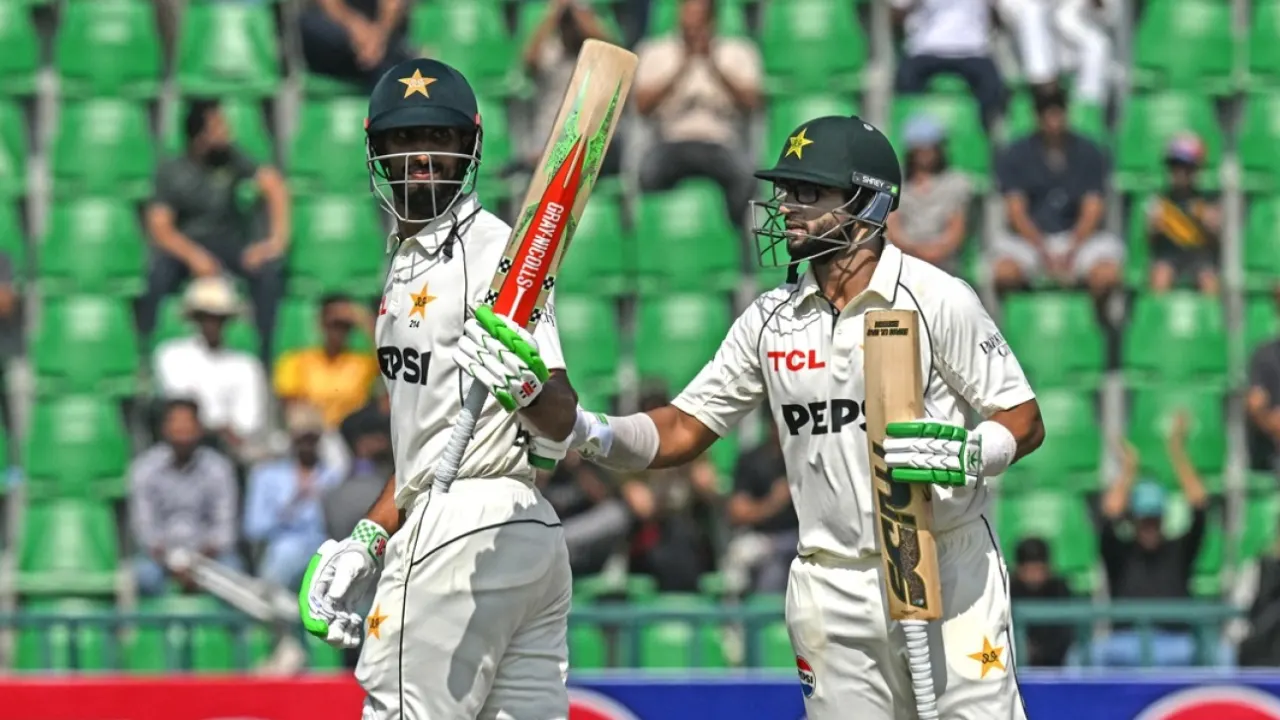
A 161-run second-wicket stand between Imam ul Haq and Shan Masood, and an undefeated 114-run sixth-wicket partnership between Mohammed Rizwan and Salman Agha bookended a strong opening day for Pakistan against South Africa, the World Test Champions. All four of Imam, Masood, Rizwan and Agha recorded fifties, with Imam falling seven short of what would have been a fourth Test hundred.
On a Lahore surface that showed signs of deterioration as early as the third session of the opening day, first-innings runs are considered crucial, and South Africa will be concerned by how many they conceded. Though they took three wickets for no run either side of the tea interval as Pakistan went from 199 for 2 to 199 for 5, South Africa could neither contain Pakistan for any length of time nor close things out. They also put down four catches which changed the complexion of the day.
Knowing conditions would be challenging and unfamiliar, South Africa opted for three spinners and two seamers in their bowling attack but it lacked international experience. Between them, the spin trio of Senuran Muthusamy, Simon Harmer and Prene;an Subraven have played just 16 Tests, but they have 422 first-class wickets, and were made to do the bulk of the work. They combined to bowl 74 overs, and took 4 for 248; enough of their deliveries gripped and turned to suggest batting will become difficult later on.
After choosing to bat, Pakistan were rocked immediately when Kagiso Rabada’s third delivery beat Abdullah Shafique’s inside edge and hit him on the back pad. Stand-in captain Aiden Markram reviewed successfully to hand the visitors their first wicket. South Africa had barely finished celebrating when Masood hit Rabada for back-to-back boundaries. Wiaan Mulder bowled just two overs before South Africa turned to spin, and Pakistan’s plan was clear. Masood hit Subrayen over his head for six to assert himself immediately.
Imam had latched on to anything too full or wide early on, used his wrists well, and played the ball late to become the dominant partner in his stand with Masood. He reached fifty off 65 balls and blunted the spin threat, especially as Harmer found turn and bounce, while also surviving a pre-lunch lbw appeal in Rabada’s second spell. Markram had reviewed again, but the impact was outside the line. Pakistan went to the break on 107 for 1.
Masood’s half-century came after lunch when he drove Harmer through mid-on, and though he was untroubled to that point, South Africa started to create chances. Masood was on 61 when Subrayen drew him forward and he inside-edged the ball on to his pad. It popped up for Tony de Zorzi at short leg, who went one-handed to his left and could not hold on. In Subrayen’s next over, Imam charged down the track and hit him aerially to mid-off, where Mulder moved to his left first and then had to readjust to his right but spilled the chance.
Subrayen was eventually rewarded, four overs later, when he beat Masood’s inside edge with a ball that didn’t turn and had him out lbw.
The Pakistan captain left to huge cheers. None of it was for his 76 though. The home crowd was celebrating the arrival of babar Azam to the crease. But they were soon stunned into silence when Babar was given out caught behind to Muthusamy, who turned the ball just past his outside edge. Babar reviewed immediately, and with no spikes on UltraEdge, the decision had to be overturned. Babar went on to inside edge Muthusamy past Kyle Verreynne for his first runs, but then found his touch with back-to-back boundaries through midwicket. He raced to 21 off his first 22 balls.
But South Africa were able to pull him back and then strike twice to end the middle session on a high. Imam inside-edged Muthusamy to de Zorzi at short leg. Saud Shakeel gave South Africa a bonus wicket when he popped a leading edge back to the bowler and leave Muthusamy on a hat-trick at the break. He didn’t complete it, but South Africa picked up a third wicket 14 balls after tea, when Harmer pinned Babar on the pad, Markram reviewed, and ball-tracking showed it would have gone to hit leg stump.
Harmer had a strong appeal for lbw against Rizwan later in the over as the ball ripped and spun in sharply, but the impact could have been outside the line. Rizwan counterattacked well, hit Muthusamy for six over long-on, and Harmer for fours through midwicket and cover. Agha seemed happy to hold his end, and was on 8 off 13 balls when he reverse-swept Harmer and the ball ended up in Verreynne’s hands, deflected in off his boots. The umpires checked for a catch, but one angle showed it had bounced off the bat and on to the turf before it made contact with Verreynne.
The chances kept coming as Rizwan, on 26, edged Muthusamy to Markram at slip. But Markram wasn’t sure whether he had taken a clean catch, and replays showed the ball died on him and bounced in front. Then, Rizwan was on 28 when he was given out lbw to Subrayen but a review showed it was missing leg stump.
Rizwan kept accumulating as South Africa wound down to the second new ball, and Markram gave himself an over before it arrived. He thought he had Rizwan, on 47, caught at leg slip but the ball had come off the batter’s arm.
Rizwan’s fifty came off the first delivery with the second new ball, which Rabada shared with Muthusamy. The new ball almost brought a breakthrough when Agha edged Muthusamy, but Verreynne initially going for the chance may have distracted Markarm at slip, who put down a simple chance.
South Africa’s day got longer when Rizwan swept Harmer powerfully to short leg, but the ball was hit so hard that it did some damage to de Zorzi’s hand as he tried to hold onto the catch. Agha’s fifty came just after that, and he took Pakistan to the close with plenty to be pleased about.
Brief scores:
Pakistan 313 for 5 in 90 overs (Imam ul Haq 93, Shan Masood 76, Babar Azam 23, Mohammed Rizwan 62*, Salman Agha 52*; Senuran Muthusamy 2-101) vs South Africa
[Cricinfo]


The Japan Premier League (JPL) T20 competition is cricket’s unlikely outpost – a self-sustaining though struggling-to-survive tournament far away from cricket’s traditional centres. It’s on a growth path just over a decade into its existence, starting to connect local players to those outside, and looking to create a cricketing community in the country.
It was founded in 2015 with four regions – North, South, East and West Kanto (Tokyo region) – in the fray, with games held at the home venues of each of the teams. That model was scrapped owing to low turnouts, and the tournament has since been played at one or the other venue, while Kansai (Osaka region) has come in as the fifth team.
In 2026, the JPL will be a three-day competition – May 2 to 4 – with 12 games at the Sano International Cricket Ground. All the buzz in the lead-up is about the participation of former Sri Lanka captain Dimuth Karunaratne, BBL winner Josh Brown, and Nepal allrounder Karan KC.
“A major goal,” Alan Curr, the Japan Cricket Association (JCA) chief operations officer, says, “is to showcase a good standard of cricket for Japanese fans so that they can really see and understand what the sport looks like.”
The challenge there is that despite being played in Japan since 1863, cricket hasn’t found a niche. There has been some systemic progress, with the formation of the JCA in the 1980s, five-year plans running up to 2032, and the presence of men and women’s leagues for juniors and seniors – including the JPL, which struggled to find traction early on.
One of the reasons for excitement recently was that a significant majority of the 15 players in Japan’s squad at the 2020 Under-19 World Cup came through the Cricket Blast, the junior participation programme. However, that’s not translated to mass acceptance or participation.

“Often, for us, cricket in itself isn’t enough to attract people to the ground,” Curr says. “We have to be creative and come up with other things – dance, music, food, drinks and Japanese commentary. But the hope is that if they see the game, it’s of a high standard because when fans see players doing special things, it’s easier to be impressed.”
When it comes to the players, not everyone is too ambitious. Those that are have rewards to aim for as the JPL can have a significant effect on selection for the national side. Having said that, those in the national side are not professionals – they are students or are employed – and use their annual leaves for international assignments. Making time can be a challenge.
“A lot of the players here play recreationally,” Curr says. “Cricket is a recreational hobby to them rather than a high-performance pursuit. For us, concentrating the talent, getting players together at once to give local players the opportunity to play at a higher standard, and going overseas and playing cricket isn’t a feasible option. [So] to be able to bring high-level cricket here is really important.”
The last bit is why Brown, especially, coming to JPL in 2024 was critical. Brown is a “pro player” – each team gets one – and will be returning for his third year in a row.
“He signed up quite a long time in advance – that year he had a breakthrough year in the Big Bash,” Curr says. “He scored 140 off 57 balls against Adelaide Strikers. We had him locked in when he did that, but we hadn’t announced it. Then his profile went up, and he started playing leagues around the world. Fair play to him, he still came.
“That year, people were pretty excited when we made that announcement, and people did come and the live-streaming certainly got up. It was the first time we had someone of genuine stature coming over and being involved.”
Other than pro players, the 14-player squads have four retained from the previous year’s teams. All of them find their teams in a draft – this year’s draft took place on March 24.

Where do these players come from, and how do they make their way? “Inside Japan is through domestic performances and trials at the start of the year for any new players,” Curr says. “The overseas talent right now comes from our own contacts as we want to make sure we get players who really understand what the tournament is about. It’s a development league; there’s no salary for these players. We just cover their costs.”
As for the future, there are different avenues for expansion. One is getting more pro players into teams, which, according to Curr, could squeeze out local players, making it a less-than-ideal option. Having more teams is more appealing, as is the prospect of having a nine-day tournament than one only over a long weekend.
“All of those things require funding. At the moment, we are relying heavily on the goodwill of people, who are happy to come out and play for no payment and out of the kindness of their heart,” Curr says. “We know that’s not sustainable. If we can get financial backing, getting a sponsor on board will really make a big difference.”
So far, cricket in Japan made news when the national team did anything of note, like qualifying for the 2020 and 2026 men’s Under 19 World Cups. If the JPL can take the next steps towards becoming bigger and better, maybe it will start attracting interest from other parts of the world in a more significant way. And that in turn could mean the next step for cricket in Japan as a whole.
[Cricinfo]
Latest News
Heat Index likely to increase up to ‘Caution level’ at some places in the Western, Sabaragamuwa, Southern, North-western, Northern and North- central provinces and in Monaragala district
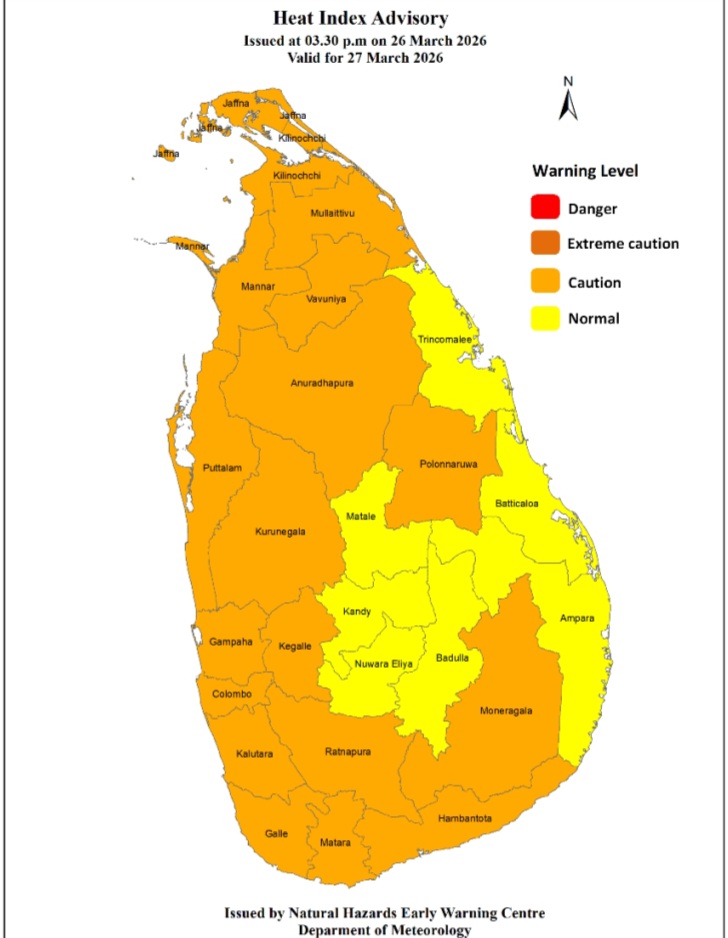
Warm Weather Advisory
Issued by the Natural Hazards Early Warning Centre of the Department of Meteorology
Issued at 3.30 p.m. on 26 March 2026, valid for 27 March 2026.
Thw Heat index, the temperature felt on human body is likely to increase up to ‘Caution level’ at some places in the Western, Sabaragamuwa, Southern, North-western, Northern and North-
central provinces and in Monaragala district.
The Heat Index Forecast is calculated by using relative humidity and maximum temperature and this is the condition that is felt on your body. This is not the forecast of maximum
temperature. It is generated by the Department of Meteorology for the next day period and prepared by using global numerical weather prediction model data.
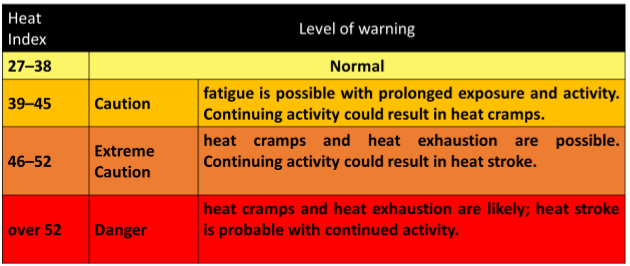
Effect of the heat index on human body is mentioned in the above table and it is prepared on the advice of the Ministry of Health and Indigenous Medical Services.
ACTION REQUIRED
Job sites: Stay hydrated and takes breaks in the shade as often as possible.
Indoors: Check up on the elderly and the sick.
Vehicles: Never leave children unattended.
Outdoors: Limit strenuous outdoor activities, find shade and stay hydrated.
Dress: Wear lightweight and white or light-colored clothing.
Note:
In addition, please refer to advisories issued by the Disaster Preparedness & Response Division, Ministry of Health in this regard as well. For further clarifications please contact 011-7446491
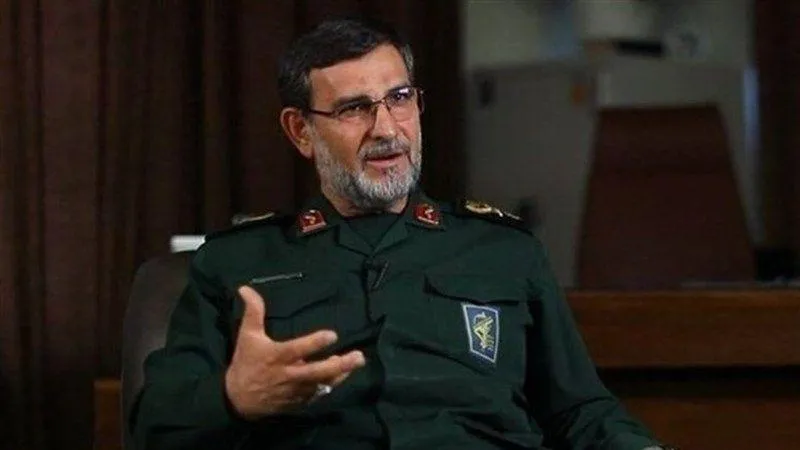
Israel says it has killed the Iranian navy chief overseeing what is a near-total blockade of the Strait of Hormuz.
Alireza Tangsiri, head of the Islamic Revolutionary Guards Corps (IRGC) navy, was “directly responsible for the terrorist act of bombing and blocking the Strait of Hormuz”, and has been “blown up”, according to Israel’s defence minister Israel Katz.
He added that a number of other “senior Navy command officials” have also been killed. Iran has not yet commented.
Since the start of the war on 28 February, Israel has assassinated several top Iranian officials, including Supreme Leader Ayatollah Ali Khamenei and security chief Ali Larijani.
Effectively blockading the Strait of Hormuz – the thin waterway between Iran, the United Arab Emirates (UAE) and Oman, through which around 20% of the world’s oil and liquefied natural gas normally passes – has been a key pillar of Iran’s strategy in the war.
Oil prices have consequently shot up, placing a direct price of the war on consumers in not only the US and Israel but across the world.
In recent weeks, an X account attributed to Tangsiri and cited by Iranian media has posted frequently about the Hormuz blockade, writing that “no vessel associated with the aggressors against Iran has the right to pass through”.
Tangsiri was appointed as the commander of the Navy in 2018, having previously served as deputy commander since 2010. In 2019, he was sanctioned by the US Treasury along with other IRGC commanders after Iran shot down a US surveillance drone near the strait.
Israeli Prime Minister Benjamin Netanyahu described Tangsiri as an individual with “a great deal of blood on his hands” and said his assassination was “yet another example of the co-operation between us and our friend, the United States, toward the common goal of achieving the objectives of the war”.
US Central Command said in a statement Tangsiri’s death “makes the region safer” and that the IRGC’s navy “is on an irreversible decline”. It also called on serving members of the IRGC to abandon their posts and return home “to avoid further risk of unnecessary injury or death”.
Israel’s military said in a statement posted on X that the head of the IRGC Navy’s intelligence directorate, Behnam Rezaei, was also “eliminated”.
(BBC)

Japan Premier League [JPL], building cricket from the ground up

Showers may occur at a few places in the Sabaragamuwa province and in Galle, Matara, Kalutara and Nuwara-Eliya districts in the evening

Energy Minister indicted on corruption charges ahead of no-faith motion against him

Over 1000 complaints of misuse of QR quotas

Fuel bowser operators demand 25% hike in haulage charges

Charge sheet issued against former NIE Director for contempt of court

‘Dates have the highest sugar content to fight Coronavirus’

Sunday Island 27 December – Headlines

#SundayIsland 17th December – Headlines

Sunday Island – 28th March

Sunday Island Headlines – 21 March

Sunday Island – 21st February – Headlines
-

 News2 days ago
Senior citizens above 70 years to receive March allowances on Thursday (26)
-

 Features4 days ago
Trincomalee oil tank farm: An engineering marvel
-

 Business1 day ago
Dialog Unveils Dialog Play Mini with Netflix and Apple TV
-

 Features4 days ago
The scientist who was finally heard
-

 News1 day ago
US dodges question on AKD’s claim SL denied permission for military aircraft to land
-

 News2 days ago
CEB Engineers warn public to be prepared for power cuts after New Year
-
 News2 days ago
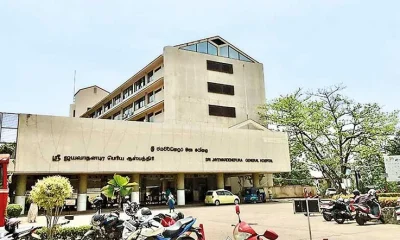
Japanese boost to Sri J’pura Hospital, an outright gift from Tokyo during JRJ rule
-

 News6 days ago
Colombo, Oslo steps up efforts to strengthen bilateral cooperation in key environmental priority areas