
Life style
Human – Elephant Conflict Is Rising in Sri Lanka

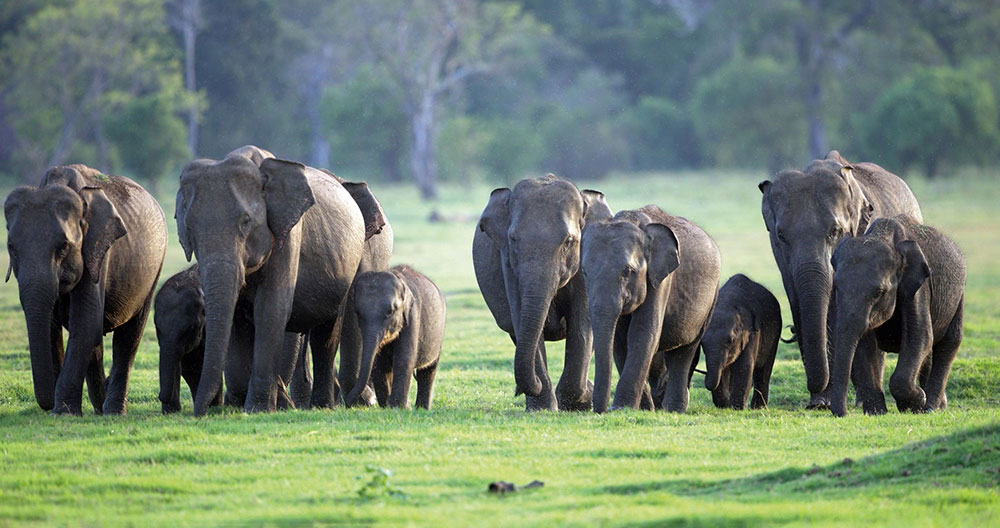
Driven from their original habitats, the animals are raiding crops and being killed by frightened farmers, but conservationists are piloting better ways to coexist
In Makulpotha village, 89 miles northwest of Colombo, Punchibanda woke up to the trumpet of an elephant while he was sleeping in a small wooden hut built on a tree beside his vegetable farm. Fearing that the elephant could destroy his harvest of pumpkins, melons and eggplants, Punchibanda rushed to chase it away. But he could not guard his produce, and instead lost his life.
The large bull elephant charged toward the 62-year-old, who fainted out of fear; the animal crushed him to death. Over a year later, villagers still live in fear as they struggle to protect their crops from wild elephants.
Historically, elephants and humans lived in harmony in Sri Lanka. When the farmers were done harvesting their fields, they would allow elephants to feed on the stubble. But deforestation, haphazard cultivation methods and massive development projects have led to increasing human-elephant conflict in the country. Sri Lanka has the highest number of elephant deaths caused by conflict with humans, and second-highest number of human deaths caused by elephants. In 2022 and 2023, over 800 elephants in Sri Lanka died.
In a bid to balance population density across the country, people have been relocated to areas with a high density of elephants. The animals are forced to live in protected wildlife parks that have limited resources. They venture into nearby villages looking for food and water, which leads to the destruction of crops, causing the farmers to employ violent methods to get rid of them.
In other instances, elephants would get aggressive and attack farmers. If you pluck someone who lives in a town and tell them to live in a village, they would not know how to coexist with the wildlife; they would carry the fear and treat them with aggression, said Zaineb Akbarally, vice president of the Wildlife and Nature Protection Society.
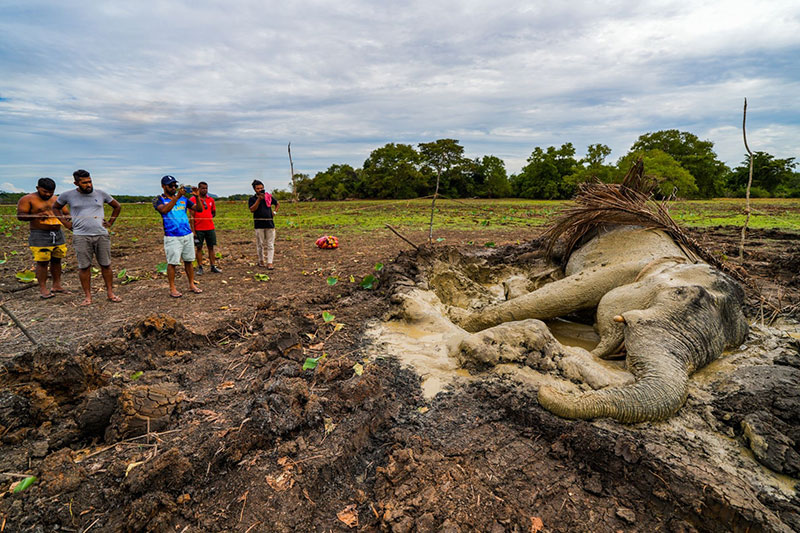
People visit a sick wild elephant in Thirappane, Anuradhapura, Sri Lanka
Sri Lanka is home to a subspecies of endangered Asian elephants and had a population of over 5,000 elephants in 2011, according to a government survey. But Akbarally doesn’t think that s an accurate number since it is difficult to count elephants in the wild, and numbers appear to have been in decline. “We’ve pretty much lost all the elephants in the central highlands,” she said, adding that only one herd remained in the Peak Wilderness nature reserve and two elephants in Sinhraja, the country s last primary rain forest, that had previously belonged to bigger herds.
Elephants have been sacred to both Hindus and Buddhists in Sri Lanka and were considered a symbol of pride to ancient rulers, who employed them in battles. To this day, domesticated elephants play a key role in Esala Perahera, an annual Buddhist cultural and religious procession, where they carry a replica of Buddha s tooth relic (the holiest religious relic for Sri Lankan Buddhists) in a casket, caprisoned in extravagant sequin-embroidered outfits accompanied by fire performers, drummers and dancers in Kandy. However, wildlife activists allege that elephants are tortured by mahouts to perform during the procession.
Elephant populations in Sri Lanka started to fall during colonial rule as the Portuguese, Dutch and then the British captured them for export. Historical records also suggest that the British killed over 5,000 elephants in 15 years as they hunted them for sport. But after independence in 1948, as infrastructure projects started getting built in the country to provide land to the landless and reduce population density, forest cover was cleared and new farmlands were created next to the elephant habitats, which laid the ground for the current conflict.
In response, local authorities started fencing elephants inside protected wildlife parks. But two-thirds of the home ranges of wild elephants, which included their feeding, watering, mating and resting sites, lay outside these parks. This also led to overcrowding, and elephants ventured into villages. Many died of starvation or became malnourished.
Currently, there are 26 national parks in Sri Lanka, and most elephants live in the large ones such as Yala, Wilpattu, Udawalawe and Minneriya. But in a 2019 survey, conservationists found out that while humans lived in 70% of these elephant ranges, only 18.4% of the elephant ranges were in those protected parks.
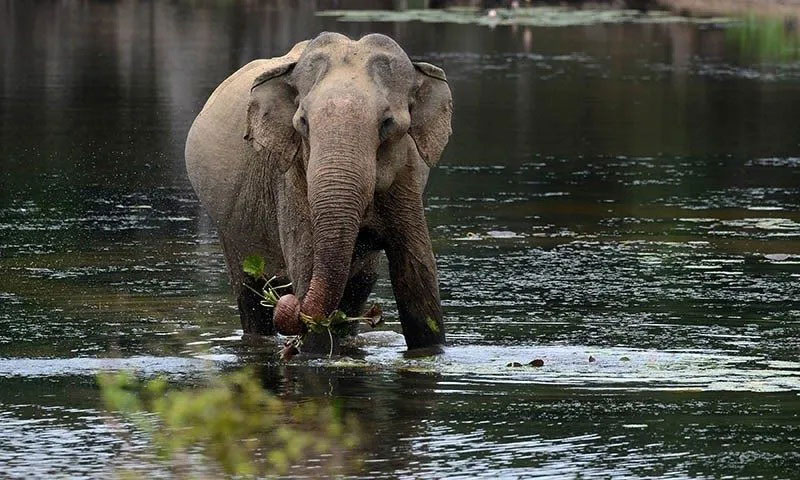
Meanwhile, farmers were growing crops like sugarcane, rice and vegetables that elephants loved to eat, so they would raid and destroy the crops and knock down houses in the process. Farmers, who are often impoverished and vulnerable, tended to retaliate by shooting at them or bursting firecrackers. Between January and April of 2023, 38 elephants were shot dead in Sri Lanka, according to the Department of Wildlife Conservation.
Villagers also use jaw bombs to drive elephants away. To make these, they pack gunpowder and metal scraps with fodder and hide them inside watermelons and pumpkins, which detonate when bitten. While these instantly kill smaller animals, they end up wounding large animals like elephants or shattering their jawbone so they can no longer eat or drink and suffer a slow, painful death with injuries. In 2022, as many as 55 wild elephants died due to this explosive bait.
Christy Nikson, 36, a farmer in Thikkodai village in eastern Sri Lanka, uses a small, low-voltage electric fence to guard his farm, but it offers little to no help now. Elephants are smart. When they see the fence, they cover it with dry wood, step on it, and come to our paddy fields, he said. For six to eight months every year, when water is scarce, Nikson and the villagers have to battle with elephants every single day. Elephants also know the smell of wheat flour. And they love it, Nikson said. When we have flour or roti in our kitchens, they try to enter from our backyards, try to break into our homes, and take the food using their trunks.
It is a very painful situation for low-income rural communities at the heart of this conflict, according to Akbarally. The crops are their bread and butter, it s their livelihood. Suddenly, animals come and destroy your livelihood. We haven’t given people a sense of security either, she said. If there s some sort of compensation when farmers lose their crops, it can at least mitigate the animals being shot and killed.
While the government did introduce an insurance scheme in 2013 to cover elephant damage to crops, farmers complained it was difficult to claim the funds or that the coverage was limited. Pritiviraj Fernando, chairman of the Centre for Conservation and Research, explained that it s challenging to verify crop loss caused by elephants. If a farmer is not happy with the compensation, they can even encourage elephants to come and eat the crops. So these programs are very difficult to implement, he said, adding that the situation leads to distrust between farmers and local authorities.
Sri Lanka s three decades of civil war also had an impact on conflict between humans and elephants. When the war was underway in the northern and eastern regions, it forced people to flee their homes and abandon their farmlands. With limited human activity, wild elephants started venturing into these areas again. However, as many people started resettling in their villages after the war ended in 2009, it worsened conflict with the elephants.
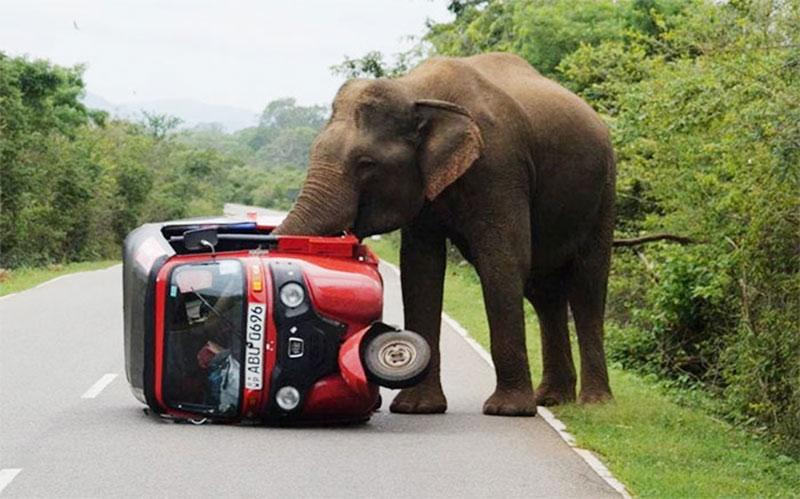
Meanwhile, over the last few decades the government’s response has been a repeat of the past, as they have forced more elephants into smaller pockets of forest cover creating unsustainable conditions. They do this through elephant drives, which involve hundreds of people walking through the forest and chasing elephants away by making different kinds of noises, firing thousands of firecrackers or shooting at the sky. Electric fences are also erected on the boundaries of these protected areas so that elephants cannot return.
Yet often these elephants do end up returning to the villages. For instance, when shrublands were cleared for the Mahaweli Development Project a program that began in the 1960s, covering 39% of the country s area, aiming to develop agricultural land and create hydroelectric power facilities the wildlife department conducted a large elephant drive to move 130 elephants into the Wilpattu National Park, but about 50 of them returned.
Over 100 ended up returning after 150 elephants were driven into the Maduru Oya National Park in 1988. While the authorities haven’t done any major drives since 2006, they conduct smaller ones when people complain. But these kinds of drives only increase the aggressiveness of elephants and subject them to severe stress, said Fernando.
While young calves and adult females live in herds, adult males lead a solitary life. And it s often these bull elephants that raid crops and cause human deaths, injuries and damage to property. Over the years, researchers have found that while elephant drives chase away some of the herds they do not drive away the aggressive, solitary males.
Later on, when the Sri Lankan government realized they could not fence wild elephants, they started building holding grounds to retain and rehabilitate them. But conservationists believe that these grounds do not hold enough food for elephants. Audit reports have also revealed mismanagement of funds allocated for feeding elephants. Out of the 65 elephants that were housed at the first holding ground in Horowpathana National Park, 16 of them died in the first six years due to malnutrition. A few were shot dead while trying to escape the grounds. Irrespective of these concerns, the government is planning to build another holding ground in southern Sri Lanka.
“Almost half of the country is now shared by elephants and humans. So it shows that the attempt to limit elephants to protected areas has completely failed and it s not an option,” said Fernando.
Looking for ways to mitigate the conflict, Fernando and his team have been testing community fencing initiatives across villages in the country. They’ve been experimenting with different kinds of electric fences to be placed around farmland to protect human habitats, as opposed to national parks which limit elephants access to sites of food and water. These fences were removed after cultivation and animals were allowed to pass through the farmlands, which, Fernando said, reduced conflict and safeguarded crops.
But small organizations can only show the way, said Fernando. Initiatives have to be planned and implemented by the government. The government has always announced plans and appointed committees but no action has been taken on the ground. Just last year, Pavithradevi Wanniarachchi, the Minister of Wildlife and Forest Resources Conservation, said that a new policy would be formed to address the conflict, but there has been no follow-up to that statement since then.
“We need to make the right policy and governance decisions,” Akbarally said. “Instead, we are creating more conflict by setting up more and more infrastructure developments, constantly cutting down forests and putting more pressure on these animals. It s not like the elephants come out and decide one day , ‘let s go to war with humans.’”
By Zinara Rathnayake
(New Lines Magazine)

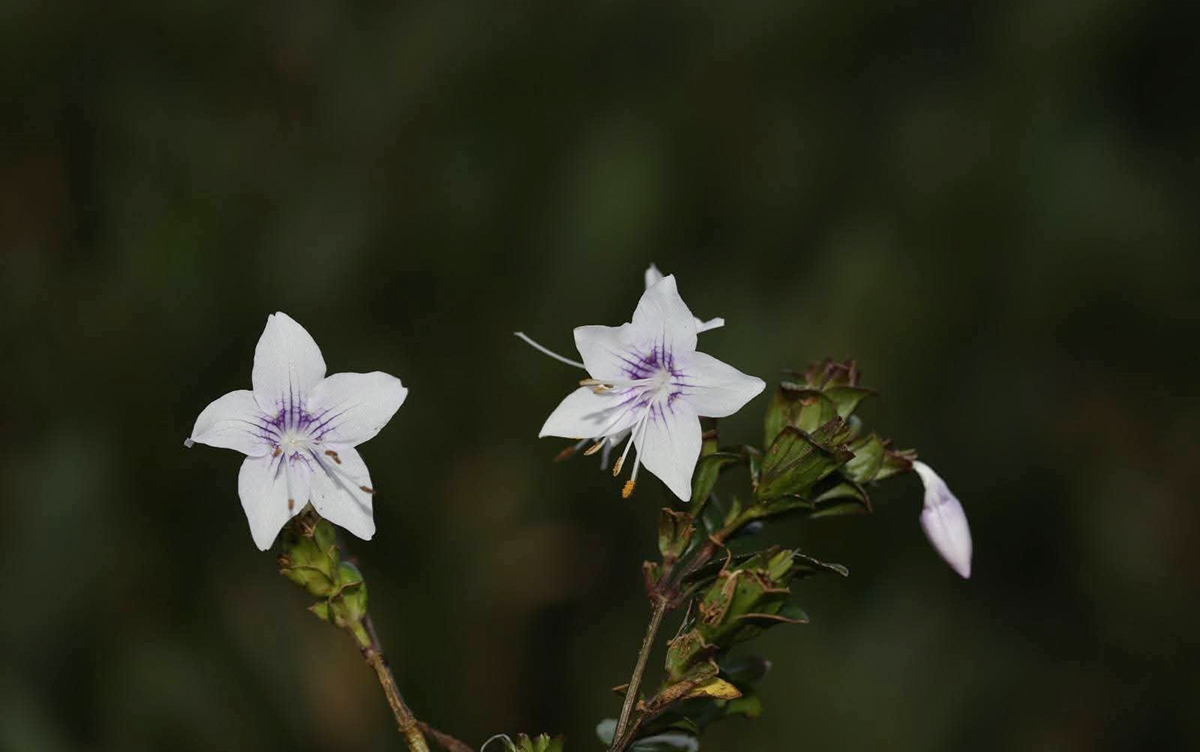
A Flower Returns From Silence:
Nearly half a century after it slipped into botanical silence, a ghost flower of Sri Lanka’s misty highlands has returned—quietly, improbably, and beautifully—from the folds of the Knuckles mountain range.
In a discovery that blends patience, intuition and sheer field grit, Strobilanthes pentandra, one of Sri Lanka’s most elusive endemic flowering plants, has been rediscovered after 48 years with no confirmed records of its existence in the wild. For decades, it lived only as a name, a drawing, and a herbarium sheet. Until now.
This rare nelu species was first introduced to science in 1995 by renowned botanist J. R. I. Wood, based solely on a specimen collected in 1978 by Kostermans from the Lebnon Estate area. Remarkably, Wood himself had never seen the plant alive. The scientific illustration that accompanied its description was drawn entirely from dried herbarium material—an act of scholarly faith in a plant already vanishing from memory.
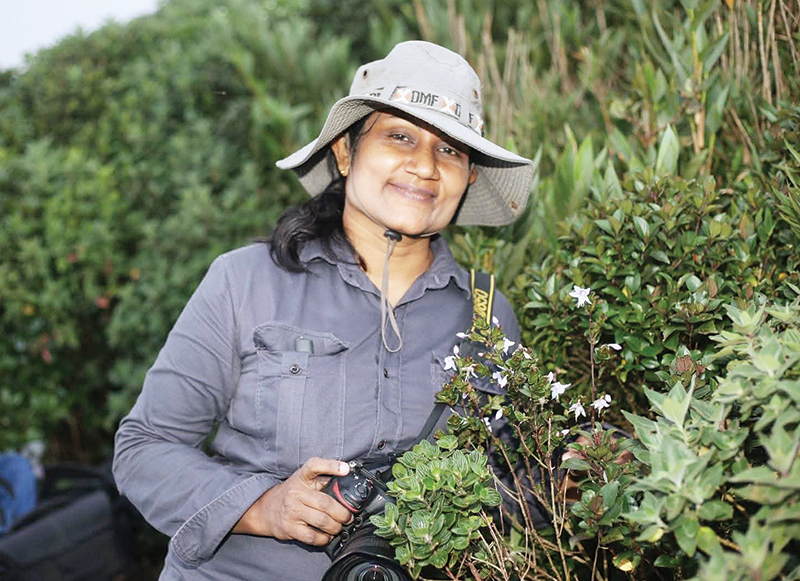
Renuka
From then on, Strobilanthes pentandra faded into obscurity. For 47 long years, there were no sightings, no photographs, no field notes. By the time Sri Lanka’s 2020 National Red List was compiled, the species had been classified as Critically Endangered, feared by many to be lost, if not extinct.
The turning point came not from a planned expedition, but from curiosity.
In October 2025, Induwara Sachinthana, a fourth-year medical student at the University of Peradeniya with a sharp eye for plants, stumbled upon an unfamiliar flowering shrub while trekking in the Knuckles region.
Sensing its importance, he photographed the plant and sent the images for verification, asking a simple but crucial question: Could this be the recently described Strobilanthes sripadensis, discovered from the Sri Pada sanctuary in 2022?
At first glance, the resemblance was striking. But something didn’t quite add up.
Based on the location, morphology, and subtle floral traits, the initial response was cautious: it was neither S. sripadensis nor S. pentandra—or perhaps something entirely new. Yet, as the pieces slowly aligned, and as the habitat details became clearer, the possibility grew stronger: this long-lost species had quietly persisted in the rugged heart of Knuckles.
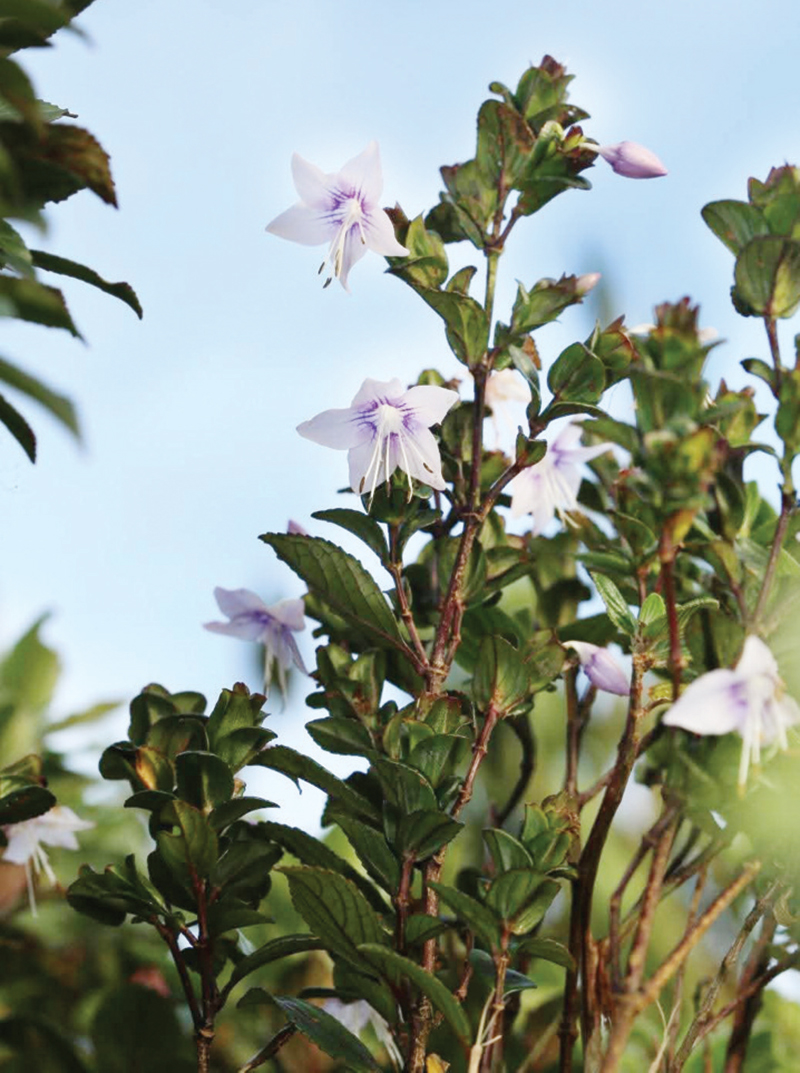
Strobilanthes pentandra
The confirmation followed through collaborative expertise. Leading Strobilanthes specialist Dr. Renuka Nilanthi Rajapakse, together with Dr. Himesh Dilruwan Jayasinghe and other researchers, carefully examined the evidence. After detailed comparison with historical descriptions and herbarium material, the verdict was clear and electrifying: this was indeed Strobilanthes pentandra.
What followed was not easy.
A challenging hike through unforgiving terrain led to the first live confirmation of the species in nearly five decades. Fresh specimens were documented and collected, breathing life into what had long been a botanical myth.
Adding further weight to the rediscovery, naturalist Aruna Wijenayaka and others subsequently recorded the same species from several additional locations within the Knuckles landscape.
The full scientific credit for this rediscovery rightfully belongs to Induwara Sachinthana, whose curiosity set the chain in motion, and to the dedicated field teams that followed through with persistence and precision.
Interestingly, the journey also resolved an important taxonomic question. Strobilanthes pentandra bears a strong resemblance to Strobilanthes sripadensis, raising early doubts about whether the Sri Pada species might have been misidentified.
Detailed analysis now confirms they are distinct species, each possessing unique diagnostic characters that separate them from each other—and from all other known nelu species in Sri Lanka. That said, as with all living systems, future taxonomic revisions remain possible. Nature, after all, is never finished telling her story.
Although the research paper is yet to be formally published, the team decided to share the news sooner than planned. With many hikers and locals already encountering the plant in Knuckles, its existence was no longer a secret. Transparency, in this case, serves conservation better than silence.
This rediscovery is more than a scientific milestone. It is a reminder of how much remains unseen in Sri Lanka’s biodiversity hotspots—and how easily such treasures can vanish without notice. It also highlights the power of collaboration across generations, disciplines and institutions.
Researchers thanked the Department of Wildlife Conservation and the Forest Department for granting research permissions, and to the many individuals who supported fieldwork in visible and invisible ways.
After 48 years in the shadows, Strobilanthes pentandra has stepped back into the light—fragile, rare, and reminding us that extinction is not always the final chapter.
Sometimes, nature waits.
By Ifham Nizam ✍️

 A conversation about intimacy, belonging and relationships with Dr Yasuni Manikkage
In an age where relationships are shaped as much by emotional awareness as by digital connection, conversations about sexual health are finally stepping out of the shadows.
As Dr. Yasuni Manikkage explains, sexual health is not just a medical issue but a lived experience woven through communication, consent, mental wellbeing and self-respect. Many couples share a home, a bed, even children, yet still feel like “Roommates with responsibilities” rather than lovers, which often signal a lack of emotional safety rather than a lack of physical contact. When desire shifts, they may panic, blame themselves or fear the relationship is dying, instead of recognising that changes in desire are common, understandable, and often transformable with knowledge, honest dialogue, and small daily acts of connection.
Q: Why did you decide to talk about sexual desire and connection now?
A: Because so many couples quietly suffer here. They love each other, share a home, raise children, but feel like “roommates with responsibilities” rather than lovers. They rarely talk about sex openly, so when desire changes, they panic, blame themselves, or assume the relationship is dying. I want people to know shifts in desire are common, understandable, and often treatable with knowledge, communication, and small daily changes.
Q: You say there is an “education gap” in sexual health. What do you mean by that?
A: Most women have never been properly taught about their own sexual anatomy, especially where and how they feel pleasure. Many men, on the other hand, have been left to “figure it out” from pornography, jokes, and guesswork. That’s a terrible training manual for real bodies and real emotions. This gap affects how easily women reach orgasm, how safe they feel in bed, and how satisfied both partners feel in the relationship.
Q: We hear about the “orgasm gap.” Is it really not biological?
A: There are biological factors, yes, but the main gap we see between men’s and women’s orgasm rates in heterosexual relationships comes from communication, knowledge, and what I call “pleasure equity.” In many bedrooms, the script is focused on penetration, speed, and the man’s climax. Women’s pleasure is often treated as optional or “extra.” When couples learn anatomy, slow down, focus on both bodies, and talk about what feels good, that gap narrows dramatically.
Q: Most people think desire should be spontaneous. Is that a myth?
A: It’s one of the biggest myths. Movies show desire as a spark that appears out of nowhere: one glance across the room and suddenly you’re tearing each other’s clothes off. That kind of spontaneous desire does happen, especially early in a relationship. But for many people, especially women, desire is often “responsive”. That means they start feeling desire after some warmth, touch, emotional closeness, or stimulation, not before.
So, if you’re waiting to “feel like it” before you touch or connect, you may wait a very long time. For many, desire comes “after” they start, not before.
Q: How would you scientifically describe sexual desire?
A: Desire is not just a physical urge. It’s a blend of attraction to your partner’s body and personality, emotional connection and feeling cared for, a sense of self-expansion or growth, learning, feeling alive with them, trust and safety, both emotionally and physically. It’s contextual: it changes with stress, health, life stages, and relationship quality. It’s relational: it lives between two nervous systems, not just in one body. And for many, it’s responsive: you get in the mood “after” a hug, a joke, a shower together, not randomly at 3 p.m. on a Tuesday.
Q: You mentioned an “updated sexual response cycle.” What does that look like in real life?
A: Older models suggested a straight line: desire, arousal, orgasm and resolution. That’s tidy, but human beings are messy and complex. Modern understanding is more like a circle or loop. You can enter the cycle at different points: maybe you start with touch, or a feeling of closeness, or even just a decision to connect. Desire doesn’t always come first; sometimes it shows up halfway through.
For example, you may feel tired and not “in the mood,” but you agree to cuddle and share some gentle touch. As you relax and feel appreciated, arousal builds, and then desire appears. That’s normal, not fake.
Q: Are there real gender differences in how desire works?
A: There are common patterns, though individuals vary a lot. Many women tend to enter through emotional intimacy: feeling heard, understood, and safe. Physical touch then wakes up arousal, and desire follows.
Many men more often start with physical attraction or arousal. They may feel desire quickly in response to visual or physical cues, and emotional intimacy can deepen later.
Both patterns are healthy and normal. The problem starts when each partner assumes the other should work exactly like them, and if they don’t, they must be “cold” “needy” or “broken.” Understanding these differences turns conflict into curiosity.
Q: How does desire change as a relationship ages?
A: Think of three broad stages.
stage 1 – Early Attraction (0-6 months): High novelty, strong chemistry, lots of dopamine. You’re discovering each other; desire often feels effortless. stage 2 – Deepening Intimacy (6 months-2 years): You know each other better. The high settles. Desire becomes more linked to emotional closeness. Frequency may drop, and that is “normal”.
stage 3 – Maintenance and Maturity (2-10+ years): Life arrives -work, kids, money, health. Desire usually doesn’t feel automatic. It needs conscious attention, novelty, and emotional safety.
A common mistake is comparing stage 3 desire to Stage 1 and assuming, “we’ve failed.” Actually, you’ve just moved into a different phase that requires new skills.
Q: What are some main things that influence desire?
A:We can think in three layers.
Biological: hormones (testosterone, estrogen), brain chemicals (dopamine, serotonin), medical conditions like diabetes, heart disease, cancer, chronic pain, sleep problems, menopause, and genital issues such as vaginal dryness or pelvic floor pain.
Psychological: negative early sexual experiences, trauma or abuse, body image concerns, low self-esteem, anxiety, depression, and certain mental health conditions.
Relational and social: how safe and respected you feel, attachment style, quality of communication, power imbalances, work and financial stress, caregiving burdens, privacy, and cultural messages that centre on penetration over pleasure. Desire is never “just in your head” or “just in your hormones” – it’s all three interacting.
Q: What tends to kill desire in long-term relationships?
A: Several patterns show up again and again:
Resentment and unresolved conflict – small hurts that never get repaired.
Lack of emotional safety – fear of being judged, rejected, or punished for being vulnerable.
Poor communication – avoiding difficult topics, sarcasm instead of honesty.
Body image shame – feeling unattractive, “too old,” “too fat,” or “not enough.”
Power imbalance -one partner controlling decisions, money, or sex.
Sexual guilt or religious shame messages that sex is dirty, selfish, or only for reproduction.
Stress, burnout, depression -when your nervous system is in survival mode, it doesn’t prioritise pleasure.
You can’t expect desire to flourish in an environment that feels unsafe, unfair, or constantly tense.
Q: And what actually builds desire?
A: Desire thrives in a combination of safety and aliveness.
Emotional intimacy: feeling seen, heard, and valued.
Nervous system calm: your body is relaxed enough to feel pleasure, not just guard against danger.
Open communication: you can talk about wants, limits, and fantasies without mocking or shutting each other down.
Continued growth: doing new things together, seeing new sides of each other, evolving as a team.
I often say: stagnation is desire’s enemy; growth is its ally. Even small adventures -trying a new cafe, dancing in the living room, travelling a different route-can reawaken curiosity.
Q: Can you give couples a simple framework to reconnect?
A: Yes, I often share a six-step framework that’s practical and gentle.
1. Check in: Ask, “How connected do we feel lately?” Not just “How often are we having sex?”
2. Non-sexual touch: Hugs, stroking hair, holding hands – without expecting sex at the end.
3. Novelty: Try something new together: a class, a walk in a different place, a game, a shared hobby.
4. Appreciation: Tell your partner what you notice and value about them, including non-sexual qualities.
5. vulnerability: Share one fear, one hope, or one truth you usually hide.
6. Initiation: Don’t wait for desire to fall from the sky. Gently invite connection; sometimes the mood follows the movement.
You don’t need to do all of this perfectly. Even one or two steps, done consistently, can shift the energy between you.
Q: How can someone tell if their desire problem needs more attention or professional help?
A: some warning signs include:
You feel emotionally distant, even though you still love each other.
Desire has dropped sharply and is tied to stress, shame, or unspoken conflict.
You feel unable to talk about sex without fighting or shutting down.
sex is used to avoid real intimacy, or to keep the peace, rather than to connect.
You feel afraid or ashamed to say what you truly want-or what you don’t want. In these situations, talking to a doctor, a sexual medicine specialist, or a therapist can be very helpful. You are not “broken” for needing support.
Q: Many couples say, “We love each other but there’s no spark.” What do you tell them?
A: I often say, “Let’s first normalise where you are.” If you’ve been together for years, maybe raising children and navigating financial pressures, it’s normal that your desire doesn’t look like the early days. That doesn’t mean your relationship is dying.
usually, you’re in the maintenance phase. Desire is quieter but can be reawakened with intentional effort: scheduling time for each other, bringing in novelty, and rebuilding emotional safety. It’s less about chasing fireworks and more about tending a fire so it doesn’t go out.
Q: what about couples with mismatched desires – one wants sex often, the other rarely?
A: This is extremely common. The mistake is to frame it as “the pursuer is demanding” and “the less-desiring partner is rejecting.” underneath, there are often two different nervous systems trying to feel safe.
one partner might use physical closeness to feel secure and loved. The other might need emotional safety first before their body can relax into physical intimacy. When couples understand this, they stop seeing each other as enemies and start cooperating: “How can we meet ‘both’ our needs, instead of arguing about who is right?”
Q: Many people, especially women, say sex feels like an obligation. What does that signal to you as a doctor?
A: It’s a red flag – not that the person is broken, but that something important is missing. sex should be about connection, pleasure, and mutual choice. when it becomes a duty, I look for:
Emotional disconnection or resentment.
Fear of conflict or abandonment if they say no.
Lack of felt safety or freedom to express preferences.
The solution is not to “force yourself more.” It is to rebuild emotional safety, renegotiate consent and expectations, and often to have very honest conversations about what feels missing or painful.
Q: If you could leave couples with a few key messages about desire and connection, what would they be?
A: I’d highlight four truths:
Desire and emotional intimacy are deeply connected. When you feel safe, loved, and seen, desire has space to grow.
Desire changes across life and relationship stages. That’s normal, not evidence of failure.
Safety is the foundation. without trust and a calm nervous system, no technique or position will fix desire.
You have agency. Through communication, intentional connection, and sometimes professional help, it is possible to revive and reshape your sexual relationship. If you are reading this and thinking, “This sounds like us,” my invitation is simple: start with one honest conversation. Ask your partner, “Where do you naturally enter the cycle -through emotions, touch, or arousal? What helps you feel desire? What do you need from me to feel safe and wanted?”
Those questions, asked with kindness and curiosity, can quietly change the entire trajectory of a relationship.

At Muslim Ladies College
The spirit of Ramadan came alive at the Muslim Ladies as the much-awaited pre-Ramadan sale “Marabha” organised by MLC PPA unfolded at SLEC the event drew students, parents and old girls to a colourful celebration filled with the aromas of traditional delicacies and the buzz of excitement from the buzzling stalls
Behind the seamless flow and refined presentation were Feroza Muzzamil and Zamani Nazeem. Whose dedication and eye for detail elevated the entire occasion. Their work reflected not only efficiency but a deep understanding of the institution’s values. It was an event, reflected teamwork, vision and a shared commitment to doing things so beautifully. The shoppers were treated to an exquisite selection of Abayas, hijabs and modern fashion essentials, carefully curated to blend contemporary trends with classic elegance. Each stall offered unique piece from intricately embroidered dresses to chic modern designs. The event also highlighted local entrepreneurs a chance to support homegrown talent. Traditional Ramazan goods and refreshment added a delighted touch, making it as much a cultural celebration as a shopping experience.
-

- Endless deals,endless possibilities
-

- Goods at reasonable prices
-
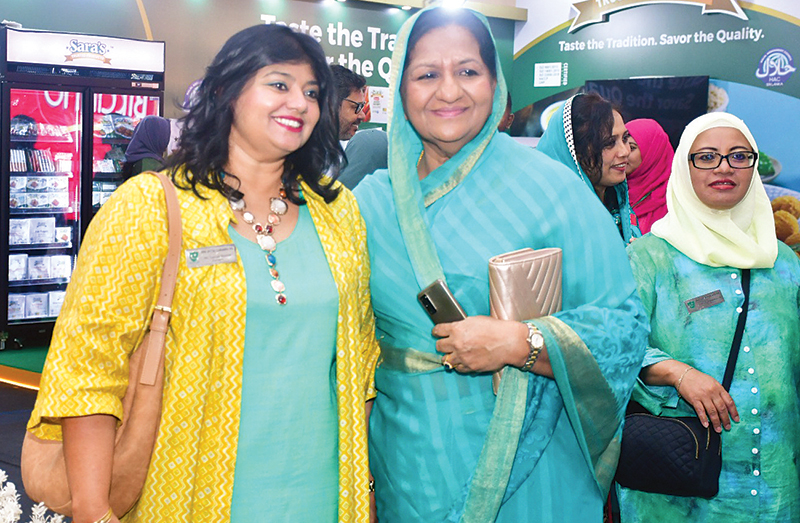
- Zamani and Feroza setting the bar high
-

 Features5 days ago
My experience in turning around the Merchant Bank of Sri Lanka (MBSL) – Episode 3
-

 Business6 days ago
Zone24x7 enters 2026 with strong momentum, reinforcing its role as an enterprise AI and automation partner
-

 Business5 days ago
Remotely conducted Business Forum in Paris attracts reputed French companies
-

 Business5 days ago
Four runs, a thousand dreams: How a small-town school bowled its way into the record books
-

 Business5 days ago
ComBank and Hayleys Mobility redefine sustainable mobility with flexible leasing solutions
-

 Business2 days ago
Autodoc 360 relocates to reinforce commitment to premium auto care
-

 Business6 days ago
HNB recognized among Top 10 Best Employers of 2025 at the EFC National Best Employer Awards
-

 Midweek Review2 days ago
A question of national pride