
Features
How universities lead transformation in global higher education


 To establish a high-quality educational institution, it is essential to create a sustainable and flexible foundation that meets contemporary educational needs while adapting to future demands. The following elements outline a robust model for a successful and reputable educational institution.
Faculty Excellence and Research Integration:
Recruit faculty members with advanced qualifications, industry experience, and a strong commitment to student development. Integrate research as a cornerstone of teaching to encourage innovation, critical inquiry, and evidence-based learning. Establish dedicated research groups and facilities, fostering a vibrant research culture led by senior academics and providing hands-on research experience for students.
Infrastructure and Learning Environment:
Develop modern, accessible campuses that accommodate diverse learning needs and provide a conducive environment for academic and extracurricular activities. Invest in state-of-the-art facilities, including libraries, laboratories, collaborative workspaces, and recreational areas to support well-rounded student development. Utilize technology-enhanced classrooms and virtual learning platforms to create dynamic and interactive learning experiences.
Global Partnerships and Multicultural Environment:
Promote partnerships with reputable international universities and organizations to provide global exposure and collaborative opportunities. Encourage student and faculty exchange programmes, joint research, and international internships, broadening perspectives and building cross-cultural competencies. Cultivate a multicultural campus environment that embraces diversity and prepares students to thrive in a globalized workforce.
Industry Engagement and Graduate Employability:
Collaborate closely with industry partners to ensure that programmes meet professional standards and graduates possess relevant, in-demand skills. Embed practical experiences, such as internships and work placements, within the academic curriculum to enhance employability. Establish a dedicated career services team to support job placement, career counselling, and networking opportunities, maintaining high graduate employment rates.
Student-Centric Support Systems and Life Skills:
Offer comprehensive student support services, including academic advising, mental health resources, and career development programmes. Provide opportunities for students to develop essential life skills such as teamwork, leadership, communication, and resilience. Promote a balanced academic and social life by fostering clubs, sports, and recreational activities that contribute to personal growth and community engagement.
Commitment to Sustainability and Social Responsibility:
Integrate sustainability into campus operations and curricula, preparing students to lead in a sustainable future. Encourage social responsibility through community engagement, service-learning projects, and ethical research initiatives. Implement eco-friendly practices across campus, from energy-efficient buildings to waste reduction, promoting environmental awareness.
Governance, Independence, and Financial Sustainability:
Establish transparent, ethical governance structures that promote accountability, inclusivity, and long-term planning. Strive for financial independence by building a sustainable revenue model that balances tuition, grants, partnerships, and philanthropic contributions. Prioritize flexibility in governance to adapt quickly to external changes while safeguarding institutional autonomy.
By emphasizing quality, inclusivity, innovation, and adaptability, an educational institution can cultivate a culture of academic excellence and social responsibility, producing well-rounded graduates who are equipped to succeed and contribute meaningfully to society. This framework provides a strategic approach to building an institution that thrives academically, socially, and economically.
Critique of the Traditional Sri Lankan University System
Outdated Curriculum and Lack of Industry Relevance:
Many traditional universities in Sri Lanka operate with rigid curricula that are slow to adapt to rapidly changing industry needs, leaving graduates underprepared for the global workforce. Syllabi are often centred around theoretical knowledge with limited focus on practical, hands-on experience, problem-solving, and critical thinking skills.
Insufficient Research and Innovation Focus:
The Sri Lankan university system places minimal emphasis on research, innovation, and practical application, which hinders the development of a strong research culture. Limited funding, resources, and incentives for faculty and students to pursue cutting-edge research reduce international visibility and publications, key factors in global rankings.
Lack of International Partnerships and Exposure:
Traditional universities have minimal collaboration with foreign institutions, limiting opportunities for student exchange programmes, collaborative research, and global internships. This lack of exposure restricts students’ cultural awareness, adaptability, and networking skills, which are essential in today’s globalized economy.
Bureaucratic Governance and Inflexibility:
Highly centralized and bureaucratic governance structures result in slow decision-making, stifling innovation and responsiveness to changing educational demands. Universities face significant limitations in introducing new programmes, hiring qualified faculty, and allocating resources, which affects their competitive edge and ability to adapt.
Underfunded Infrastructure and Resources:
The lack of adequate funding for state-of-the-art infrastructure, technological resources, and modern learning spaces reduces the quality of education and student experience. Insufficient investment in libraries, laboratories, and virtual learning tools limits access to essential resources needed to build research capabilities and attract international students.
Limited Emphasis on Student-Centric Support Services:
Support services such as career counselling, academic advising, and mental health resources are insufficiently developed in many institutions, impacting students’ overall well-being and employability. Universities often lack the means to prepare students for the workforce beyond academics, which results in graduates with high academic knowledge but limited job-ready skills.
Recommended Transformations for World-Class Standards
Curriculum Revamp with a Focus on Industry Relevance:
Shift towards an interdisciplinary, outcome-based curriculum that aligns with industry requirements and promotes experiential learning. Establish partnerships with industries to incorporate internships, co-ops, and project-based learning, providing students with practical skills. Incorporate modules on critical thinking, problem-solving, and digital literacy, which are essential for employability and adaptability.
Enhancing Research Capacity and Innovation Ecosystem:
Allocate dedicated funding for research and establish incentives for faculty and students to publish in high-impact journals. Develop specialized research centres and labs focusing on areas critical to national and global challenges, such as technology, sustainable development, and public health. Foster innovation hubs, incubators, and accelerators within universities to support entrepreneurship and collaboration with the private sector, driving societal impact and ranking potential.
International Partnerships and Global Exposure:
Form alliances with reputable international universities to offer dual degrees, joint research programs, and student and faculty exchange opportunities. Encourage academic collaborations that enable students to work on global projects, thereby enhancing cultural competence and preparing them for international careers. Create virtual exchange programs and international seminars to engage students in global conversations without extensive travel requirements.
Autonomous and Responsive Governance:
Decentralize governance to allow universities to make independent decisions on programmes, faculty hiring, and funding allocation, fostering flexibility and responsiveness. Implement performance-based accountability systems for university administrators, rewarding institutions that achieve excellence in teaching, research, and innovation. Empower universities to secure alternate funding sources through grants, industry partnerships, and philanthropic contributions, ensuring financial stability and academic independence.
Investment in Infrastructure and Digital Transformation:
Prioritize investment in modern campus facilities, advanced laboratories, and digital learning environments to provide students with a high-quality academic experience. Expand access to online learning resources, digital libraries, and virtual classrooms, offering students a more adaptable, blended learning model. Create dedicated spaces for collaborative learning and interdisciplinary activities, fostering a culture of innovation and teamwork.
Robust Student-Centric Support Systems:
Establish comprehensive support services, including career development, mental health resources, and academic advising, to help students navigate both academic and personal challenges. Introduce career-oriented training programmes focusing on employability skills, including communication, networking, and leadership, to prepare students for the workforce. Develop alumni networks and mentorship programmes, connecting students with successful graduates for career guidance and networking opportunities.
Emphasis on Sustainability and Social Responsibility:
Embed sustainability principles in campus operations, curricula, and research activities to align with global priorities and contribute to the United Nations Sustainable Development Goals (SDGs). Initiate community engagement programmes that encourage students to apply their knowledge in real-world settings, fostering social responsibility and regional development. Encourage environmental initiatives like waste reduction, energy efficiency, and green campus policies, reflecting a commitment to global best practices.
By adopting these strategies, traditional Sri Lankan universities can transform into competitive, globally recognized institutions. This shift would enable them to improve international rankings, increase graduate employability, attract a diverse student body, and contribute meaningfully to both the local and global knowledge economies.
The traditional university system in Sri Lanka, while rich in history and academic legacy, faces significant challenges in meeting the demands of the modern, globally connected world. The system requires critical reforms to enhance its alignment with international standards, improve rankings, and produce graduates ready for today’s dynamic job market. This essay discusses the shortcomings of the existing system and provides actionable recommendations to enable Sri Lankan universities to transform into globally competitive, high-ranking institutions.
(The writer, a senior Chartered Accountant and professional banker, is Professor at SLIIT University, Malabe. He is also the author of the “Doing Social Research and Publishing Results”, a Springer publication (Singapore), and “Samaja Gaveshakaya (in Sinhala). The views and opinions expressed in this article are solely those of the author and do not necessarily reflect the official policy or position of the institution he works for. He can be contacted at saliya.a@slit.lk and www.researcher.com)

(Article 04 of the 04-part series on Sri Lanka’s tourism stagnation)
If you want to understand why Sri Lanka keeps leaking value even when arrivals hit “record” numbers, stop staring at SLTDA dashboards and start talking to the people who face tourists every day: the tour guides.
They are the “unofficial ambassadors” of Sri Lankan tourism, and they are the weakest, most neglected, most dysfunctional link in a value chain we pretend is functional. Nearly 60% of tourists use guides. Of those guides, 57% are unlicensed, untrained, and invisible to the very institutions claiming to regulate quality. This is not a marginal problem. It is a systemic failure to bleed value from every visitor.
The Invisible Workforce
The May 2024 “Comprehensive Study of the Sri Lankan Tour Guides” is the first serious attempt, in decades, to map this profession. Its findings should be front-page news. They are not, because acknowledging them would require admitting how fundamentally broken the system is. The official count (April 2024): SLTDA had 4,887 licensed guides in its books:
* 1,892 National Guides (39%)
* 1,552 Chauffeur Guides (32%)
* 1,339 Area Guides (27%)
* 104 Site Guides (2%)
The actual workforce: Survey data reveals these licensed categories represent only about 75% of people actually guiding tourists. About 23% identify as “other”; a polite euphemism for unlicensed operators: three-wheeler drivers, “surf boys,” informal city guides, and touts. Adjusted for informal operators, the true guide population is approximately 6,347; 32% National, 25% Chauffeur, 16% Area, 4% Site, and 23% unlicensed.
But even this understates reality. Industry practitioners interviewed in the study believe the informal universe is larger still, with unlicensed guides dominating certain tourist hotspots and price-sensitive segments. Using both top-down (tourist arrivals × share using guides) and bottom-up (guides × trips × party size) estimates, the study calculates that approximately 700,000 tourists used guides in 2023-24, roughly one-third of arrivals. Of those 700,000 tourists, 57% were handled by unlicensed guides.
Read that again. Most tourists interacting with guides are served by people with no formal training, no regulatory oversight, no quality standards, and no accountability. These are the “ambassadors” shaping visitor perceptions, driving purchasing decisions, and determining whether tourists extend stays, return, or recommend Sri Lanka. And they are invisible to SLTDA.
The Anatomy of Workforce Failure
The guide crisis is not accidental. It is the predictable outcome of decades of policy neglect, regulatory abdication, and institutional indifference.
1. Training Collapse and Barrier to Entry Failure
Becoming a licensed National Guide theoretically requires:
* Completion of formal training programmes
* Demonstrated language proficiency
* Knowledge of history, culture, geography
* Passing competency exams
In practice, these barriers have eroded. The study reveals:
* Training infrastructure is inadequate and geographically concentrated
* Language requirements are inconsistently enforced
* Knowledge assessments are outdated and poorly calibrated
* Continuous professional development is non-existent
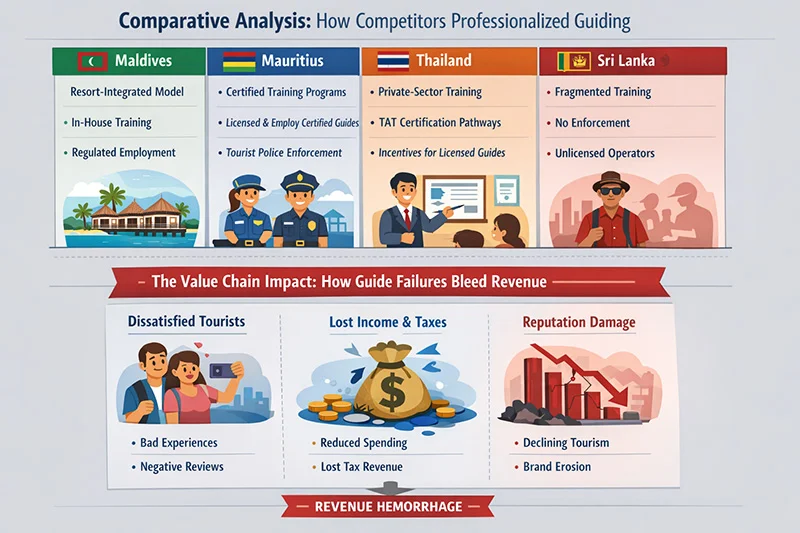
The result: even licensed guides often lack the depth of knowledge, language skills, or service standards that high-yield tourists expect. Unlicensed guides have no standards at all. Compare this to competitors. In Mauritius, tour guides undergo rigorous government-certified training with mandatory refresher courses. The Maldives’ resort model embeds guide functions within integrated hospitality operations with strict quality controls. Thailand has well-developed private-sector training ecosystems feeding into licensed guide pools.
2. Economic Precarity and Income Volatility
Tour guiding in Sri Lanka is economically unstable:
* Seasonal income volatility: High earnings in peak months (December-March), near-zero in low season (April-June, September)
* No fixed salaries: Most guides work freelance or commission-based
* Age and experience don’t guarantee income: 60% of guides are over 40, but earnings decline with age due to physical demands and market preference for younger, language-proficient guides
* Commission dependency: Guides often earn more from commissions on shopping, gem purchases, and restaurant referrals than from guiding fees
The commission-driven model pushes guides to prioritise high-commission shops over meaningful experiences, leaving tourists feeling manipulated. With low earnings and poor incentives, skilled guides exist in the profession while few new entrants join. The result is a shrinking pool of struggling licensed guides and rising numbers of opportunistic unlicensed operators.
3. Regulatory Abdication and Unlicensed Proliferation
Unlicensed guides thrive because enforcement is absent, economic incentives favour avoiding fees and taxes, and tourists cannot distinguish licensed professionals from informal operators. With SLTDA’s limited capacity reducing oversight, unregistered activity expands. Guiding becomes the frontline where regulatory failure most visibly harms tourist experience and sector revenues in Sri Lanka.
4. Male-Dominated, Ageing, Geographically Uneven Workforce
The guide workforce is:
* Heavily male-dominated: Fewer than 10% are women
* Ageing: 60% are over 40; many in their 50s and 60s
* Geographically concentrated: Clustered in Colombo, Galle, Kandy, Cultural Triangle—minimal presence in emerging destinations
This creates multiple problems:
* Gender imbalance: Limits appeal to female solo travellers and certain market segments (wellness tourism, family travel with mothers)
* Physical limitations: Older guides struggle with demanding itineraries (hiking, adventure tourism)
* Knowledge ossification: Ageing workforce with no continuous learning rehashes outdated narratives, lacks digital literacy, cannot engage younger tourist demographics
* Regional gaps: Emerging destinations (Eastern Province, Northern heritage sites) lack trained guide capacity
1. Experience Degradation Lower Spending
Unlicensed guides lack knowledge, language skills, and service training. Tourist experience degrades. When tourists feel they are being shuttled to commission shops rather than authentic experiences, they:
* Cut trips short
* Skip additional paid activities
* Leave negative reviews
* Do not return or recommend
The yield impact is direct: degraded experiences reduce spending, return rates, and word-of-mouth premium.

2. Commission Steering → Value Leakage
Guides earning more from commissions than guiding fees optimise for merchant revenue, not tourist satisfaction.
This creates leakage: tourism spending flows to merchants paying highest commissions (often with foreign ownership or imported inventory), not to highest-quality experiences.
The economic distortion is visible: gems, souvenirs, and low-quality restaurants generate guide commissions while high-quality cultural sites, local artisan cooperatives, and authentic restaurants do not. Spending flows to low-value, high-leakage channels.
3. Safety and Security Risks → Reputation Damage
Unlicensed guides have no insurance, no accountability, no emergency training. When tourists encounter problems, accidents, harassment, scams, there is no recourse. Incidents generate negative publicity, travel advisories, reputation damage. The 2024-2025 reports of tourists being attacked by wildlife at major sites (Sigiriya) with inadequate safety protocols are symptomatic. Trained, licensed guides would have emergency protocols. Unlicensed operators improvise.
4. Market Segmentation Failure → Yield Optimisation Impossible
High-yield tourists (luxury, cultural immersion, adventure) require specialised guide-deep knowledge, language proficiency, cultural sensitivity. Sri Lanka cannot reliably deliver these guides at scale because:
* Training does not produce specialists (wildlife experts, heritage scholars, wellness practitioners)
* Economic precarity drives talent out
* Unlicensed operators dominate price-sensitive segments, leaving limited licensed capacity for premium segments
We cannot move upmarket because we lack the workforce to serve premium segments. We are locked into volume-chasing low-yield markets because that is what our guide workforce can provide.
The way forward
Fixing Sri Lanka’s guide crisis demands structural reform, not symbolic gestures. A full workforce census and licensing audit must map the real guide population, identify gaps, and set an enforcement baseline. Licensing must be mandatory, timebound, and backed by inspections and penalties. Economic incentives should reward professionalism through fair wages, transparent fees, and verified registries. Training must expand nationwide with specialisations, language standards, and continuous development. Gender and age imbalances require targeted recruitment, mentorship, and diversified roles. Finally, guides must be integrated into the tourism value chain through mandatory verification, accountability measures, and performancelinked feedback.
The Uncomfortable Truth
Can Sri Lanka achieve high-value tourism with a low-quality, largely unlicensed guide workforce? The answer is NO. Unambiguously, definitively, NO. Sri Lanka’s guides shape tourist perceptions, spending, and satisfaction, yet the system treats them as expendable; poorly trained, economically insecure, and largely unregulated. With 57% of tourists relying on unlicensed guides, experience quality becomes unpredictable and revenue leaks into commission-driven channels.
High-yield markets avoid destinations with weak service standards, leaving Sri Lanka stuck in low-value, volume tourism. This is not a training problem but a structural failure requiring regulatory enforcement, viable career pathways, and a complete overhaul of incentives. Without professionalising guides, high-value tourism is unattainable. Fixing the guide crisis is the foundation for genuine sector transformation.
The choice is ours. The workforce is waiting.
This concludes the 04-part series on Sri Lanka’s tourism stagnation. The diagnosis is complete. The question now is whether policymakers have the courage to act.
For any concerns/comments contact the author at saliya.ca@gmail.com
(The writer, a senior Chartered Accountant and professional banker, is Professor at SLIIT, Malabe. The views and opinions expressed in this article are personal.)


 by Kaushalya Perera
Time has, by and large, stood still in the business of academic staff recruitment to state universities. Qualifications have proliferated and evolved to be more interdisciplinary, but our selection processes and evaluation criteria are unchanged since at least the late 1990s. But before I delve into the problems, I will describe the existing processes and schemes of recruitment. The discussion is limited to UGC-governed state universities (and does not include recruitment to medical and engineering sectors) though the problems may be relevant to other higher education institutions (HEIs).
How recruitment happens currently in SL state universities
Academic ranks in Sri Lankan state universities can be divided into three tiers (subdivisions are not discussed).
* Lecturer (Probationary)
– recruited with a four-year undergraduate degree. A tiny step higher is the Lecturer (Unconfirmed), recruited with a postgraduate degree but no teaching experience.
* A Senior Lecturer can be recruited with certain postgraduate qualifications and some number of years of teaching and research.
* Above this is the professor (of four types), which can be left out of this discussion since only one of those (Chair Professor) is by application.
State universities cannot hire permanent academic staff as and when they wish. Prior to advertising a vacancy, approval to recruit is obtained through a mind-numbing and time-consuming process (months!) ending at the Department of Management Services. The call for applications must list all ranks up to Senior Lecturer. All eligible candidates for Probationary to Senior Lecturer are interviewed, e.g., if a Department wants someone with a doctoral degree, they must still advertise for and interview candidates for all ranks, not only candidates with a doctoral degree. In the evaluation criteria, the first degree is more important than the doctoral degree (more on this strange phenomenon later). All of this is only possible when universities are not under a ‘hiring freeze’, which governments declare regularly and generally lasts several years.
Problem type 1
– Archaic processes and evaluation criteria
Twenty-five years ago, as a probationary lecturer with a first degree, I was a typical hire. We would be recruited, work some years and obtain postgraduate degrees (ideally using the privilege of paid study leave to attend a reputed university in the first world). State universities are primarily undergraduate teaching spaces, and when doctoral degrees were scarce, hiring probationary lecturers may have been a practical solution. The path to a higher degree was through the academic job. Now, due to availability of candidates with postgraduate qualifications and the problems of retaining academics who find foreign postgraduate opportunities, preference for candidates applying with a postgraduate qualification is growing. The evaluation scheme, however, prioritises the first degree over the candidate’s postgraduate education. Were I to apply to a Faculty of Education, despite a PhD on language teaching and research in education, I may not even be interviewed since my undergraduate degree is not in education. The ‘first degree first’ phenomenon shows that universities essentially ignore the intellectual development of a person beyond their early twenties. It also ignores the breadth of disciplines and their overlap with other fields.
This can be helped (not solved) by a simple fix, which can also reduce brain drain: give precedence to the doctoral degree in the required field, regardless of the candidate’s first degree, effected by a UGC circular. The suggestion is not fool-proof. It is a first step, and offered with the understanding that any selection process, however well the evaluation criteria are articulated, will be beset by multiple issues, including that of bias. Like other Sri Lankan institutions, universities, too, have tribal tendencies, surfacing in the form of a preference for one’s own alumni. Nevertheless, there are other problems that are, arguably, more pressing as I discuss next. In relation to the evaluation criteria, a problem is the narrow interpretation of any regulation, e.g., deciding the degree’s suitability based on the title rather than considering courses in the transcript. Despite rhetoric promoting internationalising and inter-disciplinarity, decision-making administrative and academic bodies have very literal expectations of candidates’ qualifications, e.g., a candidate with knowledge of digital literacy should show this through the title of the degree!
Problem type 2 – The mess of badly regulated higher education
A direct consequence of the contemporary expansion of higher education is a large number of applicants with myriad qualifications. The diversity of degree programmes cited makes the responsibility of selecting a suitable candidate for the job a challenging but very important one. After all, the job is for life – it is very difficult to fire a permanent employer in the state sector.
Widely varying undergraduate degree programmes.
At present, Sri Lankan undergraduates bring qualifications (at times more than one) from multiple types of higher education institutions: a degree from a UGC-affiliated state university, a state university external to the UGC, a state institution that is not a university, a foreign university, or a private HEI aka ‘private university’. It could be a degree received by attending on-site, in Sri Lanka or abroad. It could be from a private HEI’s affiliated foreign university or an external degree from a state university or an online only degree from a private HEI that is ‘UGC-approved’ or ‘Ministry of Education approved’, i.e., never studied in a university setting. Needless to say, the diversity (and their differences in quality) are dizzying. Unfortunately, under the evaluation scheme all degrees ‘recognised’ by the UGC are assigned the same marks. The same goes for the candidates’ merits or distinctions, first classes, etc., regardless of how difficult or easy the degree programme may be and even when capabilities, exposure, input, etc are obviously different.
Similar issues are faced when we consider postgraduate qualifications, though to a lesser degree. In my discipline(s), at least, a postgraduate degree obtained on-site from a first-world university is preferable to one from a local university (which usually have weekend or evening classes similar to part-time study) or online from a foreign university. Elitist this may be, but even the best local postgraduate degrees cannot provide the experience and intellectual growth gained by being in a university that gives you access to six million books and teaching and supervision by internationally-recognised scholars. Unfortunately, in the evaluation schemes for recruitment, the worst postgraduate qualification you know of will receive the same marks as one from NUS, Harvard or Leiden.
The problem is clear but what about a solution?
Recruitment to state universities needs to change to meet contemporary needs. We need evaluation criteria that allows us to get rid of the dross as well as a more sophisticated institutional understanding of using them. Recruitment is key if we want our institutions (and our country) to progress. I reiterate here the recommendations proposed in ‘Considerations for Higher Education Reform’ circulated previously by Kuppi Collective:
* Change bond regulations to be more just, in order to retain better qualified academics.
* Update the schemes of recruitment to reflect present-day realities of inter-disciplinary and multi-disciplinary training in order to recruit suitably qualified candidates.
* Ensure recruitment processes are made transparent by university administrations.
Kaushalya Perera is a senior lecturer at the University of Colombo.
(Kuppi is a politics and pedagogy happening on the margins of the lecture hall that parodies, subverts, and simultaneously reaffirms social hierarchies.)

 This week, too, the spotlight is on an outfit that has gained popularity, mainly through social media.
Last week we had MISTER Band in our scene, and on 10th February, Yellow Beatz – both social media favourites.
Talento is a seven-piece band that plays all types of music, from the ‘60s to the modern tracks of today.
The band has reached many heights, since its inception in 2012, and has gained recognition as a leading wedding and dance band in the scene here.
The members that makeup the outfit have a solid musical background, which comes through years of hard work and dedication
Their portfolio of music contains a mix of both western and eastern songs and are carefully selected, they say, to match the requirements of the intended audience, occasion, or event.
Although the baila is a specialty, which is inherent to this group, that originates from Moratuwa, their repertoire is made up of a vast collection of love, classic, oldies and modern-day hits.
The musicians, who make up Talento, are:
Prabuddha Geetharuchi:

Geilee Fonseka: Dynamic and charismatic vocalist

Prabuddha Geetharuchi: The main man behind the band Talento
(Vocalist/ Frontman). He is an avid music enthusiast and was mentored by a lot of famous musicians, and trainers, since he was a child. Growing up with them influenced him to take on western songs, as well as other music styles. A Peterite, he is the main man behind the band Talento and is a versatile singer/entertainer who never fails to get the crowd going.
Geilee Fonseka (Vocals):
A dynamic and charismatic vocalist whose vibrant stage presence, and powerful voice, bring a fresh spark to every performance. Young, energetic, and musically refined, she is an artiste who effortlessly blends passion with precision – captivating audiences from the very first note. Blessed with an immense vocal range, Geilee is a truly versatile singer, confidently delivering Western and Eastern music across multiple languages and genres.
Chandana Perera (Drummer):
His expertise and exceptional skills have earned him recognition as one of the finest acoustic drummers in Sri Lanka. With over 40 tours under his belt, Chandana has demonstrated his dedication and passion for music, embodying the essential role of a drummer as the heartbeat of any band.
Harsha Soysa:
(Bassist/Vocalist). He a chorister of the western choir of St. Sebastian’s College, Moratuwa, who began his musical education under famous voice trainers, as well as bass guitar trainers in Sri Lanka. He has also performed at events overseas. He acts as the second singer of the band
Udara Jayakody:
(Keyboardist). He is also a qualified pianist, adding technical flavour to Talento’s music. His singing and harmonising skills are an extra asset to the band. From his childhood he has been a part of a number of orchestras as a pianist. He has also previously performed with several famous western bands.
Aruna Madushanka:
(Saxophonist). His proficiciency in playing various instruments, including the saxophone, soprano saxophone, and western flute, showcases his versatility as a musician, and his musical repertoire is further enhanced by his remarkable singing ability.
Prashan Pramuditha:
(Lead guitar). He has the ability to play different styles, both oriental and western music, and he also creates unique tones and patterns with the guitar..

Cabinet nod to accept Japanese government grant of 08 used low floorboard buses

Payment of the financial subsidy for fertilizer to farmers cultivating paddy lands for the Yala season 2026.

Ministerial Committee appointed to submit recommendations on proposed program to mitigate loss of crops to wild animals

New Zealand elect to bowl first at Eden Gardens

Cabinet approves import of Maize to meet shortfall

Cabinet nod for the removal of Cess tax imposed on imported good

‘Dates have the highest sugar content to fight Coronavirus’

Sunday Island 27 December – Headlines

#SundayIsland 17th December – Headlines

Sunday Island – 28th March

Sunday Island Headlines – 21 March

Sunday Island – 21st February – Headlines
-

 Features3 days ago
Brilliant Navy officer no more
-

 Opinion6 days ago
Jamming and re-setting the world: What is the role of Donald Trump?
-
 Features6 days ago
An innocent bystander or a passive onlooker?
-

 Features7 days ago
Ratmalana Airport: The Truth, The Whole Truth, And Nothing But The Truth
-

 Opinion3 days ago
Sri Lanka – world’s worst facilities for cricket fans
-
 Business7 days ago
IRCSL transforms Sri Lanka’s insurance industry with first-ever Centralized Insurance Data Repository
-

 Business6 days ago
An efficacious strategy to boost exports of Sri Lanka in medium term
-
 Features4 days ago
Overseas visits to drum up foreign assistance for Sri Lanka