
Business
How the University of Peradeniya has weathered the politico-economic storms of the decades

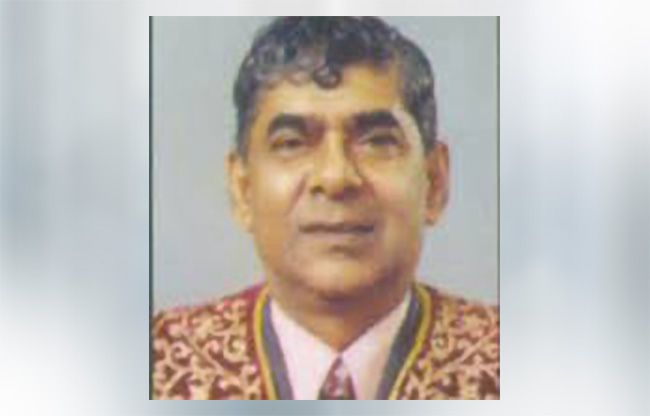
Extracts from the speech delivered by one of Sri Lanka’s most eminent historians, Emeritus Professor W.I. Siriweera, on being conferred the Degree of the Doctor of Letters by the University of Peradeniya at its convocation of August 22nd, 2024.
Peradeniya University began in 1952 when sections of the old University College in Colombo including the Faculties of Law, Arts, Oriental Studies, Agriculture and Veterinary Science were shifted there with around 1200 students. They were accommodated in five Halls of Residence: Jayatilake, Arunachalam, Marrs, James Peiris and Hilda Obeysekara. Halls of Residence have proliferated subsequently and according to the UGC statistics the internal student population at Peradeniya in 2022 was 15108. Student profile has also changed substantially. The sex ratio of the Arts Faculty in 1960 was 56.5 per cent males and 43.5 per cent females. This has changed over the years and in 2008/2009 the approximate percentage of females has increased to 79 per cent and by 2022 to 81 per cent. The percentage of girls in Agriculture, Dental Sciences, Veterinary Science and Allied Health Sciences is also relatively high.
In student politics, the traditional left was powerfully represented in the campus until late 1960’s. The Fourth International Trotskyites dominated the scene while there were quite a few Moscow wing or Peking wing communists. They agitated against and highlighted global events. For example, in June 1960, the untimely demise of the African leader Patrice Lumumba was sufficient reason for the anti-imperialist, anti bourgeois, socialist to the core intellectuals in training, to march to Kandy in a massive procession to let the people of Kandy know of the great injustices perpetrated by the imperialists on the people of Africa.
It was a long procession carrying placards and banners with strong anti-imperialist slogans. We were crying out slogans asking the Imperialists to go home. But we did not know who these Imperialists were or where they were. Those who did not know the slogans cried out whatever that came to their mind: even the titles of popular Indian films at the time.
By 1968/69 all other Marxist or leftist groups were overtaken by the Janatha Vimukthi Peramuna and also later by its offshoot: the Peratugami Samajavadi Pakshaya. These two groups have dominated student politics up to now. Unlike the earlier left-wing politicians, they have focused attention on local problems within a Marxist framework. Agitations against student suppression, against limited financial allocations, against efforts to privatize education have been their main concerns.
Food culture in Halls of Residence has also changed considerably since the beginning of the university. Professor Halpe, one of the first undergraduates has stated that “life was luxurious”. According to him food served in the Halls of Residence was better than home cooked ones.
Campus meals in 1950’s and 1960’s were of a high standard. For breakfast, toast and eggs or boiled chick peas were served. Those who did not like eggs, got a sizeable chunk of Kraft cheddar cheese. For lunch, rice and curry with beef or fish with several vegetables were served. Dinner was varied with fish or beef alternated with western food like vegetable soup, beef steaks with mashed potatoes and bread. Dessert followed both lunch and dinner.
However, as everything else, food situation too has gradually deteriorated over the years. By early 1970’s serving meals at the dining tables was discontinued and students had to queue up with their meal tickets to be served at the food counters. Even this practice was stopped in the early eighties and since then undergraduates, academic staff living in Halls of Residence and sub-wardens purchase meals from canteens or prepare their meals in rooms.
Drama activities were at their best in mid nineteen fifties and early nineteen sixties. Professor E.F.C. Ludowyk had played a key role in this development. He had persuaded the university authorities to hire Jubal, an East European, on contract basis to promote Western drama. About the same period, professor Sarathchandra was instrumental in establishing the Open Air Theatre with the surrounding terraces.
His dramas such as Maname and Sinhabahu mesmerized the crowds in that balmy atmosphere. In the case of reviving Tamil folk theatrical traditions, professor Vidyanandan played a key role.
After mid nineteen sixties, Golden era of Peradeniya university came to an end. Cultural as well as academic activities declined. But the university has been resilient in trying circumstances and has faced up to challenges and realities of the time. Amidst changes, the university has survived with some of its spirit intact.
It is up to the academic staff, students and administrators to retain its spirit irrespective of the vicissitudes of the campus environment and campus life.

By Ifham Nizam
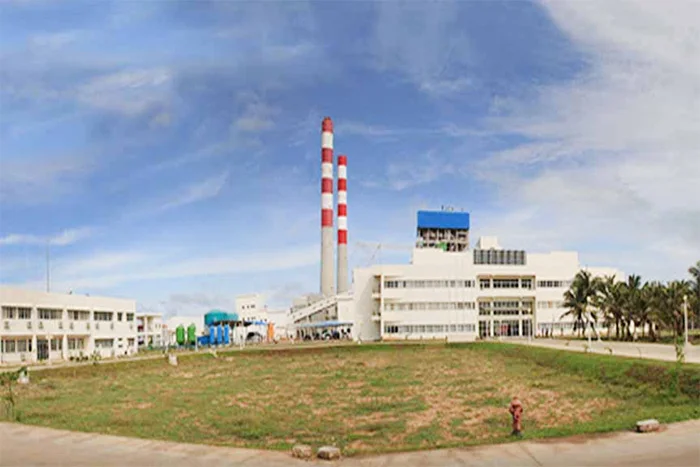
A Rs.160 million-plus diesel discrepancy at the Lakvijaya power plant in Norochcholai has triggered an internal investigation, raising questions over the handling of public funds and the controls governing fuel purchased for electricity generation.
The discrepancy surfaced during an internal audit of diesel supplied to the plant from the Kolonnawa and Sapugaskanda fuel terminals, according to senior officials familiar with the inquiry.
The audit has identified five transactions—two in December 2025 and three in January 2026—in which diesel recorded as delivered to the plant allegedly could not be fully accounted for in its physical stocks.
The investigation is now examining whether these were isolated discrepancies or part of a longer-running practice.
One transaction under scrutiny relates to January 16, when records reportedly showed that 10 diesel bowsers had arrived at the plant. Investigators subsequently found indications that the fuel stock corresponded to only nine bowsers.
A storekeeper responsible for the relevant fuel operation has reportedly been temporarily removed from those duties pending the investigation.
A senior official said investigators were reviewing historical records amid indications that similar discrepancies may have occurred over a longer period. If established, the financial exposure could therefore exceed the Rs.160 million currently identified.
The investigation is comparing fuel-terminal dispatch records, tanker movements, plant-entry records, receiving documents and physical stocks to establish exactly how much fuel was dispatched, received and accounted for.
That audit trail will also be critical in determining who authorised, received and certified the disputed consignments, and whether established controls were followed.
Relevant documents were reportedly transferred from Norochcholai to the company’s Colombo head office on September 26 for further examination, with electricity-sector security personnel assisting in the transfer.
The internal audit has also reportedly uncovered expired chemical stocks worth several hundred thousand rupees in the plant’s stores. Investigators are examining whether further inventory-management irregularities occurred.
The matter was also reportedly taken to the Puttalam Police Special Crimes Investigation Unit on September 26.
When contacted by Puttalam-based journalist Hiran Priyankara Jayasinghe for The Island Financial Review, Lakvijaya Power Plant Manager Nalaka Kumara confirmed that an investigation was under way but declined to provide further details.
The financial issue is direct: if the plant paid for diesel it did not receive, public-sector funds were spent without the electricity sector receiving the corresponding fuel.
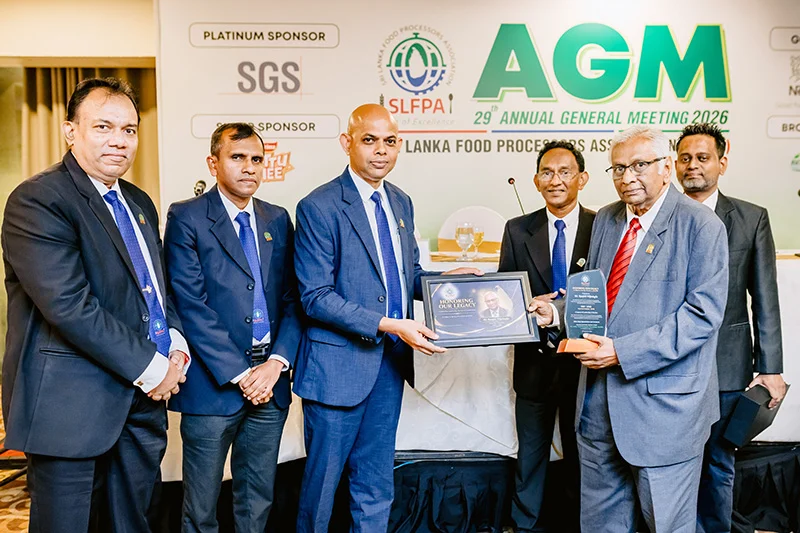
The Sri Lanka Food Processors Association (SLFPA) successfully convened its 29th Annual General Meeting (AGM) on September 23, 2026, at the Water’s Edge Hotel, Battaramulla. Bringing together key industry stakeholders and member organizations, the event served as a platform to review milestone achievements from the 2025/2026 term and outline strategic priorities for the nation’s food and beverage processing sector.
At the AGM, the new Executive Committee for 2027/2028 was appointed, comprising: Honorary President Aruna Senanayake C.W. Mackie PLC Imme. Past President Thusith Wijesinghe Trans Continental Packaging & Commodities (Pvt) Ltd.
President Elect Nadishan Guruge Meadlee Trading Co. (Pvt) Ltd.
1st Vice President Damitha Perera Forbes & Walkers Commodity Brockers (Pvt) Ltd.
2nd Vice President Rasika Seneviratne Diesel & Motor Engineering PLC 3rd Vice President Deepal De Alwis Neochem International (Pvt) Ltd.
Honorary Secretary Amila Weerasinghe Nestle Lanka Limited.
Asst. SecretaryDineth Alahakoon Country Style Foods (Pvt) Ltd.
Honorary Treasurer Sameera Jayathilaka Westmann Engineering Company (Pvt) Ltd.
Asst. Treasurer Niroshan Dalpethado C D De Fonseka & Sons (Pvt) Limited. In addition to the above office bearers, the following ten Executive Committee Members were appointed:
Sanjeewa De Silva Unilever Sri Lanka Limited Sheran De Alwis MA’S Tropical Food Processing (Pvt) Limited
Thusitha Ekanayake Anods Cocoa (Pvt) Ltd.
Vijitha Govinna Plenty Foods (Pvt) Limited Ms. Praharshi Wickramasekara International Commodity Exports (Pvt) Ltd.
Sanjeewa Niroshan SGS Lanka (Pvt) Ltd. Kushan Amarasinghe Finagle Lanka (Pvt) Ltd.
Rangajeewa Hettiarrachchi Fonterra Brands Lanka (Pvt) Ltd.
Harindra Abeyrathna Vision Technologies International (Pvt) Ltd. Thilina Weerasekara Ceylon Cold Stores PLC
The event was proudly supported by key industry partners, with SGS Lanka (Pvt) Ltd serving as the Platinum Sponsor. Unilever Sri Lanka Ltd. and Nestlé Lanka Ltd. joined as Gold Sponsors, Ceylon Agro Industries – Prima as the Silver Sponsor, while Lanka Exhibition & Conference Services (LECS) and Hero Nature Products (Pvt) Ltd., supported as Bronze Sponsors.
The proceedings concluded with a vote of thanks delivered by Hony. Secretary Deepal De Alwis, followed by cocktails and a fellowship networking session, providing an opportunity for members to connect and strengthen industry ties.
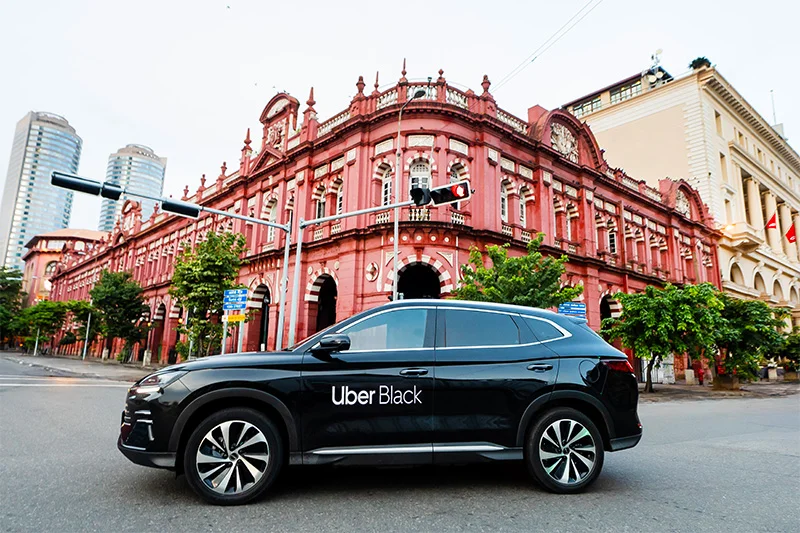
New premium ride option expands Uber’s portfolio from affordable Moto and Tuk rides to premium on-demand travel
Uber announced the launch of Uber Black in Sri Lanka, bringing its premium ride experience to the country for the first time. Designed as the “business class of back seats,” Uber Black combines premium vehicles and highly-rated drivers for riders looking for greater comfort, quality and a more elevated travel experience.
The launch comes as demand for premium products and experiences grows across Sri Lanka, with consumers seeking greater choice and quality in their everyday experiences. Uber Black brings this choice to on-demand mobility, whether for an airport journey, an important business meeting, a special occasion or simply when riders want to travel in greater comfort.

Gold winner Tharanga gets brand-new Honda Vezel from SLAAJ

Showers above 50 mm are likely at some places inthe Uva, Eastern and Central provinces and in Polonnaruwa and Mullaittivu districts after 1.00 p.m.

Civil society activist accuses govt. of favouring Ven. Gnanasara

More cops than cones

Sajith accuses govt. of using data selectively in crucial report

75 new inmates sent to Bogambara re-establishing it as a correctional facility

‘Dates have the highest sugar content to fight Coronavirus’

Sunday Island 27 December – Headlines

#SundayIsland 17th December – Headlines

Sunday Island – 28th March

Sunday Island Headlines – 21 March

Sunday Island – 21st February – Headlines
-
 Latest News6 days ago
Showers above 100 mm are likely at some places in the Western, Sabaragamuwa, Central and North-western provinces and in Galle and Matara Districts
-

 Editorial6 days ago
Crimes punished and unpunished
-

 Features5 days ago
Beyond traditional jobs: Why Sri Lanka needs to facilitate the gig economy
-

 Editorial4 days ago
Birth of a bad law
-
 Latest News5 days ago
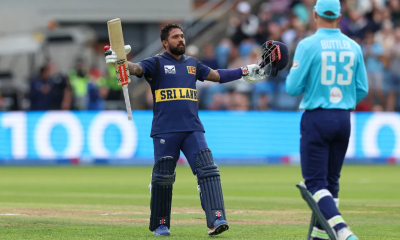
Kusal, Wellalage star as Sri Lanka defend 322 in Headingley thriller
-

 News2 days ago
Police remove Thileepan statue in Jaffna
-
 Latest News7 days ago
Ms. P. M. Jayadeera (Engineer) appointed Director General of Irrigation
-

 News6 days ago
IMF: Sri Lanka on course for 2027 market return