
News
How much longer are we going to fool ourselves by ignoring scientific evidence?

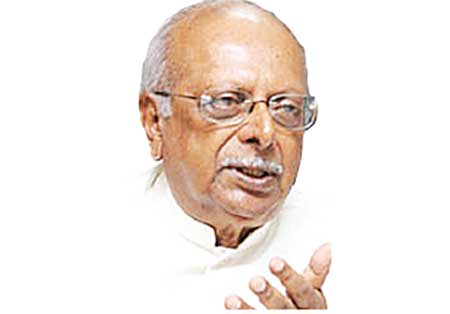
Science is based on finding the truth and acting accordingly, though the situation may keep changing, as seen with the Covid-19 pandemic. One has to adjust flexibly to recognize and accept the real position and overcome the emerging problems making best use of the available resources.
I hope I will be forgiven for mentioning some personal experiences in the last few years to make clear the attitudinal changes that need to be made to help our country and people overcome the massive problems confronting us.
I was requested to resign from the post of Governor of the North Central Province and to come to Basil Rajapaksa’s office to sign the National List to enter Parliament. I was informed by several persons that I would be a Cabinet Minister once again as the leader of the LSSP, a member of the Sri Lanka Freedom Podujana Alliance, and a former minister. In all probability, as the Minister of Science and Technology, as I had promoted the development of local value added industries, the policy of our new government. In this capacity, I had set up 263 Vidatha Development Centres, one in each administrative division, and in four years helped develop over 12,300 micro, small and medium enterprises (SMEs). Over 20,000 youth received free training in ICT. Through SLAB (which I set up through a new Act) and the SLSI, quality products resulted (17 exported, 64 sent to local food chains and 53 to hotels).
By setting up the SLINTEC, Sri Lanka became the 18th country to develop a Nanotechnology Centre, and the first to do so in South Asia, so that large industries based on our natural resources like ilmenite and graphite could become competitive abroad.(Refer Report of Research Study done by the Institute of Policy Studies, IPS). As an MP, I am unable to build on this scientific foundation and contribution.
But the bigger mystery is why I am left out of the campaign to control the Covid-19 pandemic. My first opportunity was to attend the one and only meeting of the Parliamentary Consultative Committee on Health held over six months ago (though these meetings are to be held monthly). There had been good control when the virus was brought into the country by individuals who were isolated, usually in hospital, and the contacts traced and quarantined. All credit to the military, police and health personnel for an excellent job.
But as cases were arising from local sources without a clear contact history, I said at the meeting that it had spread into the community. Among my proposals was that a Committee of Party Leaders be set up to interact with the Minister to make the campaign a national effort. Then Covid Committees, including health personnel, could be established down to village level without petty divisions. Problems like the Muslim burial issue could have been avoided. Each committee would spot suspect cases, get them PCR tested and cluster controlled. By intensive health education people would understand that it was necessary to wear the mask, practice social distancing and wash their hands well with soap and water after touching any object handled by anyone else. (I produced and distributed more than a million copies of a handbill in all three languages, with cartoons, in simple language that even a child could learn about the virus).
Current scientific evidence suggests that the virus only grows and multiplies in live cells of the human respiratory tract. It cannot multiply on its own, like all viruses, and outside our body die within a day, usually in a few hours. The Covid Committee members would help enforce the health rules. Unfortunately, the Minister refused to accept my assessment and persisted with the cluster control strategy.
An effort is being made to stop transmission of the virus by the vaccine. A minimum of 70 to 80% coverage is essential, and this will take more than a year even if we find the funds and donors. There are many problems associated with this policy and how it has been done.
Even in the UK which is targeting 100% coverage and there was good progress, the appearance of the Delta variant has led to a change in the projections to one of a large increase of cases and deaths (over 10 fold by some researches) because the protection against this variant will drop by 8% or more. With the more severe Delta plus variant the outcome will be worse. A reliable expert source has informed me that the expensive monoclonal antibody course that saved US ex-President Trump seemed to have fared poorly when tested against the Delta variant.
Now that Delta variant virus has appeared in Sri Lanka, a vigorous effort needs to be carried out to identify each and every such case, and institute effective cluster control. More funds should be provided for adequate random sampling (and testing all fever cases) by PCR in all districts, down to village and slum level, specially for lockdowns. There are still people in the Vulnerable Group (elders over 60 years, lung and heart disease, diabetes patients and others with lowered immune responses) to receive the vaccine.
Education has suffered, and while digital teaching is an answer, it is affordable by the well off but not the mass of poorer children who will suffer. I propose that selected TV channels provide the education for all. The government should postpone development projects, though they are desirable, to meet the needs of the war against Covid 19, and the fight against hunger. Fifty per cent live below the poverty line and many have only one meal a day. The malnutrition level has gone up to 18%. Priority must be given to ensure that no one starves, and they get adequate food.
The Cooperative Movement must be revived. Direct dealings between the Farmer Cooperatives and the Consumer Coops will eliminate middleman profiteering, and ensure a fair price for the farmer and the consumer. The revival of the Paddy Marketing Board and the Marketing Department to buy and sell rice and the vegetables and fruits at a reasonable price will solve the hunger problem.
But the core problem is the major economic crisis which is both global and local. It is a systemic crisis arising mainly from the capitalist system. The Government has taken the correct path of developing the national economy, reduce imports by increasing local production. Increase our foreign exchange reserve and minimize borrowing. The stress must be on promoting ecological farming, which is organic and environmentally friendly and sustainable. But the transition from chemical fertilizer must be gradual, so that yields do not suffer. For industrial development the revival of Vidatha and SLINTEC as well as other Hi-tech institutes like SLIBTEC are essential. We must reduce borrowing and increase productivity and exports. Under no circumstances should we fall into the IMF trap.
I appeal to the government to get the rich to also bear the burden. Raise personal tax from 14% to at least 70%, to enable government to get the necessary funds, avoiding debt.
– Prof. Tissa Vitarana



Trade unions of the Ceylon Electricity Board (CEB), backed by the powerful Ceylon Electricity Board Engineers’ Union, have warned of accelerated trade union action following the collapse of crucial discussions held on Monday (16) with the CEB Chairman, who also serves as Secretary to the Ministry of Power and Energy.
The issue is expected to take centre stage at today’s press conference, with unions signalling that a token strike, possibly a 12-hour countrywide action, could be staged next week unless authorities urgently intervene.
The meeting earlier this week ended without what union representatives described as any “positive or constructive outcome.”
Trade union leaders expressed disappointment that their key concerns had not been substantively addressed during discussions with the Chairman.
At the heart of the dispute is the unions’ demand for a collective agreement in accordance with Section 18(j) of the Sri Lanka Electricity Act No. 36 of 2024. Trade union representatives maintain that the law provides for structured engagement between management and employees and that a formal collective agreement is necessary to ensure transparency and industrial stability within the institution.
The unions also submitted what they termed a reasonable proposal to safeguard the CEB Employees’ Provident Fund (EPF), voicing concerns over the long-term security of workers’ retirement benefits.
However, according to trade union sources, those proposals were not adequately taken up during the discussions.
A senior electrical engineer told The Island that further internal consultations were being held to decide the next course of action. “There is growing frustration among employees. The issues raised are fundamental and relate directly to statutory compliance and the financial security of staff,” he said.
The Island learns that unless there is meaningful engagement from the authorities, the proposed token strike could mark the beginning of more stringent industrial action.
Energy sector observers warn that any escalation of trade union unrest at the CEB could have serious implications for the country’s power sector stability at a critical time.Further developments are expected following today’s media briefing.
By Ifham Nizam

Prime Minister Dr. Harini Amarasuriya yesterday (19) revealed allowances and benefits provided to Members of Parliament at present.She did so while responding to a question raised by Samagi Jana Balawegaya MP Chaminda Wijesiri.
According to the disclosure:
An MP receives a monthly allowance of Rs. 54,285, with an entertainment allowance of Rs. 1,000 per month.
Driver allowance is Rs. 3,500 per month; however, if the MP is provided with a driver by the Ministry of Public Security and Parliamentary Affairs, no driver allowance is paid.
Telephone allowance is Rs. 50,000, while transport allowance is Rs. 15,000 per month.
Office allowance amounts to Rs. 100,000.
MPs attending parliamentary sessions receive Rs. 2,500 per day, while Rs. 2,500 per day are given for MPs attending committee meetings on non-sitting days.
Meanwhile, Members of Parliament also receive a fuel allowance based on the distance from their elected district to Parliament.
For national list MPs, this is calculated as 419.76 liters of diesel per month, paid at the approved market rate on the first day of each month.Dr. Amarasuriya also emphasised that these allowances are structured to cover official duties and transportation costs.

Former OIC of the Cyber Crime Investigation and Intelligence Analysis Unit of the CID, M.M.U. Subhasinghe, yesterday expressed his regret in writing to civil activist and comedian Natasha Edirisooriya at the Supreme Court regarding her arrest under the International Covenant on Civil and Political Rights (ICCPR) Act.
The Attorney General’s Department, appearing on behalf of the respondents, informed the court that the IGP would issue a set of guidelines via a circular to all police officers to prevent unlawful arrests under this Act in the future. It was further noted that the circular would be issued within two weeks, and the petitioner, Natasha Edirisooriya, has examined and agreed to these guidelines.
These submissions were made yesterday before a three-judge bench of the Supreme Court, led by Chief Justice Preethi Padman Surasena, during the hearing of the Fundamental Rights (FR) petition filed by Edirisooriya challenging her unlawful arrest.
Following these developments, the court ordered the respondents to inform the court via a motion within two weeks of issuing the IGP’s circular and ordered the conclusion of the case proceedings.
Natasha Edirisooriya was present in open court yesterday. Addressing her, Chief Justice Surasena stated that the court appreciates the manner in which the legal proceedings were brought to a conclusion.
The letter expressing regret stated: “As the arresting officer, considering the totality of circumstances, I wish to express deep regret to you for the arrest on 27th May 2023 and your incarceration in remand custody till 5th July 2023 consequent thereto. I also extend my deep regret regarding the damage that may have been caused to your reputation and dignity, and mental and emotional trauma caused by the arrest and incarceration.”
The respondents agreed to express this regret and issue the circular based on the specific conditions put forward by Edirisooriya in consultation with her counsel Suren Fernando and the legal team.
By AJA Abeynayake

Fairly heavy showers likely in the Eastern province and in Matale, Badulla, Mullaitivu and Polonnaruwa districts

CEB trade unions hint at stringent industrial action after talks fail

PM reveals allowances and perks available to MPs

CID expresses regret to Natasha; IGP to issue guidelines on ICCPR arrests

Construction begins on country’s largest solar power project in Hambantota

Lanka silent as 85 countries rebuke Israel at UN

‘Dates have the highest sugar content to fight Coronavirus’

Sunday Island 27 December – Headlines

#SundayIsland 17th December – Headlines

Sunday Island – 28th March

Sunday Island Headlines – 21 March

Sunday Island – 21st February – Headlines
-
 Life style5 days ago
Marriot new GM Suranga
-

 Business4 days ago
Ministry of Brands to launch Sri Lanka’s first off-price retail destination
-

 Features5 days ago
Monks’ march, in America and Sri Lanka
-
 Features5 days ago
The Rise of Takaichi
-

 Features5 days ago
Wetlands of Sri Lanka:
-

 News5 days ago
Thailand to recruit 10,000 Lankans under new labour pact
-
 News5 days ago
Massive Sangha confab to address alleged injustices against monks
-
 News3 days ago
IMF MD here