
Opinion
How many Buddhas?

By Dr Upul Wijayawardhana
Not how many Buddhas but some authorities have even questioned, in the past, whether the Buddha was an actual person. Of course, there is more than enough archaeological evidence to prove that indeed He was. Born a Sakhya prince and named Siddhartha, with the family name Gautama, the year of His birth has been a bone of contention for a long time, variously quoted as 563 BCE or 480 BCE. The work of the British archaeologist, Prof Robin Coningham of Durham University, has finally established the correct era. After a three-year dig on the site of the Maya Devi Temple at Lumbini, in Nepal, Coningham and his team of 40 archaeologists discovered a tree shrine that predates all known Buddhist sites by at least three centuries. The timber structure revealed by archaeologists has been radio-carbon-dated to the sixth century BCE. Lumbini, which lay hidden under the jungle until it was excavated in 1896, was identified as the Buddha’s birthplace because of a sandstone pillar that bore an inscription documenting the visit of Emperor Ashoka. Though the UNESCO website states that the Buddha was born in Lumbini, in 623 BCE, it is more likely the year of birth is 563 BCE, in the sixth century BCE as indicated by radio-carbon-dating.
Prince Siddhartha renounced worldly life at the age of 29, attained Buddhahood after an arduous search for six years and traversed, on foot, around a vast area of India for 45 years, disseminating the truths he discovered. He is known variously as Gautama Buddha, Siddhartha Gautama, Shakyamuni or simply as The Buddha. My concept of the Buddha is that He is the only Buddha, an ordinary human being with an extraordinary intellect who discovered the Four Noble Truths and the Noble Eightfold Path. However, most traditional Buddhists may not agree with me as they believe in many Buddhas in the past and to be born in the future. Interestingly, they say that all these Buddhas preach the same thing! This, to me, is an act of devaluing the great achievements of the Buddha.
Maybe, I am looking at this with my scientific background which tells me that, there is no possibility of more than one Buddha during the period humans have inhabited this earth. Notwithstanding, many Buddhists believe that Gautama Buddha was the fourth Buddha of this eon, Kakusandha, Konagamana and Kashyapa being the predecessors with the fifth Buddha, Maitreya, to be born in this extended eon. According to Theravada tradition, there have been 27 Buddhas before Gautama Buddha and they have been named as: Taṇhaṅkara Buddha, Medhaṅkara Buddha, Saraṇkara Buddha, Dīpankara Buddha, Koṇdañña Buddha, Maṅgala Buddha, Sumana Buddha, Revata Buddha, Sobhita Buddha, Anomadassi Buddha, Paduma Buddha, Nārada Buddha, Padumuttara Buddha, Sumedha Buddha, Sujāta Buddha, Piyadassi Buddha, Atthadassi Buddha, Dhammadassī Buddha, Siddhattha Buddha, Tissa Buddha, Phussa Buddha, Vipassī Buddha, Sikhī Buddha, Vessabhū Buddha, Kakusandha Buddha, Koṇāgamana Buddha, Kassapa Buddha. Not only they are named, their birth castes, names of parents, birthplaces and under which Bodhirukkha they attained enlightenment are listed. Interestingly, they are all born in India and wonder whether they all received the same treatment as Gautama Buddha did: Forgotten in the land of birth! Whatever it is, there is no scientific basis for these assumptions.
Interestingly, Mahayana has a different approach. Mahayana Buddhists venerate numerous Buddhas, not found in early Buddhism or in Theravada Buddhism. They are generally seen as living in other realms, known as Buddhafields or Pure Lands. They are sometimes called “celestial Buddhas”, since they are not from this earth. Some of the key Mahayana Buddhas are: Akshobhya, Amitabha, Amoghasiddhi, Bahisajyaguru, Ratnasambhava, Vairochana, Prabhutaratna, Samantabhadra and Lokeshwararaja. Perhaps, this concept is more plausible as they are supposed to exist in other planes, beyond our perception.
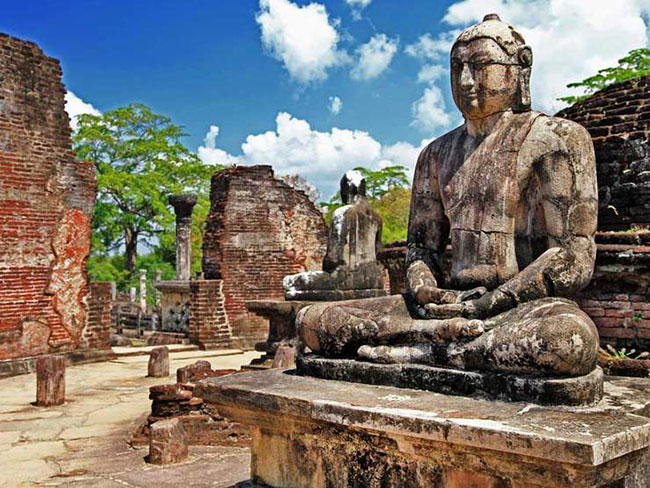
What can we say about other Buddhas, if any, when we can only imagine what Gautama Buddha was like as no one has left a detailed description of what the Buddha looked like? The Buddha was represented by signs initially, in spite of the building of Stupas, and the first statues of the Buddha were not carved till about four centuries after Parinibbana. Therefore, it is very likely they will have imaginary features and, in fact, most of the surviving early statues show Greek influence. Among the surviving early statues are:
The Standing Buddha Statue, a remarkable example of Greco-Buddhist Statuary which was built in Gandhara, which resides in the Tokyo National Museum and is dated around 1st or 2nd Century CE. It is referred to as “the most beautiful, and probably the most ancient of the Buddhas”
The Seated Buddha from Gandhara, one of the early Buddha statues built in second or third century, which was discovered at the site of Jamal Garhi in ancient Gandhara, shows the Buddha in Dharmachakra Mudra. This resides in the British Museum.
It was reported in 2017, that a centuries-old “sleeping Buddha” statue has been unearthed during excavations near Bhamala Stupa in Haripur district of Pakistan’s Khyber-Pakhtunkhwa region. This 48-feet-long statue built in the third century is considered the oldest statue in the sleeping position.
Collecting the scant data available from various sources, Bhante Dhammika of Australia described some features of the Buddha, in his very interesting article “What Did the Buddha Look Like” (Sunday Island, 6 March). Prolific writer, Mr G. A. D. Sirimal objected to this title stating: “This title should have read ‘What did Buddha Gautama Look Like?’, for the word ‘Buddha’ is a title similar in some respects to Doctor, Professor, etc. One should not forget there were 23 enlightened ones called Buddha.” (The Island, 10 March)
He seems convinced that there were previous Buddhas but seems to have got the number wrong; it is 28 as I stated previously with names, not 23. Further, he seems to suggest a new style of referring to the Buddha; Buddha Gautama whereas the Buddha is usually referred to as Gautama Buddha. In any case, when one refers to the Buddha it is meant to be Gautama Buddha. Anyway, for me there is only one Buddha!
Perhaps, the most important thing is not to count the number of Buddhas who may have been there or what Gautama Buddha looked like but to follow the path our Buddha discovered, not wait for a future Maitreya Buddha! Afterall, when He was asked who should be the successor, the Buddha replied that it would be the Dhamma.


Here is what you can do!
Comedy and the ability to have a good laugh are what keep us sane. The good news to announce is that there are many British and American comedy shows posted up and available on the internet.
They will bring a few hours of welcome relief from our present doldrums.
Firstly, and in a class of its own, are the many Benny Hill shows. Benny is a British comedian who comes from a circus family, and was brought up in an atmosphere of circus clowning. Each show is carefully polished and rehearsed to get the comedy across and understood successfully. These clips have the most beautiful stage props and settings with suitable, amusing costumes. This is really good comedy for the mature, older viewer.
Benny Hill has produced shows that are “Master-Class” in quality adult entertainment. All his shows are good.
Then comes the “Not the Nine o’clock news” with Rowan Atkinson and his comedy team producing good entertainment suitable for all.
And then comes the “Two Ronnies” – Ronnie Barker and Ronnie Corbett, with their dry sense of humour and wit. Search and you will find other uplifting shows such as Dave Allen, with his monologues and humour.
All these shows have been broadcast in Britain over the last 50 years and are well worth viewing on the Internet.
Similarly, in The USA of America. There are some really great entertainment shows. And never forget Fats Waller in the film “Stormy Weather,” where he was the pianist in the unforgettable, epic, comedy song “Ain’t Misbehavin”. And then there is “Bewitched” with young and glamorous Samantha Stevens and her mother, Endora who can perform magic. It is amazing entertainment! This show, although from the 1970s was a milestone in US light entertainment, along with many more.
And do not overlook Charlie Chaplin and Laurel and Hardy, and all the Disney films. Donald Duck gives us a great wealth of simple comedy.
The US offers you a mountain of comedy and good humour on Youtube. All these shows await you, just by accessing the Internet! The internet channel, ‘You tube’ itself, comes from America! The Americans reach out to you with good, happy things right into your own living room!
Those few people with the ability to understand English have the key to a great- great storehouse of uplifting humour and entertainment. They are rich indeed!
Priyantha Hettige

After the recent disaster, a great deal of information has been circulating on WhatsApp and YouTube regarding our reservoirs, highways, etc.
In many of these discussions, people have analysed what went wrong and how the damage could have been prevented. My question is this: why do all these knowledgeable voices emerge only after disaster strikes? One simple reason may be that our self-proclaimed, all-knowing governing messiahs refuse to listen to anyone outside their circles. It is never too late to learn, but has any government decision-maker read or listened to these suggestions?
When the whole world is offering help to overcome this tragedy, has the government even considered seeking modern forecasting equipment and the essential resources currently not available to our armed forces, police, and disaster-management centres?
B Perera
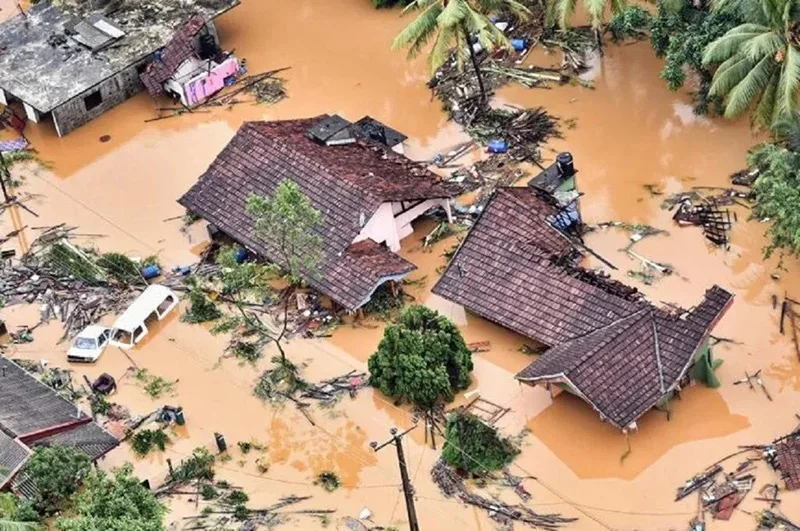
A great deal has been said about Cyclone Ditwah and its impact. To my mind one important aspect of it has not been addressed.
During the 1,400 odd landslides, it washed off a vast volume of soil which entered the various water bodies like tanks, lakes, rivers and streams etc. This process has raised their water levels reducing the water holding capacities (water holding capacity has a different meaning in soil science). What it means is that they cannot hold the same amount of water as before without spilling. Therefore, a precipitation which would not have been significant then can cause spilling of tanks leading to floods now. Hence there is a possibility of experiencing more floods in the future. Due to silting the tanks will carry less water than before, thus reducing the irrigable areas under their command. They will not be able to irrigate the same extents of paddy, thus affecting production.
How do we rectify this situation? It is desilting which can be very expensive.
It is good if these are considered in future planning.
Gamini Peiris
Panadura
Experienced agriculturist

MEPA to crack down on marine polluters

SC delegation, headed by CJ Surasena, observes Indian Supreme Court in action

Heavy rains leave communities at risk; disaster units on high alert

Rebuilding Sri Lanka for the long term

Bulk of disaster displaced centres in Kandy

Feeling sad and blue?

‘Dates have the highest sugar content to fight Coronavirus’

Sunday Island 27 December – Headlines

#SundayIsland 17th December – Headlines

Sunday Island – 28th March

Sunday Island Headlines – 21 March

Sunday Island – 21st February – Headlines
-
 Features6 days ago
Finally, Mahinda Yapa sets the record straight
-

 Features6 days ago
Handunnetti and Colonial Shackles of English in Sri Lanka
-

 Business5 days ago
Cabinet approves establishment of two 50 MW wind power stations in Mullikulum, Mannar region
-

 News5 days ago
Gota ordered to give court evidence of life threats
-

 Features5 days ago
Cliff and Hank recreate golden era of ‘The Young Ones’
-
 Opinion6 days ago
A national post-cyclone reflection period?
-
 Features5 days ago
Sri Lanka and Global Climate Emergency: Lessons of Cyclone Ditwah
-

 Latest News6 days ago
Sri Lanka squad named for ACC Men’s U19 Asia Cup