
News
Home grown clothing line appeals to expat Lankans to help earn much needed foreign currency


A 100% Lankan clothing brand competing with several global companies on e-commerce platforms appeals to the Sri Lankan expatriate community to help grow the company’s international sales volume and bring in much needed foreign currency to Sri Lanka at this crucial hour for the country.Ranil Willaddarage, CEO & founder of GFlock says, “This is not a charity appeal. This is a win-win transaction for Sri Lankan expatriates across the world that offers value for their hard-earned foreign currency, and the money in turn being used to import essential commodities for their fellow countrymen. As a nation, we have hit the rock bottom. The only way to go if we keep on fighting with each other is six feet under. We cannot start attacking each other again, destroy public property, set fire to private assets and fall even further. Everyone has to come together as a nation and overcome this terrible situation.”
When asked to elaborate on his solution to the foreign exchange crisis, he says “Our company offers a sustainable solution that can help save this country. Most of our Sri Lankan expatriate community purchases their clothing from brands such as Zara, Mango, Myer, Uniqlo, H&M, and Shein. Most of these brands are based in Europe and other developed countries in the Asia-Pacific region. Sri Lankans living in the United States, Canada, Australia and Europe tend to spend an average amount of $300-$500 as their annual clothing budget on aforementioned foreign brands. My kind request to our Sri Lankan communities abroad is to spend their clothing budget at Gflock, and place orders through our global online store, which is brought to them through the efforts of the creative workforce in Sri Lanka.”
“We know that a fashion company is a business that can earn a lot of revenue. If we take Zara, another brand with a fast fashion business model like ours, their annual revenue is between $ 20-25 billion. H&M also has similar revenue. The Shein brand founded 14 years ago in Nanjing, China, now ships to over 220 countries. With highly competitive prices and their online-only B2C model, Shein’s annual revenue is now at a staggering USD 15 billion. With the arrival of the pandemic, their annual revenue increased exponentially within the course of three years and the $3.5 billion revenue in 2019 grew to a massive $15.7 billion by 2021.”
“Taking inspiration from this and with the help of Sri Lankan expats, within 5-7 years it should be possible for us to reach an annual income of USD 5 billion. The Gflock business model is established in a way that can be scaled up as needed. My team and I have the specialized knowledge, experience and integrity required for that. So I request our Sri Lankans living abroad to think about their home country that is on the verge of collapse when spending their monthly clothing budget and buy from Gflock, a brand founded and run by the creative younger generation in their home country. Apart from that, I appeal to them to be a brand ambassador for this business by promoting the goal of saving our country with at least 5 more expats and get them to buy clothes from us. If that can be achieved, we will be able to get rid of the oil and gas queues, the shortage of medicines, and the shortage of food and bring the country back to normalcy sooner than we think.”
“1/3 of the profit from our business is spent on providing a monthly essential goods package worth Rs. 8000 to our indirect employees who function as garment workers. Every week we practice gratitude by publishing photos of such acts on our Facebook page and thanking all our customers who contributed toward these worthy causes. Also, we initiated the project of giving away a free plant with every purchase on World Environment Day -2018. Within the course of 4 years since its inception, we have managed to create over thirty thousand such meaningful bonds that link our brand and customers together with Mother Nature.”
“When the customers realize their purchase contributes to a greater good that goes beyond just a piece of clothing, it gives them a high sense of self-satisfaction, and the next time they make a purchase they do it intending to support a greater good. As owner of Gflock, I am prepared to offer 51% of the business’s shares to the Sri Lankan public in 2025. By implementing this model combined with the expected income, we shall be able to create a strong public movement that can help achieve inclusive prosperity for Sri Lankans.”
Willaddarage said GFlock releases 40-50 new designs every week, categorized under casual wear, work wear, evening wear, menswear, linen and denim for local and international customers through their three retail stores in Sri Lanka and GFlock.com online store, where they ship their products globally.

Latest News
Heat Index at Caution level’ in the Northern, North-central, North-western, Western and Southern provinces and in Trincomalee district.


Warm Weather Advisory
Issued by the Natural Hazards Early Warning Centre
Issued at 3.30 p.m. on 12 April 2026, valid for 13 April 2026.
Heat index, the temperature felt on human body is likely to increase up to ‘Caution level’ at some places in the Northern, North-central, North-western, Western and Southern provinces and in Trincomalee district.
The Heat Index Forecast is calculated by using relative humidity and maximum temperature and this is the condition that is felt on your body. This is not the forecast of maximum temperature. It is generated by the Department of Meteorology for the next day period and prepared by using global numerical weather prediction model data.

Effect of the heat index on human body is mentioned in the above table and it is prepared on the advice of the Ministry of Health and Indigenous Medical Services.
ACTION REQUIRED
Job sites: Stay hydrated and takes breaks in the shade as often as possible.
Indoors: Check up on the elderly and the sick.
Vehicles: Never leave children unattended.
Outdoors: Limit strenuous outdoor activities, find shade and stay hydrated.
Dress: Wear lightweight and white or light-colored clothing.
Note:
In addition, please refer to advisories issued by the Disaster Preparedness & Response Division, Ministry of Health in this regard as well. For further clarifications please contact 011-7446491.

On the apparent northward relative motion of the sun, it is going to be directly over the latitudes of Sri Lanka from 05th to 15th of April in this year.
The nearest areas of Sri Lanka over which the sun is overhead today (13th) are Pesalai, Mankulam and Nedunkerny about 12:11 noon.
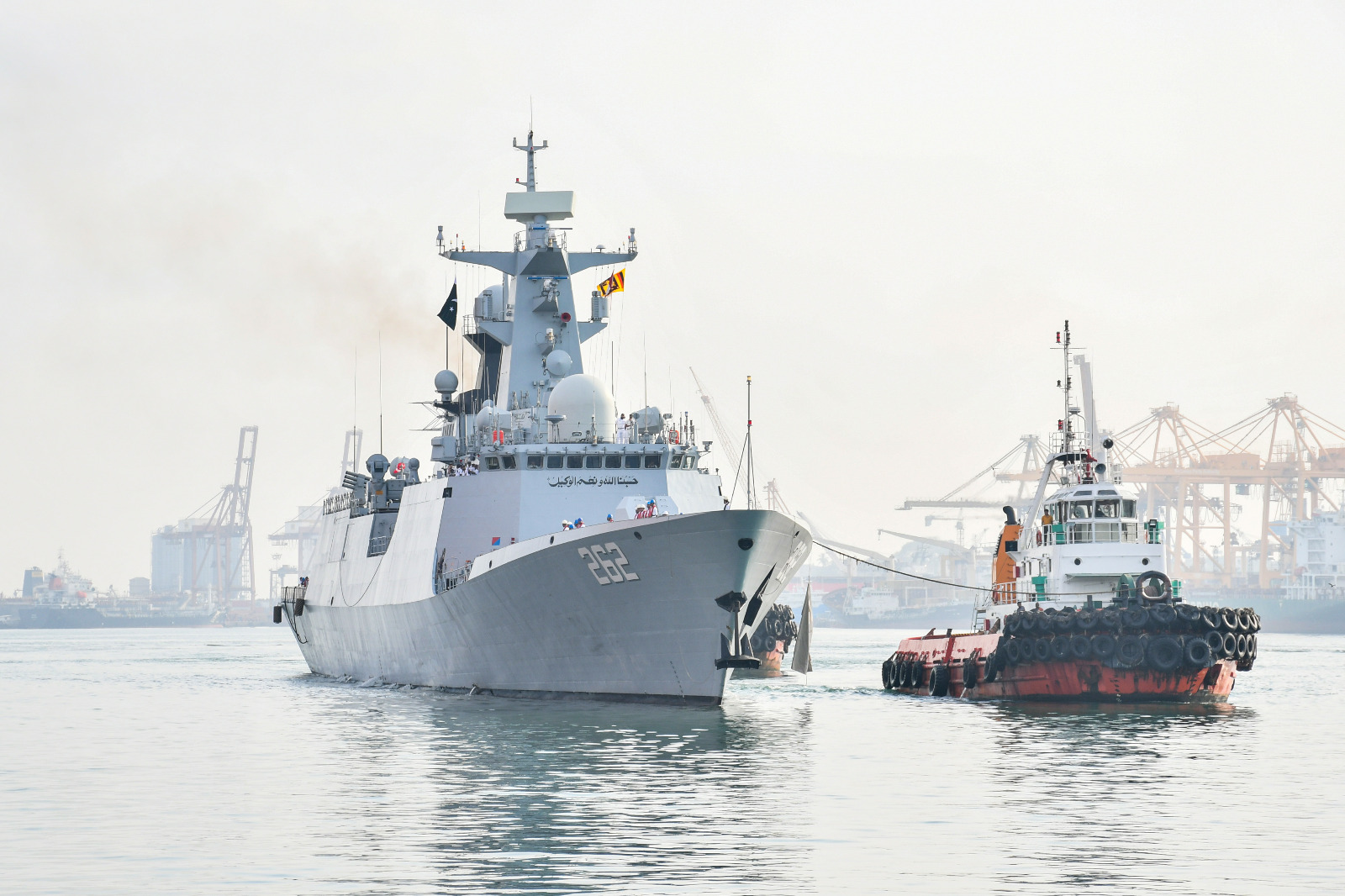
The Pakistan Navy Ship (PNS) TAIMUR and ASLAT arrived at the Port of Colombo on a goodwill visit on 12 Apr 26.
The visiting ships were welcomed by the Sri Lanka Navy in
compliance with naval traditions.
The duo of ships is commanded by Captain NIAMAT SAEED KHAN (PNS TAIMUR) and Captain NADIR MATEEN AFRIDI (PNS ASLAT).
Meanwhile, the ships are expected to conduct a Bilateral Naval Exercise LION STAR V with the Sri Lanka Navy in Colombo seas.

Salt and Patidar power RCB past Mumbai Indians

Prasidh, Buttler set up comfortable win for Gujarat Titans

Heat Index at Caution level’ in the Northern, North-central, North-western, Western and Southern provinces and in Trincomalee district.

Showers above 75 mm are likely at some places in the Western, Sabaragamuwa, Central, Southern and North-western provinces.

Sun directly overhead Pesalai, Mankulam and Nedunkerny about 12:11 noon

PNS TAIMUR & ASLAT arrive in Colombo

‘Dates have the highest sugar content to fight Coronavirus’

Sunday Island 27 December – Headlines

#SundayIsland 17th December – Headlines

Sunday Island – 28th March

Sunday Island Headlines – 21 March

Sunday Island – 21st February – Headlines
-

 News2 days ago
CEB orders temporary shutdown of large rooftop solar systems
-

 News5 days ago
AG: Coal procurement full of irregularities
-

 Business4 days ago
Israeli attack on Lebanon triggers local stock market volatility
-

 Business5 days ago
Hayleys Mobility introduces Premium OMODA C9 PHEV
-

 Business4 days ago
HNB Assurance marks 25 years with strategic transformation to ‘HNB Life’
-

 Features2 days ago
From Royal College Platoon to National Cadet Corps: 145 years of discipline, leadership, and modern challenges
-

 Sports5 days ago
DS to face St. Anthony’s in ‘Bridges of Brotherhood’ cricket encounter
-

 News6 days ago
AKD admits import of substandard coal, blames technicalities and supplier