
Latest News
Holder’s 4 for 19 and last-ball heroics keep series alive


This was not so much a game as an exhibition to showcase the brilliance of Jason Holder. The allrounder opened the bowling, took four wickets across phases of the Pakistan innings, walked in to bat when the equation was steepest, and won West Indies the second T20I with a boundary off the final delivery from Shaheen Shah Afridi. The two-wicket win sees the hosts level the series following a pulsating contest, one that ended with a savage Holder swipe past fine leg when they needed three off one, and a yell of unadulterated joy that ripped through Florida.
West Indies had won just two of their last 19 completed T20Is before this, but began the better of the two sides, puncturing Pakistan with early wickets that left them trying to catch up through the middle overs. They accomplished this to a point thanks to a counter-attacking 60-run fifth-wicket partnership between Salman Agha and Hassan Nawaz, only for Holder’s double-strike to peg them back again. The hosts dominated the final five overs which saw Pakistan produce just 23 runs, setting Shai Hope’s side an eminently manageable 134 for victory.
But batting appeared only to be getting more difficult, and Pakistan’s immaculate bowling complicated matters further for a tentative West Indies. Beyond a brief early flair from Jewel Andrew, West Indies soon fell behind the asking rate, epitomised by a tortured stay at the crease for captain Hope, who limped to 21 in 30 deliveries. With spinners scything through the middle order, it fell once more to Holder to pull off a heist.
There was some support from the other end as Gudakesh Motie and Romario Shepherd struck blows of their own. But just when West Indies had it in control, they appeared to lose it once more as Holder found himself stranded at the non-striker’s end for large parts of the final two overs. He was given the most consequential delivery of all though – the final one. When Afridi tried the surprise delivery by going at the pads rather than wide outside off, Holder found a way to get enough bat on it, slicing through two fielders, dashing Pakistan’s dreams in the process.
Holder was on fire with the bat as the first T20I closed out, taking West Indies closer to the target than they appeared on track for throughout the innings. With ball in hand, he carried on where he left off in the powerplay, drawing Saim Ayub into a slog wide outside off which kissed the edge. His opening partner Sahibzada Farhan, too, fell to Holder in the fourth over. Holder was everywhere, taking a sharp catch that sent Mohammad Haris on his way to reduce Pakistan to 21 for 3.
An hour or so later, Pakistan had stormed their way back into the game. Hasan Nawaz shook off a stodgy start to wallop Shepherd for three successive sixes to round out the 15th over and put Pakistan on target for a total in excess of 150. Once more, though, it was Holder who dragged them back, inducing Hasan Nawaz into a chip back to him to send him on his way. He would round out his bowling figures by dismissing the other Nawaz – Mohammad – and his figures of 4 for 19 did not flatter him in the slightest.
And then, of course, there was the small matter of what he did with the bat.
When Agha won the toss, he broke somewhat with modern convention and opted to bat, saying he believed the conditions would assist spin towards the back-end of the game. For the best part of the West Indies innings, Mohammad Nawaz, Ayub and Sufiyan Muqeem set about proving their captain right.
Mohammad Nawaz broke open the West Indies innings in the powerplay, removing the top three and putting paid to any notion this would be a straightforward chase. Ayub, often only good for the odd over or two, ended up bowling his full quota, showcasing his full range of variations as he removed Sherfane Rutherford and Roston Chase, while Muqeem’s masterful control of pace, length and spin tormented West Indies at a time they needed quick runs. The trio combined for six wickets in 12 overs for 53 runs, and had set Pakistan up nicely by the time they were done. But for Holder.
Thirty-one runs ahead. For all the tight margins this game saw, for all of Pakistan’s poor powerplay and sluggish start with the bat, this was how far clear they were of West Indies after the 15-over mark for each side. And though West Indies bludgeoned their way to 56 in their final 30 balls, it should have been nowhere near enough given this gulf at that late stage between the sides.
If you sense this is getting repetitive, it’s impossible to talk about this game without coming back to Holder. With Hasan Nawaz breaking the shackles with three straight sixes, Holder’s removal of the batter suddenly deprived Pakistan of their only free-flowing slogger. Though Pakistan pride themselves on batting deep, their lower order – unlike West Indies – fell apart under that pressure. The bottom five managed 13 runs between them, none with a strike rate better than a run a ball, and West Indies suddenly found bowling very easy as the boundaries dried up and the dot balls began to pool. Those three Nawaz sixes were the last boundaries Pakistan scored in their innings, and as Holder showed, hitting boundaries right down to the very last ball can be the difference between victory and defeat.
Brief scores:
West Indies 135 for 8 in 20 overs (Jewl Andrew 12, Gudakesh Motie 28, Shai Hope 21, Roston Chase 16, Jason Holder 16*, Romario Shepherd 15; Saheen Shah Afridi 1-31, Mohammad Nawaz 3-14, Sufiyan Muqeem 1-19, Saim Ayub 2-20 ) beat Pakistan 133 for 9 in 20 overs (Fakhar Zaman 20, Hasan Nawaz 40, Salman Agha 38; Akeal Hossein 1-16, Jason Holder 4-19, Shamar Joseph 1-22, Gudakesh Motie 2-39, Roston Chase 1-11) by two wickets
[Cricinfo]

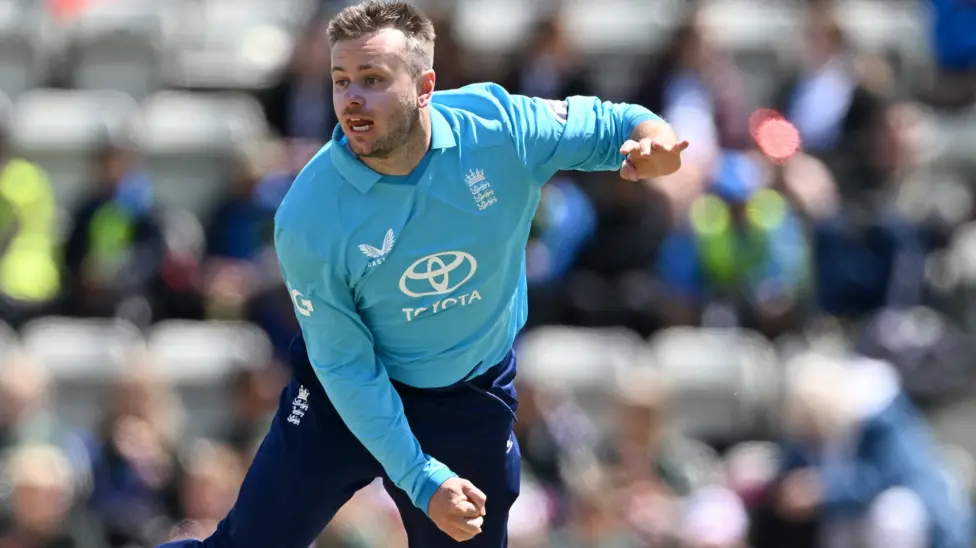
Leg-spinner Mason Crane could play for England for the first time in eight years after being recalled for the one-day international tri-series in Pakistan.
The 29-year-old won his only Test cap against Australia in Sydney in 2018 and is now given an opportunity in the series which also involves Sri Lanka next month.
Crane, who also played two T20 internationals in 2017, could also push his case in the fight to be England’s number one spinner in Test cricket.
Sam Curran and Adil Rashid both return after injuries, and uncapped pair James Coles and Henry Crocombe are included.
Jos Buttler is out with the hamstring injury he sustained last week, while Jacob Bethell is continuing his recovery from knee surgery.
Brydon Carse, who is under an investigation from the Cricket Regulator following an incident outside a nightclub in Derby in August, remains absent.
England are on a diet of white-ball cricket until three Tests in South Africa in December as they build up to the 50-over World Cup in southern Africa next year.
The tri-series in Pakistan involves the three teams taking part playing each other twice, with the top two advancing to the final. Following the trip to Pakistan, England play three one-day internationals and five T20s in Australia in November.
As England continue to shape their backroom staff following the arrival of Stephen Fleming as Test coach, Jeetan Patel, Mike Yardy, David Saker and Carl Hopkinson will assist white-ball head coach Brendon McCullum in Pakistan.
That means Marcus Trescothick, who took temporary charge of the Test team for the series against Pakistan in the home summer, misses the trip.
It is understood the make-up of the coaching staff is part of a plan to rotate the coaches – fielding coach Sarah Taylor and fast-bowling coach Tim Southee are also not going to Pakistan.
All of Trescothick, Taylor and Southee are likely to be part of England’s coaching team for other tours this winter.
England squad for tri-series in Pakistan:
Harry Brook (Yorkshire – captain), Gus Atkinson (Surrey), Sonny Baker (Hampshire), Tom Banton (Somerset), James Coles (Sussex), Jordan Cox (Essex), Mason Crane (Glamorgan), Henry Crocombe (Sussex), Sam Curran (Surrey), Liam Dawson (Hampshire), Ben Duckett (Nottinghamshire), Will Jacks (Surrey), Jamie Overton (Surrey), Adil Rashid (Yorkshire), Joe Root (Yorkshire), Josh Tongue (Nottinghamshire).
(BBC)

Latest News
I extend my heartfelt wishes to all the sons and daughters of our country for a Happy World Children’s Day – President

Children’s Day Message from President Anura Kumara Dissanayake:
“Children are the most valuable asset of a nation. Ensuring their physical and mental well-being and creating an environment conducive to their proper development is a primary responsibility of any government. Children’s imagination, aspirations and creativity will determine the shape and colour of the country tomorrow. The country we build for children must not merely be a country prepared to be handed over to them in the future; it must be a country that gives space to their dreams today, listens to their voices and provides opportunities for them to realise their potential.
For the best interests of children, we are taking the necessary steps to ensure equal access to education, guidance, social protection, opportunities for sport, leisure and recreation, proper nutrition and access to healthcare, while protecting children from all forms of violence and discrimination and safeguarding their rights.
Race, religion, economic status, geographical background or any other circumstance should not be a barrier to any child’s education or proper development. Every child should have equal and fair opportunities to realise their potential, pursue their dreams and create the future they wish for themselves. To this end, we have already begun the process of reforming the education system in Sri Lanka, transforming it towards a skills-based system suited to the new world, one that does not place a burden on parents or cause distress to children.
Our aim is to ensure that no child is left behind in the new Sri Lanka we are building, and to provide every child with opportunities for development in a safe environment. It should be emphasised that the fundamental objective of all the programmes being implemented, from expanding educational scholarships to securing the future of children growing up in child development centres and those in need of care, is to create a dignified and secure tomorrow for every child in the country.
It is the aspiration of every parent to give their children a better life than the one they themselves experienced. We are currently steering the country’s economy towards a correct and stable direction in order to provide children with a safe and happy childhood, free from the shadows of an unstable economy. At the same time, we have launched the national operation “A Nation United” (Ratama Ekata), bringing everyone together to free the younger generation from the menace of illicit drugs.
At a time when we are working towards the goal of building a safe and better country for children, I greatly appreciate the initiative of the Ministry of Women and Child Affairs in organising this year’s World Children’s Day celebrations under the theme “Strong Minds – Enriched Children”, declaring a National Children’s Day Week and conducting a range of meaningful programmes aimed at strengthening children’s rights, well-being, protection, education and freedom.
I extend my heartfelt wishes to all the sons and daughters of our country for a Happy World Children’s Day”.

England call up Crane and rest Archer for Pakistan series

ICC introduces pink-ball daytime Test trial, new time-wasting penalties

Discussion on Anuradhapura Sacred City Development Plan

India enter Asian Games final after Kishan and Bumrah ride roughshod over Sri Lanka

I extend my heartfelt wishes to all the sons and daughters of our country for a Happy World Children’s Day – President

Sri Lanka bowl first in semi final clash against India

‘Dates have the highest sugar content to fight Coronavirus’

Sunday Island 27 December – Headlines

#SundayIsland 17th December – Headlines

Sunday Island – 28th March

Sunday Island Headlines – 21 March

Sunday Island – 21st February – Headlines
-

 Editorial6 days ago
Birth of a bad law
-

 News4 days ago
Police remove Thileepan statue in Jaffna
-

 Features7 days ago
Beyond traditional jobs: Why Sri Lanka needs to facilitate the gig economy
-
 News6 days ago
TIN mandatory for key transactions from Nov. 1
-
 Latest News7 days ago
Kusal, Wellalage star as Sri Lanka defend 322 in Headingley thriller
-

 Features4 days ago
The 22nd Amendment, constitutional recovery and illiberal slippage
-

 Features4 days ago
Of foreigners as CEOs of Lankan ventures
-

 News4 days ago
Sajith rejects Jt. Opp. protest sabotage claim; SJB TU chief demands remedial action