
Business
HNB- Span Engineering partner to home loans promotion

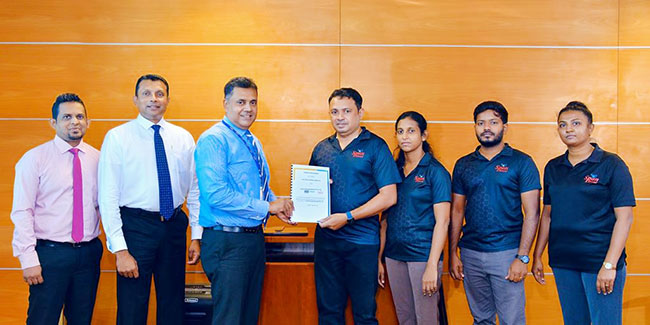
Sri Lanka’s leading private sector bank, HNB PLC, announced an exclusive partnership with renowned property developer Span Engineering (Pvt) Ltd to offer prospective homebuyers special interest rates and exciting benefits for home loans.
The partnership will offer customers the best rates and customized payment plans to provide prospective homeowners with unique home loans for purchase of apartments at all new and existing Span projects including Span Tower 27 – Moratuwa, Span Tower 28 – Negombo, Span Tower 29 – Rajagiriya and Span Tower 30 – Pereira Lane. HNB Deputy General Manager- SME and Retail Banking, Sanjay Wijemanne and Span Engineering Chairman, Sivasubramaniyam Sanjeevan participated in the ceremony held at HNB Towers to sign the MOU.
As the demand for real estate, especially those for apartments have only increased in the past year despite the obstacles faced by the construction industry in the face of the pandemic, we worked towards providing unique investment opportunities in this sector for our customers. As such we are delighted to be working with Span Engineering in creating this unique opportunity for prospective homeowners to invest in a home of their dreams,” HNB Head of Personal Financial Services Kanchana Karunagama said.
HNB will offer customer making use of promotion with flexible repayment options, Step-up facility, Grace period and residual option which ensures a repayment option in line with the customers increasing income. Prospective homeowners can customise repayment plans to suit their income pattern.
Customers can also obtain a maximum repayment period of 25 years for the loan facility for an attractive interest payment, in addition to a seamless loan approval process supported by its state-of-the-art backend systems.
“We have experienced an increase in demand for apartments over the past few years which has resulted in four new projects under our banner Span Towers. The partnership with HNB will offer our customers a unique opportunity to invest in a home of their dreams on their terms. As such we look forward to working with the bank during this promotional period to off prospective home owners access to affordable housing facilities,” Span Engineering Chairman, Sivasubramaniyam Sanjeevan said.
Span Engineering has successfully completed twenty-one quintessential condominium projects making it one of the best housing opportunities within Colombo. The company has now expanded to develop projects in Wellawatte, Negombo, Moratuwa and Nuwara Eliya catering to the high demand from local and foreign homeowners.
Further information regarding the offer can be obtained from HNB customer Centre’s on 011-2462462 and Span Engineering on 0773 686 000.
With 256 customer centres across the country, HNB is one of Sri Lanka’s largest, most technologically innovative banks, having won local and global recognition for its efforts to drive forward a new paradigm in digital banking. Consolidating its reputation for banking excellence, HNB bagged the Best Retail Bank and Best SME Bank awards in the Banking category at the International Finance Awards 2021. The bank was also ranked among the World Top 1,000 Banks list compiled by the prestigious UK-based Banker Magazine for five consecutive years. HNB was also declared Best Sub-Custodian Bank in Sri Lanka at the Global Finance Awards 2020. HNB has a national rating of AA- (lka) by Fitch Ratings (Lanka) Ltd.

Business
Ambeon Securities hosts exclusive investor forum on Sri Lanka’s economic and market outlook


Ambeon Securities recently hosted an exclusive investor forum, bringing together clients, investors, business leaders, and market professionals for an insightful discussion on Sri Lanka’s economic outlook and investment opportunities amidst a challenging global landscape.
The event was organized with the objective of providing investors with valuable insights to make better-informed investment decisions while further strengthening the firm’s engagement with its growing client base.
The forum featured Baqar Zaidi, Director and Chief Economist for Sri Lanka and India at Citi Research, as the keynote speaker. Sharing his perspectives on the evolving global macroeconomic environment, Mr. Zaidi discussed key themes influencing emerging and frontier markets, Sri Lanka’s economic trajectory, and the opportunities lie ahead.
The keynote address was followed by an engaging panel discussion comprising Baqar Zaidi, Aravinda De Silva, respected investor, entrepreneur, and the Chairman of Arcasia Holdings. Hasitha Premaratne, Group Managing Director of Brandix and Asanka Herath, Chief Executive Officer – Unit Trusts and Head of Equities at LYNEAR Wealth Management.
Moderated by Imran Furkan, the panel explored a range of topics including Sri Lanka’s macroeconomic outlook, the future of the Colombo Stock Exchange, sectoral opportunities, capital allocation strategies, investor confidence, and the role of policy reforms in attracting investment and supporting long-term growth.
Speaking at the event, Charith Kamaladasa, Chief Executive Officer of Ambeon Securities, reaffirmed the company’s commitment to facilitate quality insights, informed perspectives, and meaningful dialogue to support their clients while building lasting relationships with them. He noted that in an environment where uncertainty has become the new normal, equipping investors with timely information and expert perspectives is essential for successful wealth creation.
The event was well attended by a distinguished gathering of institutional investors, high-net-worth investors, and business leaders. Among those present were members of the Ambeon Group Board, including Group Chairman Sujeewa Mudalige, Group CEO Dr. Sajeeva Narangoda, and Chairman of Ambeon Securities Mangala Boyagoda. Their presence, together with the participation of Ambeon Group shareholders and valued clients, enriched the discussions and contributed to a vibrant networking session, fostering meaningful dialogue and stronger connections within the investment community.
Through initiatives such as this, Ambeon Securities continues to reinforce its commitment to helping clients navigate evolving market conditions, make informed investment decisions, and achieve their long-term financial goals.

The Tata Group, in partnership with ChildFund and DIMO, has successfully implemented a humanitarian education support initiative for disaster-affected schoolchildren in Sri Lanka, reaffirming its commitment to helping communities recover from the impacts of Cyclone Ditwah and the subsequent floods.
Following a formal request for support from Sri Lanka, an on-ground assessment was conducted in December 2025. Recognizing the urgent need, several Tata companies joined forces to implement the response program.
As part of this initiative, the ‘Hope in a Backpack’ programme, which provides disaster-affected children with essential educational supplies, was launched by the Tata Group at Taj Samudra, Colombo, in the presence of the Chief Guest, Hon. Prime Minister Dr. Harini Amarasuriya; the Guest of Honour, Hon. Indian High Commissioner Santhosh Jha; Ranjith Pandithage, Chairman of DIMO; Chacko Thomas, Group Chief Sustainability Officer, Tata Sons; and Aditi Ghosh, Country Director, ChildFund.
This initiative is part of DIMO’s Social and Community Pillar, under the project theme ‘Lassana Hetak,’ which focuses on giving the future generation a helping hand towards a better future.
This collective effort was further strengthened by volunteers from Tata and DIMO, who actively mobilized on the ground to pack, distribute, and support affected communities. During the proceedings, specially invited schoolchildren received the backpacks with essential supplies as well.
Commenting on the partnership, Ranjith Pandithage, Chairman of DIMO, said: “DIMO is proud to collaborate on this meaningful initiative alongside the Tata Group and ChildFund as the local implementation and logistics partner. Our relationship with Tata spans more than six decades and has been built on a shared commitment to ethical business practices, trust, and creating lasting value for the communities we serve. These values have shaped our partnership over the years, extending beyond business to initiatives that make a meaningful difference in people’s lives.”
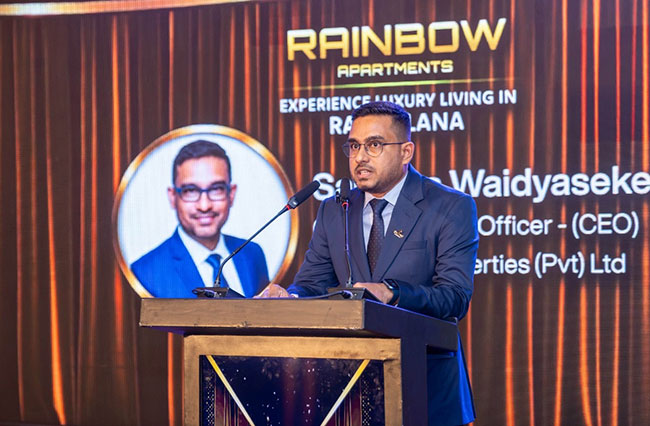
NovaNest Properties (Pvt) Ltd has officially launched Rainbow Apartments, a new residential development in Ratmalana. The announcement was made at an official launch event held at the Shangri-La Hotel, Colombo, marking the company’s latest addition to Sri Lanka’s growing apartment market.
The development is designed to cater to homebuyers seeking modern urban living, as well as investors looking for long-term value. Rainbow Apartments is located in Ratmalana, an area of increasing residential interest, and benefits from the suburb’s established social infrastructure, proximity to major transportation links, and accessibility to Colombo.
The project reflects NovaNest Properties’ commitment to delivering quality residential developments that combine contemporary design with practical living. Intended to satisfy the evolving lifestyle demands of today’s homeowners, Rainbow Apartments features thoughtfully designed living spaces supported by modern amenities. These include two infinity pools, a gym, fully functional workspaces, a mini theatre, stylish cafés, a mini-mart, and a children’s daycare. Additionally, it features a full time medical centre backed by Nawaloka Hospitals PLC Colombo, with a 24-hour ambulance service.
Commenting on the launch, the Chief Executive Officer of NovaNest Properties (Pvt) Ltd, Samitha Waidyasekera, said, “Today’s buyers are looking beyond square footage. In addition to providing long-term value, they want homes that are close to the places where they work, learn, and spend their time. With that shift in mind, Rainbow Apartments was created to bring together a strategic location, thoughtful design, and quality construction in a way that will continue to meet buyers’ needs for years to come. Through our promise of ‘Luxury Beyond Expectations,’ we are committed to delivering an elevated lifestyle experience that combines comfort, convenience, and modern living.

Can Argentina and Messi beat Spain and Yamal to defend World Cup?

Anushka Sanjeewani, Vishmi Gunaratne return for Pakistan ODIs

Lennox stars again as New Zealand take series lead after West Indies collapse

Former IGP C.D. Wickramaratne found dead at his residence

Venezuela earthquake: Number of known dead rises to nearly 5,000 victims

A few showers may occur in the Western, Sabaragamuwa and North-western provinces and in Kandy, Nuwara-Eliya, Galle and Matara districts

‘Dates have the highest sugar content to fight Coronavirus’

Sunday Island 27 December – Headlines

#SundayIsland 17th December – Headlines

Sunday Island – 28th March

Sunday Island Headlines – 21 March

Sunday Island – 21st February – Headlines
-

 Features6 days ago
Prison riots and politics: NPP’s biggest challenge and Sri Lanka’s biggest opportunity
-

 Editorial7 days ago
What’s the world coming to?
-
 Features3 days ago
Dirty Money
-

 Editorial6 days ago
Much ado about crime: Fish or cut bait
-

 Features6 days ago
More on Saudi Arabia: ARAMCO and beyond
-

 Midweek Review3 days ago
The sordid tale of theft and tragedy at Finance Ministry
-

 Latest News3 days ago
Oil prices hit 1-month high as US-Iran attacks dim Strait of Hormuz outlook
-

 Features5 days ago
Deepening Democracy – Constitutions and Constitutionalism