
Sports
History that wasn’t made in the Windies

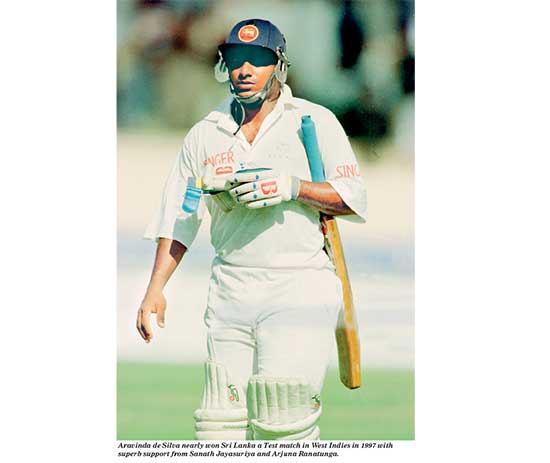
A look back at Sri Lanka’s first Test tour of West Indies
by Aravinthan Arunthavanathan
March 26th marked the 13th anniversary of Sri Lanka’s first Test victory in the Caribbean. Ever since, Sri Lanka has gone on to record only one more victory during the last tour in 2018. Despite these two special wins, the most intriguing Sri Lanka- West Indies Test match overseas remains to be the second Test of Sri Lanka’s maiden tour in 1997. It’s a Test which often goes unnoticed but was special in many ways.
When Sri Lanka set foot in the West Indies in 1997, they were the reigning ODI champs. But the eagerness to prove their mark in white flannels, resulted in an odd schedule consisting of two Tests and a solitary ODI. The late Tony Cozier would call that the equivalent of bringing down Michael Jackson to perform for an opera.
During the first Test In Antigua Sri Lanka were in with a great chance to bat the West Indians out. With a thirty plus lead and the best of batting conditions in hand, Sri Lanka succumbed to the famous West Indies line up for a paltry 152 leaving the Windies with an easy chase. The loss by six wickets on paper did not reveal the closeness of the game. With a golden opportunity lost Sri Lanka moved to the scenic Arnos Vale in St. Vincent’s, one of the most picturesque venues in the world hosting its first Test match.
Ravindra Pushpakumara who had been drafted in as replacement for Chaminda Vass who was injured wreaked havoc by giving the Winides their own medicine bowling fast and straight. The often erratic and colourful Pushpakumara had a great outing claiming five West Indian wickets.
Pushpakumara dealt early blows by blowing away the top-order with short pitched and full-length deliveries ably supported by Sajeeva de Silva who had the big fish Brian Lara caught and bowled leaving the opposition at five for three. Carl Hooper’s back to the wall half-century propelled West Indies to a paltry 147 leaving Sri Lanka in the driver’s seat.
Sri Lanka got off to a solid start propelled by Sanath Jayasuriya’s fireworks getting them to a lead of ten runs with only three wickets down at the end of the day. However tight bowling by the West Indies did not let Sanath go on his merry way and pegged back the Lankan juggernaut the following morning. This resulted in a flurry of wickets and another golden opportunity missed to seal the deal as Sri Lanka were bundled out for 222 with a lead of 75, which was inadequate given the solid start Sri Lanka had. Sri Lanka in fact had lost seven wickets for 44 runs with Hooper claiming a five wicket haul.
Sri Lanka’s grip started to loosen as the opposing openers put on 62 almost wiping out the deficit before Pushpakumara cleaned up Sherwin Campbell to provide an opening. However, the Sri Lankan comeback was short lived as Lara recovered from a slump of form and dominated the bowling in a sign of what was in store for the future by scoring a century. With Lara back in the hut holding out to Jayasuriya at square leg off Dharmasena the lead was 197 with five wickets left. The Sri lanka resurgence was again thwarted by the West Indian pair of Ambrose and Holder who put up a fifty plus stand for the eighth wicket. Murali came to Sri Lanka’s rescue picking up five wickets and keeping the lead to a manageable 268 leaving an achievable target. Nevertheless, it was an era where even chasing 200 in the last innings was a challenge as India realized only weeks prior being bowled out for 81 chasing a mere hundred in Barbados.
The fortunes had fluctuated with the upper hand being rather handed on a platter to the opposition by both teams as opposed to being wrestled back. Nevertheless, with Sanath, Aravinda and Arjuna in good nick there was a good chance Sri Lanka were on the verge of making history posting their fourth overseas win. It would be a remarkable moment given the momentum Sri Lanka had built during the period.
The Sri Lankan chase was dealt a severe blow as Walsh cleaned up Sanath attempting a flick which had fetched tons of runs in white ball formats. This was followed by the dismissal of Atapattu bringing Aravinda to the crease. The maestro showcased his absolute brilliance by smacking eighteen runs off Ian Bishop’s penultimate over of the day.
With less than 200 to chase on the final day with Aravinda at the crease in prime form, Sri Lankan hopes were high. Despite the loss of Mahanama in the morning session Aravinda and Arjuna formed a solid partnership smacking the Windies attack to all parts of the ground prior to lunch deflating the morale of the West Indians. With rain intervening and killing Sri Lanka’s momentum the resumption saw them needing a mere 80 runs with seven wickets in hand. Finally, the game seemed to have been sealed by the Lankans.
True to the pattern of events that had preceded, Walsh nailed a perfect yorker to clean up Aravinda immediately after resumption of play. He made a classy 78. Calamity struck the Sri Lankan camp as a cluster of wickets followed as had been the case with both teams during the series which saw Sri Lanka succumb to 231 for eight from a commanding 189 for three. From a position of dominance Sri Lankans were pushed against the wall hoping for divine intervention to win or at least escape unscathed. The rain gods came to Sri Lanka’s rescue immediately after Murali lobbed a short, pitched delivery to short leg and conceded Sri Lanka’s eighth wicket to the West Indies attack, who were going all out for the kill.
In hindsight, it was an opportunity which Sri Lanka would regret missing. Still with Arjuna at the other end remaining on 72 not out there was the remotest of possibilities of pulling of a miracle, but it was a situation Sri Lanka should never have got into given the commanding positions they were in during the game. Despite the most favorable result being obtained it remains by fast the most intriguing duel between both sides which the nation did not witness due to a coverage black out.
Sri Lanka may not have created history, but they gave the West Indians who were still a force to reckon especially at home a good fight which showed the world that Sri Lanka were not merely a white ball oriented team but had what required to fight it out at the Test level too.


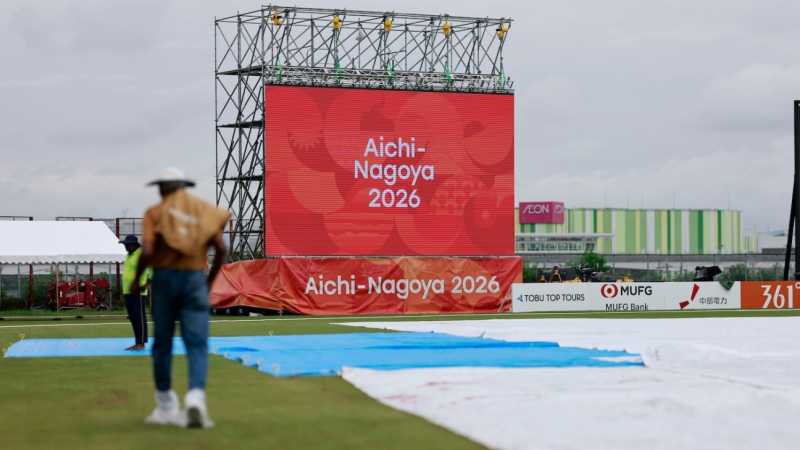
Sri Lanka will face India in the semi-finals of Asian Games men’s tournament after their quarter-final clash against Nepal was abandoned without a ball being bowled in Nisshin, Japan. The game was called off prior to the toss, with rain having begun hours prior to the scheduled 9am local start and not looking like abating.
Sri Lanka’s progression was assured by virtue of their higher seeding in terms of the ICC T20I rankings – Sri Lanka, alongside India, Pakistan and Bangladesh are the four seeded teams in the tournament. On Monday, India had qualified over Afghanistan after another washout, again by virtue of their higher. Similarly, Pakistan’s qualification was assured following a rain abandonment in their quarter-final against Hong Kong.
In the 2022 Asian Games, Sri Lanka had been eliminated at the quarter fial stages by Afghanistan. Another washout in the semis against, India though, will see the latter qualify for the final.
A few hours later, the fourth quarter-final between Bangladesh and Malaysia was also washed out. Bangladesh will now face Pakistan in the first semi-final on October 1, followed by India vs Sri Lanka later on the same day
(Cricinfo)
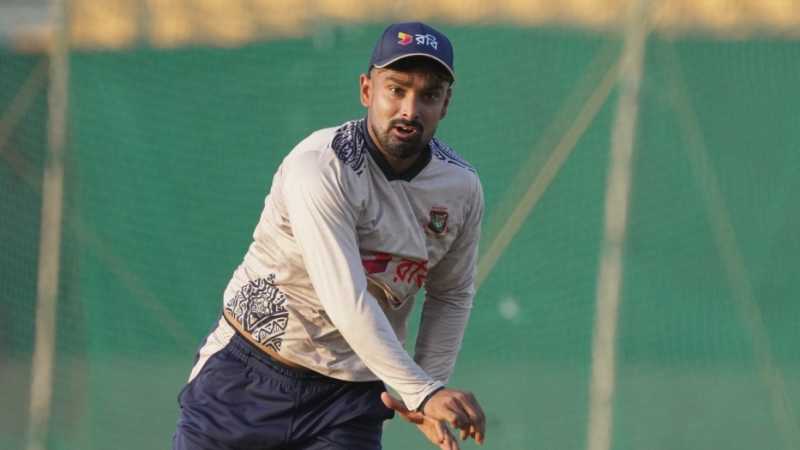
The Bangladesh vs Malaysia abandonment on Tuesday completed a quartet of rained off matches in the Asian Games men’s tournament. The match was called off two hours before the toss, with the teams told not to even turn up at the venue.
Bangladesh, by virtue of higher seeding, go through to the semi-finals where they will now face Pakistan on October 1. Earlier in the morning, the Sri Lanka vs Nepal fixture was also called off due to rain, with Sri Lanka advancing into the semi-finals where they will meet India.
There is, however, some good news, as the weather forecast in Nisshin is better for the semi-final and the medal match day, on October 1 and 3, respectively.
In the last edition (2023), Bangladesh had lost to India in the semi-final but won the third-place playoff against Pakistan to take home the bronze medal. They had won the bronze in 2014 as well and Bangladesh’s best finish was winning the gold medal in 2010, when they beat Afghanistan in the final.
(Cricinfo)
by Reemus Fernando
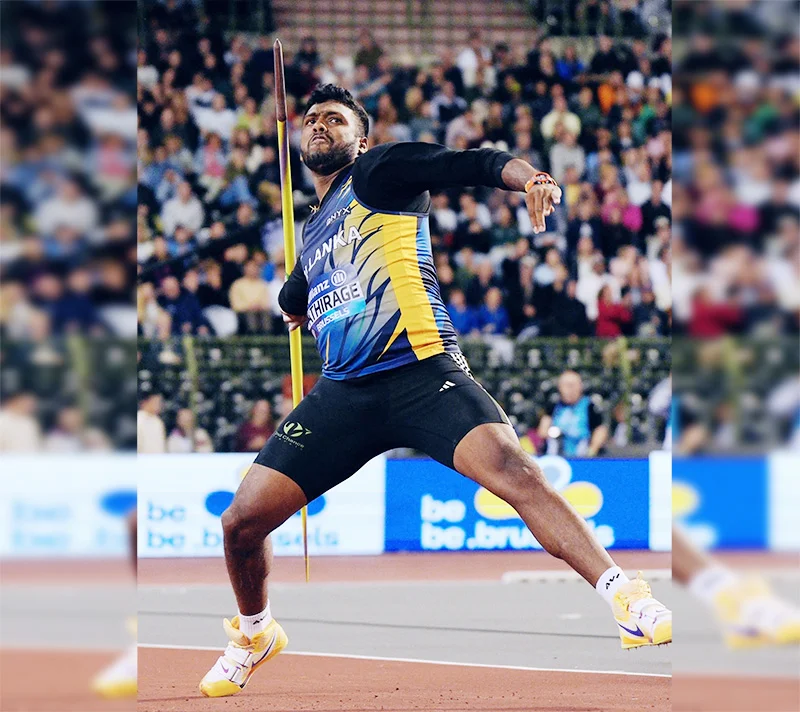
World javelin leader Rumesh Tharanga lived up to his billing to win Sri Lanka a highly anticipated gold medal, overcoming wet weather and a slow runway at the Asian Games in Nagoya, Japan, on Monday.
The overwhelming favourite after a string of victories at global level this year, Tharanga made an unlikely start, opening with 73.52m in the first round and trailing his South Asian rivals, including reigning Olympic champion Arshad Nadeem of Pakistan. At the halfway mark he surged ahead with a massive 88.33m, then sealed the contest with 88.55m.
”He rose like a true champion at the most crucial moment. It was an incredible performance in these wet conditions,” veteran coach Susantha Fernando, who watched from the stands, told The Island. “I was blessed to see a Sri Lankan win gold at back-to-back Asian Games.” Fernando’s own charge, Tharushi Karunaratne, won the 800m at the last edition. He was one of the team coaches at the venue yesterday.
The 23-year-old, trained by Tony Prasanna, arrived in Japan as world No. 1 and the season’s leading thrower. In June he became the first Sri Lankan to throw beyond 90m, launching a national-record 92.62m at the Rome Diamond League. In July he beat India’s Neeraj Chopra to take Commonwealth Games gold in Glasgow, and this month he won the inaugural World Athletics Ultimate Championship in Budapest. He also became the first Sri Lankan to win the Diamond League title. He was the only thrower in the field with two throws beyond 92m this season.
With such a reputation to carry, a Games record (89.15m) was widely expected, and Tharanga came close, but nearly every thrower struggled in the wet conditions.
With Chopra absent, India’s Y. Singh and R. Yadav took silver and bronze with 85.72m and 84.35m respectively. Nadeem finished just outside the podium with 80.29m. Former national record holder and Olympian Sumedha Ranasinghe was sixth with 78.08m.
Akalanka impresses in hurdles
Meanwhile, hurdler Ayomal Akalanka produced one of Sri Lanka’s best performances among those who narrowly missed the podium, finishing fifth in the men’s 400m hurdles.
Running from lane two, the 20-year-old clocked 49.37 seconds against an elite continental field. The former Ambagamuwa Central Udubulathgama athlete stayed in contention throughout the final and finished ahead of Japan’s Kazuki Kurokawa, India’s Santhosh Kumar Tamilarasan and Kazakhstan’s Vyacheslav Zems.
Qatar’s Bassem Hemeida won gold in 47.82, with Japan’s Taiju Goto taking silver in a personal best of 47.93. Taiwan’s Chung-wei Lin claimed bronze in a personal best 48.74, and his compatriot Jian-rong Chen was fourth in 49.25.

Cabinet nod to increase the number of new automated passenger clearance gates at the Bandaranayake International Airport to 12
Draft Bill for amending the Trust Ordinance
Implementing further relief programme to Public sffected by the Middle East conflict situation
Establishment of a Spectrum Management and Monitoring System and a Quality of Service and Quality of Experience System for the Telecommunications Regulatory Commission of Sri Lanka
Appointment of a Committee for the Restitution of Sri Lankan Cultural Heritage Held Abroad
Ten-Year National Action Plan on the Social Protection Sector (2026–2035)

‘Dates have the highest sugar content to fight Coronavirus’

Sunday Island 27 December – Headlines

#SundayIsland 17th December – Headlines

Sunday Island – 28th March

Sunday Island Headlines – 21 March

Sunday Island – 21st February – Headlines
-

 News7 days ago
Mastermind Naufer Moulavi among 15 found guilty
-
 Midweek Review7 days ago
Thileepan’s fast unto death: An authentic narrative that many missed
-

 Latest News6 days ago
Showers above 100 mm are likely at some places in the Western, Sabaragamuwa, Central and North-western provinces and in Galle and Matara Districts
-

 Editorial7 days ago
Big Bad Bills
-
Editorial6 days ago
Crimes punished and unpunished
-

 Features5 days ago
Beyond traditional jobs: Why Sri Lanka needs to facilitate the gig economy
-

 News7 days ago
No referendum needed for passage of 22 A: SC
-

 News7 days ago
One clause in Anti-Corruption (Amendment) Bill requires referendu: SC