
News
Hiding in obscure corner of India, Myanmar’s ousted lawmakers plotting to dethrone military junta

BY S VENKAT NARAYAN
Our Special Correspondent
NEW DELHI:
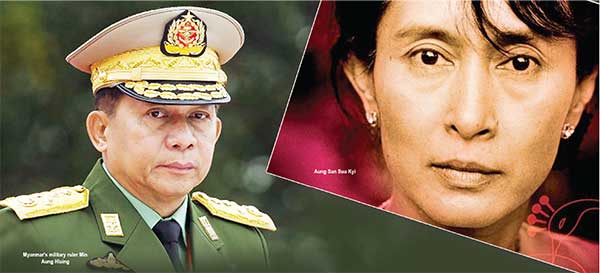
Roughly a dozen ousted Myanmar lawmakers, who fled to India after the February 1 military coup, are now busy plotting to dethrone the generals.
In a spartan hillside room in India furnished only with a thin sleeping mat, one of the Myanmar Members of Parliament (MPs) spends much of his days attentively listening to Zoom conference calls and tapping away messages on his smartphone.
The short, soft-spoken man is among the handful of ousted Myanmar MPs who have fled across the border to India’s remote north-eastern region after the military coup and the lethal crackdown on dissent.
Two of the lawmakers and a Myanmar politician spoke to a Reuters reporter. They are involved with the Committee Representing the Pyidaungsu Hluttaw or CRPH, a body of ousted lawmakers that is attempting to re-establish the civilian government and displace the military.
The three said the group is supporting demonstrations, helping distribute funds to supporters and holding negotiations with multiple entities to quickly form a civilian administration nationwide. They asked not to be named for fear of reprisals against their families back home.
Most of the ousted lawmakers are from deposed leader Aung San Suu Kyi’s National League for Democracy (NLD) that overwhelmingly won a November 2020 election, which the military has annulled.
The coup has been met with a fierce pro-democracy movement and tens of thousands of people have taken to the streets across the country, despite the crackdown.
Security forces have killed over 700 people, and more than 3,000 have been detained, including more than 150 lawmakers and members of the former government. Mobile and wireless internet services have been shut down.
The fear of detention and inability to rebuild a civilian government without internet connectivity has driven some Myanmar lawmakers involved in the resistance to work from India, the two MPs elected to Myanmar’s Parliament said.
“There is no time,” one of them, who is from the country’s western Chin state, told Reuters. “People are dying in our country.”
A spokesman for Myanmar’s military did not answer calls seeking comment. The junta has accused the CRPH of treason. The group is working to set up a national unity government to challenge the military’s authority.
Since fleeing to India around two weeks ago, the lawmaker said he had been holding regular discussions with colleagues to set up a parallel administration in Chin state, under directions from the CRPH.
The process is complex, involving building consensus between elected representatives, political parties, ethnic armed groups, civil society bodies and civil disobedience movement leaders, the two lawmakers and the politician said.
The CRPH is also keen on opening communications with India, where at least 1,800 people from Myanmar are already sheltering. It will seek New Delhi’s blessings for the parallel government it is attempting to form, the politician said.
“We can’t rely on China, Thailand and other neighbouring countries,” he said. “The only country where refugees are being welcomed is India”.
India’s External Affairs Ministry did not immediately respond to questions from Reuters.
This week, NLD lawmakers from Myanmar’s northern Sagaing region held an online conference call, but only 26 out of 49 representatives dialled in, according to the second MP who attended the meeting from India.
“We don’t know where the rest are,” the federal lawmaker said. Two party officials were now trying to track down their missing colleagues.
Some of the fiercest resistance to the junta has come from Sagaing. In the last two months, around 2,000 families involved in the civil disobedience movement in one part of the region have been given financial assistance of around 17 million Kyat ($12,143), the lawmaker from Sagaing said.
The presence and activities of escapee Myanmar lawmakers could pose a diplomatic quandary to India, particularly given New Delhi’s close ties with the Myanmar military rulers.
But India’s position on the Myanmar crisis itself appears to have somewhat shifted in recent weeks. This has also been acknowledged by some CRPH representatives.
At an United Nations Security Council (UNSC) meeting on April 10, Indian diplomat K. Nagaraj Naidu said New Delhi is pushing for a return to democracy in Myanmar. “The first, and most immediate step, in this regard is the release of detained leaders,” Naidu said.
However, India is concerned around internal divisions within the CRPH that could hobble its functioning, a source with knowledge of New Delhi’s thinking said.
The politician involved with the CRPH said he is hopeful that India will engage with the group.
“If democracy wins in Myanmar, it is also a win for India,” he said.

Latest News
Heat Index at Caution level’ in the Northern, North-central, North-western, Western and Southern provinces and in Trincomalee district.


Warm Weather Advisory
Issued by the Natural Hazards Early Warning Centre
Issued at 3.30 p.m. on 12 April 2026, valid for 13 April 2026.
Heat index, the temperature felt on human body is likely to increase up to ‘Caution level’ at some places in the Northern, North-central, North-western, Western and Southern provinces and in Trincomalee district.
The Heat Index Forecast is calculated by using relative humidity and maximum temperature and this is the condition that is felt on your body. This is not the forecast of maximum temperature. It is generated by the Department of Meteorology for the next day period and prepared by using global numerical weather prediction model data.

Effect of the heat index on human body is mentioned in the above table and it is prepared on the advice of the Ministry of Health and Indigenous Medical Services.
ACTION REQUIRED
Job sites: Stay hydrated and takes breaks in the shade as often as possible.
Indoors: Check up on the elderly and the sick.
Vehicles: Never leave children unattended.
Outdoors: Limit strenuous outdoor activities, find shade and stay hydrated.
Dress: Wear lightweight and white or light-colored clothing.
Note:
In addition, please refer to advisories issued by the Disaster Preparedness & Response Division, Ministry of Health in this regard as well. For further clarifications please contact 011-7446491.

On the apparent northward relative motion of the sun, it is going to be directly over the latitudes of Sri Lanka from 05th to 15th of April in this year.
The nearest areas of Sri Lanka over which the sun is overhead today (13th) are Pesalai, Mankulam and Nedunkerny about 12:11 noon.
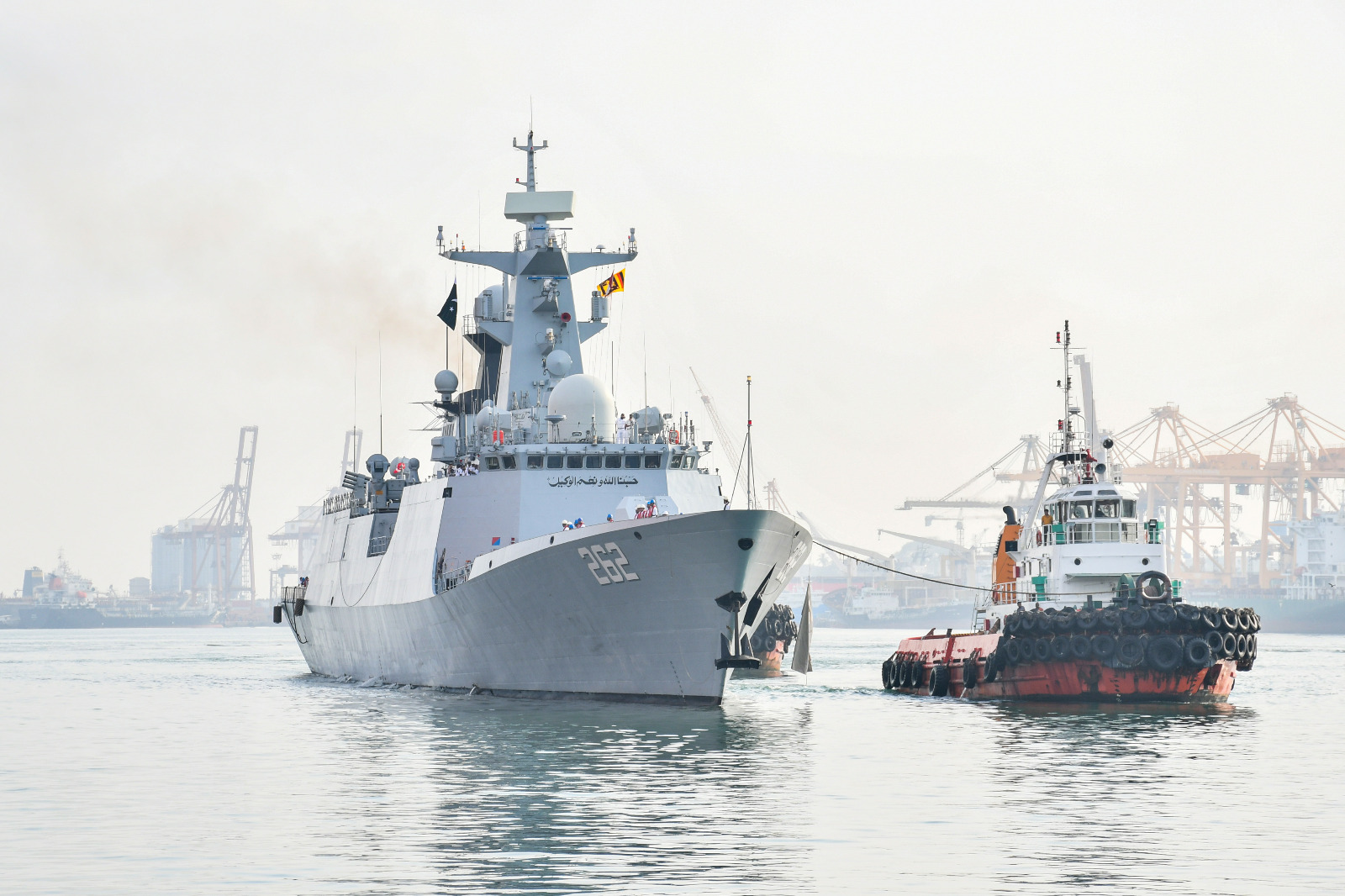
The Pakistan Navy Ship (PNS) TAIMUR and ASLAT arrived at the Port of Colombo on a goodwill visit on 12 Apr 26.
The visiting ships were welcomed by the Sri Lanka Navy in
compliance with naval traditions.
The duo of ships is commanded by Captain NIAMAT SAEED KHAN (PNS TAIMUR) and Captain NADIR MATEEN AFRIDI (PNS ASLAT).
Meanwhile, the ships are expected to conduct a Bilateral Naval Exercise LION STAR V with the Sri Lanka Navy in Colombo seas.

Salt and Patidar power RCB past Mumbai Indians

Prasidh, Buttler set up comfortable win for Gujarat Titans

Heat Index at Caution level’ in the Northern, North-central, North-western, Western and Southern provinces and in Trincomalee district.

Showers above 75 mm are likely at some places in the Western, Sabaragamuwa, Central, Southern and North-western provinces.

Sun directly overhead Pesalai, Mankulam and Nedunkerny about 12:11 noon

PNS TAIMUR & ASLAT arrive in Colombo

‘Dates have the highest sugar content to fight Coronavirus’

Sunday Island 27 December – Headlines

#SundayIsland 17th December – Headlines

Sunday Island – 28th March

Sunday Island Headlines – 21 March

Sunday Island – 21st February – Headlines
-

 News6 days ago
Lankan-origin actress Subashini found dead in India
-

 News1 day ago
CEB orders temporary shutdown of large rooftop solar systems
-

 News4 days ago
AG: Coal procurement full of irregularities
-

 Business3 days ago
Israeli attack on Lebanon triggers local stock market volatility
-

 Business4 days ago
Hayleys Mobility introduces Premium OMODA C9 PHEV
-

 Business3 days ago
HNB Assurance marks 25 years with strategic transformation to ‘HNB Life’
-

 News6 days ago
UN Regional Director launches SL’s first Country Gender Equality Profile during official visit
-

 News6 days ago
Dialog Launches ‘GanuDenu QR’, Making Cashless Transfers Free for All with eZ Cash and Dialog Finance