
Sports
Abdeen’s incredible journey in rugby spans a decade


By a Special Sports Correspondent
Sri Lanka’s legendary rugby player Hisham Abdeen has been actively involved with the sport played with the oval shaped ball for over five decades. That could be something to celebrate given all the gloom and the doom brought to us sportsmen and sports lovers via the pandemic.
In an interview with ‘The Island’ newspaper done at his second home-Havelocks Sports Club- the 61 year old recalled his heydays on the field and what he felt about the future of rugby union in Sri Lanka.
Abdeen said that it’s of prime importance to get the players mentally ready after the pandemic because the ‘break’ from the game was forced on the players and wasn’t voluntary. “They have missed so much and some couldn’t play for their schools in the final year of academic studies. It’s good if Sri Lanka Rugby can arrange an under 21 tournament for the benefit of all those players who missed the last year of school rugby,” said Abdeen who has again started running his academy called Hisham Abdeen Rugby Football Academy (HARFA). As many as 75 players from this academy have represented the First XV teams of their schools and around 10 players have represented the country.
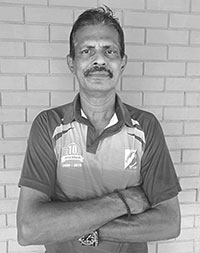 There was a time when the trend of bulking up using power training and loading on supplements made rugby a brutally contact game. But then despite the doors being opened up for spectators after the third wave of Covid patrons are not very keen on witnessing games; this is probably because of the predictable nature of matches. “There are too many hits and players lack individual skills. Very rarely do we see today a player being able to kick with both legs, punt the ball or kick a grubber,” said Abdeen. According him players of his era invested much time on personal training to lift their skills and the game.
Despite having so much credentials in the game Abdeen has stuck with schoolboy players and university undergraduates when choosing his assignments as a coach. This could be because he pays special attention and emphasis on making the players grasp the basics of the game. The other factor he focuses is on fitness. “Fit players rarely get injured,” underscored Abdeen.
We can remember how Abdeen shone for his schools-initially for Zahira and then for Isipathana College. He played for Havelocks SC as a schoolboy in 1979 and the following season (1980) he stamped his class in the school season by scoring 25 tries wearing the green jersey. This type of achievement where a schoolboy plays for a club while still being in school is rarely heard of. When Abdeen made it to the Havelocks SC side he had to play as a second row forward because the Park Club’s third row was occupied by dazzling players in the likes of Jeff de Jong, Anjelo Wickremaratne and Geoffrey Yu. There were days when he was a marked man. But on a day where he had everything coming right for him he scored eight fabulous tries. That performance came against Army SC at Longden Place. That performance was equaled by Army’s Sithara Fernando in an A Division club rugby game many years later.
Abdeen’s power came probably through the training he did and thanks to his favourite meal-rice and curry. He was a fitness fanatic and trained beyond the capacity of the average club rugby player. As for the rice he ate there are so many interesting stories associated with this aspect of his life. “Once at the Hong Kong Sevens in 1983 the BBC journalist, knowing that there were riots in my country, asked me what the problem was and I replied saying that the problem I have right now is that there is no place in Australia where I’m staying where I can have a decent rice and curry meal”. During Abdeen’s time the players were not remunerated for their availability. But he used to tell at least this much, “No rice, No game”.
Abdeen was a freak. He ate what he wanted and trained the way he wished. He never did weights for strength training purposes. He believed in natural fitness, solid technique and perfect timing when bringing down a player twice his size. Players feared Abdeen and when he tackled you just stayed ‘put’ for a while. Several players tried to imitate his walk and copy his playing style but all that proved to be a waste of time. The Abdeen we saw was ‘one and only’ and he could only be appreciated, not copied.
There were other reasons to say that he was a freak. He represented the country in three sports; rugby union (Last tour in 1993), Soccer (last tour in 1986) and sepak takraw (the last tour in the 1990s ). At present sportsmen and women cannot even think doing a second sport because of the demands in any one of the chosen disciplines are so high.
He also had his share of successes as a coach with the national side. He rates the island’s appearance at the Hong Kong Sevens in 2009 as memorable for him as a coach. “Radeeka Hettiarachchi scored twice in the match against Australia and we had a grand tournament that year. There were many new comers to the side during that tour and I was able to guide them to play at the top level,” he said. He was also a national selector for more than ten years. He is also a life member of Sri Lanka Rugby.
Abdeen now concentrates on his academy and serving the game which has given him a tremendous identity. That old saying which underscores the fact that there is a strong woman behind every successful man is fitting to Abdeen’s life story. According to him his wife ‘Jeni’ has been his source of strength and plays a major role in the academy when it comes to handling player registrations at HARFA and parents of players.
Abdeen had so much of successes, but no achievement could make him too big for his boots. Even today he remains humble and available for those who need him. He still enjoys sitting on the bench as a coach and contributing to the game he loves so much. Because individuals like Abdeen know that there is no set amount to give a signal to a player to indicate that he has given back enough to the game.

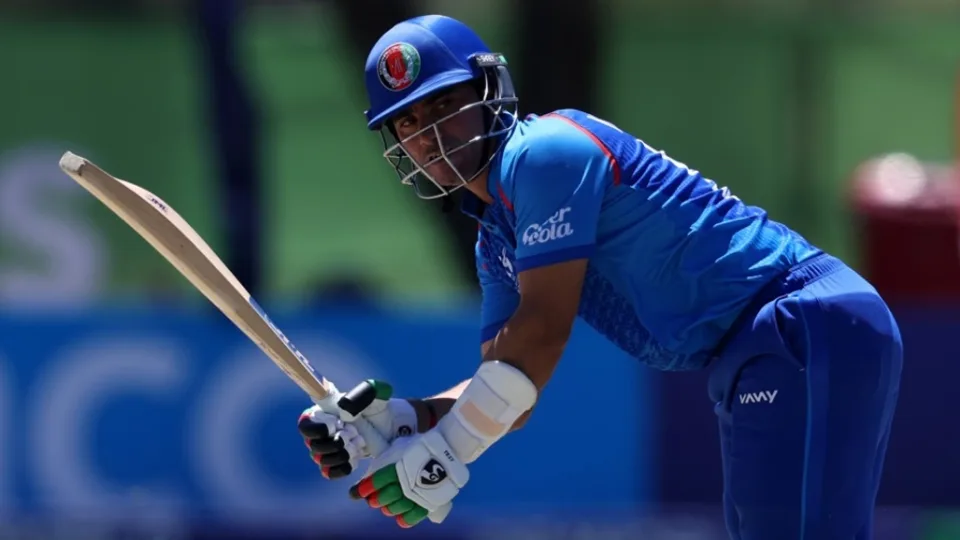
Contrasting half-centuries from Oman Sadat and Mahboob Khan set up Afghanistan’s 13 run win over West Indies. They wrapped up the win when Nooristani Omarzai bagged his fourth wicket. With two wins in as many games, Afghanistan have locked in their Super Sixes spot.
After Afghanistan opted to bat, Sadat and Khalid Ahmadzai put on 86 for the opening wicket before Vitel Lawes, the sixth bowler West Indies used in 18 overs, created a brief stutter. He struck three times in eight overs as Afghanistan lost 3 for 24. Mahboob then steadied the ship in Sadat’s company, adding 77 for the fourth wicket. While Sadat took 68 balls to get to his fifty, Mahboob got there in 54, before accelerating. Mahboob scored 36 off his next 15 balls as Afghanistan scored 79 off the last ten overs to post 262 for 7.
In reply, only Jewel Andrew, who has played eight internationals for West Indies’ senior side, and 15 CPL matches, offered some resistance. He scored 57 off 70 balls, laced with four fours and three sixes, and was the eighth wicket to fall with the score on 101.
West Indies had lost their first four wickets inside 11 overs. While Wahidullah Zadran started the slide in the first powerplay with his offspin, seamer Omarzai’s strikes through the middle overs was too much for West Indies, who were bowled out for 124.
Brief scores:
Afghanistan Under 19s 262 for 6 in 50 overs (Osman Sadat 88, Mahboob Khan 86; Jakeem Pollard 3-39, Vitel Lawes 3-48) beat West Indies Under 19s 124 in 33.2 overs (Jewel Andrew 57; Nooristani Omarzai 4-16, Khatir Stanikzai 3-20, Wahidullah Zadran 3-36) by 138 runs
[Cricinfo]
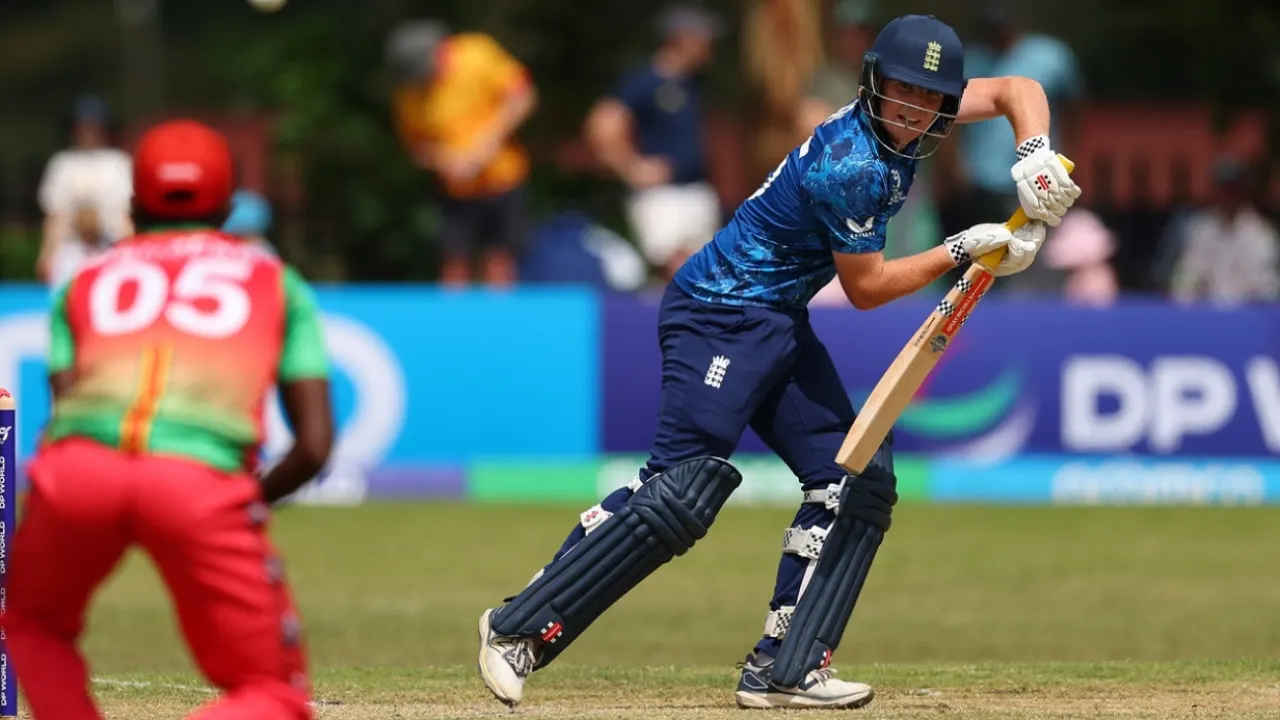
England have confirmed their place in the Super Sixes of the Under 19 World Cup 2026 after crushing hosts Zimbabwe to register successive wins in the group stage. Captain Thomas Rew (86*) and Ben Mayes (77*) led the chase of 209 in Harare. England asked Zimbabwe to bat first, and struck third ball as Alex French got Nathaniel Hlabangana for a duck.
From there onwards, each time a partnership looked stable for Zimbabwe, England hit back to disrupt their momentum. There were stands of 30, 45 and 32 for the second, third and fourth wickets, respectively, with Luke Hands, Farhan Ahmed and Ralphie Albert among the wickets.
All Zimbabwe batters from Nos. 3-6 scored at least 30 but none passed captain Simbarashe Mudzengerere’s 45 not out. England’s Manny Lumsden got three wickets.
In reply, England got off to a quick start. They were two down within seven overs, but had also scored 48. Rew and Mayes had got together on the fifth ball of that over, and their union remained unbroken on 167. Rew was the first to get to fifty off 30 balls by smashing Dhruv Patel for a six in the 18th over. Mayes got a run-a-ball half-century in the 22nd over, as England clubbed the final 64 runs in seven overs to win with a whopping 22 overs to spare.
Zimbabwe’s loss came after their first game, against Scotland, was washed out. They face Pakistan next, and could find it tough to enter the next round.
Brief scores:
England Under 19s 209 for 2 in 28 overs (Thomas Rew 86*, Ben Mayes 77*; Shelton Mazvitorera 2-54) beat Zimbabwe Under 19a 208 for 9 in 50 overs (Simbarashe Mudzengerere 45*; Manny Lumsden 3-38, Farhan Ahmed 2-33, Ralphie Albert 2-49) by eight wickets
[Cricinfo]
Latest News
Mitchell, Phillips centuries trump Kohli’s as New Zealand win first-ever ODI series in India

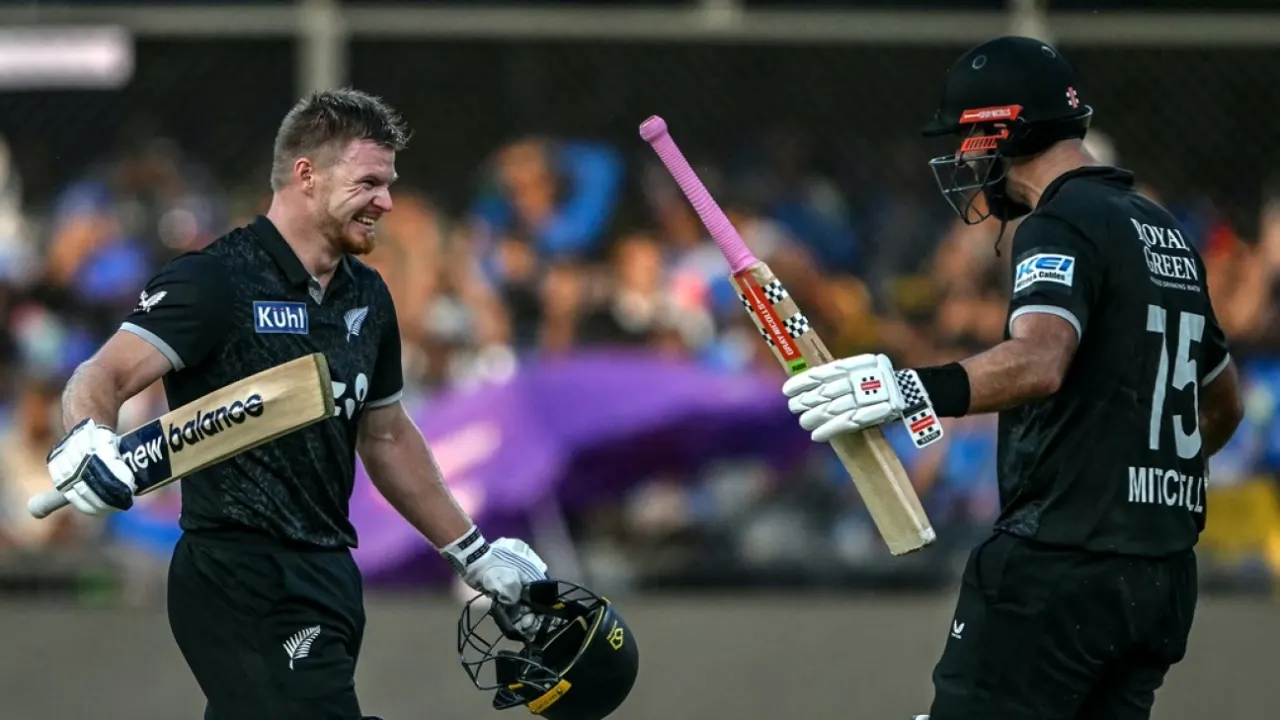
A little over a year since winning their first-ever Test series in this country, New Zealand have beaten India in India for the first time in an ODI series. Arriving with a squad severely depleted by injury, they have come from 1-0 down to win 2-1.
They achieved another impressive feat in completing the job in Indore, handing India a first defeat in 14 home ODIs where they have won the toss.
Daryl Mitchell India’s foremost scourge, was at it again, scoring his second hundred of the series, his fourth against India, and his fourth in India. Glenn Phillips, who joined Mitchell at 58 for 3, scored an 88-ball 106 in a fourth-wicket stand of 219. That set things up perfectly for the bowlers, who, defending 337, reduced India to 71 for 4. An India, that too, without Axar Patel and Hardik Pandya, and with question marks hanging over everyone batting from No. 6 down.
Virat Kohli was still there, though, and he kept India believing, scoring his 54th ODI hundred and shepherding two young seam-bowling allrounders in Nitish Kumar Reddy and Harshit Rana who scored their maiden ODI fifties. But the target was steep, India had to keep taking chances, and Kohli eventually fell short for only the fifth time in 29 hundreds in ODI chases.
There were three phases in Kohli’s innings. The first, following a pattern established over recent months, was frenetic, displaying an eagerness to charge fast bowlers and hit them in the air if required, and bringing four fours and a six in his first 24 balls. Then, with wickets tumbling at the other end, a period of nearly dot-free rebuilding, with just the one boundary in 52 balls, scoring 47 runs regardless.
And then, when Reddy and Ravindra Jadeja fell in the space of 28 balls, came the explosion. It was necessary, with India now needing 160 at nearly nine an over, and it came from both ends. Kohli punched, whipped and lofted his way from 74 off 76 balls to a century in 91, while Rana showed both muscle and finesse in rushing to his half-century in just 41 balls.
But Rana’s dismissal, which left India needing 61 off 38 balls, left the chase entirely in Kohli’s hands, and it was all over when he was ninth out after bringing the equation down to 46 from 27.
Different bowlers delivered for New Zealand at different times. Kyle Jamieson seamed the newish ball both ways to peg India back after a quick start, most crucially taking out a rampant Shubman Gill with an in-ducker. Jayden Lennox, playing just his second ODI, looked entirely at ease at a venue unforgiving to spinners, with a notoriously small outfield, bowling with pinpoint accuracy while constantly varying his pace and taking 2 for 42 in his ten overs. Zak Foulkes and Kristian Clarke, though expensive, picked up three wickets each. And Phillips, bowling eight overs with New Zealand captain and primary offspinner Michael Bracewell off the field, went for under seven an over.
Together, Lennox and Phillips took 2 for 96 in 18 overs. India’s spinners, Kuldeep Yadav and Ravindra Jadeja, bowled just six overs each and went for a combined 89 runs. Once again, New Zealand’s spinners had outbowled India.
And this, as in Rajkot, had a lot to do with how well their batters took on Kuldeep and Jadeja. Mitchell, in a manner now familiar, set the tone, jumping out to Kuldeep’s first ball and launching him for a straight six.
There was little breathing room for the spinners thereafter, and India didn’t even bring Jadeja on until the 30th over, trusting instead in their sixth bowler, Reddy, to do a job of bowling stump-to-stump medium-pace with the keeper up. He did this well at first, conceding just 17 in his first four overs, but he began looking increasingly innocuous as India kept him on for perhaps two overs too many, conceding 36 in his last four.
As India struggled to find a wicket through the middle overs, Mitchell and Phillips switched gears effortlessly. The first 70 runs of their partnership came in 89 balls; thereafter they plundered 149 in 99. Mitchell timed the ball ominously from the start, the clearest sign of his form the way he punched through the infield with a straight bat on both sides of the wicket, and attacked the spinners from all points: from yards down the pitch to right back by his stumps. Phillips, cutting with fast hands, and clearing the small boundaries with ease when he chose to, rushed from 21 off 36 to bring up his second ODI century off just 83 balls.
New Zealand looked set for at least 350 at one stage, but lost wickets in clumps through the death overs, with Mohammed Siraj bowling magnificently – getting his wobble-seam ball to grip, bowling relentless good lengths when that was required, and pinpoint yorkers and bouncers when that was the need of the hour – to finish with figures of 0 for 43 in ten overs and Arshdeep Singh and Rana more expensive but taking three wickets apiece.
Given Indore’s history of steep scoring – only Trent Bridge and the Wankhede have produced more than 380 plus ODI totals than Holkar Stadium – 337 looked like anyone’s game at the halfway point. Eventually it was more than enough, despite the evergreen Kohli’s best efforts.
Brief scores:
New Zealand 337 for 8 in 50 overs (Daryl Mitchell 137, Glenn Phillips 106; Arshdeep Singh 3-63, Harshit Rana 3-84) beat India 296 in 46 overs (Virat Kohli 124, Nitish Kumar Reddy 53, Harshit Rana 52; Kristian Clarke 3-54, Zak Foulkes 3-77, Jayden Lennox 2-42) by 41 runs
[Cricinfo]

At least six killed in Pakistan as fire rips through Karachi shopping mall

Chile declares ‘state of catastrophe’ as deadly wildfires menace cities

At least 21 killed in Spain after crash involving high-speed trains

U – 19 World Cup: Mahboob, Sadat star for Afghanistan against West Indies

U – 19 World Cup: Rew, Mayes lead England to victory

Mitchell, Phillips centuries trump Kohli’s as New Zealand win first-ever ODI series in India

‘Dates have the highest sugar content to fight Coronavirus’

Sunday Island 27 December – Headlines

#SundayIsland 17th December – Headlines

Sunday Island – 28th March

Sunday Island Headlines – 21 March

Sunday Island – 21st February – Headlines
-

 Editorial1 day ago
Illusory rule of law
-

 News2 days ago
UNDP’s assessment confirms widespread economic fallout from Cyclone Ditwah
-

 Business4 days ago
Koaloo.Fi and Stredge forge strategic partnership to offer businesses sustainable supply chain solutions
-

 Editorial2 days ago
Crime and cops
-

 Features1 day ago
Daydreams on a winter’s day
-

 Editorial3 days ago
The Chakka Clash
-

 Features1 day ago
Surprise move of both the Minister and myself from Agriculture to Education
-

 Business4 days ago
SLT MOBITEL and Fintelex empower farmers with the launch of Yaya Agro App