
Sports
Head spearheads Australia’s sixth World Cup triumph

Rex Clementine in Ahmedabad
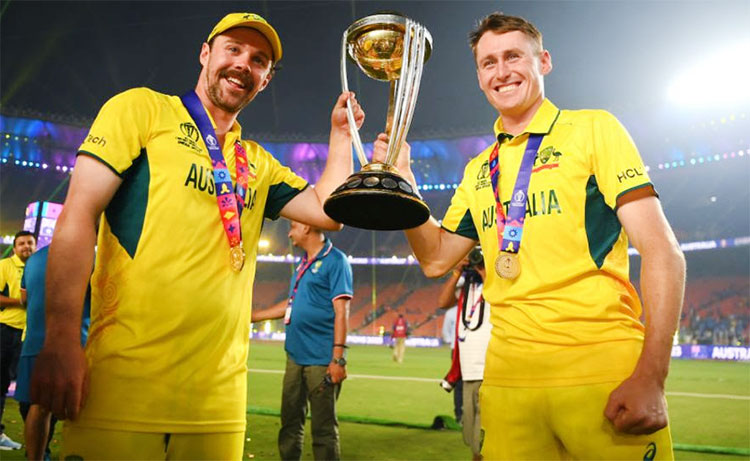
Wonder why Australia value Travis Head so much? Well, the proof was there to be seen in the World Cup final yesterday here in Ahmedabad. The middle order batter was named in their World Cup campaign despite a fractured left hand. Big call. Such a big call that he in fact missed Australia’s first five games. But when it came to the business end of the sport’s showpiece event, he showed his worth with an unbeaten hundred in the final that saw Australia winning the World Cup for a sixth time.
India were tournament favourites, by a country mile. They had been unbeaten in the competition and had all bases covered but it takes just one bad game for the wheels to come off and they came off in a hurry.
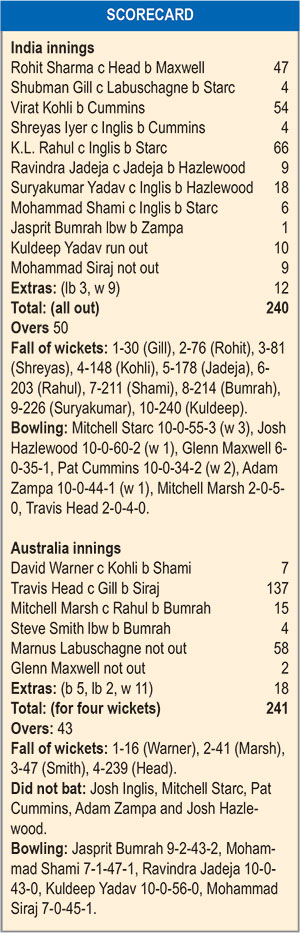
When Rohit Sharma was batting, it looked a batting paradise. The Indian captain raced to 47 off 31 balls with four fours and three sixes. It needed a blinder from Head to dismiss Rohit.
Rohit had hit Glenn Maxwell for a four and a six in one over and in the same over he stepped out of the crease to clear the off-spinner but didn’t connect properly and Head sprinted from extra cover and pulled off a diving catch.
After Rohit’s dismissal, India didn’t have any momentum to their innings. Despite Virat Kohli and K.L. Rahul scoring half-centuries, the big hitting was missing by both batters and Australia did well to restrict the formidable Indian batting line-up to 240.
If any team could make a game out of this and defend 240 it was India given their bowling resources.
And they did well restricting Australai to 47 for three. When Steve Smith was gone, trapped leg before wicket, India had their hopes high. Head was at fault too for not asking his former skipper to review, which could have saved him.
 However, he took it upon himself to see through the run chase.
It was a fabulous effort. Chanceless and had calculated risks. Of course, the required run rate was never a problem so he could pace his innings well, but the skill levels to counter this attack were fabulous.
India were searching for wickets and placed attacking fields. When Head counterattacked, Rohit knew he didn’t have much to defend and had to spread the field.
It was a clever run chase. India were in the game only when the new ball did something and couldn’t overcome Head.
While Head received all the accolades, Marnus Labuschagne was a silent hero. They shared a 192 run stand for the fourth wicket. The partnership was broken with just two runs needed for the win as Head tried to finish it off in style but failed to clear the long-on boundary.
Labuschagne was unbeaten on 58 that came off 110 balls. Head finished on 137 in 120 balls with 15 fours and four sixes.



The ICC has introduced a trial allowing pink balls to be used in daytime Test matches, among a series of changes to the Playing Conditions that come into effect for international series beginning on October 1.
The pink-ball provision is aimed at reducing the loss of playing time due to bad light. Its use will require mutual agreement between the two teams before the start of the Test and, once agreed, the ball colour cannot be changed during the match.
Continuing the push to make full use of playing time, the ICC will also clamp down on excessive time-wasting by batters in men’s cricket. A batter who is not ready to face the next delivery within the prescribed time, in the umpires’ view, will receive a warning for the first offence, followed by a final warning for the second. A third and each subsequent offence will result in five penalty runs being awarded to the fielding side, with Code of Conduct provisions potentially invoked for repeated offences.
Time-wasting came into focus during the Lord’s Test in 2025 when India captain Shubman Gill alleged that his confrontation with Zak Crawley stemmed from the England opener and his batting partner Ben Duckett seemingly arriving at the crease 90 seconds late when tasked with seeing out one final over before close of play on Day 3.
In another Test-specific change, following an MCC recommendation, the fall of a wicket in the final over of the day’s play will no longer automatically bring the day’s play to an end. If conditions remain suitable and the over has not been completed, the remaining deliveries will be bowled rather than carried over to the following day.
The ICC has also tightened the specifications for balls used in women’s international cricket, with separate size and weight requirements now in place for men’s, women’s and junior cricket. A new men’s ball must weigh between 5.5 and 5.75 ounces (156-163 grams) and measure 22.4-22.9 centimetres in circumference. For women’s cricket, the ball must weigh 5-5.25 ounces (142-149 grams) and measure 21.5-22 centimetres in circumference.
Among other changes following MCC recommendations, the ICC has also clarified the requirements around control of the ball, an area that has frequently come under scrutiny in run-out and stumping decisions. The revised laws make it explicit that mere contact with the ball is insufficient for a dismissal. For a wicket to be valid, the ball must be held with complete control at the moment the stumps are broken. Simply brushing the ball with a hand or glove while dislodging the bails will no longer meet the requirement.
The umpire will also have greater leeway in determining whether a ball is finally settled. The ball no longer necessarily has to be in the bowler’s or wicketkeeper’s hands to be considered finally settled.
Meanwhile, in ODIs and T20Is, the 15-minute interval in T20Is is now fixed, although it can be reduced to a minimum of 10 minutes when time has been lost. The ODI and T20I Playing Conditions are now aligned to allow the ‘Head Coach or their designate’ to enter the field of play at drinks intervals. [Cricbuzz]
Sri Lanka’s Asian Games gold medal hopes ended in humiliating fashion yesterday as they were bundled out for a paltry 45 in Nisshin, suffering a crushing 124 run defeat at the hands of defending champions India in the semi-final of the men’s cricket competition.
Set 170 for victory on a difficult surface, Sri Lanka’s chase never got off the ground as India’s bowlers exploited a cracked pitch superbly. The innings descended into a procession, with Sri Lanka bowled out for 45, the joint-lowest total by a Full Member nation in men’s T20 Internationals.
West Indies had also been dismissed for 45 by England in 2019.
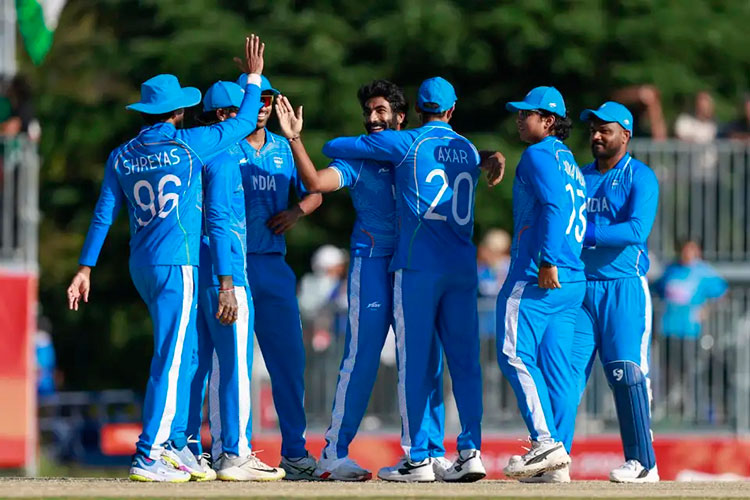
Jasprit Bumrah led the demolition with two wickets for seven runs, while Axar Patel claimed two for eight and Abhishek Sharma returned remarkable figures of two for two. Sri Lanka compounded their problems with three run outs, including two involving top-order batters.
India’s bowlers hardly needed an invitation. Bumrah operated on probing Test match lengths and proved almost unplayable on a surface where the ball occasionally behaved alarmingly, while Axar strangled the batters with 14 dot balls.
The collapse was particularly disappointing after Sri Lanka had done reasonably well with the ball to restrict a powerful Indian batting line up to 169 for seven.
Ishan Kishan proved the difference between the sides, remaining unbeaten on 80 off just 46 deliveries, although Sri Lanka were left to rue opportunities that went begging.
Kishan enjoyed his share of fortune with several mistimed aerial strokes landing safely, but the biggest reprieve came when Nuwanidu Fernando put him down on 56. India’s wicketkeeper batsman made Sri Lanka pay heavily for the lapse.
Vaibhav Sooryavanshi chipped in with 38, while Sri Lankan skipper Sahan Arachchige returned two for 28 and Pavan Ratnayake picked up two for 32.
The surface, riddled with cracks, was never straightforward for batting and a couple of deliveries misbehaved sharply during India’s innings. But whatever difficulties India encountered, Sri Lanka found them considerably harder to negotiate.
Their 45 was also the second-lowest total recorded in the men’s cricket competition at the Asian Games.
The defeat ended Sri Lanka’s hopes of reaching the gold medal match, while India advanced to face arch-rivals Pakistan in the final , the first India-Pakistan final of the year, with the Asian Games title at stake.

by Reemus Fernando
St. Joseph Vaz’s College Wennappuwa and Lyceum Inyernational Wattala rode their sprint strength to the Boys and Girls overall titles as Hansana Jayasinghe and Risana Hirupama bagged the best athlete awards of the Sir John Tarbat Senior Championships concluded on Thursday.
Lyceum’s Hirupama who dashed to victory breaking Dhamayanthi Dharsha’s longstanding record in 200 metres was awarded the best athlete title in the girls’ category. She clocked 24.10 seconds in a closely contested final against Dharmapala College Pannipitiya sprinter Ransini Perera (24.63).
The duo delivered another thrilling performance in the 100 m final as well. Once again Hirupama came on top winning in 11.98 seconds. Ransini prevented a one two finish for Lyceum by placing second ahead of Dhananjana Fernando. As expected Lyceum were the winners of the 4×100 metres relay where once again the powerful presence of Ransini made it a battle between the two schools for the gold.
World Junior Championship participant Hansana Jayasinghe of St. Benedict’s College came up with another dazzling performance to win the Under 20 boys’ triple jump. His 16.23 metres feat sealed the best athlete title in the boys’ category.
I.M. Bogoda’s dashing run in the Under 20 boys’ 400 metres was probably the highlight for St. Joseph Vaz’s as they claimed the boys’ overall championship with a tally of 167 points. Maris Stella College Thimbirigaskatuwa were the runners up with 108 points.
Bogoda clocked 46.96 seconds to win the one lap race in a near top national level feat.
S. Thomas’ high jumper S. Thribashith who cleared 2.09 metres in the Under 18 high jump and St. Joseph’s Balika Kegalle athlete Sithmini Ranaweera who cleared 6.12 metres to win the Under 20 long jump and Bogoda were awarded for their outstanding performances.
The Lyceum International won the overall girls’ championship with a tally of 192 points, while Ratnayake Central Walala were placed second with an aggregate of 125 points.

Showers or thundershowers will occur in most parts of the island after 1.00 p.m.

Unions resist tripartite EPF management plan

Two arrest warrants issued for Gnanasara thera

CA dismisses GR’s writ petition against arrest

ADB-backed virtual net metering project faces policy contradiction

Media action group flays NPP over new anti-terrorism law

‘Dates have the highest sugar content to fight Coronavirus’

Sunday Island 27 December – Headlines

#SundayIsland 17th December – Headlines

Sunday Island – 28th March

Sunday Island Headlines – 21 March

Sunday Island – 21st February – Headlines
-

 Editorial6 days ago
Birth of a bad law
-

 News4 days ago
Police remove Thileepan statue in Jaffna
-

 News6 days ago
TIN mandatory for key transactions from Nov. 1
-

 Features4 days ago
The 22nd Amendment, constitutional recovery and illiberal slippage
-

 Features4 days ago
Of foreigners as CEOs of Lankan ventures
-

 Latest News2 days ago
Gold winner Tharanga gets brand-new Honda Vezel from SLAAJ
-

 News4 days ago
Sajith rejects Jt. Opp. protest sabotage claim; SJB TU chief demands remedial action
-

 Features3 days ago
Thailand’s biggest new global star …