
Opinion
Hartal call for ‘Horu Go Home’


By Lucien Rajakarunanayake
I was 14 plus when the first hartal took place in what was then Ceylon. We had only print and radio for news, yet the LSSP-led mass protest did have echoes of workers and people’s action, police shooting, 10 persons killed, and the overall failure of the government leadership.Sixty-nine years later, the present Hartal is certainly a country and nationwide rising of the people, moving from the fuel, milk and gas queues, to a decisive political movement, calling for a complete change from the corrupt governance in Sri Lanka.

There is hartal action in all parts of the country today, with almost all public and private sector services halted, and a call for a nationwide change in the process of governance and the politically manipulated economics of the country.The Parliament is certainly the place of most interest of the people, in what is an electoral democracy; and where the key interest of Members of Parliament would be in resolving a situation of national crisis. But the Parliament of today is certainly furthest from such need and reality.The key issue in Parliament yesterday was the election of a Deputy Speaker – an office of no attachment to politics or government. Instead, it was a complete farce in the parliamentary process. The Deputy Speaker who resigned – for no reason of politics, governance or parliamentary process, whose resignation papers even went to the President — re-contested for the same office! Ranjith Siyambalapitiya was re-elected with a large majority, defeating one of the best MPs in the House, who is also the son of another Speaker, and a member of a minority community.
The focus on Gotabaya and Mahinda Rajapaksa as the targets of the mass movement to change the prevailing system of corrupt politics and governance, has certainly moved to the wider message of “Horu Go Home ” – send all thieves back to their homes.It is a sharp and necessary rise in the call of the people, for a major and meaningful change of government. It also focuses on the need to change the parliamentary system in the country – to give real meaning to the votes of the people, and not elect people to positions of corruption.What is needed today is to preserve parliamentary democracy – in its full meaning and content. The mass struggle of today – the hartal – is the call for true democracy, which was not the best from 74 years of freedom in 1948, and much worsened and hugely corrupt after 1977. The unity of the protesters at Galle Face, near Temple Trees, the approach to the Parliament, as well as in all parts of the country – with no divisions on race, ethnicity, caste and religion – should be the call for true unity in democracy.
The actions of some crooked politicians, in the past months, and after the mass uprising of the people began, call for the exposure of corrupt politics and crooked politicians who are trying to grab the flag of success in today’s struggle of the people. Can we forget the Wimal – Udaya – Vasu politicians who were the lead players in the “Ugly American” politics, with Basil Rajapaksa as the target?
In the crooked politics of today, the ugliness of Basil R is no more. He is a key player in the anti-people politics of today. Those who happily voted for the 20th Amendment, which brought Basil into Parliament, and the Finance Ministry, are now pleased to have a non-ugly American Basil in the maneuvers of crooked parliamentary politics.The recent non-worthy actions of the Parliament with a huge SLPP, pro-Gotabaya majority, even with the questionable breakaways with the non-ugly American Basil, throws a huge weight on the people to save our democracy from the powers of crooked and dirty politics. What we see amidst this Hartal is the continuing power of the thieves – in politics, finance and all the power of The Horu.The headline of yesterday’s (06) editorial in The Island is “Idiocy at its worst”. It is a layout of the idiocy that prevails in all aspects of governance. It quotes SJB MP Mujibur Rahman’s warning that “the people are so incensed that they might even set Parliament on fire, unless it finds solutions to their problems.”
There is the prevailing necessity to move away from the idiocy of politics and governance, and bring to the real goal of today’s Hartal. It is the call to bring an end to thieves, crooks, culprits, and criminals in our politics and governance, with a resounding call for all… “Horu Go Home”.The Hartal of 1953 did bring several important changes – the availability of rice to the people, and the resignation of the then Prime Minister, too. The Hartal of today calls for much more – from resignations of key people, to the removal of many others, and the cleaning up of our politics and governance. “Horu Go Home” is the call of today. It can very well come to sending all Horu to Jail – Horu Hireta – which is the rising call of the people.

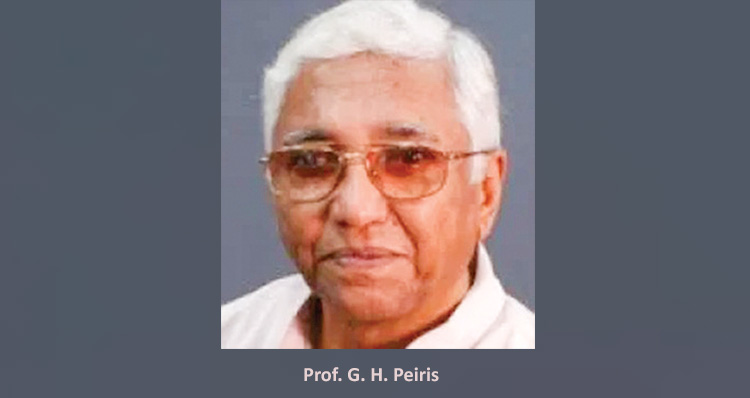
Prof. G. H. Peiris PhD, Emeritus Professor, University of Peradeniya, passed away on the 20th September 2026. His mortal remains were donated to the Anatomy Department, Faculty of Medicine, University of Peradeniya, according to his wishes. He was born on 30th January, 1938, in Junagaha, close to Negombo, and entered the University of Ceylon, at the age of 17 years. After obtaining a first class honours degree in Geography, the first to do so in the history of the University, he joined the staff of the Geography Department, Peradeniya University, and soon proceeded to Cambridge University to read for his doctorate.
Prof. Peiris excelled in academic work in teaching and research while serving the University for 43 long years. His research delved deeply into land reforms, economic and social change, irrigated agriculture, university education and ethnic conflict. He held visiting professorial appointments in Australia, Canada, the United States and Norway, and has undertaken sponsored study tours in the Philippines and the United States. His consultancy assignments include those conducted for the ILO, WHO and UNICEF. He has collaborated with scholars from India, Pakistan, Bangladesh, Nepal, Syria, the Netherlands and the United States in major research projects.
Based on his research, he debunked the homeland theory concocted by separatists.
Prof Peiris was appointed to the committee to draft a new constitution by the Gotabaya Rajapaksa government in 2020. He did not agree with the views of several members of the committee on the matter of federalism as a solution to the ethnic conflict. He held that the best solution would be devolution at the district level and consequently he submitted a dissenting report to the final draft constitution. In his extensive academic work and policy stances, such as his thesis Federalism and the ‘Federal Option’ for Sri Lanka, he argued that shifting from a unitary to a federal structure would not resolve ethnic tensions. Instead, he characterised federalism in the Sri Lankan context as an “absurdity,” given the island’s small geographic size.
He firmly contested the concept of a combined Northern and Eastern Province acting as a federal unit. He vocally opposed the “Traditional Tamil Homeland” hypothesis, arguing that merging these provinces, along ethnic lines, created severe risks to the country’s territorial integrity and ethnic harmony. Peiris maintained that supreme political power must be confined to the government.
After retirement, in 2003, Prof. Peiris authored and edited several major books focusing on socio-economic development, land policy, and ethnic conflict and these include; Sri Lanka: Challenges of the New Millennium (2006), Twilight of the Tigers: Peace Efforts and Power Struggles in Sri Lanka (2009), Political Conflict in South Asia (2013), Sri Lanka: Land Policy for Sustainable Development – To Strengthen the Struggle for Survival (2016/2017).
His book, in Sinhala, titled “Ganaduraka Sihivatana” (Memories of an Era of Darkness), a 307-page work, focuses heavily on the political history, ethnic conflicts, and peace efforts involving the Liberation Tigers of Tamil Eelam. In it, he draws from his extensive research career to provide a highly detailed critique of the LTTE’s secessionist campaigns, territorial claims, and the broader socio-political ramifications of the conflict in Sri Lanka.
Prof Peiris served as a member of the Council of the University of Peradeniya, from 2014 until he was appointed the Chancellor of the University in 2022, a post he held until 2025, when ill health forced him to step down. In the Council he consistently provided a mature viewpoint on many contentious issues and took up a balanced position that often helped the Council to arrive at an acceptable decision.
Prof. Peiris occupied the exalted seat of Chancellor of the University with much aplomb and dignity. It was so unfortunate that his tenure was cut short due to ill health.
He leaves his loving wife, Yasa, whom he had met in the University, a daughter, Indumathi, who is a Professor in Physiology in the Medical Faculty, Peradeniya, and a son, Manjula, who is a surgeon attached to the Department of Surgery, Faculty of Medicine Peradeniya. It gave him much happiness that his children and their spouses were all members of the academic staff of the University that he loved so much.
May he rest in peace!
Prof. N. A. de S. Amaratunga PhD, DSc, DLitt

An archetypal journey of life towards self-discovery
By Dr Siri Galhenage,
Psychiatrist [Retd]
The Odyssey is a narrative poem by Homer, the revered Greek poet of antiquity. Along with its forerunner, The Iliad, it is regarded as one of the foundational works of Western Literature. Both epics were transmitted for generations through the oral tradition by travelling bards before being committed to writing several centuries later. In 2026, it has received a major cinematic adaptation, and is currently being screened in theatres around the world. Written and directed by Christopher Nolan, the movie has a renowned ensemble cast including Matt Damon and Anne Hathaway, and is expected to top the charts this year.
The enduring interest in the Odyssey is reflected in its continuing reinterpretation across the arts and psychology. My interest in the epic is in the deeper meaning to the narrative – ‘the subterranean flow’ – which I have endeavoured to explore in light of the theoretical concepts developed by pioneer psychiatrists Sigmund Freud and Carl Jung, mainly the latter, while also appreciating the aesthetic dimensions of its cinematic presentation. My attempt, admittedly, is no road less travelled; yet each journey along it may reveal something new beneath the surface of the narrative!
Applicable Psychoanalytical Concepts
The psychoanalytical concepts developed by Freud and Jung concerning the structure and workings of the human mind are complex, but I shall restrict myself to outlining those aspects that are relevant to exploring the deeper meaning of the narrative in The Odyssey.
In psychoanalytical terms the human mind is divided into two domains – the conscious and the unconscious. Sigmund Freud’s structural model of the psyche was primarily applied to the individual. It consists of the ‘personal unconscious’, which harbours experiences that have been repressed or kept beneath the ‘conscious’ level.
In contrast, Carl Jung, Freud’s junior colleague, conceived the idea of a ‘collective unconscious’ as a deeper and a universal layer of the psyche shared by humanity as a whole. It contains innate patterns of psychological experience, which Jung called archetypes. An archetype may therefore be understood as an underlying psychic pattern or predisposition. In a narrative, such a pattern may appear in the form of a character, theme, image or symbol that becomes recognisable to consciousness. It is capable of presenting in different cultures and historical periods. What we encounter in a narrative, therefore, are archetypal manifestations rather than the archetype itself.
The Narrative
The Odyssey is a mythical tale; its setting and characters probably would have been familiar to the original Greek audience. A modern day audience, however, may find it ludicrous!
It is the story of Odysseus, King of Ithaca, and his struggle to return home after the victory at Troy, longing to be united with his wife, Penelope, and son, Telemachus. Meanwhile, in Ithaca, Penelope is besieged by a group of conceited suitors who pressure her to remarry, assuming that Odysseus is dead. Telemachus, now grown up, sets out in search of news of his father.
Odysseus embarks on a perilous journey across the Mediterranean Sea with his fellow soldiers, but his homeward voyage becomes a ten year ordeal as he encounters not only the forces of nature but also an array of hostile gods and mythical creatures.
The journey had a calamitous start with a raid on the Cicones at Ismarus where Odysseus loses many of his men. Soon afterwards, storms drive them to the land of the Lotus-Eaters, where some of his crew consume the intoxicating lotus and lose all desire to return home.
Odysseus rouses his men from their lethargy and moves on to confront the Cyclops, particularly the gigantic Polyphemus, son of the sea god Poseidon. Odysseus blinds Polyphemus who is blocking the cave they were trapped in, and escapes by clinging beneath a flock of sheep. It provokes the enduring wrath of Poseidon, god of the sea.
As the fleet sailed on, lost across the vast seas, Aeolus, keeper of the winds, gives Odysseus a bag of winds that might carry them home. While Odysseus sleeps, however, his suspicious crew opens the bag, believing it contains treasure. The released winds drive the ship away from their planned direction.
They next encounter the Laestrygonians, a race of gigantic cannibals who destroy most of the fleet. Odysseus escapes, but grimly continues his voyage.
He then reaches the island of Circe, where the powerful enchantress transforms some of his men into swine, who indulge in gluttony. Odysseus overcomes her spell, and Circe becomes his ally. At her direction, he consults the prophet Tiresias in the Underworld, who warns him about the continued hostility of Poseidon and advises him to refrain from harming the sacred cattle of the sun god Helios.
Returning to the sea, Odysseus encounters the Sirens, who use alluring sounds to lure sailors to their deaths. Forewarned by Circe, he orders his men to plug their ears with wax and bind him tightly to the mast so that he can hear their songs without steering the ship towards them.
He then navigates between Scylla, a six-headed sea monster, and Charybdis, a terrifying whirlpool. Choosing the lesser danger, he loses six of his men to Scylla. The incident becomes one of the most painful episodes of his journey.
With the surviving crew, Odysseus reaches the island of Thrinacia, where his starving men slaughter the sacred cattle of Helios, against the wishes of the prophet Tiresias, while he is asleep. In response to Helios’s demand, Zeus destroys their ship with a thunderbolt, killing all the men except Odysseus.
Odysseus is subsequently washed ashore on the island of Ogygia, where the nymph Calypso keeps him captive because she loves him. She commands the waves to wash him back to shore, each time he tries to make a raft and sail to sea. Odysseus turns down her offer to make him immortal if he remains with her. He longs to return home. At the command of Zeus, the God of the Heavens, Calypso eventually releases him, and Odysseus sets sail once more.
Angered by the release, Poseidon, the god of the seas, summons the winds and smashes Odysseus’s raft. Thrown overboard, an exhausted Odysseus manages to swim ashore in the land of the Phaeacians, a peaceful people living in relative isolation. With the help of Athena, the goddess of wisdom, he is brought before their king and queen. Moved by his story, they offer him hospitality and provide him with a ship, which finally carries him safely to Ithaca.
In Ithaca, Penelope has been besieged by numerous suitors, who have consumed his wealth and assumed that he was dead. With the help of Athena, he disguises himself as a beggar and secretly returns to his palace. Penelope meanwhile remains faithful to Odysseus, and has devised strategies to postpone remarriage. She announces that she will marry the man who can string Odysseus’s great bow and shoot an arrow through a series of axe-heads. None of the suitors succeeds. The disguised Odysseus effortlessly strings the bow and reveals his identity. With Telemachus and a few loyal servants, he kills the suitors and restores order to his household and reunites with Penelope.
Exploration of the ‘Subterranean Flow’ of the Narrative
Derived from the Greek root odussia, the word odyssey has entered the English language, meaning ‘long adventurous journey’ while, interestingly, some linguists argue that it is also linked to the word odyne meaning ‘pain and suffering, distress or consuming grief’.
The Odyssey can be understood as more than an adventure story. It is an archetype of the journey through life itself: departure, ordeal, wandering, self-discovery and return.
The narrative embodies three archetypal elements – a character [a hero], a theme [his journey] and a symbolic destination [home]
The character of Odysseus represents a pattern of struggle, confrontation with danger and transformation. He emerges as the archetypal ‘hero’, fighting the Trojan War to secure the release of Helen, who has been taken from her husband, Menelaus, the king of the allied nation of Sparta. Helen came to be known as ‘Helen of Troy’, an enduring archetypal image of feminine beauty. The war was brought to a dramatic conclusion by Odysseus’s ingenious stratagem: he and his men concealed themselves inside a giant wooden horse which was brought into Troy enabling them to launch a surprise attack. The ‘Trojan Horse’ has since become a lasting allegory for deception and cunning.
Odysseus is characterised as a ‘hero’, not only due to his military prowess, but also to the courage, resourcefulness and perseverance he displays throughout his archetypal journey home. Tested by forces both external and within, he endures suffering, confronts his limitations and undergoes a process of transformation before finding his way home.
He encounters storms, monsters, seductive enchantresses, intoxicating flora [lotuses: the ‘lotus eaters’ becoming an allegory for Indulgence in idle pleasure], enthralling music and the supernatural world – a realm divided between forces that protect, obstruct, tempt and test him. Yet his journey is not without errors of judgement or disagreement with his fellow crew members, and he must face the consequences of his actions, and most poignantly, the loss of his companions. His greatest challenge, however, is not merely survival, but the preservation of his identity and sense of purpose. He must resist the temptations that threaten to keep him from home, recognise the limits of his own pride and ingenuity, and ultimately learn the value of humility. The theme represents, in varying degree, a recurring pattern or journey of human experience, transformation and self-discovery, beyond its literary presentation.
Ithaca becomes not merely a geographical destination but an archetypal ‘home’, a symbol of selfhood, continuity and the restoration of order after chaos and suffering. One must not overlook the crucial role played by Penelope in preserving the home, enduring her own trials, sustaining the household and preserving its continuity against overwhelming odds.
In essence, the archetypal pattern beneath the narrative in Homer’s Odyssey is the human journey home – through danger, temptation, loss and transformation – towards identity, belonging and restoration.
Conclusion
A good piece of Art – literary or cinematic – much like Psychology, seeks to illuminate the complexities of human experience. In this regard, The Odyssey can be seen as a timeless metaphor for the human journey – the difficulties, hardships, setbacks and emotional challenges that people inevitably encounter throughout their lives: the trials and tribulations that may alter the course of a life. Such trials are not merely tests of character in the face of suffering but, more importantly, they may serve as opportunities for self-discovery, growth and transformation.
As Carl Jung, the renowned psychiatrist, postulated, much of this experience is rooted in the ‘collective unconscious’, a deeper layer of the psyche beneath conscious thought and individual experience. It is perhaps this deeper, often unspoken dimension of our shared humanity that enables The Odyssey to transcend its ancient origins and continue to resonate universally, across cultures and generations.
[sirigalhenage@gmail.com]


by Capt. (Ret) G.A.Fernando
‘Meritocracy’ is held to be an essential part of good governance in any organisation. The other two essential components are ‘pragmatism’ and ‘honesty as in Singapore’. Unfortunately, meritocracy is also subjective. Reportedly, in the early days of Air Ceylon, the first officer (co-pilot) would sometimes help to pack the operations manager’s bags before an impending trip, in order to gain ‘merit’ in the airline. Alternatively, the first officer considered for command may have been a ‘boozing buddy’ of the captain. In short, there was no system.
In Air Lanka all our managers, instructors and chief pilots were expatriates. Fairly or unfairly, a rumour had it that pilot promotions were decided at the whites-only Colombo Swimming Club. There were many instances when promotions were offered to someone of so-called ‘good standing’, or ‘a friend of the family’, in the eyes of airline management. Thus, some junior pilots were unfairly by-passed for no valid reason. Such was life in those days.
Consequently, in the mid-1980s the Pilots’ Guild declared that ‘enough was enough’, and after a quick survey of other airline practices, using data supplied by the International Federation of Air Line Pilots’ Associations (IFALPA), it was demanded of Air Lanka management that they too should establish a seniority list to ensure that no-one will be overlooked when it came to pilot promotions.
Essentially, a pilot would be given a ‘seniority number’ at the time of joining the airline. If the date of joining was the same for a batch of pilots, then the number of hours of experience at the time of joining in decreasing order would be the factor in determining individual pilots’ seniority within that batch. The lower the seniority number the greater the seniority of the pilot. That, and only that, would be the consideration. In other words, it was a pecking order of sorts. In case a pilot was bypassed due to some valid requirement, that pilot would be entitled to a good and acceptable reason, and then to a bypass allowance.
While accepting it on principle, no one in the Flight Operations department was willing to ‘bell the cat’ or buck the system.
Therefore, it fell upon the Pilots’ Guild, and specifically me as its secretary, to establish a draft copy of a seniority list, which was eventually accepted by the management of Air Lanka, for pilot promotions.
The pilot was to carry that number until his career with the airline ended. It also gave an opportunity for management to pick candidates out of sequence (for good reason), as the seniority will eventually be re-established. However, if the pilot left the airline for greener pastures and returned, he/she would have to join at the bottom of the list (as the most junior pilot).

The internationally acclaimed play ‘Every Brilliant Thing’ comes to Sri Lanka

JXG’s Spartans I graduates step forward to forge their futures

Public Relations Association of Sri Lanka completes a successful educational initiative

High value and export-oriented agribusiness: Unlocking agrifood sector potential in Sri Lanka

Akram Cassim re-elected SLGJA president for third term

NPC warns catastrophic impact of Anojan death sentence and Thileepan removal by state

‘Dates have the highest sugar content to fight Coronavirus’

Sunday Island 27 December – Headlines

#SundayIsland 17th December – Headlines

Sunday Island – 28th March

Sunday Island Headlines – 21 March

Sunday Island – 21st February – Headlines
-

 News7 days ago
Police remove Thileepan statue in Jaffna
-

 Features7 days ago
The 22nd Amendment, constitutional recovery and illiberal slippage
-

 Latest News5 days ago
Gold winner Tharanga gets brand-new Honda Vezel from SLAAJ
-

 News7 days ago
Sajith rejects Jt. Opp. protest sabotage claim; SJB TU chief demands remedial action
-

 Features5 days ago
Why Sri Lanka needs an Inclusive Civic Nationalism – urgently
-

 News4 days ago
US-assisted ‘Ice’ detection: NPC to examine IGP’s move to transfer drug-busting team
-

 Features6 days ago
Thailand’s biggest new global star …
-
 News7 days ago
From Marx to Modi: JVP heads to BJP