




Latest News
Harry Brook, Jonny Bairstow rescue act keeps England alive
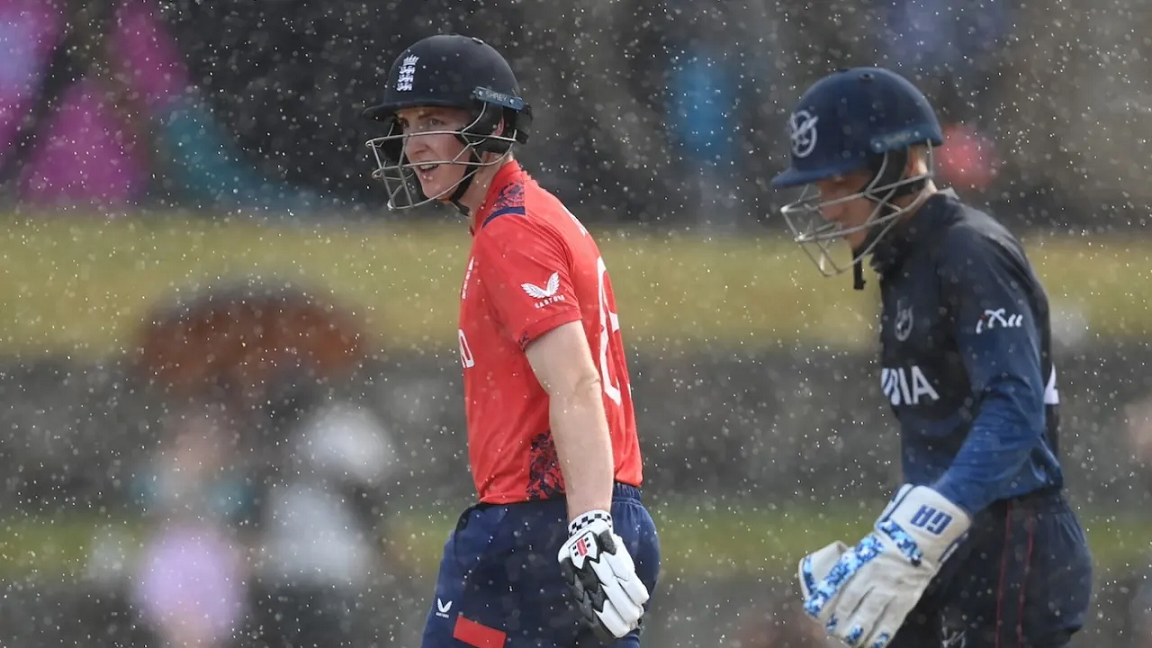
Watching rain fall doesn’t sound like a nail-biting pastime but for England the hours waiting to start their final group match of this T20 World Cup, against Namibia, were gripping. England’s eventual victory, by 41 runs in a match reduced to 10 overs per side in Antigua on Saturday, was pure relief for the defending champions.
No result other than a win would have kept England in contention for the Super Eight phase but they had to get on the park for that. After the toss was delayed by three hours – won by Namibia, who chose to bowl first – they finally had the chance to control their own destiny, to a point. The equation was simple. England had to beat Namibia and then wait to see whether Australia defeated Scotland to ensure they joined the Australians in progressing from Group B.
Showers before the scheduled start returned to Sir Vivian Richards Stadium in the form of a torrential downpour just as it looked like the covers would be lifted. England had to hold onto hope of a reduced-overs match despite the rain appearing to have set in. Eventually, play began at 4pm local time, reduced to 11 overs per side, which became 10 when rain intervened once more, albeit briefly, with England 82 for 3 after eight overs.
Harry Brook’s unbeaten 47 off 20 balls and Jonny Bairstow’s 31 off 18 steadied them from a perilous 13 for 2, the pair sharing a 56-run stand for the third wicket to help lift their side to 122 for 5. With Namibia chasing a DLS-adjusted target of 126, England’s bowlers didn’t allow them to score fast enough and secured a comfortable victory, after a torturous wait.
David Wiese conceded just a solitary run from the first over on an understandably tacky wicket, testing England openers Jos Buttler and Phil Salt by varying his lines and lengths. Then Ruben Trumpelmann removed Buttler for a four-ball duck with a wonderful inswinger that crashed into leg stump with the second ball of the next over in a dream start for Namibia. It wasn’t until 10 balls into the match that England scored their first boundary, which became two when Salt lofted wider deliveries from Trumpelmann for four down the ground and over deep third. When Wiese returned for a second over on the trot, he had Salt caught behind off an excellent knuckle ball, delivered slow outside off stump and finding a thick edge to put England in trouble at 13 for 2 inside three overs.
Left-arm spinner Bernard Scholtz came into the attack in the fourth over and in for some Bairstow treatment, reverse-swept for four and muscled over long-on for six next ball. Bairstow skied Gerhard Erasmus’s third ball back over his head and, to England’s relief, the ball plugged in a gap between an advancing long-off, long-on and the bowler running back. He crashed the next through the leg side for four. Brook chimed in with a powerful six over deep midwicket off Jack Brassell and sent the next through point for four to bring up England’s fifty off 34 balls. When Erasmus returned, Bairstow immediately nailed a six over midwicket.
Bairstow survived a run-out chance on 31 and hadn’t added to his score when he top-edged an attempted cut off Scholtz towards short cover, where keeper Zane Green collected. Bairstow’s 18-ball knock was his first foray into double figures in three innings at this tournament and his highest score at a T20 World Cup, setting a solid platform after England’s shaky start before more rain arrived to halt play.
After such a long wait to learn whether they would get to play again, England’s innings was further reduced to 10 overs when rain caused another 10-minute stoppage, by which time Brook and Moeen Ali were left with twelve balls to set an imposing target. They took 19 runs off Brassell in the penultimate over, 18 of them to Brook, who finished with 4,6,4 to take England past the 100 mark. Moeen fell for 16 off six balls but Liam Livingstone blasted the first two balls he faced from Trumpelmann for six before he was run out on the last ball of the innings and left the field clutching his side in some discomfort. Ben Duckett’s appearance as substitute fielder in his place raised further concerns over Livingstone’s fitness.
Reece Topley conceded only two runs off the opening over of Namibia’s pursuit, one of them a front-foot no-ball on the first delivery of the innings. England’s bowlers were keeping a lid on Namibia’s scoring and, needing 83 more off the last four overs, Nikolaas Davin retired out on 18 off 16, the first player to do so at an ICC event, making way for the vastly experienced Wiese. He clubbed the first ball he faced – off Sam Curran, making his first appearance at this World Cup – for four through backward point. Wiese proceeded to smash back-to-back sixes off Adil Rashid over long-off and deep midwicket then pierced the covers for four.
But they needed 55 off the last two overs and Michael van Lingen holed out to Brook off Chris Jordan, brought into the side for Mark Wood on the strength of his death bowling, on the final ball of the ninth. When Jofra Archer removed Wiese, again via a Brook catch in the deep in the final over, the 39-year-old walked off amid handshakes from several England players, a fitting international farewell in his last game for Namibia, the nation he transferred his allegiance to in 2021 after 26 matches for South Africa.
Brief scores:
England 122 for 5 in 10 overs (Harry Brook 47*, Jonny Bairstow 31; David Wiese 1-06, Ruben Trumpelmann 2-31, Bernard Scholtz 1-24) beat Namibia 84 for 3 in 10 overs (Michael van Lingen 33, David Wiese 26; Jofra Archer 1-15, Chris Jordan 1-19) by 41 runs (DLS method)
[Cricinfo]
Latest News
BCB receives investigation report on sexual misconduct allegation
Latest News
Trump confirms talks with Iran as US military shoots down Iranian drone
United States President Donald Trump has confirmed that talks with Iran are continuing to try to de-escalate tensions in the Gulf, even as the US military announced shooting down an Iranian drone that approached its aircraft carrier in the Arabian Sea.
Trump told reporters at the White House on Tuesday that Washington was negotiating with Iran “right now”, but declined to say where the talks were taking place.
“[The talks] are all over. But they are negotiating. They’d like to do something, and we’ll see if something is going to be done,” he said.
“They had a chance to do something a while ago, and it didn’t work out. And we did ‘Midnight Hammer’, I don’t think they want that happening again,” he added, referring to the operation last June in which the US Air Force and Navy struck three Iranian nuclear facilities.
Trump, who has been pushing Teheran to agree to talks over its nuclear programme, has repeatedly threatened to attack the country again over a recent crackdown on antigovernment protests. The US president sent the USS Abraham Lincoln to the Gulf last week, leading to fears of a possible military confrontation.
The carrier strike group, which brought roughly 5,700 additional US troops, joined three destroyers and three littoral combat ships that were already in the region.
Tensions have been easing in recent days amid a push by regional powers for a resolution.
Iranian President Masoud Pezeshkian said earlier on Tuesday that he had instructed the country’s foreign minister to “pursue fair and equitable negotiations, guided by the principles of dignity, prudence, and expediency”, provided that a “suitable environment exists”.
“These negotiations shall be conducted within the framework of our national interests,” Pezeshkian added
[Aljazeera]
Latest News
Seven million cancers a year are preventable, says report
Seven million people’s cancer could be prevented each year, according to the first global analysis.
A report by World Health Organization (WHO) scientists estimates 37% of cancers are caused by infections, lifestyle choices and environmental pollutants that could be avoided.
This includes cervical cancers caused by human papilloma virus (HPV) infections which vaccination can help prevent, as well as a host of tumours caused by tobacco smoke from cigarettes.
The researchers said their report showed there is a “powerful opportunity” to transform the lives of millions of people.
Some cancers are inevitable – either because of damage we unavoidably build up in our DNA as we age or because we inherit genes that put us at greater risk of the disease.
But researcher Dr Isabelle Soerjomataram said “people are surprised to hear” that nearly four in 10 cancers can be prevented as it is “a substantial number”.
The International Agency for Research on Cancer, part of the WHO, analysed 30 preventable factors known to increase the risk of cancer.
These include smoking and ultraviolet (UV) radiation which can directly damage our DNA; obesity and too little physical activity which alter inflammation and hormones in the body to raise cancer risk; and air pollution which can wake up dormant cancer cells.
The agency’s report also looked at nine cancer-causing infections including HPV, hepatitis viruses which lead to liver cancer and the stomach bug H. pylori.
The team used data on cancer cases from 2022 and from the 30 risk factors a decade earlier – across 185 countries – to perform their statistical analysis.
The big three contributors to more than 18 million cancer cases around the world were found to be:
- smoking tobacco which caused 3.3 million cancers
- infections causing 2.3 million cancers
- alcohol use leading to 700,000 cancers

However, the overall figures mask a nuanced picture of cancer risk around the world.
There is a stark sex-divide with 45% of men’s cancers being preventable compared with 30% in women, partly down to higher levels of smoking among men.
In women living in Europe, the top three preventable causes of cancer are smoking, closely followed by infection and then obesity.
While in sub-Saharan Africa, infections dominate and account for nearly 80% of preventable cancers in women.
This means any measures to tackle these cancers would need to be tailored to each region or country.
“This landmark study is a comprehensive assessment of preventable cancer worldwide, incorporating for the first time infectious causes of cancer alongside behavioural, environmental, and occupational risks,” said Soerjomataram, the deputy head of the IARC Cancer Surveillance Unit.
“Addressing these preventable causes represents one of the most powerful opportunities to reduce the global cancer burden.”
The report, published in the journal Nature Medicine, showed lung cancer (linked to smoking and air pollution) stomach cancer (linked to H. pylori infection) and cervical cancer (linked to HPV infection) made up nearly half of all preventable cases of cancer.
Dr Andre Ilbawi, team lead for cancer control at WHO, said the study was “good news” as it showed something could be done and he pointed to the success of countries that have introduced policies to tackle smoking or vaccinate against HPV.
“The percentage of preventable cancers can change over time and our goal is to get it as close to zero as possible,” he said.
[BBC]
-
Opinion5 days agoSri Lanka, the Stars,and statesmen
-
Business6 days agoClimate risks, poverty, and recovery financing in focus at CEPA policy panel
-
Business4 days agoHayleys Mobility ushering in a new era of premium sustainable mobility
-
Business1 day agoSLIM-Kantar People’s Awards 2026 to recognise Sri Lanka’s most trusted brands and personalities
-
Business4 days agoAdvice Lab unveils new 13,000+ sqft office, marking major expansion in financial services BPO to Australia
-
Business4 days agoArpico NextGen Mattress gains recognition for innovation
-
Business3 days agoAltair issues over 100+ title deeds post ownership change
-
Business3 days agoSri Lanka opens first country pavilion at London exhibition