
Sports
Hardik, Dube, spinners hand India series win


England will be wondering how they managed to lose in Pune. They squandered a chance to take the series into a decider after winning the toss, reducing India to 12 for 3 and then 79 for 5, got off to a flying start on a flat pitch and heavy dew around it, but ended up losing wickets in clumps after getting to 62 for 0 inside the powerplay. They were still favourites at 129 for in the 15th over, but lost two wickets in Varun Chakravarthy’s last over.
One of the answers they will get is they lost six wickets to spinners bowling on a true pitch with a wet ball. The other answer is India’s intent with the bat: they never really slowed down even as the wickets fell. Abhishek Sharma kept going after the triple-wicket maiden early in the innings, and Shivam dube and Hardik Pandya overcame the mid-innings blows with some targeted hitting to score 53 each and take India to a fighting total of 181.
Another answer – although they should never have let it play such a significant role – will be that India were allowed to play fast and loose with the concussion substitution. Dube, who was hit on the helmet in the final over and continued batting, complained of delayed onset of concussion symptoms, and was replaced by a full-time bowler in Harshit Rana even when a batting allrounder was available in Ramandeep Singh. Making his debut, Rana took the wickets to Liam Livingstone, Jacob Bethell and Jamie Overton to go with a six-run 19th over.
Saqib Mahmood checks in
India had the right idea to go after the bowling with the ball neither seaming nor swinging, but they ended up hitting everything straight to hand. Bowling his first over of the series Saqib Mahmood accepted the gifts although England did play a part with some inventive fields. Sanju Samson found deep square leg, Tilak Varma edged the first ball he faced to deep third, and then Suryakumar Yadav middled one straight to short mid-on.
India don’t back down
Quite often in the past, India have been guilty of taking the conservative option when forced to make a choice. Over the last year and a half, though, they have played differently. Abhishek is the flag-bearer of brave options. He made sure India had some momentum even as Rinku Singh got stuck. Not for the lack of trying, though.
When Abhishek got out for 29 off 19, India held back Hardik in order to target Adil Rashid with Dube. Rashid responded beautifully with a teasing loopy delivery first up with an attacking field, but Jos Buttler dropped a half chance at slip.
Rinku’s dismissal to Brydon Carse meant Hardik had to come in with Rashid overs still left. He channelled in his inner MS Dhoni by blocking out Rashid with proper front-foot defence. Dube helped him out by making sure Rashid went for 35 in his four even as Hardik warmed up to 13 off 16.
He returned the favour when Mahmood and Jofra Archer came back with shots full of swagger. Those two comeback overs went for 37, which meant India had something to fight with even though Overton conceded just three off the last over. He also clocked Dube in the head, an event that would assume larger significance.
Duckett stuns India, but they spin their way back
The chase started on a batting beauty, and Ben Duckett silenced the raucous crowd. More importantly, he reverse-swept Varun for a boundary, took 16 off Axar Patel’s first over, and seemed to be getting the better of spin challenge. RaviBishnoi, who had been digging the ball in, gambled with the last ball of the powerplay. With no boundary rider down the ground, he bowled the only flighted delivery of the over, and drew the mis-hit to dismiss Duckett for 39 off 19.
Phil Salt, who managed to get to spin for the first time in the series, exposed his stumps in trying to cut Axar and was done in by one that skidded on. Buttler became the victim of a touch of extra bounce for Bishnoi to make it 65 for 3, but the presence of the fielder taking the catch at short third, Rana, left him infuriated according to Kevin Pietersen on air.
Rana strikes immediately
Even at 65 for 3, this was England’s game to lose. Harry Brook and Livingstone made an assured start to their stand despite the troubles Brook has had against spin all series. There was hardly any turn to worry about. They had added 27 off 21, and the asking rate was under 10 when Rana came on to bowl in the 12th over. Livingstone guided the second ball straight to the keeper. Done in by the extra bounce when attempting the late-cut.
Brook still has it, but not quite
Even then Brook showed how easy batting was in those conditions. He took down Rana for 18 in his second over and even managed to hit his nemesis Varun for two fours, but then pre-meditated a ramp off Varun, possibly expecting the seam-up variation so he could use his pace, but ended up lobbing the slower legbreak to short fine leg. Carse made it worse with a slog-sweep straight to deep square leg in the same over.
Overton and Rashid flickered for a moment, bringing it down to 21 off 11, but fizzled out amid Overton’s questionable tactics of not taking singles even though Rashid had slogged Arshdeep Singh for a six.
Brief scores:
India 181 for 9 in 20 overs (Hardik Pandya 53, Shivam Dube 53, Abhishek Sharma 29, Rinku Singh 30; Saqib Mahmood 3-53, Brydon Carse 1-39, Jamie Overton 2-32, Adil Rashid 1-35 ) beat England 166 in 19.4 overs (Phil Salt 23, Ben Duckett 39, Harry Brook 51; Arshdeep Singh 1-35, Varun Chakrawarthy 2-28, Axar Patel 1-26, Ravi Bishnoi 3-28, Harshit Rana 3-33) by 15 runs
[Cricinfo]


Deandra Dottin was given out obstructing the field as West Indies suffered their second narrow defeat as Sri Lanka clinched the ODI series 2-0.
In the 30th over, Dottin went for a sweep against Chamari Athapaththu, the ball slipped down the leg side and was called wide. But it ballooned off the pads of wicketkeeper Kaushini Nuthyangana back towards Dottin who tapped it away with her bat then caught the ball. Umpires Candace la Borde and Vrinda Rathi conferred and Dottin was given out.
It left West Indies 116 for 6 chasing 209 and they fell further to 146 for 8. However, Janiellea Glasgow nearly hauled them over the line with her second half-century in consecutive matches. She added 45 for the ninth wicket with Afy Fletcher, before she was last player dismissed, brilliantly held on the rebound at cover by Kavisha Dilhari.
Sri Lanka had produced some impressive pieces of fielding throughout the innings with Hasini Perera taking a sharp catch at slip to remove Chinelle Henry and Nilakshika Silva taking a brilliant catch at long-off from Shawnisha Hector’s lofted drive.
Vishmi Guneratne’s half-century had been the main contribution of Sri Lanka’s innings. A series of useful top-order partnerships had taken them to 166 for 4 in the 36th over before the last six wickets fell for 42 as Karishma Ramharack finished with 3 for 26.
Brief scores:
Sri Lanka Women 208 in 47.1 overs (Chamari Athapaththu 32, Harshitha Samarawickrema 35, Vishmi Gunaratne 58, Nilakshika Silva 29; Hayley Matthews 2-44, Karishma Ramharack 3-26, Afy Fletcher 2-40) beat West Indies Women 194 in 48 overs (Shemaine Campbelle 30, Stefanie Taylor 27, Jannillea Glasgow 50, Afy Fletcher 20; Inoka Ranaweera 3-44, Sugandika Kumari 3-38, Dewmi Vihanga 2-33, ) by 14 runs
[Cricinfo]


England’s bowlers turned the screws after their batters had spluttered, skittling Sri Lanka for 95 in under 17 overs to seal a commanding 51-run victory and open their account in the Super Eight stage of the T20 World Cup at Pallekele on Sunday.
Defending a modest 147, England hit the right lengths from ball one. Their quicks bent their backs and their spinners gave the ball a rip as Sri Lanka were reduced to 34 for five inside the Powerplay, a collapse that all but signed the death warrant.
Once half the side was back in the hutch within six overs, there was no Lazarus act from the lower order. England wrapped things up clinically, boosting a healthy Net Run Rate that could yet prove gold dust in the race for the semi-finals.
England’s stranglehold over Sri Lanka in this format continued unabated. This was their 12th straight win against the former champions. Earlier this month they had whitewashed them 3-0 and Sri Lanka’s last T20 win over England dates back to 2014 at The Oval. The hoodoo shows no signs of lifting.
Joffra Archer set the tone with thunderbolts that kissed 150 kmph on the speed gun. He removed both openers, but the prize scalp was that of the in-form Pathum Nissanka, who had lit up the tournament with its first hundred against Australia. Archer lured him into the trap, a fuller delivery inviting the flick. Nissanka took the bait but failed to clear deep mid-wicket and with that wicket, the rot set in.
Will Jacks then put the game beyond doubt, weaving a web with his off-spin to snare three middle-order wickets. The packed Pallekele crowd, buoyant at the start, fell into a hush as the middle order caved in.
Dasun Shanaka waged a lone battle, striking 30 off 24 balls, but his counterattack was snuffed out by Adil Rashid. Attempting to take on the leg-spinner, Shanaka holed out to Jacks in the deep. Losing his balance near the ropes, Jacks showed sharp presence of mind to flick the ball back to Tom Banton before tumbling over.
Earlier, Sri Lanka had done well to restrict England to 146 for nine after opting to bowl. Left-arm spinner Dunith Wellalage was the pick of the attack with three for 26, applying the brakes just when England threatened to shift gears.
Phil Salt provided the early impetus with a brisk 62 off 40 balls, peppering the boundary with six fours and two sixes. But with Sri Lanka missing three frontline bowlers, their attack punched above its weight to ensure England never ran away with the game.
Wellalage struck in the Powerplay, trapping Jos Buttler and Harry Brook leg-before as England stumbled to 68-4 at the halfway mark.
Jacks (21) was the only other batter to cross 20 as wickets fell at regular intervals. Dilshan Madushanka kept it tight up front, finishing with two for 25, while Maheesh Theekshana impressed with two for 21, varying his pace cleverly on a surface that offered grip.
Rex Clementine at Pallekele
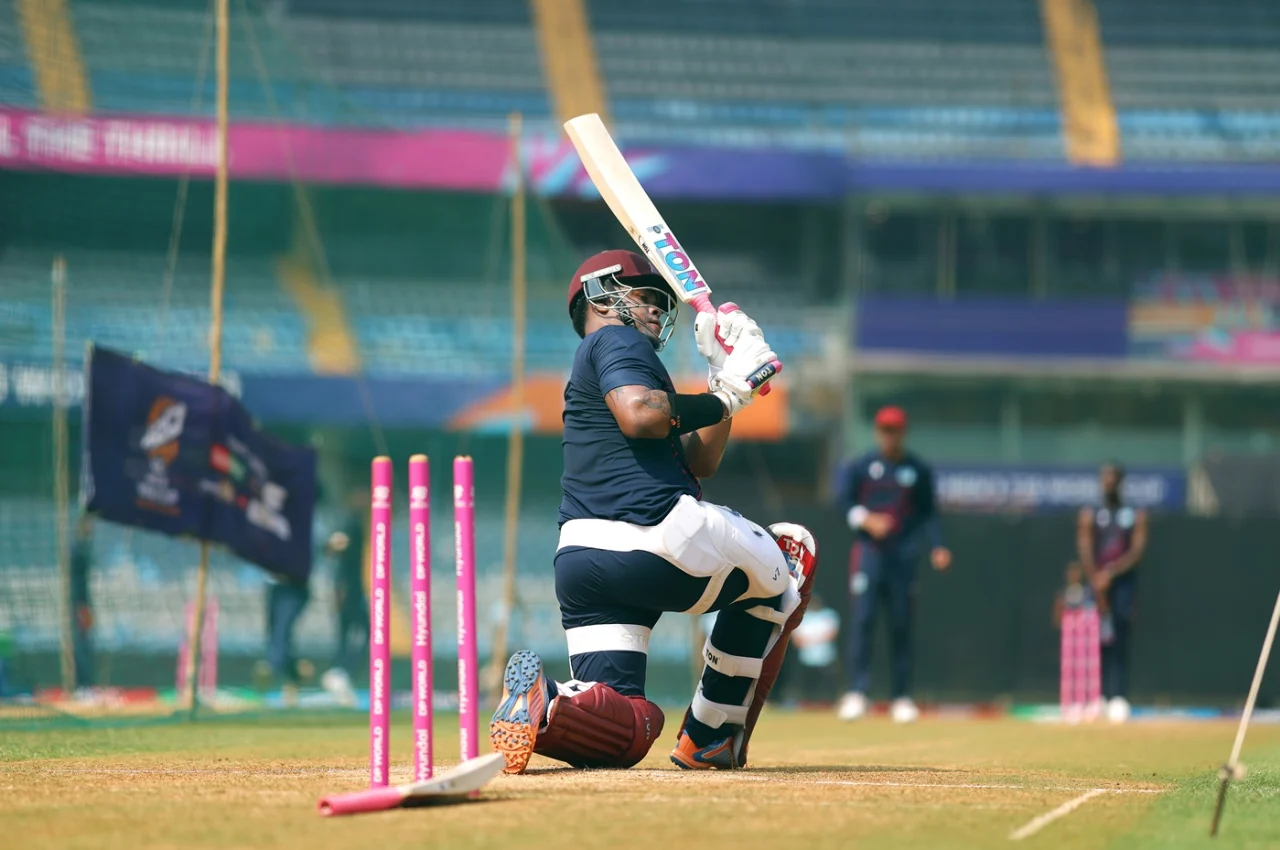
Two years ago, Zimbabwe failed to qualify for the T20 World Cup. Not only did they make the competition this time, they entered the Super Eights unbeaten.
First, it was Blessing Muzarabani who shut Australia down on a slow pitch in Colombo. Then their top four silenced the Khettarama crowd by chasing down 189 against Sri Lanka. The common factor in those wins were also Brian Bennett’s fifties and Sikandar Raza’s quick cameos. Muzarabani and Brad Evans are also among the top ten wicket takers in the tournament.
With contributions from several players, Zimbabwe could prove a handful for West Indies in Mumbai. They will have to make a quick adjustment, though, having played all their group matches in Sri Lanka, while West Indies have already played twice at the Wankhede.
These two sides have faced each other only four times in T20 internationals. When lined up player-against-player, West Indies – also undefeated – look stronger with bat, with an in-form Shai Hope, a rejuvenated Shimron Hetmyer at No. 3, and a solid finisher in Sherfaine Rutherford.
Having as many as three allrounders – with Romario Shepherd in line to return after injury – gives them the option of playing three fast bowlers and three spinners. It’s an ideal mix in Mumbai, where the quicks (35 wickets) and spinners (34) have been equally effective, averaging 26.28 and 26.25 respectively this tournament.
It’s a big game for both sides, with matches against India and South Africa to follow next. Who will get on the points table first?
Blessing Muzarabani is an early wicket-taker and a serial wicket-taker. He has height, pace and discipline on lengths that can be threatening, especially with the new ball. He also bowls at the death where he generally goes on the shorter side peppered in with the odd slower ball. That’s as all-conditions as it gets in T20s, and form is on his side too.
West Indies have a clear batting approach outlined by regular boundary hitting, and Shai Hope is the initiator and the glue as he sets up and builds innings. He has the virtues of an upgraded anchor who doesn’t have to shut down when the team is on the back foot. He is coming off two fifties, the second of which against Nepal saw him power through even as wickets fell at the other end.
Shepherd is fit again. He had strapping on his right leg as he bowled and batted for a while on Saturday. He hit one over the roof, but wasn’t as comfortable while bowling. If fit, he could replace Matthew Forde.
Zimbabwe haven’t tinkered with their squad much and that’s likely to remain the case. They could bring back Richard Ngarava for Graeme Cremer if they feel the need for pace.
West Indies (probable): Brandon King, Shai Hope (capt & wk), Shimron Hetmyer, Roston Chase, Rovman Powell, Sherfane Rutherford, Jason Holder, Romario Shepherd/Matthew Forde, Akeal Hosain, Shamar Joseph, Gudakesh Motie.
Zimbabwe (probable): Brian Bennett, Tadiwanashe Marumani (wk), Dion Myers, Sikandar Raza (capt), Ryan Burl, Tony Munyonga Tashinga Musekiwa, Brad Evans, Wellington Masakadza, Graeme Cremer/Richard Ngarava, Blessing Muzarabani
[Cricinfo]

Dottin out obstructing the field as Sri Lanka clinch series

Prime Minister Attends the 40th Anniversary of the Sri Lanka Nippon Educational and Cultural Centre

Navy’s latest addition P 628 sails for Colombo from Baltimore

Commander of the Navy attends International Fleet Review

Prime Minister attends 169th birth anniversary celebration of Lord Robert Baden-Powell

Coal ash surge at N’cholai power plant raises fresh environmental concerns

‘Dates have the highest sugar content to fight Coronavirus’

Sunday Island 27 December – Headlines

#SundayIsland 17th December – Headlines

Sunday Island – 28th March

Sunday Island Headlines – 21 March

Sunday Island – 21st February – Headlines
-

 Features2 days ago
Why does the state threaten Its people with yet another anti-terror law?
-

 Features2 days ago
Victor Melder turns 90: Railwayman and bibliophile extraordinary
-

 Features2 days ago
Reconciliation, Mood of the Nation and the NPP Government
-

 Features16 hours ago
LOVEABLE BUT LETHAL: When four-legged stars remind us of a silent killer
-
 Features2 days ago
Victor, the Friend of the Foreign Press
-
 Latest News3 days ago
New Zealand meet familiar opponents Pakistan at spin-friendly Premadasa
-

 Latest News3 days ago
Tariffs ruling is major blow to Trump’s second-term agenda
-

 Latest News3 days ago
ECB push back at Pakistan ‘shadow-ban’ reports ahead of Hundred auction