
Foreign News
Hackers steal maternity ward CCTV videos in India cybercrime racket


Hacked CCTV videos from a maternity hospital in India have been sold on Telegram, police say, raising serious questions about privacy and security in a country where such cameras have become commonplace.
Earlier this year, police in Gujarat state were alerted by the media to videos on YouTube – some showed pregnant women undergoing medical exams and receiving injections in their buttocks – in a maternity hospital in a city.
The videos had a link directing viewers to Telegram channels to buy longer videos.
The director of the hospital told the BBC that the cameras had been installed for the safety of doctors. The BBC is not naming the city or hospital to protect the identity of the women in the videos. None of them have filed a police complaint.
Police say their investigation uncovered a massive cybercrime racket where sensitive footage from at least 50,000 CCTVs from across the country was stolen by hackers and sold on the internet.
CCTVs have become ubiquitous in India, especially in urban areas. They are installed in malls, offices, hospitals, schools, private apartment complexes and even inside people’s homes.
Experts warn that while CCTV boosts security, poorly installed or managed systems can threaten privacy. In India, cameras are often handled by staff without cybersecurity training, and some domestically manufactured models are reportedly easily exploitable.
In 2018, a tech worker in Bengaluru city said that his webcam was hacked, and that the hacker demanded payment in exchange for not sharing his private videos. In 2023, a YouTuber reportedly found out that his home CCTV had been hacked after private videos went viral.
Last year, the federal government asked states to not procure CCTVs from suppliers with a history of security and data breaches and also introduced new rules to improve cyber security of CCTV cameras. But hacking incidents like these are still reported.
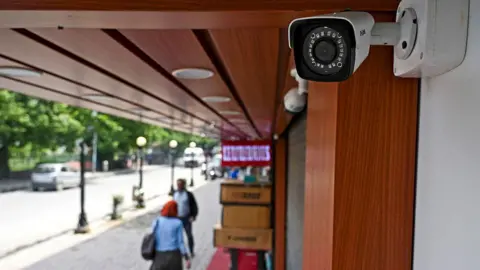
In Gujarat, police say they ended up discovering a “network of individuals spread across the country”.
“They were hacking into the video surveillance systems – or CCTV systems – of hospitals, schools, colleges, corporate offices and even the bedrooms of private individuals in multiple states,” Lavina Sinha, who heads the Ahmedabad cyber crime department investigating the case, told reporters.
Hardik Makadiya, Gujarat’s top cybercrime official, says videos were sold for 800–2,000 rupees ($9-22; £7-17, with Telegram channels offering live CCTV feeds via subscription.
Police have registered a case under various sections of the law, including violating a female patient’s privacy, publishing obscene material, voyeurism and cyber terrorism – which is a non-bailable offence. They say that they reached out to Telegram and YouTube, and the videos have been taken down.
Since February, police have arrested eight people in the case – four from Maharashtra and others from Uttar Pradesh, Gujarat, Delhi, and Uttarakhand. They remain in judicial custody as the case proceeds in court.
Yash Koshti, lawyer for three of the accused, denied the allegations, saying they were not hackers or cyber criminals and that someone else carried out the breach.
Cybercrime investigator Ritesh Bhatia warns that weakly protected CCTV and home networks are easy targets and must be properly secured.
“Wireless CCTV systems help you access the footage remotely, like on your smartphone or laptop. But once a system is connected to the web, it’s easy for hackers to decode its IP address and default password. And once they get into the system, they can see or record live footage, download it or even shut down the system,” Bhatia says.
He says that one way to secure surveillance systems is to change IP addresses and the default password.
Bhatia advises using a robust password that mixes letters, numbers, and symbols and cannot be found in a dictionary, and recommends periodic audits by a cybersecurity professional.
He adds that CCTV manufacturers also bear responsibility, and their packaging should clearly warn users to replace default passwords with strong ones – similar to cigarette packet health warnings.
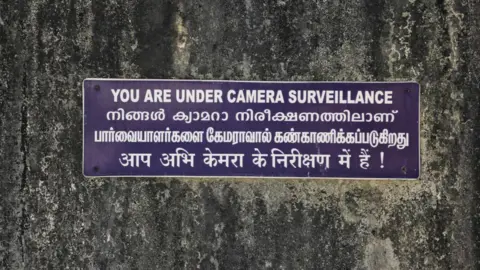
Mr Makadiya told the BBC that many of the hacked CCTVs used default passwords – like Admin123 – or weak ones.
“The hackers used brute force (the use of certain programmes to generate thousands of letter-number password combinations) to break into these systems and access videos,” he said.
Audrey Dmello of Majlis, a legal centre for women’s and children’s rights, highlights the ubiquity of CCTVs in India, often installed without consent. She urges organisations, especially in sensitive spaces, to ensure their systems are properly secured.
“Organisations and institutions that set up surveillance systems, especially in sensitive spaces, must see to it that their systems are adequately secured. It’s an absolute must,” she says.
The director of one of the affected hospitals told the BBC the CCTVs in exam and injection rooms were meant to protect doctors from false allegations. He added that the cameras have since been removed from sensitive areas.
Police in Gujarat told the BBC that neither the hospital nor any patient had come forward to file a formal complaint. The complaint was finally lodged by a police officer.
“Female patients fear that their identity will be revealed. Therefore, they are not willing to lodge a complaint,” said an officer.
Ms Dmello says that the shame women face around such incidents only adds to its horrific nature.
“When there is a sexual angle involved, the victim is re-victimised because of the patriarchal nature of Indian society. If we want women to assert their rights and we want criminals to be brought to justice, we, as a society, should first stop shaming and blaming women for the crime,” she says.
[BBC]


At least 41 people have died, and 49 others have been rescued, after a boat capsized on Lake Tanganyika in the Democratic Republic of the Congo (DRC).
Norris Mulongoyi, the provincial transport minister for DRC’s Tanganyika province, told The Associated Press news agency that search operations were under way to locate the remaining passengers
The boat was reportedly carrying about 100 people and cargo when it capsized near the Congolese village of Mapera.
The vessel was travelling from the port of Kigoma in Tanzania to the city of Kalemie in DRC when it sank on Thursday.
A survivor identified as Annie Moyoni told Radio Okapi, a UN-backed Congolese broadcaster, that passengers were awakened at about 1am and found the boat tilting to one side.
It is unclear what caused the vessel to capsize, but hundreds of people have been killed in boat disasters in the DRC in recent years, according to the AP. Vessels are often overloaded and lack life jackets.
For many in the DRC, travelling by boat is the cheapest and most affordable way to get around. The country is one of the poorest in the world and lacks sufficient infrastructure for its more than 100 million people.
The sinking was the second loss of a Congolese vessel on the Kigoma-Kalemie route in less than a month.
On August 28, the Congolese vessel MV Pacifique caught fire and exploded at the port of Kigoma while loading fuel, according to Radio Okapi.
Six crew members were killed, and a seventh was reported missing, Radio Okapi said, citing port authorities. The vessel operated between Kigoma and Kalemie and was used to transport fuel.
At least 20 people also died when a wooden boat carrying students returning from state exams sank in central DRC in July.
(Aljazeera)
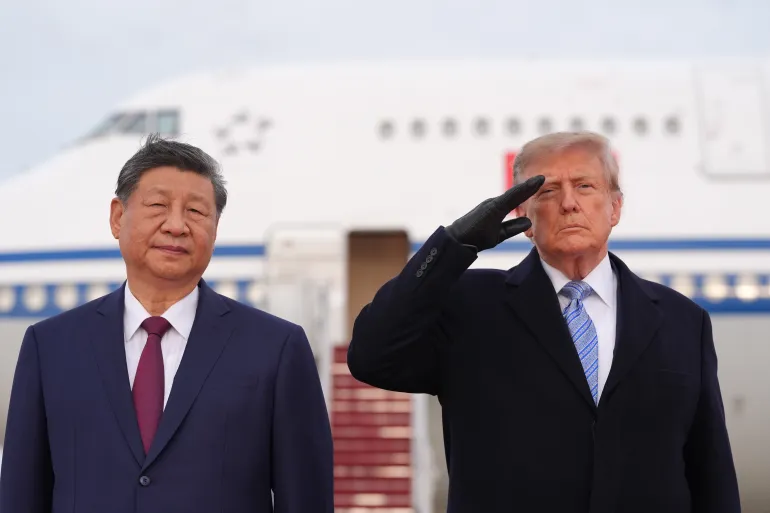
United States President Donald Trump has welcomed Chinese President Xi Jinping as he arrived in the US for a three-day trip focused on issues such as security, trade and technology.
Trump took the rare step of meeting the Chinese leader in person at Joint Base Andrews in the state of Maryland on Wednesday, the first president to do so in recent memory.
The US president and First Lady Melania Trump greeted Xi and his wife on the tarmac during a welcoming ceremony, where a red carpet was rolled out and the couples exchanged handshakes. Trump and Xi then walked side by side, flanked by US soldiers, before standing for a gunfire salute and the US national anthem
The in-person greeting is a sign of the significance that Washington ascribes to its relationship with Beijing, whose meteoric economic rise over the last several decades has transformed it into a global superpower capable of rivalling the United States.
Despite tense relations that worsened after the Trump administration placed high tariffs on Chinese goods – a move that was met with retaliatory measures from Beijing – Trump has expressed personal affinity for Xi and his desire for strong ties with China.
The Chinese president’s trip to the US will include a state dinner, attended by leaders of the country’s powerful tech industry, a military ceremony at the White House, and a visit to the National Archives, home to documents of historical and cultural significance such as the US Constitution and the Declaration of Independence
But both countries remain wary of the other as they compete for political and economic influence. The trip is likely to include discussion of issues such as the US war on Iran, trade, technology, rare-earth minerals and US ties to Taiwan, the self-governing island that China claims as part of its territory
(Aljazeera)
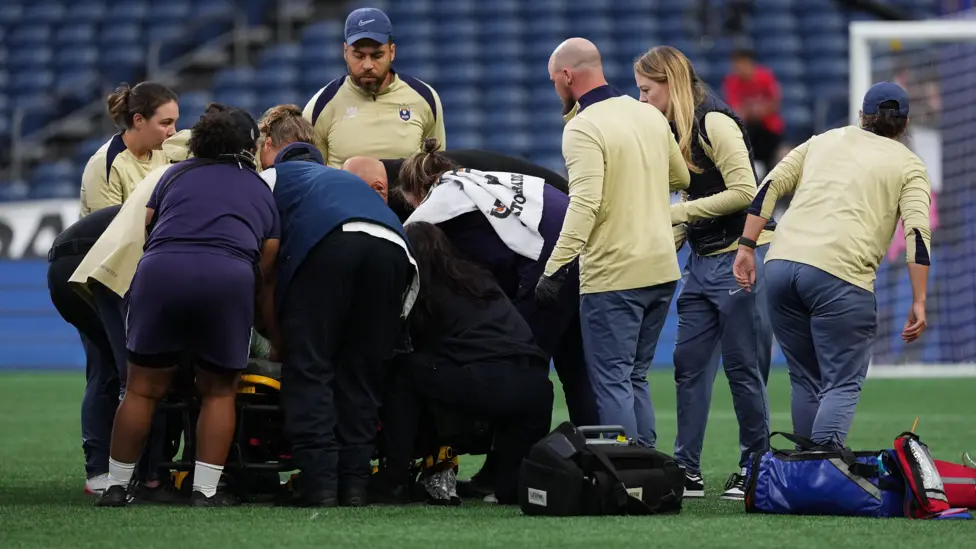
United States women’s national team player Savannah DeMelo is suing a hospital and two doctors after she suffered a cardiac arrest on the pitch last year.
Midfielder DeMelo, who has seven senior caps for the USA, has filed a lawsuit against University of Louisville Health (UofL Health) for negligence.
The 28-year-old, who plays for Racing Louisville, collapsed in the first half of a National Women’s Soccer League (NWSL) match on 14 September 2025.
According to documents seen by BBC Sport, the case was filed on Tuesday morning with Jefferson Circuit Court in Kentucky, where her club is based – a year and a day after her on-field collapse.
DeMelo’s filing claims UofL Health and two doctors, Dr Sarabjeet Suri and Dr Jennifer Daily, “failed to act as a reasonably prudent and competent medical practice, and such negligence was a substantial factor in causing DeMelo to suffer severe physical injuries, including, but not limited to, her cardiac arrest”.
Dr Daily, according to her online UofL biography, is Racing Louisville’s chief medical officer. The lawsuit states DeMelo was under the care of Dr Daily from January 2024 to July 2026.
It states that in March 2025, Dr Daily referred DeMelo to Dr Suri for “evaluation and treatment” after she had been complaining of chest pain, dizziness and shortness of air; Dr Suri obtained a history, performed a physical examination and ordered diagnostic tests.
Nearly six months later, DeMelo suffered the cardiac arrest.
“She was subsequently diagnosed and treated for ventricular tachycardia [an abnormal heart rhythm],” the suit states.
DeMelo, who has spent her entire professional career with Racing Louisville, has not played since her collapse.
In a post to her instagram page on Tuesday, De Melo – who was picked in the USA squad for the 2023 Women’s World Cup and started their first two games – marked the anniversary of the incident.
“A year ago today, while playing soccer, I collapsed due to an undiagnosed cardiac arrhythmia, that caused me to go into cardiac arrest,” she wrote.
“I respect and appreciate the privacy everyone has met me with while going through everything I have this year. I’ll never be able to fully put into words how emotionally hard this year has been. There has been a lot of uncertainty and emotions intertwined with it all.”
[BBC]

Lalit Rajbanshi, Kushal Bhurtel set up Nepal’s opening win

‘Vision’ Programme Marks Two Years

Costa Rica minister fired for unapproved meeting with Trump in US

At least 41 die as boat capsizes in DRC’s Lake Tanganyika

Showers will occur at times in the Western, Sabaragamuwa, Southern, Central and North-western provinces

Sajith vows to scrap 22A under future govt.

‘Dates have the highest sugar content to fight Coronavirus’

Sunday Island 27 December – Headlines

#SundayIsland 17th December – Headlines

Sunday Island – 28th March

Sunday Island Headlines – 21 March

Sunday Island – 21st February – Headlines
-

 News6 days ago
Shanakiyan urges urgent action over reported death sentence for Lankan in Saudi Arabia
-

 News5 days ago
Namal Rajapaksa Buddhist gambit fails, bail denied
-

 Features5 days ago
Why the spelling Sri Lankan names in English vary
-

 Features5 days ago
Three bands, a new identity: Sri Lankan wolf snake recognised as distinct species
-

 Business5 days ago
SLIIT holds largest-ever convocation
-

 News5 days ago
Vehicle prices drop by up to Rs. 1 mn, says importers’ body
-
 News5 days ago
Govt monitors reported Saudi death sentence – Foreign Ministry
-

 Business5 days ago
All-new Bolero MaXX Pik-Up unveiled in Lanka