
News
Govt. urged to act fast against moves by India to stake claim to Lankan cobalt deposit


By Rathindra Kuruwita
The government must immediately convene the National Oceanic Affairs Committee (NCAC) and seek its advice on India’s bid to carryout research at the Afanasy Nikitin Seamount, an area that is claimed by Sri Lanka to be a part of its continental shelf, Dr. Ravindranath Dabare, Attorney-at-Law and Chairman, Environmental Committee of the Bar Association of Sri Lanka (BASL) has said.
Dabare has said that regional powers are using our economic woes to stake claim to Sri Lanka’s resources and as a sovereign nation Sri Lanka must protect its interests. The Sri Lankan public needs to be aware whether politicians and bureaucrats are doing the bidding of other nations, he said.
The Afanasy Nikitin Seamount is a 400-km long and 150-km wide undersea mountain range located in the equatorial Indian Ocean. It features a main plateau that rises 1,200 meters above the surrounding ocean floor, which is at a depth of 4,800 meters. Additionally, there are secondary elevated sea-mount highs, with two notable peaks situated at water depths of 1,600 meters and 2,050 meters.
“We are the closest to Afanasy Nikitin Seamount which is 1,050 kilometers from Sri Lanka. The Seamount is 1,100 kilometers from Maldives and 1,350 kilometers from India. There is speculation that there is USD 80 billion worth of cobalt deposited there. Our total debt is about 100 billion dollars,” Dabare said, adding that on 08 May 2009, Sri Lanka had presented a submission to the United Nations Commission on the Limits of the Continental Shelf (UNCLCS), seeking the extension of the country’s continental shelf beyond the Exclusive Economic Zone (EEZ). Usually, a country’s EEZ only extends to 200 nautical miles from its shores.
“We submitted our claims in 2009. The UNCLES started studying our submission in 2016 and in March 2024, India applied to the International Seabed Authority (ISBA), Jamaica, for rights to explore Afanasy Nikitin Seamount. This isn’t a part of India’s jurisdiction. The problem is what have we done after making the submission in 2009, it has been 15 years. We have waited while other regional powers are making moves into what is ours,” Dabare said.
Dabare said that under normal circumstances the EEZ was an area 200 nautical miles from a country’s shore. However, Sri Lanka’s geological features granted it special characteristics. Article 76 of the United Nations Convention on the Law of the Sea (UNCLOS) describes how a state can define its continental shelf, he said.
According to UNCLOS a country has “special characteristics” if the; a) the average distance at which the 200 metre isobath occurs is not less than 20 nautical miles; (b) the greater proportion of the sedimentary rock of the continental margin lies beneath the rise; (c) the mathematical average of the thickness of sedimentary rock along a line established at the maximum distance permissible in accordance with the provisions of paragraph 4(a)(i) and (ii) of Article 76 as representing the entire outer edge of the continental margin would not be less than 3.5 km; and (d) that more than half of the margin would be excluded by the application of such a line.
“Sri Lanka fulfils these, and we can seek the extension of the country’s continental shelf beyond the EEZ. The reason countries like us are given this chance is that when the seabed becomes suddenly deep a country will find it difficult to access the resources available. Apart from article 76, we can also use annex 2 of UNCLOS, i.e., Commission on The Limits of The Continental Shelf to stake a claim,” he said.
Thus, Sri Lanka is authorised to: ‘‘Establish the outer edge of its continental margin by straight lines not exceeding 60 nautical miles in length connecting fixed points, defined by latitude and longitude, at each of which the thickness of sedimentary rock is not less than one kilometer.”
“As mentioned above we made a submission to UNCLCS in 2009 based on these provisions. India, Bangladesh and Thailand objected to Sri Lanka’s claim back then. We should remember that 08 May 2009 was the day before the deadline set by UNCLES for countries to make these submissions. This is how we do things,” he said.
Dabare said that in March 2024, India placed a 500,000-dollar deposit at the ISBA and requested the ISBA to grant it the right to explore Afanasy Nikitin Seamount for 15 years.
“Now we are facing a great risk. Sri Lanka has access to great resources, but it is also bankrupt. Because of our situation, those who have no right to claim our resources have started to make their moves. In the end, we might have to share these resources with everyone who is now objecting. We don’t know how many people in Sri Lanka are experts on laws of the sea, we also don’t know how many of them are working with the state. We don’t know if our politicians and bureaucrats are aware of what’s going on. How many of them are under the control of other nations? We may be small, but we don’t need to be lackeys of so-called regional powers,” he said.
Dabare said that Sri Lanka must officially object to what India is doing and take the necessary procedural steps.
“We must lobby our officials to protect our resources. Should we bow down to other countries because they have given us some dry rations? I know regional powers want to influence us, but we too are a sovereign nation. The officials need to stand for people’s rights,” he said.
Dabare said Sri Lanka needs to come up with a clear foreign policy and a national policy on agreements with other countries.
“When there are no policies, rulers and bureaucrats take decisions that benefit them, not the country,” he said.
Sri Lanka has a National Oceanic Affairs Committee, but this has not met in years. The government needs to convene this committee and seek advice.
“This is an independent committee, but we urge the committee to tell the nation what the recommendation is. We shouldn’t be opaque and secretive when we take decisions that affects millions of people,” he said.


x
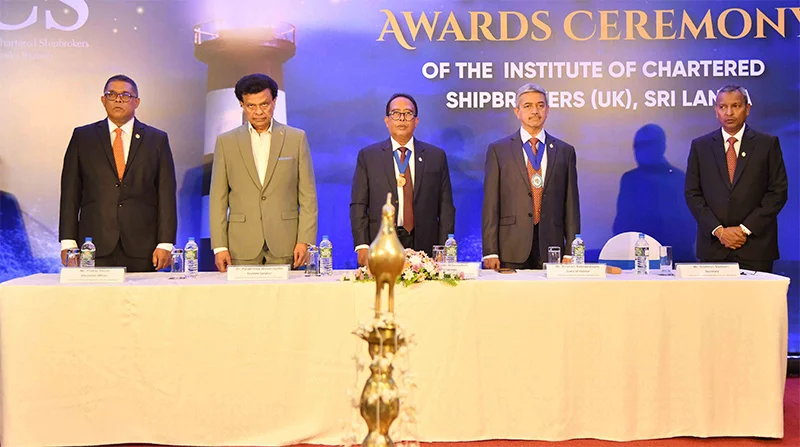
Lalith Witanachchi flanked by Dr. Parakrama Dissanayake, presidential maritime advisor (on his right) and Krishnan Subramaniam, Chairman, Institute of Shipbrokers, UK
Chairman of Institute of Chartered Shipbrokers (Sri Lanka branch) Lalith Witanachchi said that disruption of Hormuz strait due to the ongoing war between Israel-US and Iran underscores the importance of other vital routes.
Addressing the 32 annual awards ceremony of ICS Sri Lanka recently at Cinnamon Lakeside, Witanachchi said that in today’s maritime environment, global events continue to remind us how closely geopolitics and shipping are connected. The ongoing tensions and conflict involving Iran in the Middle East have once again highlighted the strategic importance of maritime trade routes, particularly around the Strait of Hormuz, one of the world’s most critical energy corridors. Such disruptions create uncertainty for global supply chains, but they also reinforce the importance of resilient ports, efficient logistics networks, and well-trained maritime professionals. For countries like Sri Lanka, positioned along major East–West shipping lanes, these shifts also present opportunities to strengthen our role as a reliable maritime hub for the region.
Witanachchi dealt with the transformation of Singapore. Singapore did not simply build a port; they transformed an entire economy. They positioned themselves as a global logistics hub, attracting international shipping lines, investors, and trade flows. What seemed risky at the time became the foundation for decades of sustainable growth, making the Port of Singapore one of the busiest and most efficient ports in the world today.
Delivering the keynote address, Dr. Parakrama Dissanayake, Advisor to the President on Maritime, Ports and Logistics, emphasised the strategic importance of human capital development, professional education, and policy alignment in positioning Sri Lanka as a competitive regional maritime and logistics hub. His address reinforced the need for innovation, knowledge-sharing, and international collaboration in navigating the evolving global shipping environment.
A key highlight of the evening was the recognition of outstanding academic achievers and industry professionals who have demonstrated exceptional commitment, competence, and contribution to the maritime and logistics sectors. These accolades not only celebrated individual excellence but also symbolised the broader progress of professional standards within the industry.
The event also served as a platform to strengthen industry-academia linkages, promote professional qualifications, and encourage the next generation of maritime professionals. The presence of a diverse audience, including corporate leaders, students, and practitioners, reflected the Institute’s ongoing role in fostering a knowledge-driven and globally connected maritime community.

The International Solar Alliance (ISA) is undertaking a high-level mission to Sri Lanka from 6 to 9 April 2026, led by Director General Ashish Khanna, to advance the operationalisation of the ISA–Sri Lanka Country Partnership Strategy (CPS) and accelerate the country’s solar deployment agenda.
The text of ISA statement: “The mission focuses on four key outcomes: formal endorsement of the CPS, signing of a Memorandum of Understanding to establish a Solar Technology Application Resource Centre (STAR-C) at the University of Moratuwa, high-level bilateral engagements with government and development partners focusing on initial support on digital tool for streamlining approval process, support on integration of battery storage and policy and regulatory reforms, along with a dedicated Floating Solar Workshop to advance project readiness.
Sri Lanka’s energy sector is undergoing a structural transition. Installed solar capacity has crossed 1 GW, with a pipeline of over 4 GW identified under the Renewable Energy Project Development Plan (REPDP 2025–2030). Accelerated solar deployment is expected to deliver nearly 75% of national emissions reductions under NDC 3.0 (2026–2035), while reducing fiscal exposure to imported fossil fuels especially under the current global scenario, making timely implementation a national priority.
The ISA–Sri Lanka Country Partnership Framework (CPF), signed at the Asia Pacific Regional Committee Meeting 2025 in Colombo in the presence of Prime Minister Harini Amarasuriya, laid the foundation for long-term collaboration. Building on this, the CPS, developed through extensive technical consultations, including ISA’s technical mission in November 2025, translates Sri Lanka’s REPDP targets and climate commitments into a results-oriented, multi-year implementation roadmap spanning policy reform, project development, capacity building, and investment facilitation.
Underscoring the significance of the mission, Minister of Energy Kumara Jayakody said: “Sri Lanka’s energy transition is well underway, and ISA has been a key partner in this journey. The CPS provides clarity across the solar value chain from policy and regulation to project development, capacity building, and investment mobilisation. This mission is delivering tangible outcomes, including CPS endorsement, alignment on our National Solar Energy Roadmap, BESS priorities, and digital approval processes, while advancing catalytic finance pathways.”
Highlighting ISA’s approach, Director General, ISA Ashish Khanna stated: “The ISA–Sri Lanka partnership is anchored in Sri Lanka’s vision of 4 GW of Renewable Energy by 2030, where the current high global prices of fossil fuels demand acceleration of electrification of economy through renewable energy as part of energy security for Sri Lanka. ISA brings global technical expertise, partnership on institutional strengthening, and use of catalytic tools for accelerating private financing. The STAR-C at the University of Moratuwa is a landmark initiative that will strengthen domestic research, testing, and skills for creation of jobs along with solar deployment at scale. Together with the CPS and the growing project pipeline under REPDP 2025–2030, this mission marks a decisive shift from ambition to implementation.”
The three-day mission includes engagements with the Ministry of Energy, utilities, regulators, and development partners, including the Asian Development Bank and the World Bank, to advance project pipelines, financing pathways, and institutional coordination.

Customs officers yesterday (07) thwarted an attempt made by four persons, including a woman, to smuggle in a consignment of medicines worth about Rs. 10 mn via the Bandaranaike International Airport.
They were arrested while leaving the airport through the green channel.
The suspects, all residents of Colombo, arrived from Bangalore, India.
Customs officers found a stock of medicines, including injections, tablets, capsules, and ointments, concealed in eight suitcases carried by the suspects, officials said.
Investigations revealed that the medicines had not been declared to Customs and were brought into the country without the required approvals from the Ministry of Health and the National Medicines Regulatory Authority (NMRA).


ISA operationalises country partnership strategy through high-level Sri Lanka mission

Coal-blackened moralists

The university bought AI, now it’s buying back the pencil

University admission crisis: Academics must lead the way

Rs. 10 mn worth of smuggled medicine detected at BIA

‘Dates have the highest sugar content to fight Coronavirus’

Sunday Island 27 December – Headlines

#SundayIsland 17th December – Headlines

Sunday Island – 28th March

Sunday Island Headlines – 21 March

Sunday Island – 21st February – Headlines
-

 Features3 days ago
Ranjith Siyambalapitiya turns custodian of a rare living collection
-

 News6 days ago
2025 GCE AL: 62% qualify for Uni entrance; results of 111 suspended
-

 News3 days ago
Global ‘Walk for Peace’ to be held in Lanka
-
 Editorial6 days ago
Search for Easter Sunday terror mastermind
-

 Opinion5 days ago
Hidden truth of Sri Lanka’s debt story: The untold narrative behind the report
-

 Opinion6 days ago
Is there hope for Palestine?
-

 Features5 days ago
The Ramadan War
-

 Features3 days ago
Beyond the Blue Skies: A Tribute to Captain Elmo Jayawardena