
Editorial
Gota going, going …


Monday 11th July, 2022
So, the inevitable happened on Saturday. President Gotabaya Rajapaksa has said he will resign on Wednesday. In 2019, he rode the crest of a wave of popularity to secure the coveted presidency by polling a whopping 6.9 million votes, and, together with his elder brother Mahinda, steered the SLPP to victory at the parliamentary polls in 2020. Their party obtained 145 seats and mustered a two-thirds majority by engineering crossovers. He then had all executive powers of the presidency fully restored with the help of the 20th Amendment to the Constitution. He would declare that his verbal instructions had to take precedence over the rules and regulations governing the public sector. But less than three years on, a wave of public anger made him run away and offer to resign.
Gotabaya, who was accused of ordering a brutal military crackdown on a peaceful protest at Rathupaswala in 2013, when he was the Defence Secretary, baulked at unleashing the military on the protesters who were all out to oust him as the President. Why did he choose to act with restraint, which is not characteristic of him? There is reason to believe that he was under pressure from some foreign powers to behave.
The people have spoken, at last, and their message is loud and clear. Those who test their patience, steal their funds, insult their intelligence, and ruin their children’s future ask for trouble. Politicians who enrich themselves fraudulently, renege on their promises and cause unbearable hardships to the public are bound to face the same fate as the Rajapaksas.
Some cadre-based ultra-radical groups sans little or no popular support have claimed the credit for the people’s successful struggle against the Rajapaksa regime, and are making various demands. True, those outfits were involved in Saturday’s uprising, but it is not only their cadres who poured onto the streets to make the President show a clean pair of heels. What we beheld was a mass uprising. The vast majority of the protesters were ordinary citizens who came forward to overthrow the bungling, corrupt Rajapaksa government, because they are undergoing untold hardships. Among them were professionals such as lawyers, doctors, accountants, engineers and university teachers.
The arson attack on Prime Minister Ranil Wickremesinghe’s private residence spoilt the success of the mass struggle, on Saturday. It must be condemned unreservedly, and all those responsible for that crime brought to justice. Victory is said to have a thousand fathers, but crimes such as murders and arson are orphans. There is no dearth of politicians, parties and associations that claim the credit for the success of People Power campaigns, but nobody takes responsibility for the savage destruction of lives and properties during protests. The members of the Helmet Brigade, which carries out those attacks must be identified and brought to justice. They are a danger to society. Violence begets violence, and let those who resort to it to compass their sinister ends be warned that they are rendering themselves vulnerable, for this is a small country and they may reap as they sow when the boot happens to be on the other foot. Similarly, the brutal police attacks on journalists on Saturday must be condemned, and action taken against the culprits.
The self-styled Marxist outfits’ bragging reminds us of the proverbial chameleon which boasted that it, together with a herd of elephants, had uprooted a massive tree, on which it was proudly perched, when a curious animal inquired how the green giant had fallen. People’s sovereignty should be exercised only in the constitutionally prescribed manner, and under no circumstances should power sharing agreements be entered into with those who are without parliamentary representation. No council must be set up above the national legislature at the behest of ultra-radical groups that claim the credit for Saturday’s uprising.
The people have made it patently clear that they will no longer suffer corrupt, inept leaders gladly. So, if anyone is planning to line his or her pockets and strike questionable deals that are detrimental to the interests of the country, he or she is asking for trouble.
What the all-party interim administration to be formed shortly is expected to accomplish will be as formidable as the labours of Hercules. It will have to ensure that the ongoing efforts to secure the IMF bailout package will be on track; people will be granted relief; there will be a significant increase in national production; funds will be raised for importing food, medicine and fuel, which has to be dispensed equitably, and action will be taken to boost tourism and exports. Most of all, tentative dates for parliamentary and presidential elections will have to be announced. The wish list is not exhaustive.



Monday 6th July, 2026
President Anura Kumara Dissanayake’s recent attempt in Parliament to defuse the ongoing controversy over his government’s plan to extend the retirement ages of the judges of the Supreme Court (SC) and the Court of Appeal (CA) has been in vain. He spoke at length, offering excuses for his failure to initiate action to fill judicial vacancies, but they did not sound convincing. They have only prompted the Bar Association of Sri Lanka (BASL) and other lawyers’ associations to reiterate their opposition to the prospect of a constitutional amendment being moved to raise the retirement ages of the SC and CA judges.
Addressing a public forum, on Saturday, BASL President Rajeev Amarasuriya reiterated his association’s opposition to the proposed move to change the SC and CA judges’ retirement ages arbitrarily. The BASL’s position has been endorsed by several legal associations, including the Colombo Law Society, the Colombo High Court Lawyers’ Association (CHCLA), LAWASIA, and the Commonwealth Lawyers’ Association (CLA).
CLA President Steven Thiru has gone to the extent of warning that Sri Lanka risks repeating Zimbabwe’s judicial crisis if it goes ahead with its controversial plan to extend the retirement ages of sitting superior court judges arbitrarily. Stating that the CLA did not object to the extension of the mandatory retirement age of judges, given changing demographic realities, Thiru pointed out that the danger lay in the politicised context and particularised application of the proposed move by the sitting executive and the legislature to alter the tenure of a few judges. He stated that Sri Lankan leaders had to heed “the sobering lesson of the Zimbabwean crisis; when a ruling government alters the rules of judicial longevity mid-stream, the damage to the legal fabric is severe. “If Sri Lanka proceeds with an ad hoc, non-transparent extension of Superior Court judges’ tenure without a broad consultative process, it risks plunging its legal system into a similar crisis of legitimacy,” he warned, noting that a structural policy matter must not be perceived as a personalised intervention; to do so would fundamentally invite public cynicism, compromise the appearance of judicial neutrality and shatter the very institutional stability that is to be protected.”
It is hoped that the JVP-NPP government will heed the concerns of lawyers’ associations, abandon its plan at issue and ensure that constitutional reforms follow proper consultation, without undermining judicial independence or public confidence in the judiciary. The JVP/NPP came to power promising a new Constitution and not politically motivated piecemeal constitutional amendments. It said in its election manifesto, inter alia, “A new constitution will be drafted and passed through a referendum with necessary changes, if any, after going through a public discourse” (A Thriving Nation: A Beautiful Life, 2024, p. 109).
As the CHCLA, in a letter to President Dissanayake, has rightly pointed out, “the Judicial Service of Sri Lanka is constituted by officers who ascend through a rigorous hierarchy … This progression is not merely a career ambition; it is a legitimate expectation, recognised and protected by the principles of natural justice and the law governing public service. Officers of the Judicial Service plan their professional and personal lives around the reasonable anticipation of such advancement.” The CHCLA’s views deserve serious consideration.
Meanwhile, Chief Justice Preethi Padman Surasena, addressing a group of newly recruited Magistrates, at Sri Lanka Judges’ Institute, recently, stressed the need for judicial officers to do their best to preserve public confidence in the judiciary. A country could be destroyed by a bad judiciary in the same way it could be devastated by natural disasters, the Chief Justice said, stressing the need to safeguard the integrity, independence and dignity of the judiciary. His message was loud and clear.
However, some factors that erode public confidence in the judiciary are beyond the control of judges. The alleged government move to extend the retirement ages of the judges of the SC and the CA is a case in point. It is widely seen as an instance of political interference with the judiciary. One can only hope that the Sr Lankan legal fraternity and international lawyers’ associations will be able to knock some sense into the JVP-NPP government, and prevent this country from facing the same fate as Zimbabwe, where a serious constitutional crisis erupted in 2021, when its Constitution was arbitrarily amended to change the judges’ retirement ages. That issue raised broader concerns about the separation of powers and judicial independence. The constitutional amendment undermined public confidence in courts and amounted to political interference with the judiciary. Another crisis is the last thing Sri Lanka needs at this juncture.

The World Bank’s annual income reclassification, which takes effect every July 1, has placed Sri Lanka, Vietnam, the Philippines, Jordan and the Pacific state of Micronesia in the upper-middle income bracket.
Sri Lanka’s elevation to the upper-middle income status has gladdened many a heart. It is no mean achievement for a country emerging from a crippling economic crisis that led to foreign currency reserves woes, shortages, queues, prolonged power cuts, a steep rise in inflation, and unprecedented political upheavals. However, one should not lose sight of the fact that although the reclassification is a marker of resilience, Sri Lanka only narrowly crossed the threshold, according to economic analysts.
Sri Lanka will now face some challenges. The upper-middle income status generally indicates economic progress and can help improve investor confidence, which Sri Lanka perhaps needs more than anything else to rebuild its forex reserves and be ready to resume foreign debt repayment in earnest. However, a higher income category could reduce Sri Lanka’s access to concessional loans, grants and some forms of international assistance. Commercial borrowing generally carries higher interest rates and shorter repayment periods than concessional development loans.
Trade preference schemes such as the EU’s GSP and GSP+ have stood developing countries, such as Sri Lanka, in good stead. These trade concessions are based on specific eligibility criteria, not income classification alone, but moving into higher income categories can eventually affect eligibility under some preferential trade arrangements, as some economists have pointed out. There’s the rub.
The biggest challenge for Sri Lanka is to ensure that its economy will become more productive, competitive and resilient so that it can lessen its dependence on international assistance, with the help of sustainable growth and investment, as countries like Vietnam have done.
Policymakers should reflect on the state of the economy and ordinary Sri Lankans’ lot, which has not improved despite the country’s income classification upgrade. Such categorisations based on credible data may be technically sound and useful in making economic decisions, but they cannot be considered realistic and reliable yardsticks where the wealth distribution is concerned.
The upper-middle income status usually masks inequality. There are economic tools to gauge income inequality, which affects social stability, poverty levels, and access to education and healthcare, but they too have limitations. It is imperative that the issue of income inequality be addressed as a matter of national priority.
Sri Lanka faced an economic crisis in 2022, despite a previous income classification upgrade, mainly because it did not get its macroeconomic fundamentals right, and acted in a reckless manner. True, the Easter Sunday terror attacks and the Covid-19 epidemic took a heavy toll on the economy, but Sri Lanka would have been able to overcome their impact if its economic imperatives had not been subjugated to the political agenda of the government in power at that time.
If action had been taken to prevent a sharp drop in state revenue by keeping taxes at a realistic level and rationalising pandemic relief while seeking IMF assistance at the first signs of trouble, the economy may have been able to withstand internal and external shocks without going into a tailspin.
Sri Lanka should emulate Vietnam, whose income classification upgrade follows a different track and is a story of growth. Vietnam’s gross national income per capita exceeded the USD 4,636 threshold because of manufacturing export growth. Its GDP expanded at approximately 8 percent in 2025, driven by electronics and consumer goods assembly. Vietnam has reportedly set an ambitious goal of achieving the coveted high-income status by 2045. Sri Lanka, too, should raise the bar for itself and work towards achieving its economic goals.

Saturday 4th July, 2026
The Police Department has its fair share of rogue elements who have brought the law enforcement authorities into disrepute and make them get bad press. But the police are not short of personnel who even go above and beyond the call of duty to nab lawbreakers and ensure public safety. Sadly, their good work often goes unappreciated.
Unit 2 of the Western Range (North) has done the police proud. On 28 June, its men and officers raided a house in Malabe, where illicit liquor was bottled, and arrested six suspects with as many as 18,000 bottles of illicit liquor.
The bottles of counterfeit arrack complete with security stickers and ready for distribution were virtually indistinguishable from the genuine products, according to investigators. Nobody knows how many bottles of counterfeit arrack had been produced there and how injurious the illicit brew is to health.
Under interrogation, the suspects revealed that the illicit brew had been distributed in the Eastern Province. On Thursday, the police team that conducted the Malabe raid rushed to Batticaloa, where they seized a large number of bottles of illicit liquor transported from Malabe. The police officers who took part in the raid deserve praise.
While the police were busy packing the bottles of illicit brew taken into custody and doing necessary paperwork, a group of Excise officers materialised, and claimed that the police had made a documentation error. Their intervention led to a recount of the bottles of counterfeit liquor in custody, but the allegation turned out to be baseless. Obviously, the Excise Department personnel did not take kindly to the police raid.
One of the police officers told the Excise officers some home truths, one being that the police were doing what the Excise Department should have done. One cannot but agree with him.
The police had to move in as the Excise officers had failed to carry out their duties and functions. The latter should have been able to trace the untested brew transported and sold illegally in liquor outlets in the East. It is possible that the Malabe brew, as it were, was distributed in other parts of the country as well.
Illicit liquor has claimed many lives in this country during the past several years and therefore the brew, seized in Malabe and in some parts of the Eastern Province, must be tested urgently to see if it contains harmful substances. One may recall that in January 2026, six people died in Wennappuwa after consuming arrack purchased from a licensed liquor outlet. Such tragedies occur due to contamination, counterfeit infiltration and supply-chain frauds.
As for the police raids in Malabe and the East, there is reason to believe that so many bottles of illicit liquor could not have been distributed and sold in licensed outlets, unbeknownst to the Excise Department personnel, who are paid with public funds to keep a watchful eye on liquor retailers, among others, and act on any transgressions. That the police had to do their job is an indictment of the Excise officers, especially those under whose nose the illicit brew was sold in the East.
A member of the police team which conducted the raid in the East has asked how the security stickers meant for the legally produced bottles of liquor got into the wrong hands. A thorough investigation should be conducted to ascertain whether Excise officers were involved in the liquor racket and why they confronted the police in the East instead of cooperating.

Death toll in violent clashes at Negombo Prison rise to 25

The Government is committed to equipping children with new technology and knowledge – PM

Bellingham inspires 10-man England to beat Mexico 3-2 in last-16 thriller

Haaland scores twice as Norway stun Brazil 2-1 in World Cup 2026 last 16

A few showers will occur in the Western and Sabaragamuwa provinces and in Galle, Matara, Kandy and Nuwara-Eliya districts

Appointment of SPO to probe AG on hold until establishment of Ind. Public Prosecutor’s Office

‘Dates have the highest sugar content to fight Coronavirus’

Sunday Island 27 December – Headlines

#SundayIsland 17th December – Headlines

Sunday Island – 28th March

Sunday Island Headlines – 21 March

Sunday Island – 21st February – Headlines
-
 Features7 days ago
Climate action to bring South Asia together
-
 News7 days ago
Chamuditha to seek removal of injunction on Youtube programme
-
 News2 days ago
Singapore-based Buddhist monk marks nearly four decades of humanitarian service
-

 News3 days ago
Freedom 250: US Embassy celebrates America’s 250th Independence Day through magic of American cinema
-
 News4 days ago
CIABOC to question Harak Kata on Rs. 200 mn bribery allegation
-
 News4 days ago
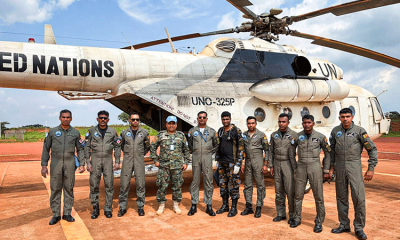
SLAF conducts successful rescue mission under UN command in Central African Republic
-
 Opinion7 days ago
Matara Maha Keralla– Uprising against the Dutch
-
 Midweek Review6 days ago
H’tota port’s strategic status remains focal point of geopolitical scrutiny