
Latest News
Gold Coast mayor scraps bid for 2026 Commonwealth Games

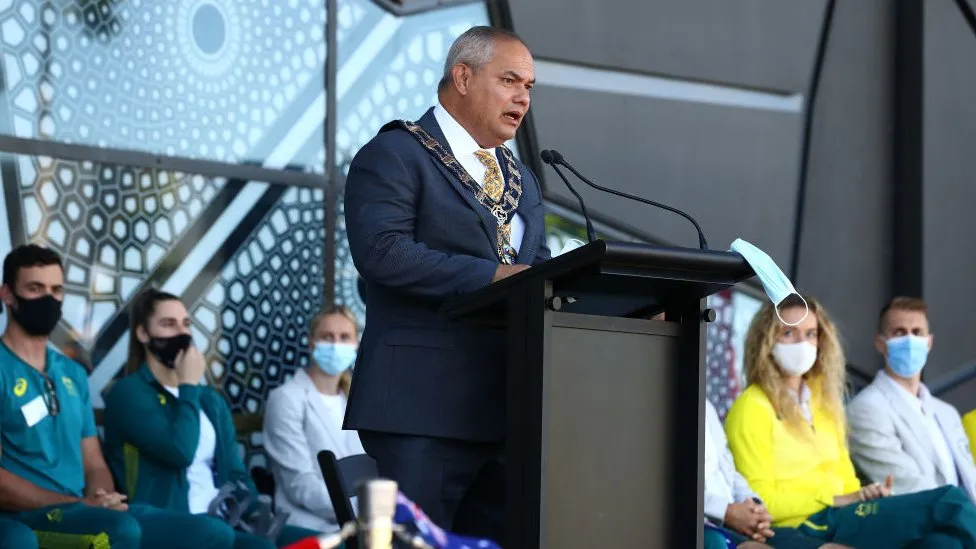
The Gold Coast has withdrawn its bid to host the next Commonwealth Games, ending any hope the tournament could still be held in Australia.
The coastal city hosted the 2018 Games, and mayor Tom Tate had – unilaterally – insisted it could do it again. But the federal and state governments have repeatedly ruled out supporting the event, as had his own deputy mayor.
Organisers have said they may have to postpone or cancel the next installment of the Games.
The Commonwealth Games are a multi-sport tournament that take place every four years. They have only ever been cancelled during World War Two. To be eligible to participate in the games, competitors must be from one of over 70 nations or territories – many of which were once part of the British Empire.
The Commonwealth Games Federation (CGF) had struggled to find a host for the 2026 Games before Victoria volunteered, and a month after the state’s withdrawal, the only contender for the 2030 Games – the Canadian province of Alberta – also dropped its hosting plans.
There are no other firm bids to host either the 2026 or 2030 Games. Governments say the cost of the event is skyrocketing, while experts argue its global image and perceived relevance is waning.
Organisers had originally estimated the Victorian Games – hosted across cities including Geelong, Bendigo, and Ballarat – would cost A$2.6bn (£1.4bn; $1.bn), but the government said it had ballooned to over A$6 bn.
Mr Tate had said the Gold Coast could host a “streamlined” version of the event for A$700m and had floated the idea of sharing the tournament with the city of Perth – a six-hour flight away.
He says his plan had attracted support from Australian billionaires like Gina Rinehart and Gerry Harvey and athletes who are desperate for the event to proceed, but that it could not win over the Queensland or federal governments. “We did our best and that’s all people can expect,” Mr Tate said in a statement on Sunday. Australia will now be known as “a place that reneges on a global sports contract”, leaving its reputation “in tatters” he added.
Commonwealth Games Australia (CGA) had stated they wanted to keep the Games in Australia, but chief executive Craig Phillips said he understood Mr Tate’s decision. “CGA, alongside our colleagues at the CGF, are working tirelessly to find an alternative solution for the athletes of Australia and the Pacific and conversations continue on four continents including here at home,” he said, according to the Gold Coast Bulletin.
(BBC)









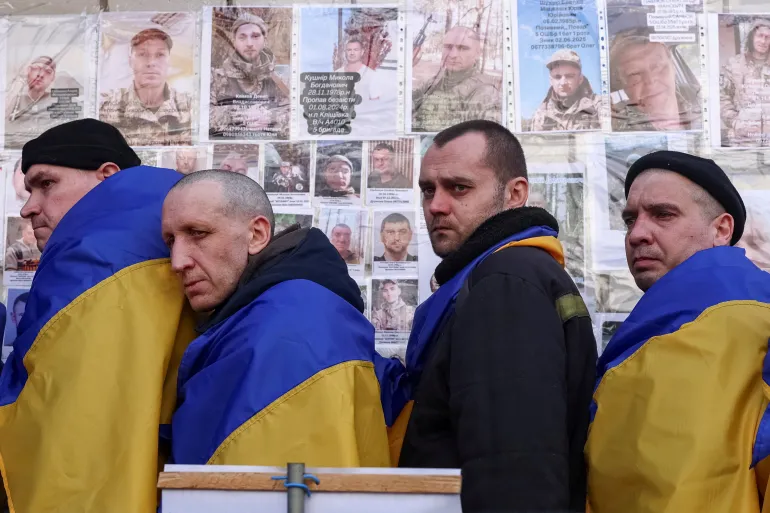
Ukrainian President Volodymyr Zelenskyy said he had visited the eastern front line as Ukraine and Russia completed a two-day prisoner-of-war swap, exchanging 500 soldiers each.
The swap, which included the exchange of 200 soldiers each on Thursday and another 300 each on Friday, came as US-brokered peace negotiations remained deadlocked, with a planned trilateral meeting this week shelved due to the escalating conflict in the Middle East.
Two Ukrainian civilians were also returned home.
Video posted by Zelenskyy of the exchange showed dozens of men stepping off white buses, waving and embracing border guards. One soldier, phone to his ear, could be heard telling his mother: “I am at home. That’s it, I am home.”
US special envoy Steve Witkoff credited the swap to “sustained and detailed peace discussions” held in Geneva under the direction of President Donald Trump, thanking Switzerland for hosting the negotiations.
“Discussions remain ongoing,” Witkoff wrote, “with additional progress anticipated in the weeks ahead.”
On Friday, Zelenskyy travelled to positions near Druzhkivka and Kostiantynivka in the eastern Donetsk region, where Russian forces have massed before an anticipated spring offensive, to visit soldiers from the 28th separate mechanised brigade.
He told troops on the front line that their efforts were vital in strengthening Ukraine’s position in future peace talks.
“The stronger we are in the eastern direction,” he told troops, “the stronger we are in the talks process.”
[Aljazeera]

The Inter-American Court of Human Rights (IACHR) has ordered Peru to pay reparations to the family of Celia Ramos, a mother of three whose death resulted from a campaign of forced sterilizations during the 1990s.
Thursday’s landmark ruling stated that the 34-year-old Ramos was coerced into sterilization against her will, causing an allergic reaction that led to her death.
The court ordered Peru to pay her family $340,000 as part of the ruling.
It noted that the Peruvian government had “failed to fulfill its obligation to initiate and conduct a thorough investigation” into Ramos’s case, heightening the strain on her family.
“Ms Ramos Durand’s family members — especially her three daughters, who were children at the time of the events — suffered profound harm as a consequence of the sterilization and death of Celia Edith Ramos Durand and the impunity surrounding the case,” the IACHR wrote in its decision.
Peru’s campaign of forced sterilization took place under the late President Alberto Fujimori, whose tenure included widespread human rights abuses that continue to cast a shadow over the country.
The scheme largely targeted poor and Indigenous women who were often tricked or coerced into sterilisation procedures.
This week’s ruling is the first time the human rights court has weighed in on the issue, which has been the subject of years of legal contestation in Peru.
“After almost 30 years of searching for justice, the Inter-American Court of Human Rights recognised the responsibility of the Peruvian state in the forced sterilization and death of Celia Ramos,” the Peruvian feminist organisation DEMUS said in a social media post, celebrating the ruling.
“This ruling marks a fundamental step in reparations for Celia, her family and the thousands of victims of forced sterilizations in Peru.”
As many as 314,000 women and 24,000 men were sterilized against their will in Peru under Fujimori’s government, which sought to forcibly lower the birth rate as a means of addressing poverty.
The procedures were particularly invasive for the women involved, and some suffered long-term complications, including death.
Family members often received little information about the circumstances that led to loved ones dying after the unnecessary operations. Some survivors did not realise what had happened to them until years later, when they discovered they were unable to have children.
In Ramos’s case, the 34-year-old mother had gone to a state health clinic for medical assistance on July 3, 1997, but was instead forced to undergo tubal ligation.
Ramos, however, suffered a severe allergic reaction during the procedure. She was placed in a recovery room, but the clinic was not able to treat her adequately.
In its decision, the IACHR explained that the clinic “lacked the necessary equipment and medications for adequate risk assessment or to handle emergencies”.
Ramos was ultimately transferred to an intensive care unit in the city of Piura, where she died 19 days later, on July 22, 1997.
The state did not carry out an autopsy and declined to share details with her family.
The compensation outlined in this week’s ruling includes reimbursement for the costs of medical procedures conducted to save Ramos’s life and the estimated loss of income from her death.
In October 2024, the Committee on the Elimination of Discrimination against Women at the United Nations ruled that Peru’s sterilization programme amounted to sex-based violence and discrimination against poor, rural and Indigenous women.
The committee’s statement cited a lack of adequate medical facilities and a lack of informed consent, just as the IACHR did in its decision this week.
“The victims described a consistent pattern of being coerced, pressured, or deceived into undergoing sterilizations at clinics lacking proper infrastructure or trained personnel,” committee member Leticia Bonifaz said.
“The procedures were carried out without informed consent from these victims, with some of them, especially those from remote areas, unable to read and speak Spanish, or fully understand the nature of the procedure.”
Scholars have concluded that Fujimori’s sterilization campaign was driven, in part, by racist views among government officials who saw rural, Indigenous communities as an obstacle to economic modernisation.
[Aljazeera]

Donald Trump has stressed that any deal with Iran must result in the country’s “unconditional surrender”, setting maximalist war objectives for the United States.
The US president’s remarks on his Truth Social platform on Friday appear to reject the prospect of a compromise amid Iranian confirmation of diplomatic mediation to end the conflict.
“There will be no deal with Iran except UNCONDITIONAL SURRENDER!” Trump wrote.
“After that, and the selection of a GREAT & ACCEPTABLE Leader(s), we, and many of our wonderful and very brave allies and partners, will work tirelessly to bring Iran back from the brink of destruction, making it economically bigger, better, and stronger than ever before.”
Iranian President Masoud Pezeshkian had said earlier that some countries are engaging in mediation efforts to end the war, emphasising that Iran is committed to peace in the region but prepared to defend itself.
“Mediation should address those who underestimated the Iranian people and ignited this conflict,” Pezeshkian said in a social media statement.
The conflict has spread across the Middle East, igniting Iranian attacks across the Gulf and a war between Hezbollah and Israel, resulting in a mass displacement crisis in Lebanon.
Iran has been launching missiles and drones at Israel and US interests and assets across the region. Iranian forces have also targeted energy and civilian infrastructure in Gulf countries, straining ties with the Arab world.
The violence, which saw Iran largely succeed in closing down the Strait of Hormuz, has sent oil prices soaring globally.
Iranian officials have expressed defiance since the start of the war, stressing that they are ready for a long conflict and prepared to fend off a US ground invasion should it occur.
Iran’s Foreign Minister Abbas Araghchi said in a message to Trump on Thursday that the US plan for a “clean rapid military victory failed”.
“Your Plan B will be even a bigger failure,” Araghchi wrote on X.
On Friday, Iran’s top diplomat posted a photo of the coffins of a mother and child, the apparent victims of US-Israeli attacks. “Our Brave and Powerful Armed Forces will avenge each and every Iranian mother, father, and child who has been targeted by hostile forces,” Araghchi wrote.
The war has killed at least 1,332 people in Iran, among them 181 children, according to UNICEF.
The deadliest incident was a strike on a girls’ primary school in the southern city of Minab on the opening day of the conflict, which Iranian authorities said killed about 180 pupils and staff.
The Trump administration has pushed to project confidence and dominance over Iran, with top officials saying that the US would “rain missiles”, “death and destruction” on the country.
In recent days, Trump has repeatedly said that he would like to replicate the Venezuela playbook in Iran – keeping the governing system in place but installing a leader who is friendly to US interests.
On Wednesday, Trump said he has to be “involved” in choosing the successor of Supreme Leader Ayatollah Ali Khamenei, who was assassinated in a US-Israeli attack on Saturday.
Trump told CNN later on Thursday that the situation in Iran is going to work “easily” like it did in Venezuela when Delcy Rodigues replaced President Nicolas Maduro after he was abducted by US forces in January.
Rodriguez, who previously served as Maduro’s vice president, has allowed Washington to sell Venezuela’s oil and cut off petroleum supplies to Cuba under the threat of further US strikes.
Trump said he does not mind of the next leader of Iran is a religious figure.
“I’m saying there has to be a leader that’s going be fair and just. Do a great job. Treat the United States and Israel well, and treat the other countries in the Middle East — they’re all our partners,” he told CNN.
The supreme leader of Iran must be a Shia Muslim religious scholar.
Khamenei’s successor will be selected by an elected council of 88 members known as the Assembly of Experts.
[Aljazeera]

Zelenskyy visits front line as Ukraine and Russia swap 500 prisoners each

UNP concerned about govt.’s silence over US sub sinking Iranian warship in Lanka’s EEZ

Govt. warns of possible adverse developments in the next few weeks due to Gulf conflict

Human rights court orders reparations for forced sterilization case in Peru

Peradeniya Uni issues alert over leopards in its premises

Wife raises alarm over Sallay’s detention under PTA

‘Dates have the highest sugar content to fight Coronavirus’

Sunday Island 27 December – Headlines

#SundayIsland 17th December – Headlines

Sunday Island – 28th March

Sunday Island Headlines – 21 March

Sunday Island – 21st February – Headlines
-

 Features5 days ago
Brilliant Navy officer no more
-

 Opinion5 days ago
Sri Lanka – world’s worst facilities for cricket fans
-

 News2 days ago
Legal experts decry move to demolish STC dining hall
-

 Features5 days ago
A life in colour and song: Rajika Gamage’s new bird guide captures Sri Lanka’s avian soul
-

 Business2 days ago
Cabinet nod for the removal of Cess tax imposed on imported good
-

 Features6 days ago
Overseas visits to drum up foreign assistance for Sri Lanka
-
 Features6 days ago
Sri Lanka to Host First-Ever World Congress on Snakes in Landmark Scientific Milestone
-
 Latest News2 days ago
Around 140 people missing after Iranian navy ship sinks off coast of Sri Lanka