
Opinion
Give teachers and principals their due

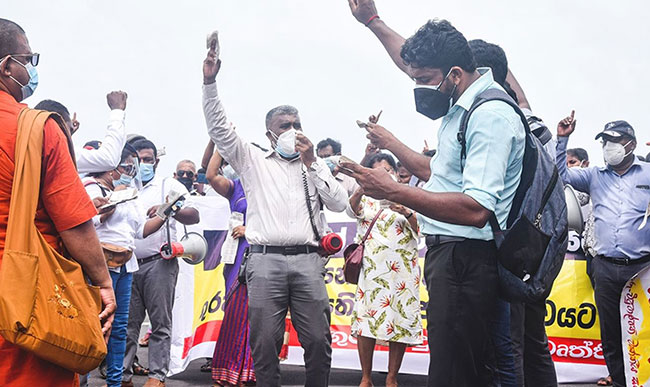
Why didn’t the Education Minister and the Secretary pay due attention to the fair voices of the most vulnerable and largest service sector of this country, at the initial stage, making the alliance of teacher-principal trade unions proceed to street protests, which started in the absence of any positive gesture from the Ministry of Education? That is how the present state of chaos originated.
The prolonged online teaching strike has kept the younger generation of all school-going children in darkness, and their right to learn has been deprived of. Blaming the teachers is not the solution. What is required is the right solution at the time of need. The unions are demanding the implementation of the Subodhini Committee report, plus the Cabinet subcommittee proposals, in a gazette notification. It is more sensible for the government to respond to this final flexible stance of the unions, rather than prolonging the issue with temporary solutions.
The strikers of the teacher-principal unions are not ready to give in to the temporary sugar candy sachet which is a pretty ridiculous joke, a consolation allowance to dodge the crux of the problem. Plastering or patching up the situation by offering an allowance of Rs. 5000 for three months is a shame to the teacher community. Such an allowance should be allocated for COVID-19 affected people of low-income or refugees in flood-affected regions.
What could have been broken with the nail was allowed to grow to the extent that it couldn’t be crushed even with an axe. Successive governments disregarded the demands of teachers and principals, treating them as nonentities; although the ungrateful present-day politicians rose to their present high positions because their bright lives were designed, brain powers sharpened and heads enlightened by teachers.
Although all teachers are not saints, the majority of our teachers are worthy of veneration. They are the architects of nation-building. They must have sufficient pay for a decent living, commensurate with the commitments and their toil. With an ungratified mentality, they may be unenthusiastic to discharge duties. Under such circumstances, the process of nation-building will collapse. So far, they have been doing yeoman’s service but they can’t continue to do so amidst the rising cost of living and unfavourable living conditions. When the salaries of all other employee categories have been brought to a satisfactory level, why does the government not heed to their demand?
In response to the mounting pressure from the teacher-principal trade union strike, the government appointed a cabinet subcommittee to produce another report to solve the problem; but it turned out to be a futile attempt, akin to changing the pillow as a treatment to the headache, wasting the valuable time of both parties. Such a committee should comprise experts from the education field, not from the lobby with the loquacious MPs who are in the habit of suspending and postponing everything until the next budget. On the other hand, what is the need for piling up further committee reports, when there is already a much-quoted and assumed fairly balanced Subodhini Committee report, which has been formulated by a panel of members comprising a former minister, four additional secretaries, and the accountant of the Ministry of Education.
True that the government is in dire straits with financial difficulties, but that is not a sound reason to postpone this issue. If so, why should the government introduce new megaprojects, such as 200 city beautification programmes, import of luxury vehicles for MPs and walking tracks, which are not critical requirements. The problem of teacher salary anomalies could be solved by holding such long term, not so urgent schemes.
The proposed four-phased payment of the salary increments is a nice way of circumventing serious demands of trade unions and yet another fairy tale. It is a way of escaping the main responsibility.
To illustrate this point, let us take the case of the state employees who retired between January 2016 and December 2020. All government employees including judges, ministry secretaries, directors, doctors, nurses, police and armed forces personnel, and mind you, a former director-general of the Pensions Department, was entitled to a revised salary increment system in five stages starting in 2016, and final amalgamation of all increments, due to be paid with effect from January 2020. The salary increment rates are clearly stated in the pension award letter issued by the Director-General of the Department of Pensions, which is a legal document to confirm the claim.
The present government unreasonably cancelled the (2016-2019) pensioners amalgamated salary increment of five stages, by the circular 35/2019(1) dated 20.01.2020 following a cabinet decision. More than 100,000 pensioners have been victimised and deprived of their fundamental right of the salary and sad to say, nearly 1819 pensioners have already died without getting their increments. But the government so adamantly refused to pay up and adopted a slippery policy with various cock and bull stories.
The basis for the development of a country is the education system, spearheaded by the formidable workforce of teachers hailing from Aristotle and Disapamok. All of the so-called thriving politicians; garrulous speakers who look down upon teacher communities; professionals, academics, philosophers, entrepreneurs, scholars, scientists, inventors, artists, all of these are the intellectual outputs of the dedicated energies of humble teachers who never gave priority to building highrise palaces for their self-indulgence and luxurious lives. Not to let it happen again and again, they deserve to be freed from this muddle of salary anomalies at this critical moment.
Finally, a word about the mediation of the Prelates of Malwatta and Asgiriya Chapters, who are urging the alliance of the teacher-principal trade unions to give the strike up , and restart online teaching. May I appeal to the venerable prelates to be fair to all. Could you, in your respected designations, kindly convey the same message to the government, asking why it is not taking an initiative to resolve this burning issue, by issuing a circular or gazette notification, without postponing it off further, for the sake of the innocent school children?
M.B. NAVARATHNE

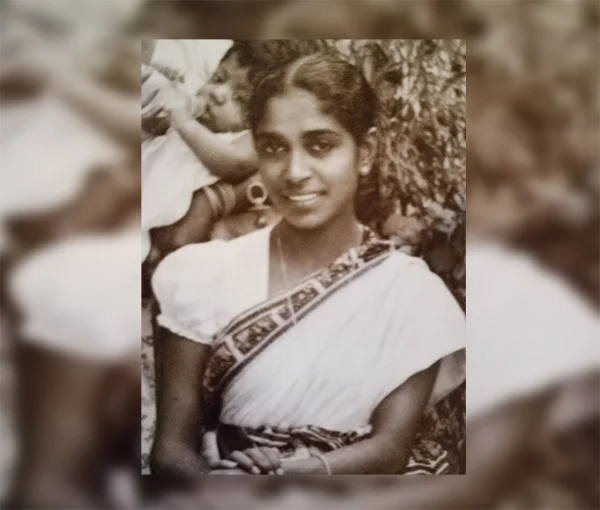
Chandra de Silva, 20th Death Anniversary
After a convulsive struggle for national liberation from British colonialism which tore the subcontinent apart, India gained its independence in 1947. Way ahead of Ceylon, on the cusp of this momentous event, it established a degree-awarding College of Nursing at the University of Delhi in 1946, a committee having visited and considered the best practices in nursing education in Canada, the USA, England and Scotland. It then carefully designed a course to meet the needs of India’s social and health requirements, and admitted its first batch of 13 students in July 1946, for a four-year BSc (Honors) degree in Nursing.
Soon after, they offered this advantage through a competitive interview to students from Ceylon.
In 1950, the year India adopted its first Republican Constitution, Chandra Samarasinghe was one of the three persons admitted to this course, and would go on to be the one who eventually introduced university education for Sri Lankan nurses in 1992, after a lifetime of campaigning.
When Chandra de Silva (nee Samarasinghe), much loved and respected by her students and colleagues alike, passed away 20 years ago on 28th January 2006, a former student wrote a moving tribute to her titled “The Morning Star of the World of Nursing Has Faded…” on the front page of the February 2006 issue of the magazine New Vision, a publication of the Graduate Nurses’ Foundation of Sri Lanka.
Describing Chandra as “the Nightingale of Sri Lanka”, a “most noble lady (Athi uththama kanthawa) filled with compassion”, “born for the good fortune of the nation” and “incomparable teacher-mother (guru mathawa) of hundreds of thousands of students”, the writer, Malini Ranasinghe, who was the President of the Graduate Nurses Foundation, confesses it is beyond her to set down in full Chandra’s life-long service of over 50 years to the profession. The magazine New Vision itself was one of Chandra’s many initiatives as was the encouragement for the Nursing Profession to obtain membership of the Sri Lanka Association of Professionals. Malini Ranasinghe promises in this heartfelt farewell, that Chandra’s legacy would be passed down the ages to each new batch of nursing students, to remain in their hearts through the course on the History of Nursing.
Chandra was Sri Lanka’s first Chief Nursing Education Officer (CNEO, now titled Director Nursing) at the Ministry of Health. She took up the pioneering role in 1967, having returned from Boston University, USA, after completing a Master’s degree in Education and Administration.
In her first year in the role, Chandra presented a comprehensive memorandum drawing the attention of the government of the day to the country’s need for a Bachelor’s degree in Nursing. She was the first to do so. It took decades before this dream came true, with Chandra having made several more proposals many years apart, before she was invited by a Canadian University in collaboration with the Open University of Sri Lanka (OUSL) to help set up the degree course in Nursing in 1992. Having spent most of her professional life in a battle to uplift the nursing profession in Sri Lanka to international standards, she was setting exam papers at the OUSL the day before she was admitted to hospital for kidney surgery, and passed away at the recovery unit. By then, she had seen not only several batches of undergraduate nurses don their robes, but also graduate nurses earn Master’s degrees with a PhD programme well on its way to being implemented.
When Delhi Built Bridges
It all started when three young ladies boarded a train with their Thomas Cooks travel documents, to Delhi in July 1950, having competed and won places at Delhi University to follow a BSc Honours degree, majoring in Nursing. Chandra Samarasinghe from Mahamaya College Kandy, dressed in a Kandyan Saree, Trixie Marthenesz from Ladies College and later Ananda College Colombo, and Shireen Packeer, also from Ananda College Colombo, in dresses, were the lucky ones selected, and became firm friends known as the “The Trio from Ceylon” at their university in India. They had “luxury accommodation” at their residential university campus at number 12, Jaswant Singh Road, New Delhi, and travelled everywhere on their bikes.
They had a blast during their four years there, not only completing their degrees but also able to experience the newly independent nation in transition, already forging a future for itself. Chandra continued to wear the Kandyan saree throughout her stay there, and when she had to introduce herself to the rest of the students, said “I am Chandra Samarasinghe from Kandy, in Lanka”, leaving a puzzled Trixie wondering why she didn’t say Ceylon. When they left the university after four years, the Principal, Dr. Margeretta Craig, O.B.E. told them “You three Ceylonese girls have been live wires!” They got on well with the staff including the Vice Principal Dr. Edith Buchanan, a Canadian from the Canadian Faculty of Nursing, who had an interesting experience with Chandra at their first encounter. When asked to explain the meaning of the term “prone position”, Chandra, always the first to offer an answer, piped up to say somewhat indelicately, “That’s the one with the backside up!” to giggles from the class. She was soon persuaded that “face-down” was a much more decorous way of saying it.
They sang and danced in the presence of Lady Edwina Mountbatten who graced the university’s annual concerts and had their names appear approvingly in the Indian newspaper report of the event. They were invited to Rashtrapati Bhavan in 1951 where they met India’s iconic first Prime Minister Jawaharlal Nehru and Dr. Rajendra Prasad, the first President. They made friends with J. Wijetunga, author of ‘Grass for my Feet’ fame who lived only a short distance away from their hostel, who gave them free access to his pantry and taught them the cultural history of India and also of Sri Lanka. They travelled to places of interest including a long-desired visit to Shanthi Nikethan, having developed a love for Rabindranath Tagore’s work, and took photos in front of the Taj Mahal.
When they first arrived in Delhi, they were thrilled to meet another Sri Lankan student in the senior year who had known them from Ceylon, Viola Perera. Viola introduced them to her friends, one of whom on obtaining her PhD became the Principal of the College of Nursing, University of Delhi.
It was clear that their time at Delhi University left a deep impression on the girls. They were being trained to take over from the departing British, and to maintain the required standards as well as to develop them further. The sense of patriotic duty they saw in India made an impression on them. They also had plenty of fun, and Chandra was able to keep Ceylon’s end up when the beautiful Bengali voices of Indian students sang at their gatherings, having herself been voice-trained by Saranagupta Amarasinghe, and according to Trixie Marthenesz’s reminiscences in her book, ‘Those Delhi Days”, also by Ananda Samarakoon (p143).
A Worthy Battle Waged
Back in Ceylon, Chandra tried many times to introduce the educational opportunities she herself had obtained, to others in her profession. And yet, unlike India at Independence, Ceylon and later even Sri Lanka, was not ready to accept such progress easily. With the Health Ministry decision makers being male and mostly doctors, they ignorantly regarded the role of the nurse as a minor one, needing just “a pair of hands”. It may have involved some insecurity which masqueraded as good sense, at the cost to the country for many decades. As CNEO, Chandra battled through it all, rewriting the curriculum to bring it up to international standards, doing what she could to send Nurses overseas for training. And she kept presenting proposals for a BSc programme, which fell on deaf ears. Decades later, she was rewarded for her unwavering commitment to the cause when she was asked to start the BSc Nursing programme at the Open University of Sri Lanka (OUSL), which is now a great asset to the country, with other universities also offering it.
In 2004, two years before she passed away, the first publication of New Vision by the Graduate Nurses Foundation of Sri Lanka was presented to her. In the 2005 issue, they reproduced on the front page her keynote address at their AGM on the 31st of October 2004, at which she was Chief Guest.
Her speech recounts the painfully hard journey that the profession (and she herself) had to endure to raise it to its current status. Chandra recalls with sadness that the three-year Nursing Diploma did not entitle Sri Lankan nurses to pursue higher education, qualifying them only to follow a few courses at the Post Basic School of Nursing:
“I had to fight a very hard battle to keep the 3 year programme intact because there was a very serious effort to downgrade the three year programme to two years, a step that would have prevented our nurses from obtaining any acceptance and recognition in a foreign country. There was intense official and political pressure for a long time to effect this change but with the assistance of a few other Nursing Leaders this retrograde step was suppressed, perhaps forever. Such dangers can arise in the future too. The price we nurses have to pay, is eternal vigilance to challenge and suppress any effort to downgrade the standard of Nursing Education in Sri Lanka.”
She happily announced that at that stage, there were 200 BSc graduates and 25 who had obtained their Master’s degree, with two heading for their PhD. She defined the lack of access to higher education for nurses as a “human right denied”. She also declared that for the first time, there was agreement across all nursing services to propose a nursing degree at conventional universities, disclosing that this was the “first time such consensus has manifested in the Nursing Services”. She called upon nurses to retain this unity “at whatever cost” and just as in other professions such an engineering, law, medicine, “it was time to rectify this anomaly” and “work together to achieve this new dimension in Nursing Education.”
A Mother to More Than Her Own
As I write this memorial to honour my mother Chandra for her life of service and unwavering dedication to provide for others the education she herself received at two of the best universities in the world (Delhi and Boston), her determination and grace under pressure, I know why I have focused on her professional life rather than her personal one. It is because I grew up sensing that she was truly a mother to a larger family, of nursing students and professionals she was responsible for. She never turned away any of them coming over to her home for special help with their dissertation topics or applications for scholarships. She encouraged the senior nursing staff to follow the degree course and helped them complete it when they were discouraged. Some who recognized me at the counters in private hospitals came up to declare their gratitude to her for this specific gesture of help, because their employment prospects had expanded greatly with that.
Though infinitely patient, graceful and ladylike, my mother was a fighter. I saw how she never gave up on her ambitions for her profession, although she was hardly ambitious for herself. I saw her pain, and her determination to fight on in a hostile environment of male dominated bureaucracy.
I am eternally grateful to Aunty Trixie (Trixie Marthenesz, her fellow student at Delhi Uni) for writing a delightful little booklet called “Those Delhi Days” (Tharanjee Prints, Maharagama, 2009), recounting their time from 1950 to 1954 at the University of Delhi, with wonderful photographs of their 4-year journey as undergraduates, including at the annual concert in creative costumes and also on their holidays around India. An especially charming photo on the first page is the one on Convocation Day 1954, which shows Chandra, Trixie and Shareen together with a few of their batch mates wearing their robes with the distinctive Delhi Uni Cap. The book recalls in such delicious detail their time during such an exciting period in India, just two years after Independence from the British. I found some of the facts for this article from that book. Aunty Trixie, whom my mother drew in, together with Aunty Viola (Viola Perera, the senior student at Delhi University) talking them both out of retirement to begin the work of setting up a new department of Nursing at the Open University, writes in her book, of the young student Chandra who screamed at witnessing the death of their first patient in a hospital in India, bringing “half the ward to the scene”, but who then turned into “a leader among professional nurses in Sri Lanka” which appellation Trixie says “befitted her”.
I see that others have now taken the profession to new heights. Her students are now the warriors at the forefront of the battle for even further professional and pedagogical development. She would be proud. I like to believe that she was as much a guiding light as a Morning Star, softly glowing in the memories of those who knew her, inspiring them to never give up, and to do things with grace. That’s why I share these memories of my exceptional, beloved mother with all those nurses who have known her personally, her colleagues, lecturers and students in white who lined the path throwing jasmine blossoms at the vehicle taking her on her final journey through Kanatte, Colombo’s the main cemetery, and those who have and will come to know her, and the contribution she made to their profession, through the History of Nursing in Sri Lanka.
By Sanja de Silva Jayatilleka
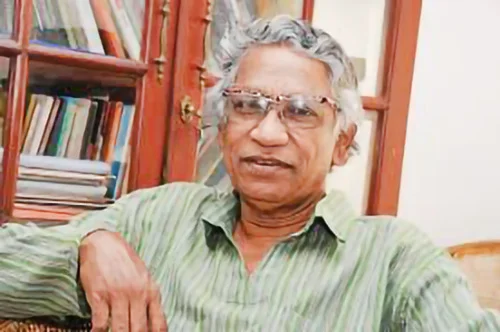
Dharmasena Pathiraja’s eight death anniversary falls today
it is in loss and loneliness, one
finds words of solace, without which,
none may live or even die,
fling forging nouns,
into the far-flung corners
of birth and death, departing
from the beaten tracks of heavy tread.
dreams come and go,
in colour, as a contamination of the real,
the waking hours, a coming and going,
of departure and death
of bodies lined up shot,
in eelam, in lanka, or any other place.
the political is strained, half breathing,
lines the tongue with lashing words.
stories we tell our children
of war in words of peace,
and of peace in words there’s nothing to tell.
in silence, the quiet beat of the heart, strums louder and louder,
calling up the sound of waiting, for that time, when it is
all a matter of leaving, and now a matter for grieving,
living out the vanishing moments as limn, time pass, and
as our life foreshadowing death, not yet dreamt of,
but dreaded still.
in gaza, the children are gone forever
and it’s been a long journey, these forever years.
sumathy – january 2026
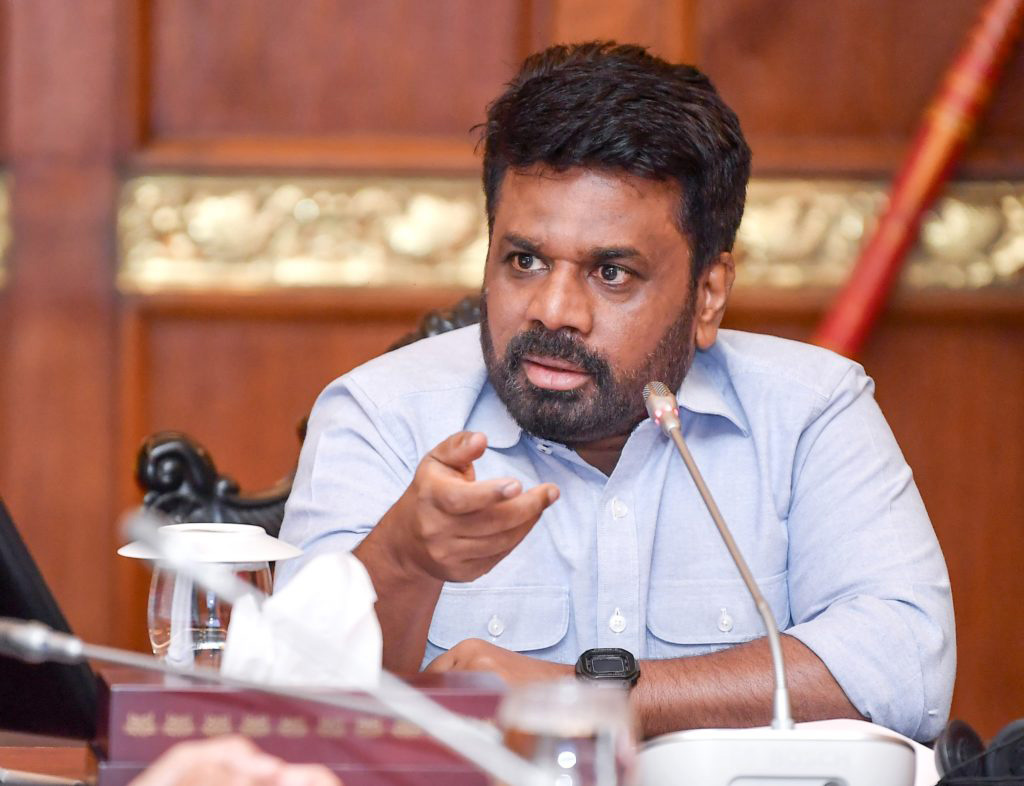
President Anura Kumara Dissanayake should listen at least to the views of the Mothers’ Front on proposed educational reforms.
I was listening to the apolitical views expressed by the mothers’ front criticising the proposed educational reforms of the government and I found that their views were addressing some of the core questionable issues relevant to the schoolchildren, and their parents, too.
They were critical of the way the educational reforms were formulated. The absence of any consultation with the stakeholders or any accredited professional organisation about the terms and the scope of education was one of the key criticisms of the Mothers’ Front and it is critically important to comprehend the validity of their opposition to the proposed reforms. Further, the proposals do include ideas and designs borrowed from some of the foreign countries which they are now re-evaluating in view of the various shortcomings which they themselves have encountered. On the subject, History, it is indeed unfortunate that it has been included as an optional, whereas in many developed countries it is a compulsory subject; further, in the module the subject is practically limited to pre-historic periods whereas Sri Lanka can proudly claim a longer recorded history which is important to be studied for the students to understand what happened in the past and comprehend the present.
Another important criticism of the Mothers’ Front was the attempted promotion of sexuality in place of sex education. Further there is a visible effort to promote trans-gender concepts as an example when considering the module on family unit which is drawn with two males and a child and two females and a child which are nor representative of Sri Lankan family unit.
Ranjith Soysa

South Korea’s former first lady sentenced to jail term in bribery case

Plane crash kills prominent Indian politician Ajit Pawar

New circular issued to support disaster-affected Micro, Small and Self-Employed Businesses

Food safety practices should not be confined to the school curriculum alone, but must become an integral part of the attitude and daily behavioral patterns of the child -PM

Vintage Markram, clinical Linde headline South Africa’s comfortable win

Cabinet nod for MOU between Sri Lanka and Romania on the cooperation in the Labour Field

‘Dates have the highest sugar content to fight Coronavirus’

Sunday Island 27 December – Headlines

#SundayIsland 17th December – Headlines

Sunday Island – 28th March

Sunday Island Headlines – 21 March

Sunday Island – 21st February – Headlines
-
 Business3 days ago
ComBank, UnionPay launch SplendorPlus Card for travelers to China
-
 Business4 days ago
ComBank advances ForwardTogether agenda with event on sustainable business transformation
-
 Opinion7 days ago
Remembering Cedric, who helped neutralise LTTE terrorism
-
 Business7 days ago
CORALL Conservation Trust Fund – a historic first for SL
-
 Opinion4 days ago
Conference “Microfinance and Credit Regulatory Authority Bill: Neither Here, Nor There”
-
 Opinion6 days ago
A puppet show?
-
 Opinion3 days ago
Luck knocks at your door every day
-
 Features6 days ago
‘Building Blocks’ of early childhood education: Some reflections