
Latest News
Ghulam’s debut century carries Pakistan as England stay in touch

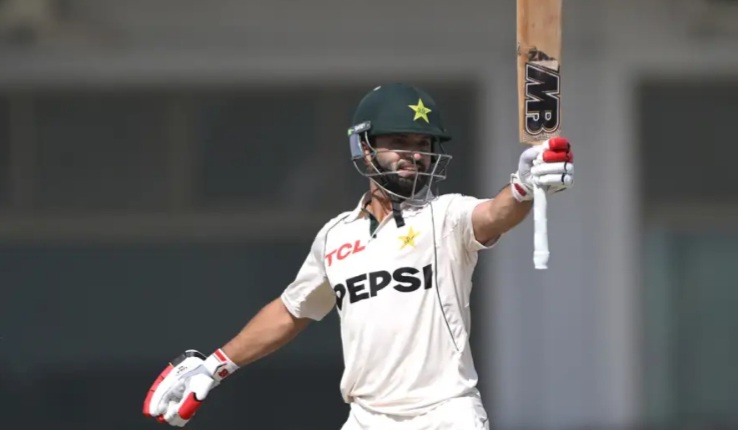
There has been precious little for Pakistan cricket to cheer in recent months, but on the opening day of the second Test in Multan, Kamran Ghulam provided a moment of unbridled joy as he brought up a gutsy century in his maiden Test innings, to carry the fight for his embattled team.
Though he fell late in the day for 118, bowled by Shoaib Bashir as he looked to stay proactive with the close of play looming, Ghulam’s debut efforts helped to lift Pakistan to 259 for 5 – scarcely riches by the standards that England were dishing up on this very same surface last week, but the beginnings of a score nonetheless.
Despite Pakistan’s experience in the first Test, when their first-innings 556 ended up on the wrong side of an innings defeat, Ghulam’s resolute efforts – allied to a career-best 77 from Saim Ayub and an atypically entrenched 37 not out from Mohammad Rizwan – kept Pakistan on course for the sort of 300-plus score that could yet be competitive if their spin-heavy attack can take advantage of a pitch that had been heavily watered and dried with industrial fans in the four-day turnaround between Tests.
The danger for Pakistan, however, may yet come from the weapons that they won’t be able to deploy. Despite two early wickets for Jack Leach, who has now claimed nine in three innings on this surface to reassert his status as England’s senior spinner, their most pronounced threat came through a mid-afternoon spell of reverse-swing, excellently harnessed by a three-pronged seam attack. Uniquely, all three hail from Durham, among them Ben Stokes, who was back to lead the team for the first time since his hamstring tear in August. In opting to ditch both Shaheen Shah Afridi and Naseem Shah for this contest, much will be resting on their lone quick, Aamer Jamal, if Pakistan hope to utilise similar skills.
All such considerations can wait for now, thanks to the efforts of Ghulam, who – at the age of 29 – was the second oldest Pakistani to record a debut century. He achieved the feat with a gleeful swing through the leg-side off Joe Root, after an anxious wait in the 90s that had encompassed the evening drinks break. A few more moments of delay could not perturb him, however, after more than a decade of service in Pakistan’s Quaid-e-Azam Trophy, in which time he might have assumed that his haul of more than 4500 runs at 49 would forever be overlooked.
His innings had begun at 19 for 2 in the tenth over, after Leach – thrown the ball early after Stokes’ quick assessment of the surface – had become the first England spinner to strike twice so early in a Test match since Johnny Briggs in 1889. His impact threatened another meltdown to match Pakistan’s fourth-evening collapse in the first Test, but Ghulam proved his mettle from the outset, showcasing his familiarity with the arid conditions and his faith in the methods that had finally got him noticed.
His first boundary was a composed launch for six back over Leach’s head, and in easing through to his first half-century from 104 balls, he recorded a milestone that had eluded his more illustrious compatriot, Babar Azam, in the 18 out-of-form innings that had resulted in his omission.
Ghulam had faced just two deliveries of fast bowling in his first 120, however, when Stokes brought himself into the attack midway through the afternoon, and the challenge instantly went up a notch. In his first over, Stokes found a fat edge that flew at a catchable height through the vacant slip cordon, and when a second edge fell short soon afterwards, Root found himself donning a helmet four yards from the bat in a bid to make any further chance count.
The breakthrough, however, arrived at the other end. Ayub’s reputation had suffered in this series, largely as a consequence of his hopelessly misfiring opening partnership with Abdullah Shafique, which at least reached double-figures for the first time in nine innings. It didn’t get much further, however, as Leach bowled Shafique for 7 to reduce Pakistan to 15 for 1, before Shan Masood clipped on the up to Zak Crawley at midwicket for 3.
In isolation, however, Ayub has been a qualified success at the top of Pakistan’s order, and this was his third half-century in four first innings, following his twin fifties against Bangladesh last month. But, with tea approaching, and England beginning to make the ball talk, Matthew Potts threatened his outside edge with a diet of hooping outswingers from over the wicket, before Stokes pouched a firm push through the line at a very straight silly mid-off (168 for 3).
After tea, Brydon Carse, energetic as ever, roughed up Saud Shakeel with an excellent short ball, then found his edge for 4 with an even better 140kph/87mph delivery that fizzed through to Jamie Smith behind the stumps. And England’s position could have been stronger still had Ben Duckett clung on to a loose slap from Ghulam, on 79, as he chose to take the attack to the returning Leach and almost paid the price at mid-on.
The value of Stokes’ economy with his seamers throughout a morning session was brought to bear in the evening, with Carse helping to keep Rizwan under the cosh for 19 deliveries without scoring before Potts took over and so nearly landed an innings-altering blow. His first delivery to Rizwan, on 6 at the time, zipped past the outside edge and into Smith’s gloves, but England declined to use a review – even though replays showed that the ball had grazed the splice of his bat.
England’s endeavours were worthy of another breakthrough before the close, and though he had once again been the weaker link in the attack, Bashir obliged with a critical strike late in the day. Armed with the second new ball, he skidded a good-length delivery past Ghulam’s tired charge, and clipped the top of leg to prise a critical opening that could yet make the difference in Pakistan’s quest for a serviceable first innings.
Brief scores:
Pakistan 259 for 5 in overs (Kamran Ghulam 118, Saim Ayub 77, Mohammad Rizwan 37; Jack Leach 2-92 ) vs England
[Cricinfo]


President Anura Kumara Dissanayake today (20) paid his last respects to the remains of Most Venerable Kappetiyagoda Siri Wimala Thera, Anunayake of the Sri Lanka Ramanna Maha Nikaya and Chief Incumbent of the Rajopawanaramaya Temple in Gatambe, Kandy, who passed away.
The President visited the Rajopawanaramaya Temple in Gatambe, Kandy, where the remains of the Thera are lying, and paid his last respects. He subsequently expressed his deepest condolences to the Maha Sangha and the temple’s Dayaka Sabha, who are mourning the passing of the Thera.
Central Province Governor and Consultant Physician Dr Harsha Suranga Fernando, Kandy District Secretary Indika Udawatta and several others were present.
President’s Media Division (PMD)

India opener Shafali Verma has received an official reprimand and a demerit point for breaching Level 1 of the ICC Code of Conduct during the second T20I against Zimbabwe on Sunday.
Shafali, an ICC release said, breached Article 2.2 of the ICC Code of Conduct for Players and Player Support Personnel, which relates to “abuse of cricket equipment or clothing, ground equipment or fixtures and fittings during an International Match.”
It was Shafali’s first offence in a 24-month period.
The incident occurred in the 12th over of Zimbabwe’s innings when Shafali threw the ball into the ground in frustration after dropping a chance at mid-off offered by Chipo Mugeri-Tiripano off Sree Charani.
Shafali admitted the offence and accepted the sanction proposed by match referee GS Lakshmi, which meant there was no need for a formal hearing.
Level 1 breaches carry a minimum penalty of an official reprimand, a maximum penalty of 50% of a player’s match fee, and one or two demerit points.
India currently lead the three-match series 2-0 with the third game to be played on Tuesday evening. The T20Is will be followed by three ODIs in Vadodara from October 23.
(Cricinfo)

A total of 146 players will be competing for 27 available slots in the WPL 2027 mini auction on October 28 in Kochi. Of these, England batter Sophia Dunkley and Australia captain Sophie Molineux are the only two players who have listed themselves at the maximum base price of INR 50 lakh.
The auction pool has 119 Indian players, including 22 capped and 97 uncapped players, with 20 slots available for Indian players. The overseas pool has 27 players – 14 capped and 13 uncapped – including six from Associate teams, with seven slots available.
G Kamalini (released by Mumbai Indians), Kiran Navigre (released by U P Warriorz), Heather Graham and Jess Jonassen have registered at the second-highest base price of INR 40 lakh, while a total of 30 players have registered at INR 30 lakh.
Among the notable absentees are West Indies allrounder Deandra Dottin, who was released by UPW, and Australia legspinner Alana King, who was released by Delhi Capitals. Lizelle Lee, who was DC’s highest run-scorer last season, has also not listed herself after being released by the franchise.
What the teams look like going into the auction
Only two English players – Dunkley and Kira Chathli (INR 10 lakh) – have registered for the auction, with several others, including Danni Wyatt-Hodge, Alice Capsey, Dani Gibson, Lauren Filer and Linsey Smith opting to skip the WPL next year.
Cricinfo has learned that England are likely to play three T20Is in Sri Lanka in early February, which will clash with the final week of the WPL. While the ECB is likely to allow players to stay in India to complete the tournament, most players have instead chosen to prioritise their international commitments ahead of the Champions Trophy later that month.
The relatively low salaries on offer at the WPL are also understood to be a factor in many English players deciding not to register, with most internationals earning significantly more to play in the Hundred (up to £190,000 last year) than the highest permitted base price in the WPL of INR 50 lakh (£40,000 approx).
Molineux was part of the Royal Challengers Bengaluru [RCB] title-winning squad in 2024, and had bagged 12 wickets in ten games at an economy rate of 7.31. She was retained by RCB for the 2025 season but a knee injury ruled her out of the season. Dunkley, meanwhile, played for Gujarat Giants [GT] in 2023 before opting not to register for the 2024 season. She went unsold in the 2025 auction.
Among the premier internationals who have listed themselves for INR 30 lakh are Australia allrounder Grace Harris (released by RCB), Sri Lanka captain Chamari Athapaththu, South Africa left-arm spinner Nonkululeko Mlaba and South Africa allrounder Chloe Tryon.
UPW, who released nine players, will go into the auction with the biggest purse of INR 3.75 crore.
[Cricinfo]

Environmental laws will be enforced equally against everyone

President pays last respects to Most Venerable Kappetiyagoda Siri Wimala Thera

Shafali receives demerit point for breaching Level 1 of ICC code of conduct

Heavy showers about 100 mm are likely at some places in the Northern, North-central, Central, Eastern, North-western and Uva provinces

Molineux, Dunkley enter WPL 2027 auction with top base price of INR 50 lakh

Ranawaka accuses govt. of using JVP cadres and police to suppress political opponents

‘Dates have the highest sugar content to fight Coronavirus’

Sunday Island 27 December – Headlines

#SundayIsland 17th December – Headlines

Sunday Island – 28th March

Sunday Island Headlines – 21 March

Sunday Island – 21st February – Headlines
-

 Features3 days ago
Kotahena:A Small Enclave, An Extraordinary Legacy
-

 News7 days ago
Sri Lanka, India caught in US-Iran ship crisis
-
 News4 days ago
Asgiri Mahanayake calls for immediate release of Gnanasara Thera
-

 Latest News7 days ago
Missiles intercepted near Riyadh after Saudi coalition hits Yemen fuel depot
-
 Latest News7 days ago
Kusal Mendis’ unbeaten 87 hands Sri Lanka consolation win
-

 News2 days ago
Record 1,600 students take Russian Classical Ballet examination in Sri Lanka
-

 News6 days ago
AC President recuses himself from hearing prison attire case pertaining to Gnanasara Thera
-

 Latest News7 days ago
Heavy showers above 100 mm are likely at some places in the Western, Sabaragamuwa, Southern, Central, and North-western provinces and in Anuradhapura district.