
News
General election: GTF discourages voters from backing major parties…

…warns of authoritarian rule
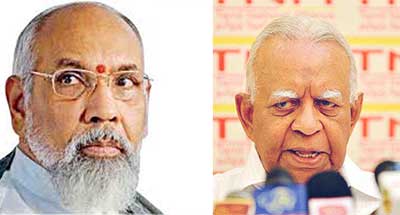
The UK headquartered Global Tamil Forum (GTF), which has been working closely with Tamil National Alliance (TNA), has urged the Tamils to vote for those only contesting the northern and eastern regions. In addition to the TNA, the Thamizhi Makkal Tesiya Kootani or the Tamil People’’s National Alliance led by former Northern Province CM C.V. Wigneswaran are in the fray in the former war zones.
The GTF, in a statement issued yesterday said: “First and foremost, ensure that people appreciate the significance of this election and the power of their vote – every vote matters. Second, no vote should be wasted on the multitude of independent groups and those representing countrywide parties, as these could only dilute the strength of the Tamil representation for future political engagements. Overly unrealistic agenda and an inward-looking insular political strategy is not the most suited in the present circumstances. The question for the Tamil voters is among the parties that represent Tamil national interest, which party and candidates are the best suited to navigate Tamil politics through the turbulent times ahead.”
The GTF urged all citizens of Sri Lanka, including those from Tamil and Muslim communities, to view the election with long-term perspective and exercise their franchise prudently and responsibly. Otherwise, the price of apathy could be too high.
The GTF alleged the election was being held amidst authoritarian presidential rule through decrees and task forces, key civilian functions entrusted to serving and retired military officers (some of whom credibly implicated in serious human rights violations), an atmosphere of intimidation and fear leading to media self-censorship and silencing of civil society activists, and insecurity among the minority communities.
The GTF said: “It is in this atmosphere that Rajapaksas are seeking 2/3rd majority to change the constitution, in particular, to abolish the 19th Amendment. It is not difficult to contemplate where this will lead to – executive power without checks and balances, marginalisation of Parliament and Judiciary, and key institutions made irrelevant. In such a quasi-democracy, rule of law and human rights will become expendable, and impunity will reign. The argument that a strong leader with unconstrained power is a must for development and prosperity is phony and self-serving.”
The GTF statement: “The last two attempts at constitution making (1972 and 1978), where the political parties that drove the process had 2/3rd majority, were disastrous, and their effects are still crippling the country. Democratic fundamentals and the multi-ethnic, multi-lingual, multi-religious character of the state were severely compromised to satisfy the power greed of the rulers. There is no indication that politics or statesmanship will be any different this time. In fact, if history is a guide, the outcome could be worse than what was achieved during the last two attempts. It is crucial, therefore, that all citizens should unite in denying the present rulers unfettered freedom for constitution making, rather ensure that only a widely consulted and compromised charter will be possible.
“While a functioning democracy with checks and balances are important for all citizens, it is so paramount for the minority communities. When the fangs of the majoritarian state unfairly target minority communities, even the theoretical possibility of legal recourse can be significant. So, it is vital that Tamil, Muslim and Christian communities study their electoral options and act wisely.
“Eleven years after the end of war, re-evaluating political circumstances and electoral possibilities is a must for the Tamil community. Gaining a respectable and secure status in the country is still a dream and there are many disappointments to contend with – no tangible outcomes on constitutional and accountability fronts, lack of momentum in returning to normalcy for the war-affected, and lingering concerns about protecting identity of the Tamil majority North-East. However, it is also undeniable that during the last five years there was notable relief for the Tamil people due to de-escalation of the military stranglehold in the North-East and people enjoyed some normalcy and freedom which included the right to memorialize the war-dead. How much of these could be lost due to the electoral outcomes is one important question to consider.
“The Tamil political leadership during the last decade has earned some positive marks on the national politics of the country – its role in the 2018 constitutional crisis being one notable example. A far-sighted political approach has somewhat weakened the apprehensions and animosities existed between the Tamil and other communities. Further, the Tamil nationalistic politics in Sri Lanka is viewed in the major capitals of the world as a far more progressive one than what it used to be. These fundamental building blocks are crucial for future political settlements, and need to be further strengthened, not weakened, as Tamil struggle moves on.
“Tamils in Sri Lanka is a significantly weakened community today – the population is relatively small with reduced electoral strength, and its educational and economic performances are among the worst in the country. Meeting political aspirations, though overwhelmingly the dominant issue for Tamils, is one of many objectives for the rest of the country. While the Tamil community should never take its eyes off from achieving political outcomes, it is no longer tenable that it be approached in a sequential manner, i.e. – ‘political resolution first, economic development later’. It is crucial that the Tamil political leadership become more cognizant of this reality and take necessary initiatives in this direction.
“The Sri Lankan political leadership’s intransigence in accommodating the legitimate aspirations of the Tamil community, made the Tamils look to the international community and India, with hope and expectation. While this is an integral part of the Tamil political struggle and need to be strengthened and leveraged to the maximum, this cannot substitute an effective political and civil society engagement with all communities in the country. This, too, needs to be a factor when Tamils consider their political choices.
“The Tamil community faces monumental challenges today. The Rajapaksas-led political ‘movement’ does not have many parallels in Sri Lanka’s history. It relies entirely on Sinhala-Buddhist vote and highly insensitive to the concerns and aspirations of the minority communities. No commitment to accountability and reconciliation (withdrew from co-sponsorship of UNHRC resolution), increased militarisation of civil functions (military officers for every village in the North-East), and the appointment of all-Sinhala task force to ‘preserve the historical heritage of Sri Lanka’ in the multi-ethnic Eastern Province are a few examples. More ominous is the possibility of losing some of the fundamental reforms such as power devolution under 13th Amendment and the parity status for Tamil language. A major economic contraction Sri Lanka is expected to undergo could lead to intensifying authoritarianism and militarisation, and in all likelihood the minority communities will be used as scapegoats for the wrong doings of the powerful.
“The period ahead will test the capability of the Tamil political leadership. Forming effective partnerships with the elected representatives from all minority communities and with those from the majority community with progressive views could be critical, so is fostering effective engagement strategies with the international community and India. If Rajapaksas are denied 2/3rd majority, such coalitions would be particularly powerful in preventing the constitution being amended on their own right. Perhaps the better strategy for the Tamil community could be protecting its hard-won gains, while exploring opportunities for furthering its community interests.
” Despite the fundamental weaknesses in Sri Lanka’s democracy, the country is often viewed favourably by the international community because it unfailingly conducts elections which are viewed largely as free and fair. In such circumstances, voting is fundamental and in fact the most powerful tool available to effect political, social and economic transformations in the country. The Global Tamil Forum (GTF) appeals to every citizen of Sri Lanka, and the Tamil people in particular, to cast their precious votes and cast it wisely, keeping the long-term interest of the country and their political, economic and democratic rights in mind.”

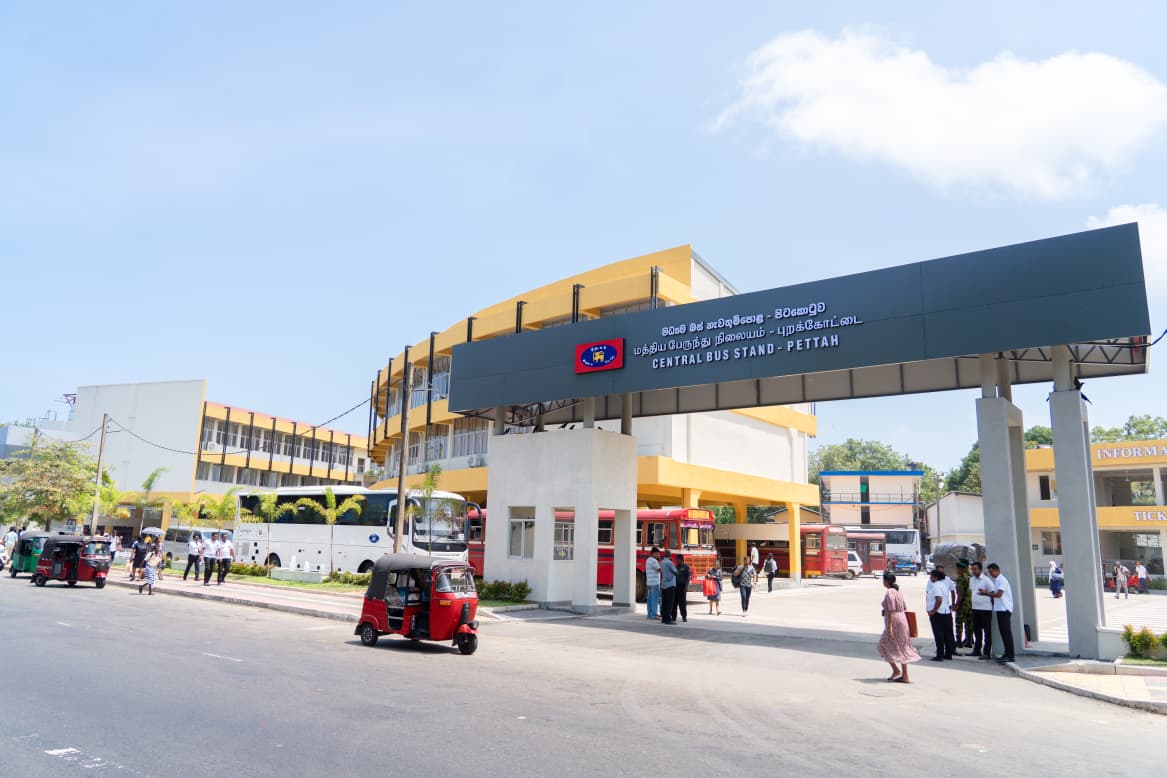
The Colombo Central Bus Stand, which has a history of over six decades and had remained without a proper maintenance for many years, has now been renovated under the current government’s development programme and vested to the public. Following that, the Prime Minister undertook an inspection tour of the newly renovated Colombo Central Bus Stand.
Originally constructed in 1964, the bus stand was refurbished with modern facilities to meet current needs and was officially reopened to the public on April 8. The primary objective of this initiative is to provide passengers with a higher-quality and more comfortable transportation service.
During the renovation process, special attention has been given to the comfort and safety of women, which was commended by the Prime Minister. In particular, a modern rest area designed to ensure privacy for nursing mothers travelling from distant areas received special praise.
The Prime Minister also reviewed the newly introduced passenger seat reservation system and information services established to assist commuters. In addition, the modern surveillance unit and other security measures installed within the premises to ensure passenger safety were also inspected.
During the visit, the Prime Minister engaged in conversations with passengers at the bus stand and inquired about their views on the newly renovated facilities and the quality of transport services.
It was emphasized that the government’s objective is to transform public transportation into a safe, technologically advanced service that can be used with convenience by all citizens.

(Prime Minister’s Media Division)
Latest News
Sun directly overhead Nagawilluwa, Galgamuwa, Sigiriya, Palugasdamana and Mankerni about 12:11 noon today (10)


On the apparent northward relative motion of the sun, it is going to be directly over the latitudes of Sri Lanka from the 05th to 15th of April in this year.
The nearest areas of Sri Lanka over which the sun is overhead today (10th) are Nagawilluwa, Galgamuwa, Sigiriya, Palugasdamana and Mankerni about 12:11 noon.

No-faith motion to be taken up today
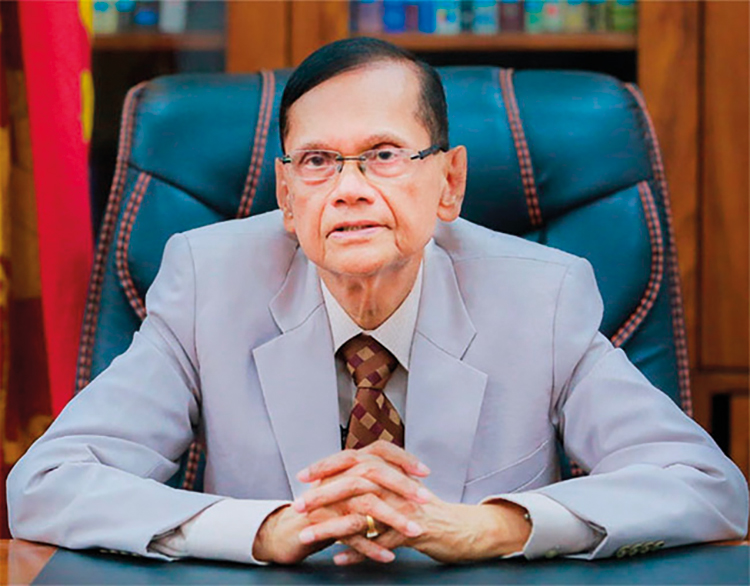
Former Foreign Minister Prof. G. L. Peiris yesterday (9) said that President Anura Kumara Dissanayake should remove Energy Minister Kumara Jayakody unless the minister stepped down on his own.Prof. Peiris, addressing a press conference called by the Opposition, said that Jayakody couldn’t under any circumstance continue to serve as a minister after the Commission to Investigate Allegations of Bribery or Corruption (CIABOC) moved the Colombo High Court against the government member over a previous financial scandal.
Pointing out that Minister Jayakody had been indicted of a corrupt deal struck during the yahapalana regime, Prof. Peiris said it was wrong for the NPP to retain him as a minister, claiming that the offence was not committed during his tenure as a Cabinet minister in the current government.
Prof. Peiris and several other Opposition members dealt with the No-Confidence Motion (NCM) against Jayakody that would be taken up today (10) with the academic calling the vote an acid test for the NPP. Having campaigned on an anti-corruption platform at presidential and parliamentary polls, the NPP couldn’t protect Jayakody though he was widely believed to be close to President Dissanayake.
As the Manager of the Procurement and Import Division of the Ceylon Fertilizer Company, Jayakody is alleged to have committed the offence of corruption, according to CIABOC.
Jayakody has been accused of causing a loss of Rs. 8,859,708 to the State by influencing and exploiting the procurement process.
Following the serving of indictments on 27 March, the judge ordered Jayakody’s release on two personal bail bonds of Rs. 1 million each. The court directed that the defendant’s fingerprints be obtained and a formal report be submitted. The case has been scheduled for a pre-trial conference on 6 May.
Prof. Peiris stressed that the CIABOC action against Jayakody is central to the NCM primarily moved over the irregularities ridden coal procurement process launched in 2025 that caused severe disruption to the power generation. Responding to The Island query after the media briefing, Prof Peiris expressed surprise that the JVP/NPP accommodated a person under investigation by the CIABOC. Having taken an utterly irresponsible decision, the JVP/NPP were now playing down the developing issue, prof. Peiris said.
The entire government parliamentary group faced the prospect of having its image tarnished by defending Jayakody, the former lawmaker said.
Prof. Peiris said that they intended to build a campaign around the issues involving the energy minister to expose the government. With yet another electricity tariff hike in the offing due to the growing demand for thermal generation as a result of coal-fired Lakvijaya power plant’s failure to meet the requirement[RA1] , the energy minister and ministry’s performances have to be examined, Prof. Peiris said.The timely release of the Auditor General’s report on controversial coal procurement should compel the government to decide on the energy minister’s fate or be prepared to face the fallout.
By Shamindra Ferdinando

PM on inspection tour of newly renovated Colombo Central Bus Stand

Israel to hold direct talks with Lebanon but no ceasefire, Netanyahu says

Sun directly overhead Nagawilluwa, Galgamuwa, Sigiriya, Palugasdamana and Mankerni about 12:11 noon today (10)

Showers expected in the Western, Sabaragamuwa, Southern and Uva provinces and in Kandy and Nuwara-Eliya districts after 2.00 p.m

Opposition tells Minister Kumara Jayakody to resign

Coal tender scandal: FSP to move court against illegal deals

‘Dates have the highest sugar content to fight Coronavirus’

Sunday Island 27 December – Headlines

#SundayIsland 17th December – Headlines

Sunday Island – 28th March

Sunday Island Headlines – 21 March

Sunday Island – 21st February – Headlines
-

 Features5 days ago
Ranjith Siyambalapitiya turns custodian of a rare living collection
-

 News5 days ago
Global ‘Walk for Peace’ to be held in Lanka
-

 News3 days ago
Lankan-origin actress Subashini found dead in India
-

 Features5 days ago
Beyond the Blue Skies: A Tribute to Captain Elmo Jayawardena
-

 Features5 days ago
Aspects of Ceylon/Sri Lanka Foreign Relations – 1948 to 1976
-

 Business1 day ago
Hayleys Mobility introduces Premium OMODA C9 PHEV
-

 News1 day ago
AG: Coal procurement full of irregularities
-

 Sports1 day ago
DS to face St. Anthony’s in ‘Bridges of Brotherhood’ cricket encounter