
Sports
Gamini – My friend


Today marks the 80th birth anniversary of visionary SLC President Gamini Dissanayake
by Nuski Mohamed
Gamini Dissanayae was my mentor and friend. My first interaction with him was in 1969 at the Institute of Chartered Accountants of Sri Lanka, when he was a lecturer in Company Law. Since then, we had been in close touch in terms of politics, cricket and corporate management.
In 1981 when Gamini was elected the President of the Board of Control for Cricket in Sri Lanka, I was the Treasurer. That was the year we famously became a Full Member of the International Cricket Council. Gamini’s leadership and the role he played towards Sri Lanka obtaining Full Membership is only too well known and need not be elaborated upon.
The following year, I was elected as Secretary of the Cricket Board and worked alongside Gamini until 1989 for a continuous period of seven years and was in constant contact with him. Gamini had a personality and a mind of his own, thought creatively and acted fearlessly. His leadership was unmatched. His decision making was precise in order to achieve timely and optimum results. One of those decisive moments was in 1982 when he took action with the blessings of the ExCo to ban the cricketers who went on the Rebel tour to South Africa for a period of 25 years without any hesitation whatsoever. It was an eye opener for younger generations.
Following the conclusion of the ICC meeting in 1985, over a coffee in the Long Room at the Lord’s Cricket Grounds, Gamini asked me whether I could take over the Chairmanship of the Sri Lanka Land Reclamation and Development Corporation almost overnight. It took me by surprise, since I knew that the responsibility of heading a State Corporation was demanding besides being a full time job. I was then with the Private Sector since the early 1970’s post qualified.
Although I was on a few Director Boards of State Corporations, the task of taking over a Corporation appeared to be a challenge. However, knowing Gamini’s thinking that he will not take ‘No” for an answer, I requested a few days’ time, to ponder over same.
But that was not to be and on our return to Sri Lanka two days later, he summoned me to the Ministry of Lands and issued me with the letter to take charge of the Corporation immediately. He had obviously made up his mind long before though it was not communicated to me. On hind sight it was a pleasure working with a personality of Gamini’s stature including the experience and knowledge I gained. We always had mutual respect for each other in our work ethics. I enjoyed every bit of our working relationship.
In the early to mid 1980s, the bid for the 1987 World Cup was a tussle between Australia/ New Zealand on the one hand and India/ Pakistan representing the Asian region. Australia had been very helpful to Sri Lanka in terms of exchange of tours which at that time was rare due to our not so strong cricket strength with the exit of key players on account of the rebel tour. Domestically too in coming tours were hampered as a result of the LTTE terrorist activity. Besides, the fact that Australia supported us positively during the crucial vote at ICC without exercising the veto following the visit of ACB Chairman Fred Bennet to Sri Lanka was foremost in Gamini’s mind.
In the midst of the ICC meeting Gamini mentioned to me that Sri Lanka should show some gratitude and thereby initiated a dialogue with the Aussie delegation which included David Richards, to explain to them the circumstances that will compel Sri Lanka to extend support to the bid from the Asian Region. This was well received and appreciated by the Australian delegates. Regional politics did eventually play a dominant role with the Prime Minister of India Rajiv Gandhi speaking to his Sri Lankan counterpart President J.R.Jayewardene and SLC had very little choice.
Gamini’s concluding speech on behalf of the Asian Region Countries on the concept that the World Cup should be rotated as a part of promoting the game globally received overwhelming applause and support from the ICC membership.
Lt. Gen Safdar Butt, President of the Pakistan Cricket Board was a great friend of Gamini. Lt.Gen Safdar was very commandeering and had a personality of his own. During the Pakistan tour of Sri Lanka in 1986 there was a fair amount of upheaval between the Sri Lankan umpires and the captain of the Pakistan team Imran Khan.
The current Prime Minister of Pakistan threatened to abandon the tour and take his team back home. That would have also jeopardized the Asia Cup in 1986 which was to immediately follow the Pakistan tour. Gamini using his personal friendship immediately phoned his counterpart Lt. General Safdar Butt who promptly took a flight and arrived in Sri Lanka at Gamini’s request to settle the dispute. Sanity prevailed and the tour continued with a change of Umpires for the final Test at the P. Sara Oval. A major catastrophe was thus averted.
Gamini never mixed cricket with politics. It was during our regime that the long felt need of a headquarters for the Cricket Board was identified and the project commenced at the SSC grounds. Gamini was able to negotiate terms with President J. R. Jayawardene who was also the President of SSC to construct the headquarters and the award was given to the State Engineering Corporation. We had no funds, but Gamini used his offices and found sponsors with the Sri Lanka Cricket Foundation, Gamini’s creation also chipping in.
During completion stage Turnor Wickremasinghe, Engineer in charge of the project at SSC told me that he would use light green and black paint to the front of the building and that he has consulted the Architects etc. They also opined it would blend well with the green grass in the background. As Secretary of the Board the State Engineering Corporation Consultants were in touch with me on a daily basis on all routine matters during construction and I gave the green light to go ahead.
A couple of weeks later, I happened to travel to the SLC with Gamini for a board meeting and he was fuming when he saw the external walls in a light green shade and questioned me as to whose bright idea it was to use green colour on the walls. I must say he was very polite and I admitted that I had given the go ahead since it came from the Architects. He requested me to get them to substitute the green colour immediately with white at whatever cost since the public perception would be that we used green as he was the President of the Board as it was his party colour. It remains white to date.
During the early 1980s, Gamini appointed me as the Treasurer of the Lanka Jathika Estate Workers Union with the blessings of HE the President when he took over the reigns of the Union as the President. He set out his program of work in such a manner always conscious of the fact that LJEWU being a Trade Union its paramount commitment should be towards the welfare of the members that is the plantation workers employed mostly in the tea, rubber and coconut plantations who were suffering untold hardships.
Gamini was particularly grieved to note that the worker’s relationship with the Estate Management left much to be desired. He realized a new dialogue was a pre requisite and it was time the Management recognised this new challenge. He succeeded in bringing about this change through persuasive powers which included seeking government intervention from time to strike deals for the estate workers beyond wage hikes. That was the hallmark of Gamini as a Trade Union leader.
Dame Betty Boothroyd, former Speaker of the House of Commons of the UK once said “From the numerous occasions that I have interacted with Gamini, it is clear that he has a huge vision for Sri Lanka and its people. While one could consider him an idealist, the very fact that he delivered in terms of the gigantic Mahaweli Project illustrates that he is also an extraordinary performer. It is a testimony to Gamini’s pragmatism and determination.
Finally, back to the Cricket Board Presidency, it is my view that he carried out his responsibilities with consummate ease and tact. He was well aware of the divide and the club rivalries in cricket, yet he always endeavored to make the Cricket Board a place that is accessible to all both players and administrators alike, so long as it was in the best interest of cricket. I am so proud and privileged to have been closely associated with Gamini, the personality who took Sri Lanka Cricket to such great heights during his regime.
Sports Editors’ note:
Mr. Nuski Mohamed was the right hand man of late Gamini Dissanayake having functioned as Secretary and Treasurer of the Board of Control for Cricket in 1980s. He served the cricket board up until 2015. He is still actively involved in cricket dedicating time to club cricket.



Trinity College ran riot at Sugathadasa Stadium, tearing past Royal College 58-26 with a ten-try blitz to clinch the Dialog Schools Rugby Knockouts 2026 President’s Trophy and end a 15-year title drought.
In a final dripping with history and rivalry, Trinity struck early and never loosened their grip, turning the contest into a one-sided procession after a brief Royal resistance.
Royal’s discipline wavered from the outset and Trinity pounced. After forcing early penalties, they worked the ball through the hands with purpose before centre Kevin Weerakoon finished in the corner, setting the tone for what followed.
Royal hit back swiftly through their tried-and-tested driving maul, prop Lemitha Amerasinghe crashing over with Mohamed Simak converting to edge them ahead. But it was a fleeting lead.
Trinity’s response was clinical. A well-orchestrated lineout move released Sadeesha Weerawansa and slick handling sent Dimath Abeypitiya over in the corner, skipper Shan Althaf adding the extras. Moments later, Trinity struck again, stretching Royal’s defence before Abeypitiya dotted down for his second.
Royal stayed in touch through another muscular maul, skipper Disas Pathirana finishing at the tail, but Trinity’s backline carried a sharper edge. Abdul Malik’s deft cross-kick found Ammaar Manzil, who plucked the ball out of the air to score, before Malik himself rounded off a flowing move just before the break.
At half-time, Trinity led 27-12 and Royal were already chasing shadows.
If there was any hope of a Royal revival, Trinity extinguished it immediately after the restart. Althaf pounced on a loose ball from a clever kick to extend the lead, before finishing another well-weighted cross-kick moments later to put the result beyond doubt.
With Malik pulling the strings, Trinity’s attack cut through at will. Hamza Abdeen chased down a grubber to score and Manzil capped a sweeping move after sharp interplay with Evin Jayasena and Thisara Paris as the scoreboard ticked relentlessly.
Royal managed a late rally, Hiruka Jayadinu and Akira Yatawara crossing for consolation tries with Simak converting both, but it barely dented Trinity’s dominance.
Fittingly, it was Althaf who had the final word. Completing his hat-trick after another cross-kick was gathered and recycled, the Trinity skipper sealed a commanding victory and with it, a long-awaited return to the top.
by Carlos Van de Berg

Royal College secured a place in the semi-finals after eliminating one of the title favourites, Mahanama College, with a first innings win in the Under 19 Division I Tier ‘A’ cricket tournament quarter-final at the D.H.H. Ground, Madampella on Saturday.
Royal are now set to meet Trinity in the semi-finals.
A superb century by Rehan Peiris and impressive bowling performances from paceman Mahiru Kodituwakku and spinner Himaru Deshan paved the way for Royal to clinch the crucial first innings advantage.
In reply to Royal’s formidable first innings total of 319, Mahanama were bowled out for 244 on the third day morning. Kodituwakku, who had earlier struck vital blows during an impressive opening spell by removing three top order batsmen, claimed his fourth wicket when he dismissed Eshan Withanage in the fourth ball of the day. Mahanama had faint hopes until Withanage anchored their late order.
Spinner Himaru Deshan provided valuable support to the pace attack with three wickets, while Ramiru Perera chipped in with two scalps to help Royal establish a significant 75-run first innings lead.
With less than three sessions remaining in the match, Royal only needed to bat out time to secure their passage to the semi-finals. However, Mahanama fought back briefly by removing four Royal top order batsmen cheaply.
Rehan Peiris steadied the innings with a patient knock of 43 runs before a crucial fifth wicket partnership of 107 runs between Dushen Udawela and Thevindu Wewalwala effectively ended Mahanama’s hopes of a comeback.
Udawela produced a determined innings to top score with 89 runs off 197 balls, striking ten fours and a six, while Wewalwala remained unbeaten on 56 after facing 128 deliveries as Royal reached 253 for 6 in their second innings. It was Wewalwala’s second half century of the match.
Earlier in the match, Peiris had set the tone for Royal with an outstanding 146 in the first innings, supported by Thevindu Wewalwala’s 57 as Royal posted 319.
For Mahanama, Venura Kaveethra was the most successful bowler with figures of five wickets for 86 runs.
Scores
Royal
319 all out in 87.2 overs (Rehan Peiris 146, Thevindu Wewalwala 57, Hirun Matheesha 28, Ramiru Perera 27; Venura Kaveethra 5/86, Chamika Heenatigala 2/80) and 253 for 6 in 81 overs (Rehan Peiris 43, Dushen Udawela 89, Thevindu Wewalwala 56 n.o.; Chamika Heenatigala 2/58)
Mahanama
244 all out in 80.4 overs (Sithum Vihanga 70, Eshan Withanage 46, Sanul Weerarathne 37, Chamika Heenatigala 32; Mahiru Kodituwakku 4/49, Himaru Deshan 3/87) (RF)

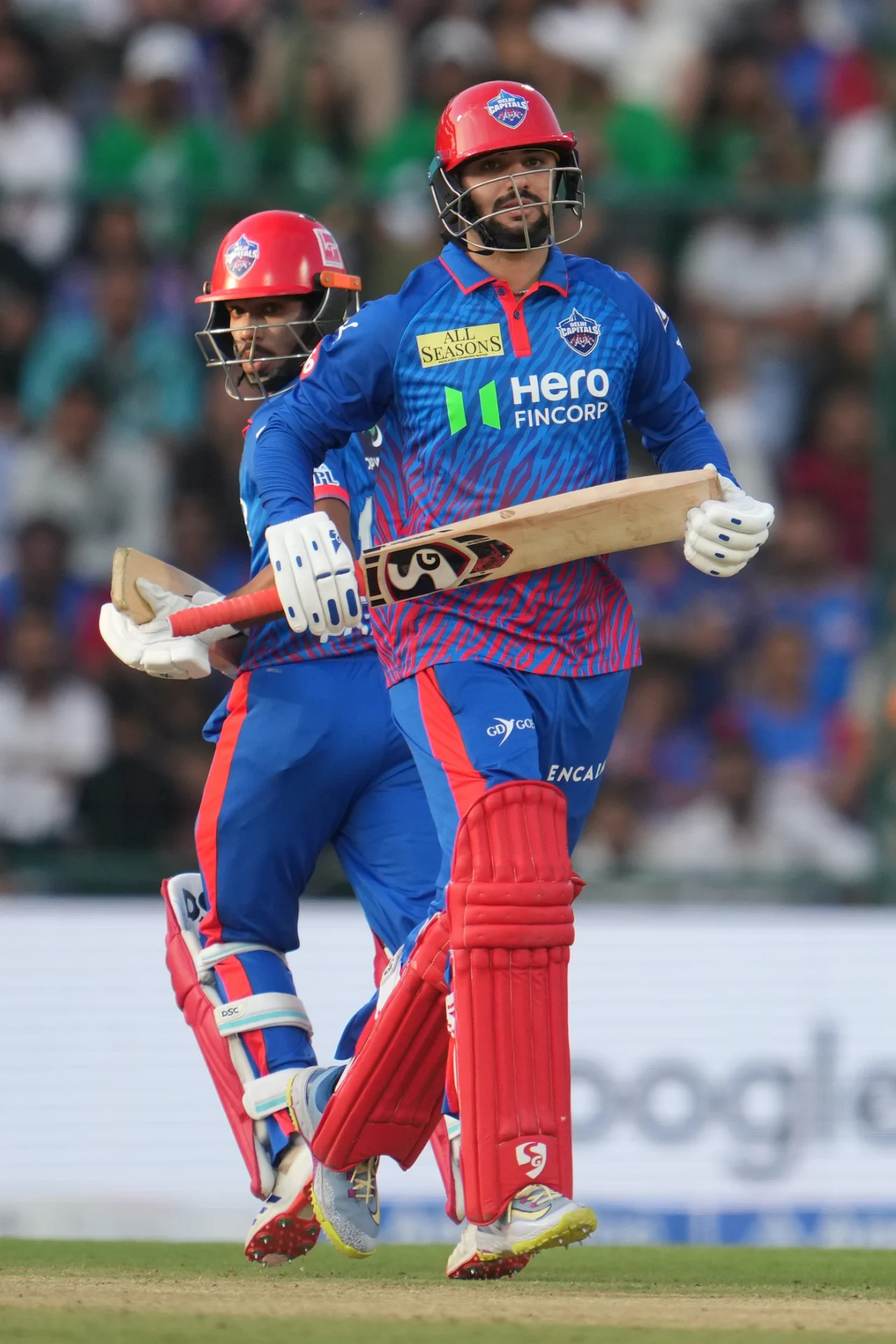
Sameer Rizvi picked up his second Player-of-the-Match award in as many games in IPL 2026, this time scoring 90 off 51 balls to help Delhi Capitals [DC] seal a tricky chase against Mumbai Indians [MI] with six wickets and 11 balls to spare. If you include his Player-of-the-Match award from DC’s last game of the 2025 season, it makes it three in a row. Only seven others have done so, and no one has gone beyond.
Before the Rizvi show, the DC bowlers restricted MI to 162 for 6 on a slow, black-soil pitch at the Arun Jaitley Stadium. With Hardik Pandya unwell, Suryakumar Yadav captained MI and top-scored with 51 off 36 balls. But most other batters struggled to play their shots. In fact, the first six of the MI innings came on the last ball of the seventh over.
DC, too, lost KL Rahul and Nitish Rana early in the chase but Pathum Nissanka’s counterattack kept them going. Nissanka made 44 off 30, after which Rizvi, coming in as DC’s Impact Player once again, ran away with the game.
Mukesh Kumar started waywardly, and Ryan Rickelton made him pay with two leg-side boundaries. From the other end, Rohit Sharma did the same against Lungi Ngidi. But Mukesh bounced back in his second over. He had Rickelton miscuing to mid-off and then caught and bowled Tilak Varma off a knuckleball.
With two right-hand batters, Rohit and Suryakumar, in the middle, Axar immediately brought himself on and sneaked in a three-run over. Rohit did hit two fours off Ngidi’s slower ones in the sixth over, the first a streaky one but the second a caress through covers, to take MI to 41 for 2, but it was a six-less powerplay for them. The last time it happened for MI was in 2023, against Chennai Super Kings in Chepauk.
Axar had a good match-up against Rohit coming into this game and he improved it further by having the batter caught at cover in the tenth over. Rohit made 35 off 26 balls. His match-up against Axar in the IPL now reads 77 balls, 67 runs, four dismissals.
Sherfane Rutherford didn’t last long and holed out to deep square leg against Vipraj Nigam, but Suryakumar kept MI going. He attacked the spinners and hit Kuldeep for two sixes. In the company of Naman Dhir, he brought up his fifty but was lbw to Ngidi off the following delivery. In Hardik’s absence, MI could score only 38 runs in the death overs.
Against Lucknow Super Giants, Rahul was out for a first-ball duck. Here he lasted three balls and made 1 before being caught down the leg side off Deepak Chahar. Rana was run out in the next over when Jasprit Bumrah, after fielding the ball off his own bowling, nailed a direct hit at the non-striker’s end.
At 7 for 2, Nissanka decided to take the attacking route. In the fourth over, he picked up back-to-back fours off Mitchell Santner, the second of which came via a reverse-hit over a leaping Rohit at cover. In the following over, he smashed two fours and a six off Shardul Thakur. Nissanka got a life on 41 when Dhir dropped him off Corbin Bosch but he fell to Santner three runs later.
After ten overs, DC were 73 for 3 – the exact score MI were at the same stage of their innings. The game was in the balance. Rizvi was batting on 25 off 23 but shifted the momentum in just one over. He flayed Bosch over mid-off, ramped him to the deep-third fence, cut him over deep point and launched him down the ground for 20 runs in all.
To ram home the advantage, he used his feet against Mayank Markande in the following over for back-to-back sixes. The first of those took him to his fifty off 31 balls. Such was his dominance that when the fifty stand for the fourth wicket came up, David Miller’s contribution in that was 1 off five balls. He was more of a bystander than a partner.
By the end of the 15th over, the result was a foregone conclusion. The only real interest left was whether Rizvi could reach his hundred. DC needed 25 to win, Rizvi needed 17. On 90, he attempted yet another big hit off Bosch but holed out to long-off.
Brief scores:
Delhi Capitals 164 for 4 in 18.1 overs (Sameer Rizvi 90, Pathum Nissanka 44, David Miller 21*; Deepak Chahar 1-20, Mitchell Santner 1-22, Corbin Bosch 1-39) beat Mumbai Indians 162 for 6 in 20 overs (Rohit Sharma 35, Suryakumar Yadav 51, Naman Dhir 28, Mitchell Santner 18*, Corbin Bosch 11*; Mukesh Kumar 2-26, Lungi Ngidi 1=34, Axar Patel 1-22, Vipraj Nigam 1-24, T Natarajan 1-24) by six wickets
[Cricinfo]

Carnage, justice and politics

Sri Lanka sees silver lining in ties with Russia and Britain amid Middle East shocks

John Keells Foundation marks its 21st anniversary with a redesigned website and new Volunteer App

Sun overhead until 15 April; heat index to reach caution level

Dhaka releases six Lankan fishermen in goodwill gesture

Preparations underway for Nuwara Eliya Spring Festival

‘Dates have the highest sugar content to fight Coronavirus’

Sunday Island 27 December – Headlines

#SundayIsland 17th December – Headlines

Sunday Island – 28th March

Sunday Island Headlines – 21 March

Sunday Island – 21st February – Headlines
-

 News4 days ago
2025 GCE AL: 62% qualify for Uni entrance; results of 111 suspended
-

 News6 days ago
Tariff shock from 01 April as power costs climb across the board
-
 News7 days ago
Inquiry into female employee’s complaint: Retired HC Judge’s recommendations ignored
-

 Business5 days ago
Hour of reckoning comes for SL’s power sector
-
 Features7 days ago
New arithmetic of conflict: How the drone revolution is inverting economics of war
-

 Editorial4 days ago
Search for Easter Sunday terror mastermind
-
 Features6 days ago
Seychelles … here we come
-

 Opinion6 days ago
Sri Lanka has policy, but where is the data?