Sports
Galle Marvels cruise to LPL final
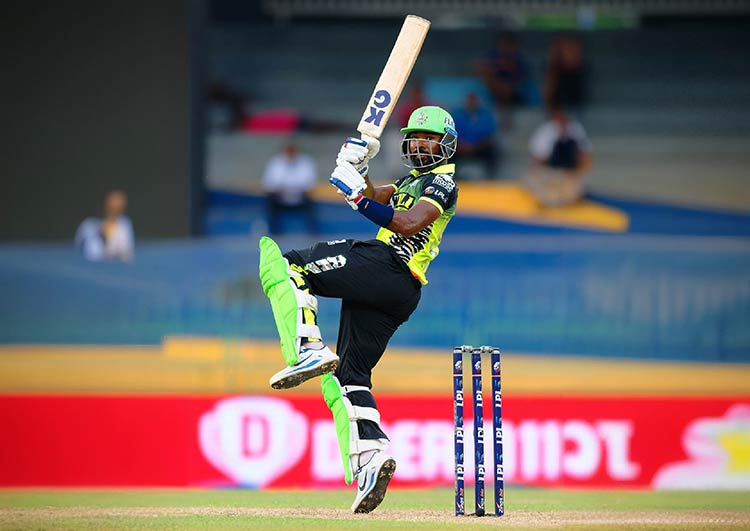
Galle Marvels overcame Jaffna Kings in the first qualifier of the Lanka Premier League to book a berth in Sunday’s final while Jaffna Kings will have to now win the second qualifier to go through. Their opponents on Saturday will be the winners of the Kandy Falcons and Colombo Strikers eliminator.
Galle Marvels have been a very organized outfit under new owners and they cruised to the playoffs having topped the points table in the league stage. They were hardly tested last night in the first qualifier as they won handsomely with seven wickets and 11 deliveries to spare at RPS.
A target of 178 was not a walk in the park, but Galle had no problems whatsoever as they showcased why they are tournament favourites. Former England opener Alex Hales smashed 36 off 21 balls with five fours and two sixes and Galle were 70 for two at the end of the Power Play giving them a superb platform.
The middle order didn’t have to do anything silly and just needed to go with the flow with less than eight runs an over required.
Tim Seifert and Janith Liyanage anchored the innings adding 92 runs for the third wicket and there was nothing much Jaffna could do after Hales had done the early damage.
Seifert finished on 62 off 41 balls and hit nine fours and one six. Janith Liyanage continued to impress finishing with 56 off 36 balls with five fours and three sixes.
While all Galle batters were striking at over 150, Jaffna’s tactics may have cost them dearly.
They persisted with Kusal Mendis despite his horrendous form and although he made 46, it wasn’t the typical aggressive T-20 innings. His strike rate was 117 something that you can not afford in modern day cricket.
Avishka Fernando, recalled to the Sri Lankan side, continued to impress top scoring with 52. He hit four fours and three sixes and was striking at 157.
The top order had given them a decent start but Jaffna failed to finish things off with a bang and in the end a target of 178 proved to be below par.
South African Dwaine Pretorius was fabulous finishing with a four-wicket haul. His four overs went for just 23 runs, remarkable figures in T-20 cricket even if you don’t pick up a single wicket.
Galle have sent a strong statement and they will be a tough side to beat in the final.
Brief Scores:
Jaffna Kings 177/7 (20) (Kusal Mendis 46, Rilee Rossouw 40, Avishka Fernando 52, Dwaine Pretorius 4-23, Isuru Udana 2-37)
Galle Marvels 181-3 (18.1) (Alex Hales 36, Tim Seifert 62, Janith Liyanage 56, Tabraiz Shamsi 1-27)

Latest News
All-round Archer helps Rajasthan Royals secure last playoffs spot
It was a must-win game, and they were in early trouble, but Jofra Archer pulled off one of the IPL’s great all-round performances to seal Rajasthan Royals’ (RR) passage into the playoffs with a 30-run win over Mumbai Indians (MI) at the Wankhede Stadium.
RR will now face Sunrisers Hyderabad (SRH) in the Eliminator on May 27 in New Chandigarh. The IPL’s last league game, between Kolkata Knight Riders and Delhi Capitals in Kolkata, is now a dead-rubber.
Sent in to bat on a somewhat slow pitch in an afternoon game, RR lost both their rampaging openers early, and struggled for momentum through the early middle overs with hard lengths and pace-off deliveries proving difficult to hit. Then RR, despite having Shubham Dubey and their designated Impact Player Ravindra Jadeja padded up, promoted Archer to No. 7, and he hit three sixes in a 15-ball 32 that shifted the game’s momentum.
That innings sparked a late surge that pushed RR’s total beyond 200. Then Archer began its defence spectacularly, taking two new-ball wickets with high pace and movement. And just when Hardik Pandya seemed to threaten a late heist and deny RR their playoffs spot, Archer came back for his final over and removed him with the perfect hard-length delivery. He finished with figures of 4-0-17-3, and RR wrapped up victory by 30 runs.
That MI were well-prepared for this contest was clear in the first over itself. When Vaibhav Sooryavanshi came on strike, Deepak Chahar stationed a sweeper cover as one of his two deep fielders, and dangled a full ball wide of off stump, asking the boy wonder if he fancied taking on the fielder. Sooryavanshi went after it, and could have got six for it had Will Jacks not pulled off a spectacular diving save to keep him down to a single, but on another day he could have also been out.
As it happened, Sooryavanshi was starved on strike for the next few overs, as Yashasvi Jaiswal hit three sixes before falling for a 17-ball 27, out to Jacks who bowled two overs of match-up offspin to the two left-hand openers for just 10 runs off 10 balls.
When Sooryavanshi finally faced his sixth ball at the start of the fifth over, he tried to hit against Chahar’s over-the-wicket angle, lost his shape for once, and fell to a sliced miscue.
When Riyan Parag fell to AM Ghazanfar off the final ball of the powerplay, caught with great awareness and balance on the edge of the long-on boundary by Tilak Varma, RR were 54 for 3.
Dasun Shanaka ensured RR didn’t spend too long worrying about the wickets they had lost, with a bit of help from ordinary MI bowling. Ghazanfar and Raghu Sharma fed him slot balls that he launched down the ground for six, and Shardul Thakur sent down a short ball down the leg side that he helped over fine leg for another six. Shanaka’s 15-ball 29 was an important innings, coming when Dhruv Jurel endured another slow start. Jurel eventually hit Ghazanfar for two fours and a six in the 12th over before getting yorked by Corbin Bosch in the 13th for 38 off 26 balls.
RR have often underutilised Archer’s batting ability, and now they seemed to be erring in the other direction entirely, sending him in ahead of two recognised batters with 7.1 overs remaining.
But Archer’s right-handedness may have been one reason for this – MI could have sneaked in an over of Jacks against Dubey or Jadeja. The other could have just been his pure ball-striking ability on a slow pitch where MI were looking to bowl into the pitch as much as possible. Archer’s height, stable base, and baseball-style swing were instrumental in his being able to hit three sixes off that kind of delivery, all either pulled or flat-batted down the ground.
Thakur eventually dismissed him with a hard-length ball that climbed high enough to force a miscue, but by then Archer had given RR serious momentum. Jadeja and Nandre Burger took the baton from him and collected 30 off the last two overs. RR scored 73 off their last five.
Archer’s new-ball wickets came from dissimilar deliveries that did similar things. To Rohit Sharma, he bowled what seemed an attempted inswinger that pitched and seamed away from the fuller side of a good length. To Naman Dhir he bowled a fast legcutter on the line of the stumps. Both straightened after angling into the batter. Rohit nicked off while attempting to work the ball leg side, and Dhir was bowled swiping across the line.
When Burger got one to nip into Ryan Rickelton and induce him to miscue a catch to midwicket off the inside half of his bat, MI were 24 for 3. That became 38 for 4 when Brijesh Sharma sneaked an unplayable, in-ducking shooter through Tilak Varma in the final over of the powerplay. RR seemed to have a foot in the playoffs.
Suryakumar Yadav began his innings with a trademark scoop to the fine-leg boundary. It was the eighth time he had hit his first ball to the boundary in IPL 2026. As long as he was in, MI still had a chance, and even if he wasn’t demonstrating the range of his peak version, he still played a breathtaking shot from time to time, such as when he punched Jadeja inside-out for a flat six over the covers.
He put on 63 with Jacks for the fourth wicket before Yash Raj Punja ended the partnership in the 12th over with a bravely flighted wide legbreak right after getting hit for six. RR may have wondered if the wicket of Jacks had been counter-productive, because Pandya walked in and began to smoke the ball to all parts. He hit Punja for two sixes in his first over in the crease, then pulled Shanaka for two fours in the 13th. By the end of that over, he was batting on 25 off seven balls and MI needed 75 off 42.
The equation had come down to 59 off 30 when Archer came back for his final over. He struck with his fourth ball, with a delivery not dissimilar to the one that had dismissed him. Hard length, into the pitch, climbing awkwardly towards Pandya’s back shoulder. The attempted flat-bat hit ended up as a simple catch to long-on, and RR could breathe again.
Victory swiftly became a formality thereafter, with Bosch failing to nail a slog-sweep off Punja in the 17th over and Suryakumar – who scored just 10 off 10 after reaching his fifty in 32 balls – toe-ending an attempted pull back to Burger for a return catch in the 18th.
Brief scores:
Rajasthan Royals 205 for 8 in 20 overs (Yashasvi Jaiswal 27, Dhruv Jurel 38, Riyan Parag 14, Dasun Shanaka 29, Donovan Fereirra 18, Jofra Archer 32, Ravindra Jadeja 19*, Nandre Burger 10*; Shardul Thakur 2-41, Deepak Chahar 2-43, Will Jacks 1-12, AM Ghazanfar 1-45, Corbin Bosch 1-38) beat Mumbai Indians 175 for 9 in 20 overs (Ryan Rickelton 12, Suryakumar Yadav 60, Will Jacks 33, Hardik Pandya 34, Shardul Thakur 10*; Jofra Archer 3-17, Brijesh Sharma 2-26, Nandre Burger 2-43, Yash Raj Punja 2-44) by 30 runs
[Cricinfo]
Latest News
Devine intervention brings New Zealand back from the dead
A firefighting 87 from Sophie Devine propelled New Zealand from a perilous 11 for 4 to a series-squaring 14-run win over England in the second women’s T20I at Canterbury.
Already 1-0 down, the tourists were floored when reduced to 5 for 3 after just nine balls – New Zealand women’s joint-lowest total at the fall of the third wicket in T20Is. They were soon four-down in the fourth over, with Linsey Smith (3 for 25) the main destructor, her wily brand of slow left-arm swing flummoxing the top-order.
But Devine and Maddy Green, who finished with an unbeaten 56, rebuilt and then thrived with a stand of 159 that ended with Devine’s run-out off the final ball of the innings. Regular boundaries between the pair – including eight sixes, six belonging to Devine – ensured the White Ferns did not miss out on the pristine batting conditions that convinced Melie Kerr to bat first upon winning the toss.
Yet again, Lauren Bell struck early, dismissing Izzy Gaze at the end of her first over having dismissed Georgia Plimmer with the first delivery of the opening T20I at Derby. Plimmer had the ignominy of a second successive golden duck when she got herself in a tangle to gift Smith a return catch at the start of the second over.
But Devine and Green ensured there would be no repeat of Wednesday’s defeat. England’s target would have been more manageable than 171 had Smith effected a run-out at the non-striker’s end midway through her third over. It would have removed Devine for 48 in the 14th over. She struck 39 off her remaining 20 deliveries, and faced 57 in all before finally being run out off the final ball of the innings.
In their reply, England were above the rate at the three-over mark, before Sophia Dunkley was dismissed for a sprightly 26, caught off Nensi Patel, the offspinner having come into the side for Suzie Bates. And New Zealand assumed the ascendancy out when set batters Heather Knight (25) and Maia Bouchier (38) were dismissed in successive balls. It was particularly poor from Bouchier, finding the fielder at long-on off Patel, moments after Knight had been run out after aborting a second run following a late call.
The silver lining for England was that it brought hard-hitting allrounders Freya Kemp and Dani Gibson to the middle at the death. But with too much to do, Gibson was bowled by Bree Illing hacking across the line, and Kemp became the returning Leah Tahuhu’s 99th T20I wicket when caught on the fence with 23 required from the final four balls.
Issy Wong, replacing Sophie Ecclestone who sat out with a tight hamstring, lofted the final ball over the boundary, reducing the margin of defeat. It also highlighted a key difference between the two teams. It was only England’s second six, a third as many as Devine had managed on her own.
It has been an excellent first half of the year for Sophie Devine. Saturday’s half-century was her third so far, giving her an average of 48 and strike rate of 160. While admittedly from a sample size of seven innings, it speaks to a player focussed on going out on a high. This, by the way, is now her second highest score in the format, slotting beneath her sole century that came against South Africa in February 2020.
“I’m enjoying my cricket and enjoying what I got left on the international scene,” Devine said during her play of the match interview. Retiring at the end of the upcoming T20 World Cup, the 36-year old is gunning for the sweetest swansong.
England were warned. On, Wednesday in a similar situation, Devine counterpunched with 45 off 22 from less shakier ground – 13 for 2 in the fourth over – but was eventually trimmed off by Gibson. The difference this time was not just carrying on (especially after the life on 48) but support from Green.
Overall, Green was only striking at 116.66, but she was able to keep pace for the majority of what became a maiden T20I fifty. A brace of fours off Gibson took Green to 40 from 33, with Devine watching on appreciatively, 49 off 38 to her name.
That passage of five overs after the midway point saw Green momentarily assume senior status, facing 20 balls and allowing Devine to rest up for the final push. The 56 from the final four overs – 36 from Devine – put New Zealand out of reach.
“It shows the growth of the group, to be able to rebound and put on a score of 170,” said Devine. “For a player like me, I don’t really like sitting back. It’s a real battle of the mind regarding what you want to do.
“We absorbed pressure really well and then to be able to throw it back at them at the backend. It’s a fantastic confidence builder for us.”
“They keep playing her like a left-arm spinner – they need to play her like a left-arm swing bowler,” said Nasser Hussain on Sky. In between celebrating Linsey Smith’s brilliance, the former England men’s captain could not help but lament New Zealand’s approach to the left-arm orthodox bowler.
At the toss, Melie Kerr revealed the team had discussed how best to combat Smith, who had flummoxed them in the first T20I. Stifling the White Ferns scoring with 15 dot balls among her 1 for 10 from her four overs, Kerr called for a more pro-active batting effort. Unfortunately, she could not lead as an example, out LBW sweeping her first ball, gifting Smith her second dismissal halfway through her first over.
Blindly swinging across the line was surely not a tactic formulated in that brainstorming session. Georgia Plimmer attacking immediately – a return catch giving her a second successive golden duck – was a little too cavalier. Left-hander Brooke Halliday’s initiative to advance down the crease felt the most appropriate, even if that resulted in a straight-forward catch to Bouchier at long off.
Smith has added a fascinating dimension to the XI, as a slower bowler thriving in the Powerplay. And it will be interesting to see how opposition batters deal with her at the World Cup given what she’s shown weeks out from the competition.
As Hussain states, tit may be wiser to approach Smith like a seamer, focussing on the movement through the air rather than what revolutions there may be on the ball. It was instructive that Smith, speaking ahead of the match, revealed she had got into trouble for forgetting to shine the ball, a regular habit for quick bowlers but something this spinner needs to remember to do given how much of her success is coming from swing rather than spin.
Most of New Zealand’s right-handers have had little joy trying to heave her to leg. Might more joy be found making room and accessing the off side, particularly during the first six overs? We may be about to find out.
That England happened to get their strongest hitters Kemp and Gibson out there in the final five overs was entirely by accident. Even if they had managed the 52 required from the remaining 26 deliveries, the main takeaway should be that they were introduced too late.
Angling for what would have been the side’s third-highest successful chase, perhaps Kemp, off the back of a handy 31 not out to finish the first T20I, should have come out when Capsey fell at the end of the 10th over. At that point, the required rate was on the verge of reaching double figures. By the time Knight and Bouchier were done, both allrounders would have had to strike at 200 to get England home.
Head coach Charlotte Edwards has focussed on adding more heft to the lower order, and there is no doubt Kemp and Gibson give opponents something to fear. Gibson’s consecutive fours off Devine sparked momentary jeopardy before her dismissal. A little more time and maybe her and/or Kemp could have made a decisive impact. No doubt an error to learn from ahead of the main event next month.
Brief scores:
New Zealand Women 170 for 5 in 20 overs (Sophie Devine 87, Maddy Green 56*; Lauren Bell 1-22, Linsey Smith 3-25) beat England Women 156 for 6 in 20 overs (Sophia Dunkley 26, Alice Capsey 22, Maia Bouchier 38, Heather Knight 25, Freya Kemp 14, Dani Gibson 12; Bree Illing 1-27, Nensi Patel 2-25, Lea Tahuhu 1-32, Mellie Kerr 1-28) by 14 runs
[Cricinfo]
Latest News
Shreyas Iyer’s maiden IPL ton keeps Punjab Kings in the hunt for playoffs spot
Shreyas Iyer’s first IPL entury helped Punjab Kings break a six-match losing streak and keep their playoffs hopes alive. PBKS are now in the top four and will remain there should Rajasthan Royals lose their final game of the season against Mumbai Indians. Also, for PBKS will hope Kolkata Knight Riders won’t win big against Delhi Capitals, who are now eliminated.
A weakened Lucknow Super Giants – they fielded only two overseas players in the XII, with Mitchell Marsh and Aiden Markram going home – were beaten with 12 balls and seven wickets to spare.
LSG had a hit-and-miss powerplay. Overs two, three and four produced just eight runs. Overs one, five and six produced 58 runs. Ayush Badoni walked in ahead of Rishabh Pant at No. 4, when the innings was going nowhere. Badoni himself was 2 off 5 before suddenly surging to 42 off 16.
Josh Inglis was 16 off 6 with four boundaries. From there, he made just 10 off the next 15 balls. Just when it looked like he had lost all form – including instances where his favourite ramps were failing him – the Australian batter found another high-scoring period, hitting 29 off nine balls. He brought up his fifty during this second burst and was largely the reason why LSG could get to a total of 196.
Yuzvendra Chahal was crucial to PBKS’ bowling effort. He dismissed Badoni, though credit for that should go to Prabhsimran Singh, who had the batter stumped with smart glovework. Badoni made the mistake of thinking the ball was dead as soon as he played and missed. It was not. Prabhsimran waited for the moment he knew was coming – Badoni resetting his position in the crease. Just as his back foot went up he flipped the bails off.
Pant, who began the season as an opener, then wanted to be LSG’s No. 3 spot, came in at No. 5 today. He faced 14 balls from Chahal and hit him for two boundaries. But the legspinner won the battle in the end, concentrating on keeping the ball wide of the left-hander’s reach. Chahal could have dismissed Pant for 20 off 19 had Iyer taken a simple catch at extra cover. But Iyer’s drop didn’t matter much, because Chahal still dismissed him on 26 off 22.
Arshdeep Singh was having a bad night. PBKS, knowing they can’t afford any mis-steps, took their World Cup winner off the attack. They opted for a few overs of Shashank Singh, and the gamble worked.
Shashank got rid of Inglis in the 17th over. Marco Jansen (4-0-33-2) and Vijaykumar Vyshak (3-0-26-0) delivered superb 18th and 19th overs, which cost just 10 runs. PBKS then turned to Arshdeep for the 20th, over Azmatullah Omarzai – who had almost bowled a wicket-maiden earlier in the night – and Arshdeep leaked runs again.
Samad turned down singles and kept strike for all nine balls of the over (including three wides) and hit 17 runs. LSG hit 28 boundaries in the innings. Ten of those came off Arshdeep. His economy rate of 17.33 was a new personal low for him in the IPL.
According to ESPNcricinfo’s ball-by-ball data, Priyansh Arya had a strike rate of 366 against short balls in the IPL until April 27 this year. On April 28, PBKS suffered their first of six straight losses.
Since April 28, Arya has faced eight short balls, scored six runs and gotten out twice, including the first ball of the chase today to Mohammed Shami. Shami has nine wickets in the powerplay (out of 12 overall this season). Only Kagiso Rabada (17), Bhuvneshwar Kumar (15), Mohammed Siraj (13) and Jofra Archer (10) have done better.
When the two of them got together, ESPNcricinfo’s forecaster suggested PBKS had a less than 30% chance of winning. PBKS were 22 for 2 in the third over. But neither man was taking a backward step. Unless, of course, it was to find the boundary.
Iyer was so good playing the cut shot, using the depth of the crease, arming himself with that little bit more time to find the gap either side of point, whether it was against pace or spin. Prabhsimran went back and across to keep swiping fast bowlers to the backward-square-leg boundary, getting underneath the ball and hitting up into the sky. Both men brought up their sixth fifty-plus score of the season. Iyer matched his tally from 2025. Only one PBKS player has more in a season (KL Rahul with seven from 2019).
Iyer was on 61 off 36 when PBKS needed 47 to win. He lost Prabhsimran for 69 and decided there was no time to muck about. Launching Arjun Tendulkar for back-to-back fours and Shami for three sixes in over, he hurtled towards both the target and his century. With 10 to get, Suryash Shedge got an outside edge for four and threw his head back in disappointment. Next ball, he took a single and Iyer did the rest, hitting Mohsin Khan for a six and bringing his helmet off to flash a big smile.
Brief scores:
Punjab Kings 200 for 3 in 18 overs (Prabhsimran Singh 69, Cooper Conolly 18, Shreyas Iyer 101*; Mohammed Shami 2-45, Arjun Tendulkar 1-36 ) beat Lucknow Super Giants 196 for 6 in 20 overs (Josh Inglis 72, Ayush Badoni 43, Rishabh Pant 26, Abdul Samad 37; Azmatullah Omarzai 1-29, Yuzvendra Chahal 2-25, Marco Jansen 2-33, Shashank Singh 1-29) by seven wickets
[Cricinfo]
-
Features5 days agoOctopus, Leech, and Snake: How Sri Lanka’s banks feast while the nation starves
-
Opinion4 days agoMurder of Ehelepola family, Bogambara Wewa and Sightings of Wangediya
-
News4 days agoSteps underway to safeguard Sri Lanka’s maritime heritage
-
Sports5 days agoSri Lanka women’s volleyball team ready for Central Asian challenge
-
Editorial4 days agoA play without its protagonist
-
Midweek Review5 days agoOverall SLPP failures stressed in new Aragalaya narrative
-
Opinion3 days agoThe need to reform Buddhist ecclesiastical order
-
Features23 hours agoThe NPP’s pivot to the past