
Sports
Future hopes meet present needs as Group 2 pace-setters clash in St Lucia


On the face of it, things are going smoothly for South Africa. They are unbeaten at the tournament and have won matches when both setting targets and chasing but, and this is a big but, none of it has been easy. It’s not just they were pushed by former champions Sri Lanka (who actually did the least pushing) and fellow Super Eighters Bangladesh but also by three Associates: Netherlands, Nepal and USA. If England were watching, they will have seen the flaws in South Africa’s make-up, most notably in the batting. Two of the top three – Quinton de Kock and Aiden Markram – have only just found form and the middle-order have not yet had the opportunity to play to their potential.
England will have been more pre-occupied with their own sideshows. They survived a group-stage scare in which they were all but written off after their rain-out against Scotland and have played and lost to their biggest rivals, Australia. Their net-run-rate boosting victories over Oman and Namibia helped ensure their survival once Scotland’s challenge had faded, but their most recent win over West Indies could yet propel their campaign to a new level. It is entirely possible that three teams in a Super Eight pool of four could end up with two wins each, especially given USA’s underdog status in Group 2, and so net run-rate could provide decisive. England’s is currently at 1.34, which leaves them in a good position, and after their shaky start, they would like to think they’ve got on a roll.
South Africa might argue that they are already on one, and all they have to do is stay consistent with the knockouts in sight. Their next challenge is to maintain their winning start against two former champions. England’s task is much less abstract. South Africa humbled them at the 2023 ODI World Cup, in the middle of a horror run they don’t want to repeat, and with only USA to come, they have a chance to stamp their authority on this event.
Both Quinton de Kock and Phil Salt played their best innings of the T20 World Cup in their last games with de Kock’s 74 setting South Africa up for a big total and Salt’s 87* helping England chase 181 against West Indies. Before those knocks, the numbers were not quite what the pair may have liked. De Kock had scores of 20, 0, 18 and 10 and Salt 37, 12 and 11. Starts, for sure and crucial to the tone of the innings, but they were not there at the end. Having players with their aggression bat through could be key on surfaces that seem to have offer runs and so how they perform in the next two matches could be key to their respective team’s semi-final hopes.
South Africa have not had the challenge of consistent and genuine pace until now which makes Jofra Archer an interesting opponent. He is England’s joint-leading bowler at the tournament so far and has their best economy rate of 6.58 and could prove a handful to a top-order that is still finding its feet at the event. They’ll hope to counter-punch through Anrich Nortje , who equalled Dale Steyn’s record for the most wickets by a South African at T20 World Cups in the last match, and has looked menacing throughout. Nortje is the tournament’s second-highest wicket-taker so far and has been played with respect. Will England’s batters, who enjoy pace on, show him the same?
South Africa are spoilt for choice in the bowling department and opted to bench Ottneil Baartman to accommodate an extra spinner in Antigua. That team composition could work well for them in St Lucia too but Tabraiz Shamsi was expensive against USA and they may consider left-arm spinner Bjorn Fortuin instead. However, given the variations he offers, Baartman could come back into contention too and it is a case of trying to fit three players into one spot.
South Africa: Quinton de Kock (wk), Reeza Hendricks, Aiden Markam, Tristan Stubbs, Heinrich Klaasen (wk), David Miller, Marco Jansen, Keshav Maharaj, Kagiso Rabada, Tabraiz Shamsi/Ottneil Baartman, Anrich Nortje
England: Phil Salt, Jos Buttler (capt, wk), Moeen Ali, Jonny Bairstow, Harry Brook, Liam Livingstone, Sam Curran, Jofra Archer, Adil Rashid, Mark Wood / Chris Jordan, Reece Topley
(Cricinfo)



A stunning hundred by opening bat Lasith Croospulle helped Sri Lanka ‘A’ to post a commanding 368 for nine in their allotted 50 overs and then restrict New Zealand ‘A’ to 158 for three and a secure a 44 run win [DLS method] at Suriyawewa yesterday. The win helped Sri Lanka to take an unassailable 2-0 series lead.
The star for Sri Lanka ‘A’ was the former Maris Stella College, Negombo cricketer Lasith Croospulle as he smashed 103 off just 76 balls hitting 13 fours and six sixes as the hosts piled up the runs.
Croospulle has represented Sri Lanka in one T20I and performances such as these are sure to earn him a regular spot in the white ball sides.
The middle order then ensured that they didn’t spoil the good work of the top order with captain Sahan Arachchige and Sonal Dinusha posting half-centuries.
Arachchige smashed 76 in 68 balls with five fours and two sixes while young Sonal Dinusha put the bowling to the sword during the death overs. His 93 came off 77 deliveries with six fours and four sixes.
Dinusha, who has already made his Test debut and impressed many with his electric fielding could have gone on to post his hundred but sacrificed his wicket in a bid to score quick runs.
With the World Cup less than a year away and the selectors keeping a close eye on the second string, performances like these are sure to get their attention.
Rain reduced the game to 28 overs and New Zealand were given a revised target of 203 but they only managed 158 for three to hand Sri Lanka a comfortable win.
Sri Lanka ‘A’ had won the first game by 140 runs in Galle. Saturday’s third one-dayer will be a dead rubber.
The teams will stay back at Suriyawewa for two further weeks where the two match unofficial Test series will be played.
The composition for the four day games is set to change with Pasindu Sooriyabandara set to lead the side.

St. Joseph’s College secured a place in the final after their spinners, spearheaded by Sri Lanka Under-19 spinner Vigneswaran Akash, overcame determined resistance from the Prince of Wales College tail to claim first innings points in the Under 19 Division I Tier ‘A’ tournament semi-final at the D.H.H. Ground, Madampella on Wednesday.
The final day began with an early breakthrough when spinner Vishwa Peiris struck in the very first over to dismiss overnight centurion Thusindu Deemantha. Deemantha, who had already batted for more than three sessions, anchored the Cambrians’ innings with remarkable determination while chasing St. Joseph’s imposing first innings total of 354.
At that stage Prince of Wales were still more than 100 runs adrift with only four wickets in hand, but the lower order refused to surrender easily. Number seven batsman Pasan Cooray dug in with a courageous knock of 66, frustrating the Josephian bowlers for long periods.
However, Akash gradually tightened the screws on the tail, claiming three of Cooray’s partners before the resistance was finally broken. Cooray eventually fell to Nushan Perera, who played a crucial holding role despite taking just one wicket. Perera bowled a disciplined spell of 25 overs, conceding just over two runs per over to keep the pressure on the Cambrians.
Akash emerged as the pick of the bowlers with impressive figures of four wickets for 109 runs from a marathon 33-over spell.
As expected, the outcome of the match was effectively decided once the first innings concluded. With the semi-final berth secured, the remainder of the contest became a formality as St. Joseph’s batted through until the penultimate over of the match.
Opener Aveesha Samash continued his outstanding form by registering back-to-back centuries. Having scored 122 in the first innings, Samash followed it up with a brilliant 133 off 104 balls, striking 20 fours and a six as St. Joseph’s posted 238 for four in 48 overs.
Yenula Danthanarayana contributed 28 while Senuja Wakunegoda added a useful 48. Shehan Ashein and Matheesha Aponso claimed two wickets apiece for Prince of Wales.
St. Joseph’s will now wait two more days to learn their opponents for the final.
Meanwhile, in the second semi-final which commenced on Wednesday, Royal College ended the opening day strongly at 328 for four against Trinity College, with Dushen Udawela leading the charge with a fine century of 105. (RF)
Sports
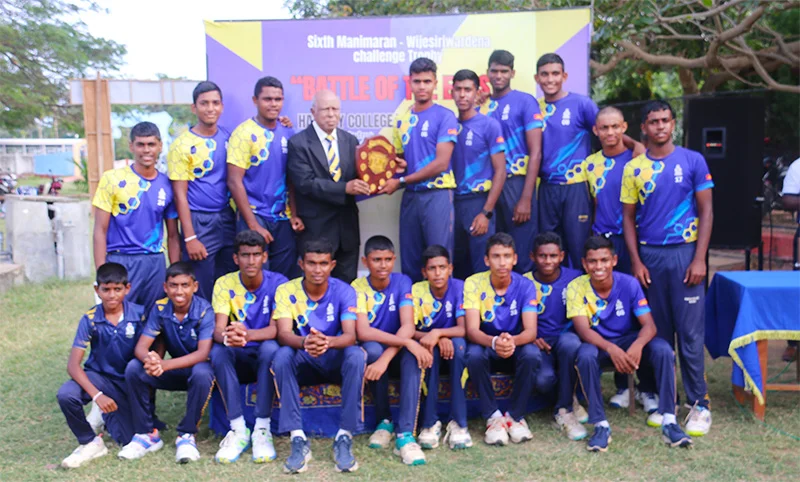
Manimaran-Wijesiriwardena trophy at stake when Rahula Matara host Hartley Point Pedro at Uyanwatta on Friday

BATTLE OF THE ENDS
The Manimaran – Wijesiriwardena Trophy will be up for grabs when Rahula College Matara host Hartley College Point Pedro for the 7th edition of the’ Battle of the Ends’ the traditional encounter between two schools situated at the Southern and Northern points of the island.
The annual encounter between these two schools was envisioned by two illustrious cricketers, Ramakrishnan Manimaran of Hartley College and Lal Wijesiriwardena of Rahula who are domiciled in Australia. The inaugural game was hosted at the Uyanwatta Stadium in 2017 and has been played continuously except from 2020 to 2022 due to the Covid 19 pandemic. The series so far has been one sided with Rahula College winning all six previous encounters.
The Rahula XI led by M.A.Nadil Sandesh will be selected from Janiru Thejana Wijayawardana, D.G.Indumin pawara Pabasara, J.K.Aayu Geesara Kaviraj, H.G.Pramuditha Nawanjana, Naviru Nethwan Abeydiwakara, Ishantha Gimhan Abesingha, M.L.Senuk Dewditha, Jayaru Kaveeshwara Ekanayake, .H.M.Eeshala Uththiya Bandara, A.A.Lithum Seunitha, R.M Chathum Geenath Rathnayaka, H.A Shewan Shanuka, H.Sandalu Hasaranga Rajapaksha, H.M.Hirun Manyuga, J.K.Divan Sri Nithish, K.B.Minidu Idusha, Dulana Mallawaraja Samarawickrama Abeysekara
The visiting Hartley College Team for this years ‘ Battle of the Ends’ is led by T Abishaan and will be selected from R Kishaaran, K Kanalventhan, S Mathushan, P Atheesh,V Venukaran, V Vishrukeethan, S Thanushanth, J Ilankeeran, R Jathushan, S Vikasan, D Blesshin, U Abinayan, T Jishnuram, A Arshaan
Hartley College will miss the services of Sri Lanka Under 19 player, Vigenshwaran Akash who moved to St Joseph’s College Colombo this season. Akash was the top scorer for Hartley in last year’s encounter which Rahula won by seven wickets.

Greece to ban social media for under-15s from next year

Showers will occur at a few places in the Western, Sabaragamuwa and North-western provinces and in Galle, Matara, Kandy, Nuwara-Eliya and Mannar districts after 2.00 p.m.

Sun directly overhead Chilaw, Bingiriya, Halmillawewa, Panduwasnuwara, Gokarella, Kawudupelella, Koppaveli and Kirankulam about 12:12 noon. today (09)

Heat Index at Caution Level in the Western, Sabaragamuwa, Southern, Eastern, North-western, Northern and North-central provinces and in Monaragala district

AG: Coal procurement full of irregularities

Rs 13.2 bn NDB fraud: House committee declares serious breach in banking system

‘Dates have the highest sugar content to fight Coronavirus’

Sunday Island 27 December – Headlines

#SundayIsland 17th December – Headlines

Sunday Island – 28th March

Sunday Island Headlines – 21 March

Sunday Island – 21st February – Headlines
-

 Features4 days ago
Ranjith Siyambalapitiya turns custodian of a rare living collection
-

 News4 days ago
Global ‘Walk for Peace’ to be held in Lanka
-

 News2 days ago
Lankan-origin actress Subashini found dead in India
-

 Opinion6 days ago
Hidden truth of Sri Lanka’s debt story: The untold narrative behind the report
-

 Features4 days ago
Beyond the Blue Skies: A Tribute to Captain Elmo Jayawardena
-

 Features6 days ago
The Ramadan War
-

 Features4 days ago
Aspects of Ceylon/Sri Lanka Foreign Relations – 1948 to 1976
-

 Editorial5 days ago
Brouhaha over a book