
News
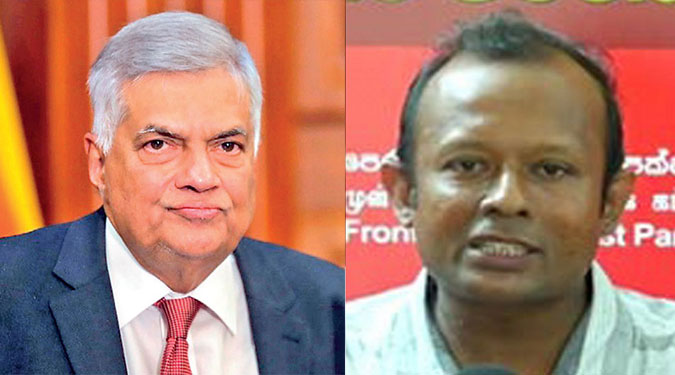
FSP accuses President of taking country on 1977 path to disaster

Budget 2023
By Rathindra Kuruwita
President Ranil Wickremesinghe is all ot to reverse people’s hard-won victories, Education Secretary of the Frontline Socialist Party (FSP) Pubudu Jayagoda says.
“Wickremesinghe talks about moves to introduce revolutionary changes to the country. His budget is anything but that. He repeats the criticism that progressive forces have been making for decades, but the solutions he has suggested are anti-people,” he said.The President is all out to destroy the welfare state and following in the footsteps of his uncle, JR Jayewardene, Jayagoda said.
“He is trying to usher in the reforms that Margaret Thatcher introduced.”
The 2023 budget proposals would even give the IMF economists a pause, the FSP stalwart said.
“The IMF has similar ideas but at least they pay lip service to the importance of maintaining basic social welfare mechanisms. Wickremesinghe’s proposals will destroy all low- and middle-income families,” Jagoda said.
“Wickremesinghe in his budget says that he wants the majority of Sri Lankans to benefit from economic development. Echoing leftists, he has claimed that there should be income redistribution.
“We must look at what he is doing. He quotes the Buddha and says that loans must be used for investments and not consumption. Leftists have been saying for decades that loans should be used to boost productive capacity. However, what have governments done since 1977? They have borrowed heavily and used them on white elephants. We have also built a lot of infrastructure but unlike in China, the infrastructure we built is not linked with factories. This infrastructure does not promote productive forces. President Wickremesinghe has been in Parliament for decades. He was a minister and prime minister for decades. He is now the President. Has he used loans for proper investments? He doesn’t practice what he preaches,” the FSP Education Secretary said.
When the country has hit rock bottom Wickremesinghe and his lackeys claim that we have taken too much debt and wasted it on consumption, he said. “The same people who borrowed like there is no tomorrow have suddenly discovered that borrowing like gambling addiction is bad. However, Wickremesinghe doesn’t tell us what his plans for developing and expanding the manufacturing capacity is,” he said. Jayagoda said that the budget proposal has nothing to build confidence among investors and producers. The small and medium scale investors are in serious trouble and they have been begging for relief for months, Jayagoda said.
“Wickremesinghe wants to give tax concessions to multinationals, and he wants to undermine local manufacturing. Wickremesinghe talks about building infrastructure and facilitating investors. However, his budget has nothing for SMEs that employ millions,” he said. Jayagoda said that the government also plans to fast-track free trade agreements. This will be done while weakening the local industries, he said.
“The workers of Sri Lanka have won certain rights after making enormous sacrifices. Wickremesinghe wants to destroy all that. Soon all laws that protect workers’ rights will be abolished. Taxpayers will have to pay for workers that are fired by private companies. Even if the government takes away all the laws that protect workers, investors won’t come here. There are no labour laws in the poorest countries in the world, are investors running there? China is increasing wages and rights, but companies still go there, even after America’s ttempts to undermine China,” he said.
Jayagoda said that the government also wants to open agricultural land to the market. Right now, large swaths of farming lands can’t be sold. If farmers are allowed to sell land, at a time like this, a few companies will buy up a lot of land for a song and farming will collapse, he said.
“Wickremesinghe talks about selling state owned enterprises. He talks about selling SriLankan airlines, Insurance Corporation, Sri Lanka Telecom, Hilton and Waters Edge. Apart from SriLankan airlines, all the others make enourmous profits. SriLankan was destroyed by a henchman of Mahinda Rajapaksa. When Ranil was prime minister in the Yahapalana Government, they appointed a commission on SriLankan airlines. Now he can implement the commission recommendations,” he said.
The budget also takes steps to privatise education and health. There is a lot of inequality in Sri Lanka and people still have some upward mobility because of free education and healthcare, Jayagoda said.
“Ranil plans to take the country on the same path it had been travelling since 1977. We have had nothing but disaster since 1977. The definition of insanity is doing the same thing expecting different results,” he said.


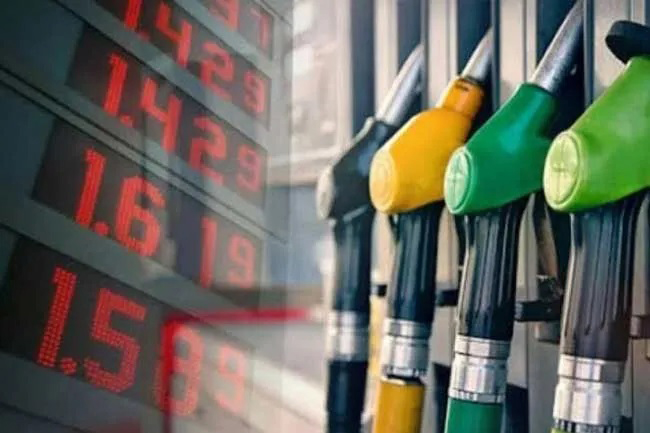
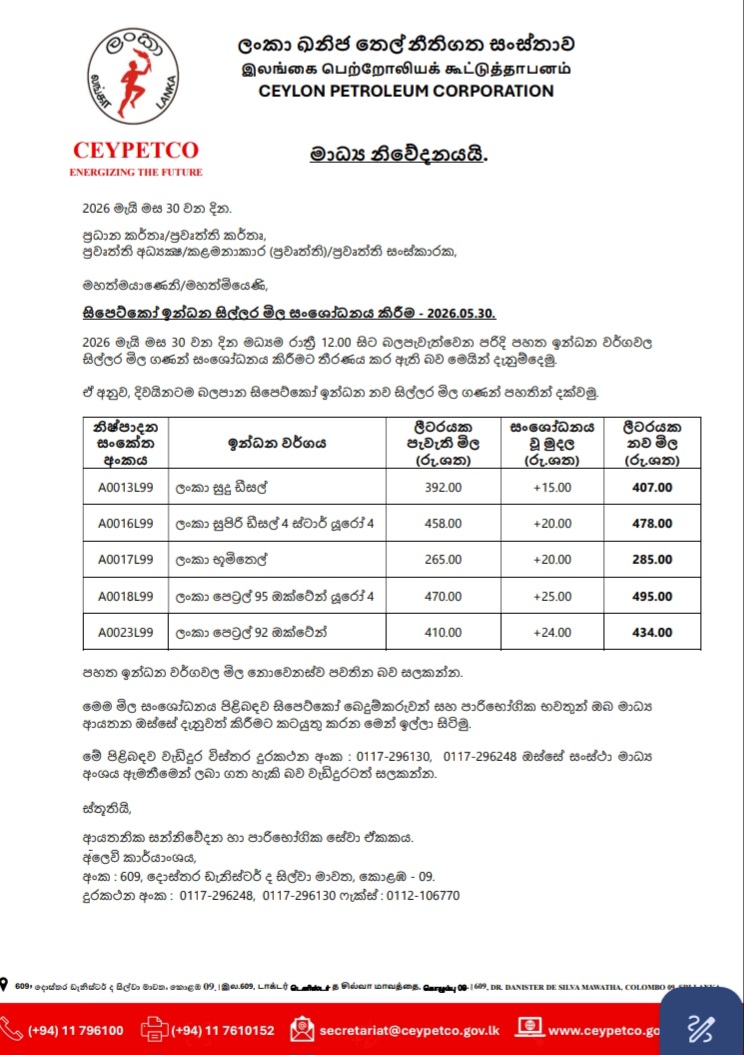
The Ceylon Petroleum Corporation (CEYPETCO) has announced a revision of fuel prices, effective from midnight on Saturday (May 30).
Accordingly,
the price of Auto Diesel has been increased by Rs. 15 to Rs.407 per liter,
the price of Super Diesel has been increased by Rs. 20 to Rs. 478 per liter.
the price of Petrol 92 Octane has been increased by Rs. 24 to Rs. 434 per liter
the price of Petrol 95 Octane up by Rs. 25 to Rs. 495 per liter
the price of kerosene by Rs. 20 to Rs. 285 per liter.
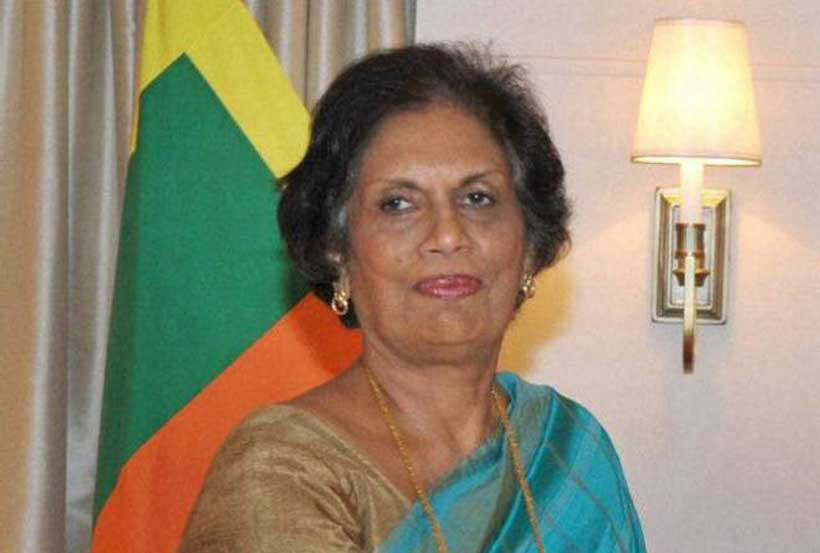
Former President Chandrika Bandaranaike Kumaratunga has called for a comprehensive reform programme within Sri Lanka’s Buddhist clergy, warning that repeated efforts to strengthen the Sasana have in the past been derailed by opposition from within sections of the Sangha itself.
In a statement addressed to the Mahanayake Theras of the three Buddhist chapters, Kumaratunga stressed that the long-term preservation of Buddhism depends on safeguarding both the Dhamma and Vinaya, or disciplinary code, and urged urgent internal reform to address what she described as deep-rooted structural weaknesses.
She noted that Buddhist history has consistently demonstrated that periods of institutional crisis were addressed through reform processes, citing precedents from the First Buddhist Council to reforms during the Kandyan era under Welivita Sri Saranankara Thera.
Referring to post-independence efforts, Kumaratunga said initiatives taken during the 1956 Bandaranaike administration to strengthen Buddhism were left incomplete following the assassination of former Prime Minister S.W.R.D. Bandaranaike.
She further stated that during her own presidency, plans to convene a Buddhist Council under the guidance of the late Madihe Pannasiha Mahanayake Thera had received government backing but were ultimately abandoned due to resistance from certain sections within the clergy.
The former President alleged that, on both occasions, vested interests benefiting from existing weaknesses within the Buddhist establishment had worked to obstruct meaningful reform efforts.
Warning that Buddhism in Sri Lanka is currently facing serious challenges, she called for a broad internal dialogue within the Sangha to identify root causes and implement both short- and long-term corrective measures.
Kumaratunga urged the Mahanayake Theras to take the lead in convening a Dharma Sanghayana, or Buddhist Council, and said she was prepared to work with senior lay Buddhist leaders to support such an initiative.
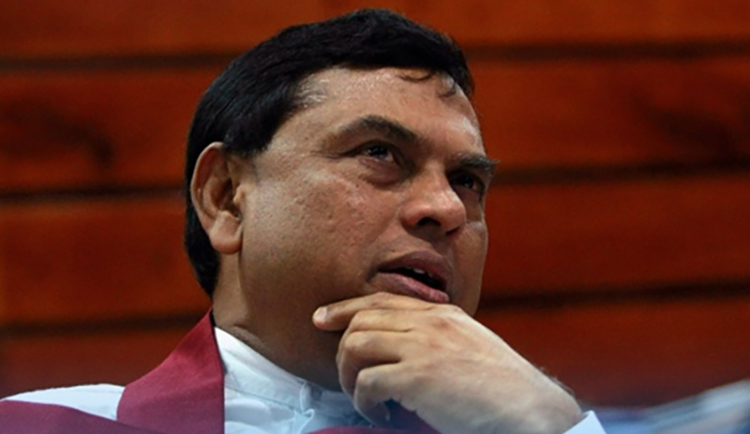
The Colombo Fort Magistrate’s Court on Friday ordered the arrest of former Minister Basil Rajapaksa, Tourism Promotion Bureau Chairman Bhashwara Gunaratne, Managing Director Rumi Jauffer and several others over the alleged misuse of Rs. 7.8 million belonging to the Tourism Promotion Authority during the 2014 Uva Provincial Council election campaign.
Magistrate Pasan Amarasena directed the Criminal Investigation Department (CID) to arrest and produce the suspects before court, after it was informed that they would be named under the Public Property Act on the advice of the Attorney General.
The CID told court that attempts to take the suspects into custody from their residences had been unsuccessful as they were not present.
The Magistrate also imposed an overseas travel ban on the suspects and ordered that the Controller of Immigration and Emigration be notified.
Investigations have reportedly revealed that the funds were used to print 12,000 T-shirts bearing an image of former President Mahinda Rajapaksa on one side and the name of a political party on the other.
According to the CID, the T-shirts were later distributed at a political event held in the Monaragala District.

Oscar-winning Star Wars editor Marcia Lucas dies aged 80

Hundreds arrested in France after wild Champions League celebrations

‘Disappointing’ – Sangakkara on Sam Curran turning out for Surrey with IPL still on

Truck carrying Afghan returnees from Pakistan flips on highway, killing 18

PSG beat Arsenal to win back-to-back Champions League titles after shootout

What Hegseth’s comments at Shangri-La Dialogue say about US foreign policy

‘Dates have the highest sugar content to fight Coronavirus’

Sunday Island 27 December – Headlines

#SundayIsland 17th December – Headlines

Sunday Island – 28th March

Sunday Island Headlines – 21 March

Sunday Island – 21st February – Headlines
-
 News7 days ago
Police probe underway to ascertain links between criminals deported from UAE and local politicians
-
 News2 days ago
IMF urges Lanka not to meddle with exchange rate
-
 News6 days ago
Easter Sunday carnage: Court told Maulana’s statement cannot be accepted without cross-examination
-
 News6 days ago
UK passport holder hiding here wants to have deportation order rescinded to leave without blemish
-
 Opinion6 days ago
Undermining the democratic political framework
-
 Features3 days ago
The Division Bell Mystery
-
 News7 days ago
Dickoya double murder suspect arrested
-
 Midweek Review5 days ago
Israeli-US aggression won’t go unanswered -Iranian Ambassador