
Midweek Review
From meeting Pottu, Balraj and Soosai to being Sri Lanka’s top envoy in Canada

By Shamindra Ferdinando
Who could have imagined that the incumbent government would name wartime President Mahinda Rajapaksa’s one-time emissary for talks with the top LTTE leadership, as Sri Lanka’s High Commissioner in Ottawa?
Prominent civil society activist Harsha Kumara Navaratne, on Dec 07, 2021 presented his credentials as Sri Lanka’s High Commissioner to the Governor General of Canada Mary May Simon, at a ceremony held at the Rideau Hall in Ottawa. Having rejected the nomination of retired Air Force Commander Air Marshal Sumangala Dias, Ottawa swiftly accepted the appointment of Navaratne. Founding chairperson of the Sevalanka Foundation, Navaratne succeeded career diplomat Asoka Girigagama, who was unceremoniously recalled in the wake of Gotabaya Rajapaksa’s triumph at the Nov 2019 presidential election.
Canada, a member of Sri Lanka Co-Chairs at the Geneva-based United Nations Human Rights Council (UNHRC), ignored AM Dias receiving unanimous approval of the Parliamentary High Posts Committee, Chaired by Speaker Mahinda Yapa Abeywardena, On Nov 09, 2020. Following the Nov 2019 presidential election, Navaratne received appointment as a member of the Human Rights Council of Sri Lanka (HRCSL). The HRCSL comprised former lawmaker Dr. Jagath Balasuriya, (Chairperson),– Dr. M.H. Nimal Karunasiri, Dr. Vijitha Nanayakkara, Ms. Anusuya Shanmuganathan and H.K. Navaratne Weraduwa. Under President Gotabaya Rajapaksa, the new Board of HRCSL was constituted on Dec 10, 2020. Balasuriya’s appointment drew flak from various quarters, especially from the NGO front. The former lawmaker quit on Oct 31, 2021. He was replaced by retired Supreme Court Judge Rohini Marasinghe. In place of Harsha Kumara Navaratne, the government brought in Ven. Kalupahana Piyarathana, a member of the civil society grouping, Sri Lanka Collective for Consensus (SLCC) engaged in a high profile dialogue with the Rajapaksa government.
However, the SLCC has failed to receive the much required support from other mainly Western-funded prominent civil society groups. The writer dealt with the simmering disputes among the civil society over the government-SLCC relationship in Midweek piece titled ‘Govt-civil society imbroglio’ published on the Dec 15 edition of The Island.
The decision to bring in Navaratne, in place of AM Dias, underscores the readiness on the part of the government to please the Western powers, despite the obvious snub, based on unverified allegations against the victorious Lankan security forces over “the most ruthless terrorist outfit in the world” amidst all odds arrayed against them. Canada is behaving in this arrogant and crass manner at the behest of the US-led West, despite a wealth of fresh evidence against her over committing genocide against its native population. There are instances of, for example, members of its so-called famed Royal Canadian Mounted Police being used by oil and gas companies as a private militia to harass natives and their supporters standing in their way in what is left of their own traditional lands to this day. But bleeding heart prominent liberal outfits funded by the West see nothing of it even though they are ever ready to scream bloody murder in places like Sri Lanka, at the slightest digression.
During his short tenure as a member of the HRCSL, the writer had an opportunity to discuss the accountability issues with Navaratne. By then, t Parliament had confirmed his appointment as Sri Lanka’s top envoy to Ottawa, one of the countries vigorously pursuing accountability agenda against us. Navaratne’s appointment should be examined against the backdrop of the passage of Bill 104 in the Legislative Assembly of Ontario in May 2021. The Bill designated May 18 each year as ‘Tamil Genocide Education Week.’ Sri Lanka couldn’t have sent a better person than Navaratne to convince the Canadians. The civil society activist is one of those who had been in touch with the Colombo-based diplomatic community and the Liberation Tigers of Tamil Eelam (LTTE). Navaratne had access to the LTTE leaders as senior as the much-feared LTTE Intelligence Chief Shanmugalingam Sivashankar aka ‘Pottu Amman, Balasegaram Kandiah alias Balraj and Sea Tiger leader Thillaiyampalam Sivanesan aka Soosai. Asked whether he had met Velupillai Prabhakaran, Navaratne said: “No I haven’t talked to him though I saw him at well-attended media conferences in Kilinochchi in the wake of the Feb 2002 Ceasefire Agreement (CFA).
Clandestine meet with Pottu and Balraj
The LTTE triggered a major crisis by stopping the free flow of water from the Mavil-aru anicut. The Mavil-aru crisis gripped the country in the wake of an abortive bid to assassinate the then Army Chief, Lt. Gen. Sarath Fonseka, on April 25, 2006. The country was rapidly hurtling towards Eelam War IV. In between the Mavil-aru crisis (July-August 2006) and the attempt on the life of the Army Chief (late April 2006), the LTTE mounted claymore mine attacks.
In spite of taking a bold public stand, the then President Mahinda Rajapaksa made a desperate bid to prevent the resumption of fighting. The LTTE believed it had the wherewithal to bring large scale offensive operations, both in the Northern and Eastern Provinces,to a successful conclusion, simultaneously. On the other hand, the then political leadership felt the military lacked the sufficient firepower to meet the LTTE threat.
On the instructions of President Rajapaksa, Harsha Kumara Navaratne had accompanied the then Secretary to the President Lalith Weeratunga to meet Pottu Amman and Balraj in KIlinochchi. Navaratne, at that time, appeared to have enjoyed the confidence of the LTTE as his social service organisation Sevalanka was doing a great deal of work in that violent environment both in the North and the South, and received a prompt response despite the LTTE launching a spate of claymore mine attacks in the Jaffna peninsula and Mannar as well. Navaratne told the writer how they tried to convince the LTTE to ease pressure on the military in the North. President Mahinda Rajapaksa had summoned Navaratne for a meeting at his official residence and instructed him to arrange for an urgent meeting with the LTTE. However, they had to return empty handed as Pottu and Balraj ruled out giving up their renewed violent strategy.
However, C.A. Chandraprema, in his widely led ‘Gota’s war: The Crushing of Tamil Tiger Terrorism in Sri Lanka’ published in 2012, asserted that Weeratunga met an LTTE representative named Poovannam at Arippu, Mannar. Chandraprema, one time Sunday Island political correspondent now our Permanent Representative in Geneva, Chandraprema referred to Weeratunga reaching the destination in a Sevalanka vehicle though no reference was made to Navaratne. Now both Chandrapema and Navaratne hold key diplomatic appointments in Geneva and Ottawa, respectively. They cannot absolve themselves of their responsibility to set the record straight. But that depends on the incumbent government’s strategy.
Then Defence Secretary Gotabaya Rajapaksa sought Navaratne’s help once again when the LTTE triggered the Mavil-aru crisis in the East. On the instructions of President Rajapaksa, Navaratne had taken the then Minister Jeyaraj Fernandopulle for a clandestine meeting with the LTTE leadership. Soosai had represented the LTTE and the meeting had taken place in an extremely hostile environment in KIlinochchi. Navaratne told the writer that Jeyaraj couldn’t convince Soosai to de-escalate Mavil-aru. Obviously, the LTTE believed, at that time it had the wherewithal to overwhelm the military and force a stalemate, regardless of the consequences.
However, the then Defence Secretary Gotabaya Rajapaksa thought otherwise. ‘Evaluation of Norwegian peace efforts in Sri Lanka 1997-2009’ launched in Nov 2011 revealed the then Defence Secretary’s response. Let me reproduce the relevant section verbatim. “On April 06, 2006, Hanssen-Bauer and Brattskar had a tense meeting with Defene Secretary Gotabaya Rajapaksa. In response to a question about whether the ethnic and political problems in Sri Lanka could be solved by military means Gotabaya answers ‘yes’”.
In the second week of August 2006, the LTTE mounted simultaneous offensives in the North and the East. Navaratne said that former editor of Ravaya, Victor Ivan, in a brief article following the assassination of Minister Fernandopulle quite appropriately dealt with the meetings in Kilinochchi, arranged by him on President Mahinda Rajapaksa’s request. The LTTE assassinated Fernandopulle on the morning of April 06, 2008 at Weliweriya. Victor Ivan’s article appeared in a book titled ‘Jeyaraj’ published by Cyril Ederamulla in 2011. Ivan made the revelation as regards secret talks sought by President Mahinda Rajapaksa on the thebasis of a discussion TNA leader R. Sampanthan, then lawmakers, Mavai Senathiraja and Suresh Premachandran, Harsha Kumara Navaratne and himself had at the residence of Dr. Kumar Rupesinghe several months after Fernandopulle’s assassination.
Navaratne had revealed determined efforts made by President Rajapaksa to prevent war when one of the TNA lawmakers therein accused the President of not making an attempt to solve the conflict through negotiations. Ivan conveniently refrained from naming the TNA MP but obviously the accuser had been one among Sampanthan, Mavai Senathiraja or Suresh Premachandran.
Based on what Navaratne had told the gathering, Ivan asserted that Fernandopulle’s equally aggressive response to Soosai at the Kilinochchi meet had influenced the decision to assassinate the Minister. But by the time, the LTTE carried out the Weliweriya assassination, the LTTE was retreating on the Vanni front after having lost the battles in the Eastern Province. The military brought the war to a successful conclusion in May 2009, less than one and half years after Fernandopulle’s assassination.
It would be pertinent to mention that the LTTE operative, known as Morris, who played a significant role in Fernandopulle assassination, also planned the suicide attack on Lt. Gen. Fonseka. Fonseka recently declared in Parliament that Morris should be released along with others held under the Prevention of Terrorism Act (PTA).
According to Ivan, in his presence at the Finance Ministry, Fernandopulle, in 1994 requested the then Prime Minister Chandrika Bandaranaike Kumaratunga to include him in the government delegation for talks with the LTTE. This was immediately after Kumaratunga took oaths as the Prime Minister following parliamentary polls in August 1994. In spite of Fernandopulle asserting himself a place in the delegation due to his ability to converse in three languages, in addition to his knowledge of the national issue, Kumaratunga rejected the proposal. Ivan said that Kumaratunga expressed the view that inclusion of Ministers weren’t suitable. Interestingly, Ivan revealed that following the 1995 peace negotiations and the resumption of war, Kumaratunga sent him to Jaffna to meet the LTTE, unofficially. This should be examined against the backdrop of Ivan’s claim that though he had been invited by Kumaratunga to be a member of her delegation for talks with the LTTE, he was not included.
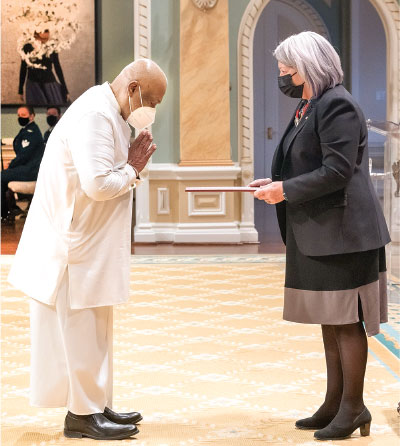 Harsha Kumara Navaratne pictured with the Governor General of Canada, Mary May Simon at a ceremony held at the Rideau Hall in Ottawa on Dec 07, 2021, after the new HC, presented his credentials as Sri Lanka’s High Commissioner(pic courtesy Foreign Ministry)
New HC’s responsibilities
There is no harm in the government seeking a consensus with the civil society as regards the post-war reconciliation process. However, the government cannot turn a blind eye to sharp differences among civil society members over the SLCC dialogue with the incumbent dispensation. In addition, the government should pay attention to the high profile joint Global Tamil Forum (GTF) and the Tamil National Alliance campaign meant to pressure Sri Lanka on the human rights front. For some strange reason, the government continues to refrain from setting the record straight in Geneva. There is absolutely no point in only educating the public by way of presentations, articles and statements. The newly set up Strategic Communication Unit (SCU) of the Lakshman Kadirgamar Institute of International Relations and Strategic Studies has so far dealt with some issues at hand. Waruni Kumarasinghe and Dinithi Dharmapala countered lies in a well compiled article headlined ‘AI report on Sri Lanka: Far from the truth.’ Subsequently, attorney-at-law Dharshan Weerasekera, an SCU consultant, in an article titled ‘Ontario’s Bill 104: Tamil Genocide Education or Mis-education Week?’ discussed the absurdity in the Canadian action. But, would that be enough to overcome the challenge faced by Sri Lanka. Due to utterly irresponsible, sluggish and treacherous response on the part of the Foreign Ministry of Sri Lanka, the Western powers had no difficulty in including the war-winning country on the Geneva agenda ON THE BASIS OF UNSUBSTANTIATED ALLEGATIONS.
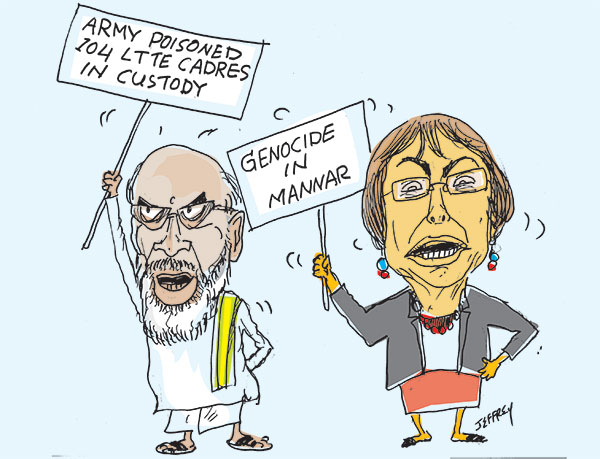
The following are the issues that needed government attention without further delay. (1) Dismissal of war crimes accusations by war time US Defence Attaché Lt. Col. Lawrence Smith in Colombo. Smith did so at the May-June 2011 first post-war defence seminar in Colombo. The State Department disputed the official’s right to represent the US at the forum though it refrained from challenging the statement. (2) Examine the US statement along with Lord Naseby’s Oct 2017 disclosure based on the then British Defence advisor here Lt. Colonel Anthony Gash’s cables to London during the war. (3) Wikileaks revelations that dealt with the Sri Lanka war. A high profile Norwegian study on its role in the Sri Lanka conflict examined some of these cables. However, the Norwegian process never strengthened Sri Lanka’s defence. Instead, Norway merely sought to disown its culpability in the events leading to the annihilation of the LTTE. One of the most important Wikileaks revelations disputed the oft-repeated narrative against Sri Lanka of deliberately targeting civilians. The cable proved that ground forces took heavy losses by taking the civilian factor into consideration. (4) Wide discrepancies in loss of civilian lives claimed by the UN and various other interested parties. The UN estimated the figure at 40,000 (March 2011) whereas Amnesty International (Sept 2011) placed the number at 10,000 and a member of the UK Parliament (Sept 2011) estimated the death toll at 100,000. (5) Disgraceful attempt made by Geneva to exploit so called Mannar mass graves during the Yahapalana administration. The Foreign Ministry remained silent as was often the case on the Mannar graves, while Western diplomats played politics only to be proved utterly wrong. Acting at the interest of those hell-bent on blaming Sri Lanka, Geneva too faulted Sri Lanka before the conclusion of the investigation. The then Northern Province Governor C.V. Wigneswaran rejected scientific findings of Beta Analytic Institute of Florida, USA, in respect of samples of skeletal remains sent from the Mannar mass grave site. Human Rights Commissioner Michelle Bachelet went to the extent of commenting on the Mannar mass grave in her report that dealt with the period from Oct 2015 to January 2019. We come to wonder whether she was actually a victim of Gen. Pinochet or a mere manufactured victim. (Now, Wigneswaran as the leader of a Northern Province political party representing the current Parliament continues to propagate war crimes accusations. Other political parties never properly challenged Wigneswaran’s lies. They should be ashamed and take remedial measures at least now.) Had the US lab issued a report to suit their strategy, would they have accepted fresh tests in case the government of Sri Lanka requested? The following is the relevant section bearing No 23 from Bachelet’s report: “On May 29, 2018, human skeletal remains were discovered at a construction site in Mannar (Northern Province), Excavations conducted in support of the Office on Missing Persons, revealed a mass grave from which more than 300 skeletons were discovered. It was the second mass grave found in Mannar following the discovery of a site in 2014. Given that other mass graves might be expected to be found in the future, systematic access to grave sites by the Office as an observer is crucial for it to fully discharge its mandate, particularly with regard to the investigation and identification of remains, it is imperative that the proposed reforms on the law relating to inquests, and relevant protocols to operationalise the law be adopted. The capacity of the forensic sector must also be strengthened, including in areas of forensic anthropology, forensic archaeology and genetics, and its coordination with the Office of Missing Persons must be ensured.”
(6) Wigneswaran, in his capacity as the then Northern Province Chief Minister in August 2016 accused the Army of killing over 100 LTTE cadres held in rehabilitation facilities. Wigneswaran claimed the detainees had been given poisonous injections resulting in deaths of 104 persons. The unprecedented accusation made by the retired Supreme Court judge had been timed to attract international attention. Wignewaran is on record as having said a US medical team visiting Jaffna at that time would examine the former rehabilitated LTTE cadres, who he alleged had fallen sick because they were injected with poisonous substances at government detention or rehabilitation centres.
Sri Lanka paid a very heavy price for its pathetic failure to counter a web of lies fashioned by interested parties, both local and foreign and well-funded by the West to coerce the country to adopt a new Constitution to the liking of its long time agenda here. The previous government played a key part in this strategy. Their strategy remained simple. A new Constitution meant to do away with Sri Lanka’s unitary status to address STILL unsubstantiated war crimes allegations. The previous government reached agreement with Geneva regarding a new Constitution as part of the overall deal that could have been executed successfully if not for the UNP causing a massive crisis by way of Feb 27, 2015 Treasury bond scam at the onset of the yahapalana administration.
Over two years after the last presidential election, the government is yet to take tangible measures to counter specific lies. That should be a key part of overall strategy to convince the world and the Tamil speaking people here that eradication of the LTTE was certainly not a war waged against them though the group, almost 100 percent comprised Tamils.


Iranian Ambassador in Colombo Dr. Alireza Delkhosh says the Islamic Republic of Iran remains fully prepared to face US-Israeli aggression.
In an interview with The Island at the Iranian Embassy, in Colombo, Dr. Delkhosh emphasised that in case of a fresh outbreak of hostilities, the aggressors, as well as those who provided bases for unprovoked military campaign ,should be prepared to face the consequences.
Excerpts of the interview:
The Island: Did Iran anticipate Israel-US launching unprovoked attacks in the midst of indirect nuclear talks between Iran and US in Geneva, mediated by Oman?
Ambassador: Iran’s wall of mistrust towards the US is rooted in decades of hostile policies and, specifically, Washington’s dark record of broken promises. We always welcomed diplomacy in good faith and serious intent, entering diplomatic channels accordingly; yet, we have repeatedly witnessed the US chose the path of betraying diplomacy in the midst of negotiations.
We do not build our foreign policy on optimism toward the US, as we fundamentally do not view the current US administration as a trustworthy party. The recurrence of provocative patterns and coordination with the Zionist regime’s actions during sensitive negotiations indicate a systematic approach to discredit diplomacy.
From our perspective;
“Any coercive or military action taken alongside mediation efforts serves as further evidence of Washington’s lack of sincere will for diplomacy and its attempt to exert pressure under the guise of dialogue—an approach that will not go unanswered.”
The Island: Do you think the latest war and regional developments, such as the UAE pulling out of OPEC, should be examined, taking into consideration the Oct0ber 7, 2023, Hamas attack on southern Israel.
Ambassador: Allow me to rephrase your question: Is there a link between the attacks carried out by the US and Israel against Iran and the Zionist regime’s warmongering policies? My answer is a definitive “yes”.
Any serious analysis of the current regional dynamics must be placed within the broader historical and structural context of the Palestinian question and the continuation of occupation and blockade. Iran has consistently maintained that the developments of October 7, 2023, did not emerge in a vacuum, but are rooted in decades of unresolved injustice, the denial of legitimate rights of the Palestinian people, and the absence of a credible political horizon.
From this perspective, the subsequent escalation in the region reflects a chain of reactions shaped by long-standing structural tensions, rather than isolated incidents. Iran has repeatedly emphasised that sustainable stability can only be achieved through ending occupation, addressing the root causes of the crisis, and upholding the inalienable rights of the Palestinian people.
Thus, it is important not to reduce complex geopolitical developments to a single starting point. Energy market decisions, alliance shifts, and military escalations are influenced by a broader set of strategic, economic, and political factors.
The Island: What is the status of talks mediated by Pakistan?
Ambassador: A high-ranking Iranian delegation attended an intense day of negotiations, with American negotiators, in Pakistan, on 12th of April, to permanently end a US-Israeli aggression against the country. Iran agreed to participate in the negotiations after US authorities indicated they had accepted Iran’s general conditions as a baseline for peace deal discussions. However, during 20 hours’ intense talks, the US changed its position.
The main sticking point in the talks was the US reluctance to agree to Iran’s legitimate rights to have a peaceful nuclear programme, which Iran has insisted on for years and just before entering the talks, based on the UNSC resolution and the relevant laws.
Iran’s foreign policy is firmly grounded in the principles of dignity, mutual respect, and rejection of coercion or imposed negotiations. Within this framework, Iran has consistently stated that it remains open to indirect diplomatic engagement through mediators, including regional partners, such as Pakistan, provided that diplomacy is conducted in a balanced and credible environment. At the same time, Iran has repeatedly emphasised that the effectiveness of any negotiating track is directly undermined by the US coercive measures, unilateral sanctions, and pressure-based policies.
Sustainable diplomacy necessitates a complete decoupling from pressure tactics; it must be grounded in genuine reciprocity and respect for national rights and interests. Guided by this principled approach, Iran continues to engage in mediation efforts, in good faith, while resolutely safeguarding its sovereign rights and rejecting any framework that resembles ‘dictation under pressure’.”
The Island: The UN has pathetically failed to intervene in the current West Asia conflict. Both Israel and the US simply ignored the UN and the world body seems irrelevant. As a seasoned diplomat what is your opinion on the UN? What is wrong with the global body”
Ambassador: Iran views the UN as an important multilateral institution established to safeguard international peace and security; however, its effectiveness has increasingly been constrained by the selective application of its Charter and the politicisation of decision-making, particularly within the Security Council.
Currently, the international community is witnessing highly dangerous interpretations of ‘peace,’ ‘rights,’ and ‘aggression’ by the US and the Israeli regime. In their lexicon, if they attack a country, it is labelled a ‘peace operation’ or ‘legitimate defence’; yet, if a nation defends itself, it is branded as ‘warmongering.’
“When the innocent people of Gaza, Lebanon, Syria, Yemen, Iran, and Iraq are stripped of their fundamental human and humanitarian rights and endure profound suffering due to attacks, genocides, and inhumane sanctions, it is as if—in the prevailing international discourse—’human rights’ are not being violated at all.”
The world witnessed, on many occasions, that when certain permanent members are directly involved, or aligned with one side of a conflict, the UN’s ability to act impartially is significantly weakened.
From this perspective, the current situation does not reflect irrelevance of the United Nations itself, but rather highlights the structural imbalance in the international order, where enforcement mechanisms are often subject to geopolitical considerations. Iran has, therefore, consistently called for fundamental reform of global governance structures, including democratisation of the Security Council and strengthening of multilateralism, based on justice, equality, and respect for sovereignty.
The Islamic Republic of Iran supports a United Nations that truly represents the rights of nations and establishes justice. The current state of global affairs reflects the failure of certain powers to adhere to the fundamental principles of the UN Charter.
While emphasising the necessity of effective multilateralism to guarantee international peace and security, the Islamic Republic of Iran has consistently reaffirmed its commitment to an international order, based on international law and the principles of the UN Charter.
In conclusion, I must state that: “Unilateralism negates the essential and fundamental principles of the United Nations. Unilateralism is an invitation to injustice, confrontation, and war.”
The Island: In spite of sustained US pressure, its NATO allies declined to join military action against Iran or commit forces to Hormuz Strait. The British and French positions caused an unprecedented rift between them and the US. Do you think NATO countries’ split position on Iran war caused irreparable damage to the largest military organisation in the world?
Ambassador: Differences among NATO members on the use of force in external theatres are not unprecedented. Divergent approaches to specific regional conflicts can place strain on political unity and strategic messaging within this alliance. Whether such differences translate into long-term structural damage depends on how effectively members manage internal consultation and reaffirm shared principles.
Let’s not forget that NATO is fundamentally a military alliance shaped by the strategic priorities of the United States, and differences among its members often reflect not a principled divergence, but rather varying degrees of alignment with Washington’s regional policies.
What is presented as “internal consultation” within NATO is frequently constrained by asymmetric influence, where key decisions on the use of force are effectively driven by the US agenda.
In this context, disagreements among NATO members on external military actions are seen in Tehran less as an institutional safeguard and more as evidence of the alliance’s limited strategic autonomy, particularly in relation to West Asia. Therefore, these divergences do not merely represent tactical differences, but highlight a deeper structural issue: the growing questioning of interventionist policies and the sustainability of military blocs in addressing complex regional crises.
The Island: When did you first hear about the unprovoked US attack on Iran frigate off Galle? (The date and time, please). Who told you about the unfortunate incident? What was your first reaction?
Ambassador: What was particularly concerning was that the IRIS Dena was understood to be undertaking a routine passage in the region, returning from an official visit to India, and was not engaged in any combat or hostile activity. Any incident involving a naval vessel, under such circumstances, is naturally a matter of serious concern and a war crime, especially when it raises questions about maritime safety and the protection of unarmed or non-combat assets.
My immediate priority, upon receiving credible confirmation about this attack, would have been the safety of personnel and the prevention of any escalation. From the first moments of receiving this information, I have been in direct talks and consultations with the Ministry of Foreign Affairs of Sri Lanka and other relevant government authorities, while ensuring that no conclusions are drawn until all facts are verified.
The Island: Did you visit the Iranian vessel and sailors now at Trincomalee?
Ambassador: At this stage, I would like to state that the primary responsibility of the mission has been to maintain continuous contact with the relevant Sri Lankan authorities and ensure the safety, welfare, and proper handling of Iranian personnel and assets involved. In this regard, we have been in close and ongoing coordination with the Ministry of Foreign Affairs of Sri Lanka and other competent government institutions to follow up on all necessary arrangements.
Our focus has been on ensuring that all matters are addressed through official diplomatic channels in accordance with international maritime and humanitarian procedures. The well-being of our personnel and the proper management of the situation remain our highest priority.
The Island: Ambassador, you presented your credentials to the then President Ranil Wickremesinghe in late October, 2023. What were the previous diplomatic stations you served before taking over the Colombo mission?
Ambassador: Prior to my mission in Sri Lanka and the Maldives, I served in various diplomatic capacities in Turkey, Sweden, and Uzbekistan.”
The Island:Would you mind stating Iranian red lines about issues that Iran would never give up such as the right to use nuclear power for civilian purposes and control over Hormuz Strait?
Ambassador: Iran’s foreign policy is based on the principles of sovereignty, deterrence, and the rejection of coercion and unilateral pressure, while simultaneously affirming its commitments under international law. In this framework, we have consistently emphasised that the Islamic Republic will never relinquish its inalienable right to peaceful nuclear energy, including enrichment for civilian purposes, such as energy production, medical applications, and scientific development. As we continually maintained, this right is fully consistent with the Non-Proliferation Treaty.
At the same time, Iran regards the security and management of the Strait of Hormuz as a strategic national responsibility, given that it lies within Iran’s sovereign waters and is one of the world’s most sensitive maritime corridors. Our officials have repeatedly stated that the security of the Persian Gulf and Hormuz must be maintained by regional states themselves, without external militarisation or domination.
However, Iran has consistently expressed concern over certain regional developments in which neighbouring territories have been utilised for the projection of external military power, including by the United States, which, in Tehran’s view, contributes to heightened tensions and undermines regional stability. From Iran’s perspective, such dynamics are among the key factors affecting and jeopardising the security environment of the Persian Gulf and the Strait of Hormuz.
Within this framework, Iran has emphasised that any threat to its sovereignty, territorial integrity, or strategic security interests would be met with firm and proportionate resistance, while at the same time reaffirming its commitment to freedom of navigation in accordance with international law.
Taken together, from a broader perspective: “The overarching framework of Iran’s foreign policy is built upon three primary pillars: countering diplomatic pressures, maintaining autonomy in strategic decision-making while safeguarding national interests and sovereignty, and emphasising the principle of reciprocity. This approach—rooted in the three guiding principles of ‘Dignity, Wisdom, and Expediency’—reflects Tehran’s explicit opposition to unilateralism and bullying in the global arena.”
The Island: Iran proved that it had the strength and the will power to face daunting military challenges and, in spite of civilian protests, influenced by economic hardships, the public stood by the leadership during the hour of crisis. What is Iran’s message to the world?
Ambassador: Iran is the heir to a great civilisation, spanning several millennia. Iran’s message to the world is that national resilience is ultimately rooted in the bond between the state and its nation, particularly, during times of external pressure and security challenges. Despite economic hardships, the Iranian people have demonstrated that in moments of national crisis, priorities converge around the defence of sovereignty, territorial integrity, and national security.
From this perspective, the experience of recent years is a clear testimony that external pressure, military threats, or coercive policies do not weaken national cohesion; rather, they reinforce a shared sense of resistance and the bond between the leadership and segments of society around core national principles. It highlights that such domestic economic issues are addressed within the framework of national stability, not through external intervention.
There exists an inviolable principle: “Sustainable national cohesion is achieved only in the light of full sovereignty over internal affairs and the rejection of any intervention or the politicisation of domestic developments by foreign powers.”
The Island:Wishful Israel-US assessment for regime change, following the Supreme Leader’s assassination failed. Against the backdrop of US success in Venezuela, they seemed to have wrongly asserted the situation and Iranian military response. How do you see the next few weeks as the US and Israel maintain a fragile ceasefire, regardless of some isolated incidents?
Ambassador: The assumptions that external pressure, military action, or targeted scenarios, such as the assassination of its leadership, would lead to structural political change in Iran, have repeatedly proven to be a strategic miscalculation. “Iran’s security architecture is not modelled after classic Western patterns that could be brought down, through sanctions or threats; rather, it possesses its own unique design.
Iran’s strategic decision-making is rooted in institutional continuity, national sovereignty, and a well-established defence and command structure—one that cannot be disrupted by external pressures or short-term military developments.”
Regarding the current situation, the existing ceasefire environment looks to be fragile and highly sensitive. As repeatedly stressed by our officials and leadership, stability cannot be sustained through coercive measures, continued military pressure, or selective escalation. Therefore, any lasting calm depends on adherence to commitments, respect for sovereignty, and cessation of hostile actions.
In the coming weeks, the situation will remain volatile, yet manageable, and Iran will continue to maintain its readiness to respond to any potential adventurism.
Iran continues to emphasise that sustainable regional security cannot be built on failed assumptions of regime change or military superiority, but only through recognition of political realities and mutual respect under international law.
The Island: Finally, the senseless killing of over 150 schoolgirls and teachers at an Iranian school, at the onset of the latest conflict, horrified the world. However, the response of Western governments, and various human rights bodies, seemed inadequate. Some refrained from commenting on the incident. The situation in Lebanon, too, is deteriorating. Why do they act differently when the perpetrators happened to be the US or Israel?
Ambassador: I believe that the disparity in reactions reflects a long-standing flaw in the international system: the selective application of international law and humanitarian principles, based on political considerations rather than universal standards.
As you noted, when incidents involve the US or Israel, many international actors—including certain Western governments and institutions—tend to interpret events through the narratives of ‘security,’ ‘self-defence,’ or ‘strategic necessity.’ The brutal attack on the Minab girls’ school, which resulted in the slaughter of over 168 students and teachers, has pulled back the curtain on the double standards of those who claim to champion human rights. While the smallest incidents in other countries trigger immediate global outcries. We witness a response characterised by silence, projection, and brazen falsehoods regarding this blatant crime—as well as the horrific atrocities in Gaza and Lebanon. These tactics aim at nothing but distorting reality and whitewashing the perpetrators of these tragedies. This pattern has undermined the credibility of international law and the global human rights framework, as it ignores the principle of ‘sovereign equality’ and suggests that accountability is not applied equally to all members of the international community.
This is not merely a legal issue but an expression of a structural imbalance in the international order, where political alliances and strategic interests dictate the interpretation and enforcement of norms. Therefore, I maintain that: “The only way to restore trust in the international system is through the consistent and non-selective enforcement of international law, without exceptions or double standards, regardless of the identity of the parties involved.”
As a final word: “Ibn Khaldun 1332-1406, a famous philosopher and historian, believes that ‘politics is the product of geography.’ The essence of this hypothesis is that the temporary presence of extra-regional powers in West Asia and the Persian Gulf must not lead certain small coastal states of the Persian Gulf into a strategic miscalculation.
The time will come when outsiders are expelled from this region, leaving only the neighbours who are destined to coexist. Instead of focusing on Outsourced Security and legitimacy from distant powers, they must return to geographical realities. They ought to study history to recognise which nation has been the source of security and stability in the Persian Gulf for millennia.
By Shamindra Ferdinando

‘Aragalaya’ betrayed? ‘The treason of the intellectuals’ in the age of populism – Part III
The JVP/NPP government, which relied heavily on social media to come to power, seems to be deeply afraid that it will be overthrown by a second aragalaya fuelled by social media. The government has been accused of organising and directing forces—including pro-government social media activists—from behind the scenes to prevent criticism of the government’s actions from shaping public opinion against the government through social media. Critics say that the aim is to discourage, silence, and drive away critics of the government through ridicule, insults, obscene statements, and intimidation.
Leaving aside these behind-the-scenes manoeuvers, the news that a group of YouTubers, who are identified as “dhobies” or “washers,” recently attended a private press conference at the JVP party headquarters at the invitation of the President and the Minister of Mass Media and Cabinet Media Spokesperson, is a powerful example of the weight the current government places on social media.
“Dhobies”/”washers”
The intelligentsia and intellectuals in democracies play a key role in shaping public opinion, which is traditionally vital in determining the outcome of elections or in building public protests. In the era of social media ubiquity, the primary location of the intelligentsia engaged in politics has shifted to social media. Influencing social media users is now seen as the key to political victory—hence the significance of the phenomenon identified by the term “dhobies”/”washers” (literally laundrymen).
Manifested as a voluntary social media activity—dominated by Facebook and primarily occurring in the Sinhala medium (this article does not cover Tamil social media)—the phenomenon of “washers” is an unprecedented and unique addition to the political process in Sri Lanka. This is an activity of political significance with a certain level of intellectual content that goes beyond the level of mere social media activism, and is carried out by the intelligentsia and intellectuals. These “washers”, alongside the academics who lead them, emphatically state that it is their responsibility to work vigorously to protect this government—one that they brought to power and which aligns with the ideology they believe in.
This group also includes social media journalists who identify themselves as left-wing political activists and as ‘analytical’ discussion presenters via content creation—podcasts and video interviews—as opposed to being mere social media activists.
To achieve their goal, the “washers” understand their role as “cleaning” or “whitewashing” the government in the face of criticism or controversy. They seek to prove the government right by targeting, attacking, and silencing critics through quibbling and intimidation, thereby “protecting” the government.
Although these attacks primarily come in the form of “intellectual” attacks, the range of attacks unleashed under that “intellectual leadership” includes ridicule, insults, and harassment, which are encouraged to be directed at opponents at various levels. Posts are published subtly or directly inviting the “people” who habituate social media as “friends” to post their emojis—likes, dislikes, laughter, ridicule—which may take the form of reaction images, or verbal “comments” against political opponents who publish their views on social media.
In addition to organised “washers,” there are highly credentialed academics who contribute to the “washing” process on their own Facebook pages, either directly or in tacit, subtle ways. Those who do not actively join indicate their support tacitly as “friends” of the organized “washers”—either via emojis or by participating through seemingly innocuous comments that nevertheless get the job done.
They claim this activity of ‘washing’ is the real ground on which politics is determined today. Their stated argument is that in the current era of social media, ridicule, insults, and harassment are inevitable in politics; therefore, those who cannot face them should not be involved in politics. In other words, in this view, politics dominated by social media seems to reenact Hobbes’”state of nature,” which is “nasty, poor, solitary, brutish, and short,” indicating an unprecedented level to which Sri Lanka’s intellectual culture has descended.
Isn’t it an indictment of academia that the practice of “washing” led by academics comes under serious scrutiny from their academic “friends” on social media, especially in relation to the vocation of intellectuals and their role in politics? Notably, the self-identified intellectual leaders of left populism—some of whom are themselves drawn from academia—circulate within these same social media circles.
What they are trying to protect the government from by silencing their rivals and banishing them from the public arena is a second aragalaya that they and the government seem to firmly believe will build on social media operations if criticism of the government is allowed to spread unabated. Hence, there is the need to somehow suppress criticism while giving the act a veneer of intellectual activity. They are participating in this effort, rallying as both organisations and individuals at different levels.
It needs to be added that while these “washing” activities take place mainly in the medium of Sinhala, related “higher” intellectual content is aired in the English medium as well, mainly in the form of interviews with academics.
Criticising the government from a left political perspective
What has come to be expressed as the essence of this “washing” process is the idea, presented in the form of a theoretical formulation, that when criticising the current government from a leftist political perspective, one should first consider who benefits from it. What it means is that if the current government is criticised from a leftist perspective, it could result in a second aragalaya, leading to the return of those who are currently out of power.
A related question that critics are often asked is this; whom do they see as the leaders of a government that could replace the current government? It is as if citizens should only criticise a government that affects their lives if they have a clear alternative to replace it. It is as if criticism is not something that can be done with the intention of correcting something, or a way to develop an alternative.
This argument rejects the traditional liberal political science argument about bourgeois democracy, which considers holding elections at regular intervals to bring governments to power and changing governments when necessary as positive—which requires accepting as positive the development of a critique of the government in power. Accordingly, it implies that the current government must be kept in power at all costs to prevent the power groups that the people rejected from coming back to power, and that is why the Left should stop criticizing the current government. This is a very strange idea of democracy. It is clearly not the bourgeois liberal democracy we have known so far. So, what kind of democracy is it? As some are wont to do, we can keep on tweaking the term to suit the changing conditions instead of developing a critique in the name of the ideal of democracy. So, what is the new term for what is done with democracy under the new regime? Or, do they think that we have reached an era of post-democracy?
Traditionally, the role of intellectuals and the intelligentsia has been to provide the critical thinking that society needs. But the intellectuals who are engaged in “washing” say that the Left should silence its criticism in order to save the government, and then everything will be fine. Some who support “washing” argue that what the Left should do is not criticize the current government, but push it further to the left. While this argument presumes the government to be Left notwithstanding the Left criticism of it, what it fails to take into account is that one of the reasons the government needs repressive social media forces and “washers” may be that the government is intolerant of criticism that pushes it to the left.
The NPP government came to power by rallying around the NPP organisations and individuals who called themselves liberal, progressive, leftist, radical, etc., outside of the JVP membership. The group that can be called intellectuals among them identified themselves with the NPP through a series of actions—starting from contributing to the work of building the National People’s Power and the formulation of its policies, to taking the leadership of relevant committees at various levels and appearing publicly at various public events of the NPP, even on the election platform. Some of them won the elections on the basis of their identity-based vote blocks or became members of parliament from the national list and even became ministers. Many others, as is customary after an election victory, got themselves appointed to various positions in the government bureaucracy as chairpersons, board/council members, directors, etc., either immediately or later.
Some, whether or not they were appointed, abandoned the critical role they were previously playing in society and have remained silent. Some of them have abandoned the theoretical interventions they were making in the public arena with a view to a “system transformation” until they brought the current government to power, in favour of safe literary or other topics as if the transformation that all those criticisms targeted had been achieved with the coming to power of the current government. Others entered the “washing” business while holding official positions in the current ruling regime. Although not all those involved in the “washing” process are in positions of power, there have been allegations that some of those who are involved without holding positions do so in exchange for payment. Among these groups are those who, traditionally known as independent journalists, are now mostly known as content and/or digital creators, questioning the validity of their claims to represent independent journalism.
Some leftists assume that this will be the last time a left-wing government has come to power in Sri Lanka, and therefore have joined the government believing that they should achieve the maximum good for the people, as if they think that history has ended.
Conclusion: Populism and the treason of intellectuals
In conclusion, returning to the ideology of populism that provided the backdrop for this article, it is relevant to note how some of the key characteristics of populism identified in the literature align with critics’ accounts of the policies followed by the current JVP/NPP government.
At its core, populist ideology presents a dichotomy between a “pure,” idealised conception of the people and a “corrupt” elite. It frames politics as a moral struggle against corruption, seeking to displace the traditional class basis of politics. Being deeply anti-institutional, populism dismisses expert and academic knowledge as elitist.
Driven by a Schmittian logic of friend-versus-enemy politics, populist leaders and the intelligentsia seek to displace the traditional elite, aiming to purge them from politics, academia, and culture with a view to appointing themselves as the new elite.
Populism rejects the democratic state in the name of the people. Political theorist Wendy Brown points out that populism focuses instead on aggressive law and order, statism, and a non-democratic view of liberty—where authority rules, yet individuals claim libertarian freedom.
Globally, populism tends to breed authoritarian leaders who centralise power in the executive branch, stripping judges of their independence and turning elected parliaments into mere rubber stamps. To stay in power, populist movements systematically target checks and balances, the free press, and universities, labeling them as roadblocks against the people’s mandate. Once in control, these regimes use legal gray areas to oppress opposition parties and subvert democracy to ensure they remain in power.
The Treason of the Intellectuals
For the title of my article, I have borrowed the title of a seminal work by the French philosopher and essayist Julien Benda, The Treason of the Intellectuals (1927). Almost a hundred years ago, Benda critiqued the intelligentsia’s betrayal of their vocation as intellectuals, focusing on their abandonment of the Enlightenment ideal of universal humanity. In our case, I would argue that intellectuals have abandoned their vocation in the very name of the “renaissance” and “enlightenment” ideals—or the punarudaya—they claim to stand for, allowing political partisanship to dictate their understanding of the intellectual vocation itself.
In her 2023 book, Nihilistic Times, political theorist Wendy Brown argues that we are living in deeply nihilistic times. Placing this rise in nihilism at the very center of our current political crisis, she warns that it is actively undoing democracy while degrading and confounding both political and academic life. In Brown’s view, nihilism leads to the devaluation of both knowledge and political responsibility—a crisis that is especially clear in academia. She argues that intellectuals have abandoned democracy, the common good, and the pursuit of objective truth, choosing instead to align themselves with whoever holds political or cultural power to serve partisan or authoritarian goals. Ultimately, Brown argues that public intellectuals must act as honest, thoughtful analysts who hold politicians accountable rather than seeking to win their favor. Finally, she issues a direct challenge to left-wing intellectuals to make good on their foundational commitment to true critical thinking.

Cutting across the brooding greenery,
Of the big city’s outlying wetlands,
That are verily its purifying lungs,
Are roads less traveled and sought,
That teem with Nature’s All,
Beginning with the tiniest forms of life,
To sprawling giants of the wilds,
Not to speak of birds and butterflies,
Rising to the skies in mesmeric flight…
But nature lovers are nowhere in sight,
Except for frolicking young couples,
Whose purses are pinching so much,
That they can’t afford costlier hideouts,
But there’s no denying that our wetlands,
Need to be right away protected,
Lest they win mention in the Red List,
Of earthly beings heading for extinction.
By Lynn Ockersz

Farmers Affected by the Nilwala Salinity Barrier paid Rs. 1.2 Billion in Compensation

State Vesak Festival held with the participation of the President

Let us all build a society valued with peace and harmony, guided by unity and solidarity beyond all differences – PM

Showers will occur at times in the Western, Sabaragamuwa and North-western provinces and in Galle, Matara, Kandy and Nuwara-Eliya districts

Rajitha calls for combined lists, denounces those unwilling to join as traitors

20 lawmakers, four officials visiting China

‘Dates have the highest sugar content to fight Coronavirus’

Sunday Island 27 December – Headlines

#SundayIsland 17th December – Headlines

Sunday Island – 28th March

Sunday Island Headlines – 21 March

Sunday Island – 21st February – Headlines
-

 Business6 days ago
Historic launch of CCWE Fashion Week & International Summit 2026
-

 News4 days ago
All-New GRAVITE launches at LKR 6.99 Mn
-
 Features4 days ago
The NPP’s pivot to the past
-
 News3 days ago
Police probe underway to ascertain links between criminals deported from UAE and local politicians
-
 News2 days ago
Easter Sunday carnage: Court told Maulana’s statement cannot be accepted without cross-examination
-

 Opinion6 days ago
The need to reform Buddhist ecclesiastical order
-
 Features4 days ago
End of Peacekeeping
-
 Opinion2 days ago
Undermining the democratic political framework