
Foreign News
From behind bars, Aung San Suu Kyi casts a long shadow over Myanmar


As of Wednesday the Burmese democracy campaigner Aung San Suu Kyi will have spent a total of 20 years in detention in Myanmar, five of them since her government was overthrown by a military coup in February 2021.
Almost nothing is known about her state of health, or the conditions she is living in, although she is presumed to be held in a military prison in the capital Nay Pyi Taw. “For all I know she could be dead,” her son Kim Aris said last month, although a spokesman for the ruling military junta insisted she is in good health.
She has not seen her lawyers for at least two years, nor is she known to have seen anyone else except prison personnel. After the coup she was given jail sentences totaling 27 years on what are widely viewed as fabricated charges.
Yet despite her disappearance from public view, she still casts a long shadow over Myanmar.
There are repeated calls for her release, along with appeals to the generals to end their ruinous campaign against the armed opposition and negotiate an end to the civil war that has now dragged on for five years.
The military has tried to remove her once ubiquitous image, but you still see faded posters of “The Lady”, or “Amay Su”, Mother Su, as she is affectionately known, in tucked away corners. Could she still play a role in settling the conflict between the soldiers and the people of Myanmar?
After all, it has happened before. Back in 2010 the military had been in power for nearly 50 years, brutally crushed all opposition and run the economy into the ground. Just as it is doing now, it organised a general election which excluded Aung San Suu Kyi’s popular National League for Democracy, and which it ensured its own proxy party, the USDP, would win.
As with this election, which is still underway in phases, the one in 2010 was dismissed by most countries as a sham. Yet at the end of that year Aung San Suu Kyi was released, and within 18 months she had been elected an MP. By 2015 her party had won the first free election since 1960, and she was de facto leader of the country.
To the outside world it seemed an almost miraculous democratic transition, evidence perhaps that among the stony-faced generals there might be genuine reformers.
So could we see a re-run of that scenario once the junta has completed its three-stage election at the end of this month?
A lot has changed between then and now.
Back then there had been many years of engagement between the generals and an assortment of UN envoys, exploring ways to end their pariah status and re-engage with the rest of the world. It was a more optimistic era; the generals could see their South East Asian neighbours prospering through trade with the Western world, and they wanted an end to crippling economic sanctions.
They also sought better relations with the US as a counterbalance to their dependence on China, at a time when the Obama administration was making its celebrated “pivot” to Asia.
The top generals were still hard-line and suspicious, but there was a group of less senior officers keen to explore a political compromise.
It is not clear what finally persuaded the military leadership to open the country up, but they clearly believed their 2008 constitution, which guaranteed the armed forces one-quarter of the seats in a future parliament, would be enough, with their well-funded party, to limit Aung San Suu Kyi’s influence once she was released.
They badly underestimated her massive star power, and they underestimated how much their decades of misrule had alienated most of the population.
In the 2015 election the USDP won just over 6% of the seats in both houses of parliament. In the next election in 2020 it expected to perform much better, after five years of an NLD administration which had started with impossibly high hopes, and had inevitably disappointed many of them. But the USDP fared even worse, winning just 5% of seats in the two houses.
Even many of those who were dissatisfied with Aung San Suu Kyi’s performance in government still chose hers over the military’s party. This raised the possibility that she might eventually win enough support to change the constitution, and end the military’s privileged position.
It also ruled out the armed forces commander Min Aung Hlaing’s hopes of becoming president after his retirement. He launched his coup on 1 February 2021, the day Aung San Suu Kyi was due to inaugurate her new government.
This time there are no reformers in the ranks, and no hopes of the kind of compromise which restored democracy back in 2010. The shocking violence used to put down protests against the coup has driven many young Burmese to take up arms against the junta. Tens of thousands have been killed, tens of thousands of homes have been destroyed. Attitudes on both sides have hardened.
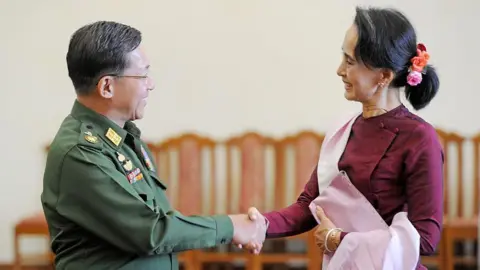
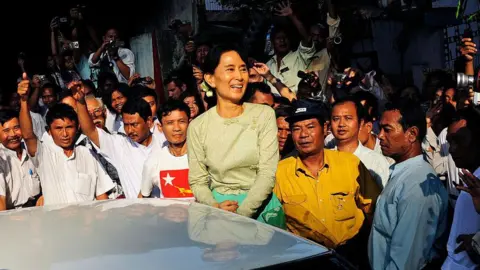
The 15 years Aung San Suu Kyi was detained after 1989, under conditions of house arrest in her lakeside family home in Yangon, were very different from the conditions she is being held in today. Her dignified, non-violent resistance won her admirers across Myanmar and around the world, and during the occasional spells of freedom the military gave her she was able to give rousing speeches from her front gate, or interviews to journalists.
Today she is invisible. Her long-held belief in non-violent struggle has been rejected by those who have joined the armed resistance, who argue that they must fight to end the military’s role in Myanmar’s political life. There is a lot more criticism of how Aung San Suu Kyi governed when she was in power than before.
Her decision to lead Myanmar’s defence against charges of genocide at the International Court of Justice over the military’s atrocities against Muslim Rohingyas in 2017 badly tarnished her saint-like international image. It had much less resonance inside Myanmar, but many younger opposition activists are now willing to condemn how she handled the Rohingya crisis.
At the age of 80, with uncertain health, it is not clear how much influence she would have, were she to be released, even if she still wants to play a central role.
And yet her long struggle against military rule made her synonymous with all the hopes of a freer, more democratic future.
There is simply no-one else of her stature in Myanmar, and for that reason alone, many would argue, she is probably still needed if the country is to chart a path out of its current deadlock.
[BBC]

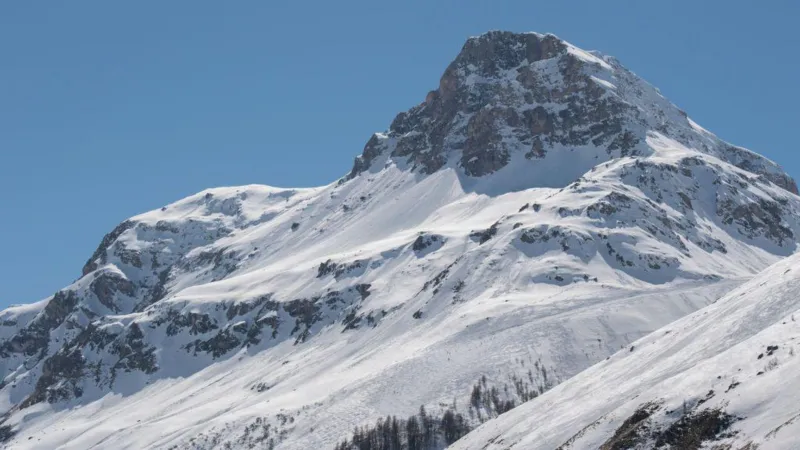
Two Britons and one French person have died in an avalanche in the French Alps on Friday.
The British pair were part of a group of five people skiing off-piste with an instructor in the Manchet valley, near Val d’Isère, a spokeswoman for the resort told the BBC.
The French national was skiing alone when the avalanche struck at 11:30 local time (10:30 GMT), Albertville prosecutor Benoit Bachelet said in a statement announcing the deaths.
Another British person has minor injuries, he added.
A spokesperson for the Foreign Office told the BBC they are aware of the death of the two British men and they are “in contact with the local authorities and stand ready to offer consular assistance”.
A manslaughter investigation has now been launched by the Albertville public prosecutor’s office and will be carried out by CRS Alpes mountain rescue police.
The ski instructor, who was unharmed, tested negative after taking alcohol and drug tests, according to Bachelet.
Val d’Isère already experienced avalanches this winter, with one person dying in the resort of Tignes nearby last month.
France’s national weather service had issued a red alert for avalanche risk across the Savoie region on Thursday, which was then lifted on Friday. But the risk level remained high across the Alps with “very unstable snow cover”.
The avalanche comes in the wake of Storm Nils, which passed through France the day before, leaving between 60cm and 100cm of snow, the weather service said.
There have been a number of fatal avalanches in the region in recent weeks, including the death of a British man off-piste skiing at the La Plagne resort in January.
“We have had some very complicated, very unstable snow since the beginning of the season,” Luc Nicolino, slopes manager at La Plagne, told AFP.
“It’s a kind of mille-feuille with many hidden, fragile layers.”
[BBC]
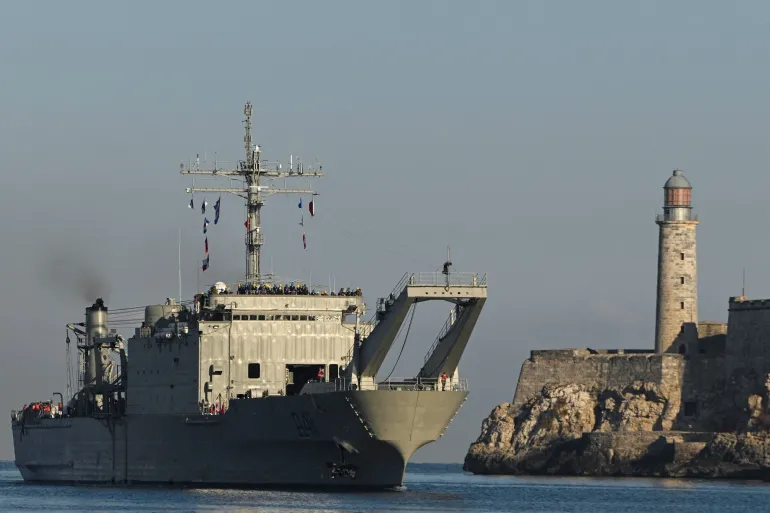
Two Mexican ships bearing humanitarian aid have docked in the harbour of Cuba’s capital Havana, as the United States continues its efforts to cut the island off from outside fuel supplies.
On Thursday, pedestrians on Havana’s seawall watched as the ships, one of which was the Papaloapan, unloaded white pallets on shore.
Mexican President Claudia Sheinbaum addressed the delivery in her morning news conference, promising that more help was on the way.
“We are sending different forms of help, different forms of support,” Sheinbaum said. “Today, the ships arrive. When they return, we are going to send more support of a different type.”
She also described her country’s role as “opening the doors for dialogue to develop” between Cuba and the US, but she insisted that maintaining Cuba’s sovereignty would be paramount among her priorities.
Since January, the administration of US President Donald Trump has sought to cut off the oil supplies that power Cuba’s energy grid and other critical infrastructure.
The campaign is part of a long-running series of sanctions imposed by the US on the Caribbean island nation, stretching back to the Cold War.
But the latest effort, under Trump, has experts at the United Nations warning of an imminent humanitarian “collapse” in Cuba, as oil supplies dwindle.
The oil embargo began on January 3, when Trump authorised a US military operation to attack Venezuela and abduct its then-leader, President Nicolas Maduro, and his wife Cilia Flores.
[Aljazeera]
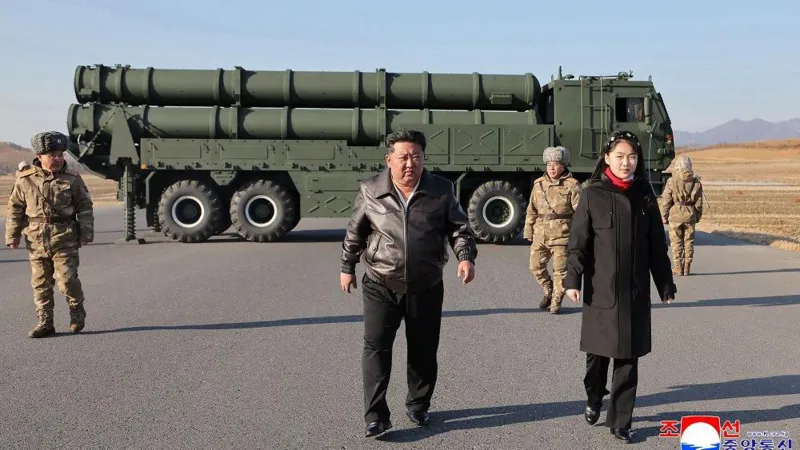
North Korean leader Kim Jong Un has selected his daughter as his heir, South Korea’s spy agency told lawmakers on Thursday.
Little is known about Kim Ju Ae, who in recent months has been pictured beside her father in high-profile events like a visit to Beijing in September- her first known trip abroad.
The National Intelligence Service (NIS) said it took a “range of circumstances” into account including her increasingly prominent public presence at official events” in making this assessment.
The NIS also said it would keep close tabs on whether she will attend the North’s party congress later this month – its largest political event that is held once every five years.
The party Congress is where Pyongyang is expected to give more details about priorities like foreign policy, war planning and nuclear ambitions for the next five years.
On Thursday lawmaker Lee Seong-kwen told reporters that Ju Ae, who was previously described by the NIS as being “trained” to be a successor, was now at the stage of “successor designation”.
“As Kim Ju Ae has shown her presence at various events, including the founding anniversary of the Korean People’s Army and her visit to the Kumsusan Palace of the Sun, and signs have been detected of her voicing her opinion on certain state policies, the NIS believes she has now entered the stage of being designated as successor,” Lee said.
Ju Ae is the only known child of Kim Jong Un and his wife, Ri Sol Ju. The NIS believes Kim Jong Un has an older son, but this son has never been acknowledged nor shown on North Korean media.
News of Ju Ae’s existence first emerged through an unlikely source: the American basketball player Dennis Rodman, who revealed to The Guardian newspaper back in 2013 that he “held baby Ju Ae” during a trip to the secretive state.
Ju Ae – who is believed to be 13 – made her first appearance on state television in 2022. She was shown inspecting North Korea’s latest intercontinental ballistic missile while holding her father’s hand.
She has since made frequent appearances on on state media, softening her father’s image of a ruthless dictator. She accompanied him to Beijing for China’s largest-ever military parade, where she was seen stepping off his armoured train at Beijing Railway Station.
She is often seen wearing her hair long, which is forbidden for her peers, and wearing designer clothes, which are out of reach for most in her country.
Another lawmaker, Park Sun-won said the role Ju Ae had taken on during public events indicated that she has started to provide policy input and is being treated as the de facto second-highest leader.
The North Korean power had passed down the three generations of the Kim family, and it is widely believed that Kim Jong Un will pass on the throne to Ju Ae.
In recent months, she was shown standing taller than her father, walking beside him, rather than following him.
In North Korea, where photos published by the state media are believed to carry a great symbolic weight, it is rare for individuals other than Kim Jong Un to be positioned equally prominently in the frame.
Although the South Korean spy agency now believes Ju Ae is the designated heir, it still raises questions.
It is puzzling why Ju Ae, a daughter, would be selected as the heir above an older son in North Korea’s deeply patriarchal society.
Many defectors and analysts had previously dismissed the idea of a woman leading North Korea as an unlikely scenario, referring to the country’s entrenched traditional gender roles. But Kim Jong Un’s sister – Kim Yo Jong – does offer a precedent for female authority in the regime.
Kim Yo Jong currently holds a senior position in the Central Committee of the Workers’ Party of Korea, and is reported to have influence over her brother.
However, it is also a mystery why Kim Jong Un, who is still young and appears relatively healthy, is already designating a 13-year-old child as his heir now.
It is unclear what changes Ju Ae’s succession may bring to North Korea.
Many North Koreans hoped that Kim Jong Un, a Western-educated young man, would open their country up to the outside when he succeeded his father.
Yet such hope was unfulfilled. Whatever plans this teenager may have for her country, she would likely have the singular power to shape it however she likes.
[BBC]

High risk of rain in marquee India vs Pakistan T20 World Cup game in Colombo

New Zealand and South Africa look ahead to Super Eights in low-pressure contest

Teacher recruitment examinations will be conducted in accordance with the relevant court decisions – PM

Low-pressure area is likely to form over the southeastern Bay of Bengal around 15th February

Kolkata the stage as England, Scotland resume auld rivalry

Showers will occur at times in the Central, Uva, Eastern, Northern and North-central provinces and in Hambantota district

‘Dates have the highest sugar content to fight Coronavirus’

Sunday Island 27 December – Headlines

#SundayIsland 17th December – Headlines

Sunday Island – 28th March

Sunday Island Headlines – 21 March

Sunday Island – 21st February – Headlines
-
 Features6 days ago
My experience in turning around the Merchant Bank of Sri Lanka (MBSL) – Episode 3
-

 Business6 days ago
Remotely conducted Business Forum in Paris attracts reputed French companies
-
 Business6 days ago
Four runs, a thousand dreams: How a small-town school bowled its way into the record books
-

 Business6 days ago
ComBank and Hayleys Mobility redefine sustainable mobility with flexible leasing solutions
-

 Business3 days ago
Autodoc 360 relocates to reinforce commitment to premium auto care
-
 Midweek Review3 days ago
A question of national pride
-
 Opinion2 days ago
Will computers ever be intelligent?
-
 Midweek Review3 days ago
Theatre and Anthropocentrism in the age of Climate Emergency