
News
Former govt sabotaged probe into Easter Sunday bombings, retired police officer alleges


(ABC) A retired police officer has shed new light on claims that the former Sri Lankan government may have colluded with a terrorist group for political gain, resulting in the deaths of hundreds of people, including Australians, in the 2019 Easter Sunday bombings.
The attacks by Islamic state-inspired terrorists on churches and luxury hotels killed 269 people including two Australians and injured about 500 other people.The head of the Catholic Church in Sri Lanka is now calling on the Australian government to support an independent investigation into the allegations, a call backed by Melbourne woman Chathudilla Weerasinghe, who survived the attack on Colombo’s Kingsbury hotel.
“They should carry out an investigation … because there were so many blasts on the date — similar timings, coordinated – it has to be a major planned-out thing,” Ms Weerasinghe said.
In September, the UK’s Channel 4 aired claims by a former government aide, Asad Maulana, that a top intelligence official met with members of the terrorist group National Thowheed Jam’ath (NTJ) as part of an alleged plot to help former Sri Lankan president Gotabaya Rajapaksa win government by creating a national security crisis from the attacks.
Now, the former head of the investigation into the bombings has spoken out for the first time about what he claims was political interference which derailed the police probe.
Former deputy inspector general of police Ravi Seneviratne said his team was taken off the case when Mr Rajapaksa took office six months after the bombings.
Mr Seneviratne told ABC Investigations that his lead investigator was removed without explanation “immediately after the new government was elected — at the time, not even a prime minister or the cabinet had been appointed”.
He said over the months that followed, 22 more officers were removed from the investigation, “but I was not given any reason for any of those transfers”.
The incoming government also imposed an overseas travel ban on more than 700 Criminal Investigation Department officers under Mr Seneviratne’s command.
Mr Seneviratne said this was seen as a bid to intimidate police who might investigate allies of the Rajapaksa regime.
“This was quite illegal,” Mr Seneviratne said.
“Because of this action, many officers were scared. Some officers even sought transfers because they didn’t want to work there any longer.”
Police charged more than 90 people in connection with the Easter Sunday attacks, but Mr Seneviratne said investigators hit roadblocks when they found “some intelligence officers had links with the Muslim group”.
One of these was unearthed with help from the US Federal Bureau of Investigation, which traced regular communications with the NTJ terrorists to an Internet Protocol address used by a secret military intelligence operative.
Mr Seneviratne has claimed that military intelligence officers also visited the house of one suicide bomber on the morning of the attacks but did not share this information with police.
“On such occasions, when we tried to question certain individuals and groups, we faced some obstacles,” Mr Seneviratne said.
Sri Lankan intelligence agencies twice stopped police from questioning associates of the suicide bombers on the grounds they were involved in national security operations, he said.
“As military intelligence informed us that those officers were dealing with intelligence related secret matters, we didn’t investigate them further.”
Mr Seneviratne said military intelligence had thwarted an earlier investigation which he believed could have prevented the Easter Sunday attacks.
He said military intelligence had given police “wrong information” which concealed the role of the NTJ in the murder of two constables in east Sri Lanka six months before the Easter Sunday attacks.
In documents filed in the Supreme Court of Sri Lanka last year, Mr Seneviratne alleged the Directorate of Military Intelligence and the Security Intelligence Service were “suspected to have conspired to plant [evidence] to mislead CID investigations on the murder of two police officers to prevent them from discovering the real assailants”.
Mr Seneviratne told ABC Investigations that he believed there was “a possibility to prevent the Easter Sunday attacks, if we were able to find out the suspects of the police murders”.
In September, Asad Maulana, a former aide to a current Sri Lankan government minister, told Channel 4’s Dispatches program that he witnessed a meeting between the NTJ terrorists and then head of military intelligence, Suresh Salley in February 2018, 14 months before the Easter Sunday bombings.
Mr Maulana claimed to Channel 4 that the intelligence chief later told him Mr Rajapaksa needed “an unsafe situation” to win an election.Mr Seneviratne said Mr Maulana’s claims demanded a “thorough investigation”, including into why intelligence officers misled police about NTJ.
Mr Maulana’s former boss, the State Roads Minister Sivanesathurai Chandrakanthan, has accused him of concocting the allegations to bolster his claim for asylum overseas.
Mr Rajapaksa, who after his ousting last year was sanctioned by Canada for human rights violations during Sri Lanka’s civil war, has dismissed the allegations as “absurd”.
Mr Salley has denied any contact with the NTJ terrorists, saying he was overseas at the time of their alleged meeting.He is now the head of Sri Lanka’s Security Intelligence Service, a role that saw him meet Australian officials including Home Affairs Minister Clare O’Neil last year.
Neither Mr Rajapaksa nor Mr Salley responded to ABC interview requests or questions.Last month, Channel 4 declined to appear before a commission of inquiry launched by current Sri Lankan President Ranil Wickremesinghe, citing a need to protect confidential sources.
The head of the Catholic church in Sri Lanka, Cardinal Malcolm Ranjith, called on the Australian government to help build international pressure for an independent investigation to “help us to find out what really happened to these 270 people and who was behind it”.
“We want the Australian government, and also many governments in the world, to consider this as a serious human rights violation, violation of the dignity of human beings and serious suspicions of a political plot appearing,” he said.
He said in Sri Lanka, “big people, ministers … those who are in the intelligence services, had some role to play in the general mayhem that existed during the wartime: disappearances, murders during the war time, and then subsequently”.
“That is why we have been clamouring and asking for a transparent investigation, which is free, which is not guided by politicians … and also according to international standards.”
Cardinal Ranjith said one of his priests was being sued for defamation by Suresh Salley, after raising questions about the Easter Sunday attacks and what he said appeared to be “a political plot by a group of people at the top”.
“Other priests … have been under surveillance of these people. I am sure they are having files about many of us, even myself, I’m quite sure of that, because our telephones are not safe anymore for us to converse freely,” he said.In Melbourne, Chathudilla Weerasinghe still lives with a fragment from an NTJ bomb inside her from the Easter Sunday attack on Colombo’s Kingsbury hotel.
“It’s too risky to get the shrapnel out because it’s right next to the heart,” she says.
“[The doctors] don’t want to risk that. So, it’s better to just leave it there.”
Her father Ranjith, a Monash University mathematics lecturer, said the family took seriously allegations that some Sri Lankan officials might have been complicit in the attacks.
“If it happened in Australia, definitely I am shocked,” he said.
“But back in Sri Lanka, it could be possible. The politicians are a very different breed.”

Latest News
Heat Index at Caution Level in the Northern, North-central, North-western, Western, Sabaragamuwa, Eastern and Southern provinces and in Monaragala district

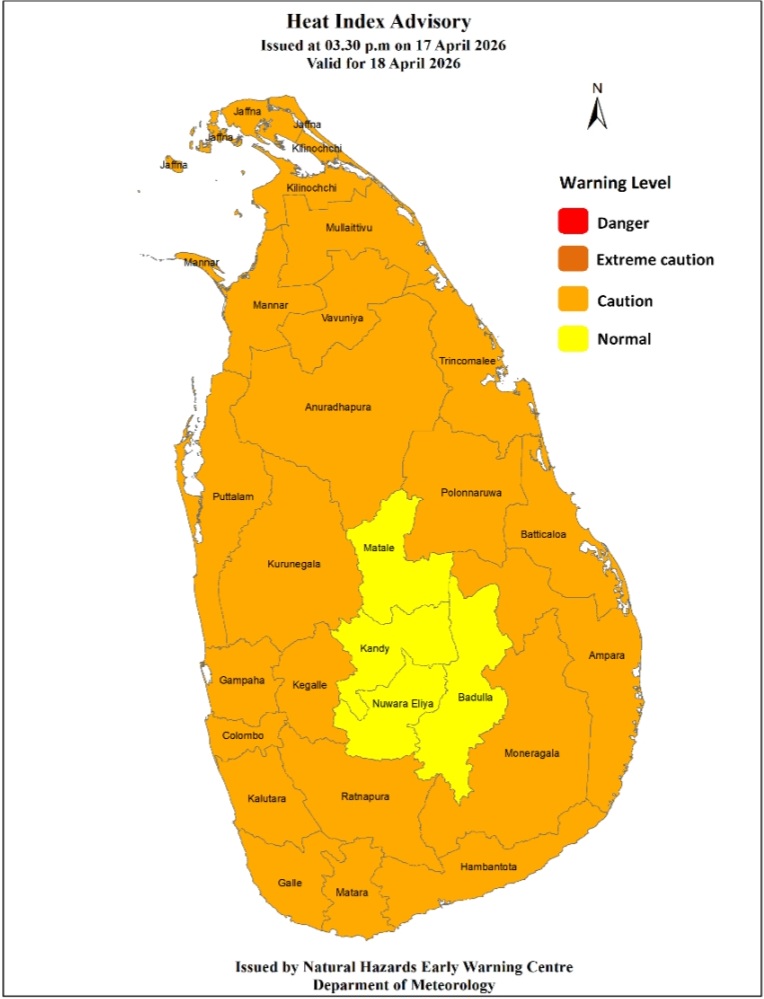
Warm Weather Advisory
Issued by the Natural Hazards Early Warning Centre
Issued at 3.30 p.m. on 18 April 2026, valid for 19 April 2026
The Heat index, the temperature felt on human body is likely to increase up to ‘Caution level’ at some places in the Northern, North-central, North-western, Western, Sabaragamuwa, Eastern
and Southern provinces and in Monaragala district.
The Heat Index Forecast is calculated by using relative humidity and maximum temperature and this is the condition that is felt on your body. This is not the forecast of maximum temperature. It is generated by the Department of Meteorology for the next day period and prepared by using global numerical weather prediction model data.

Effect of the heat index on human body is mentioned in the above table and it is prepared on the advice of the Ministry of Health and Indigenous Medical Services.
ACTION REQUIRED
Job sites: Stay hydrated and takes breaks in the shade as often as possible.
Indoors: Check up on the elderly and the sick.
Vehicles: Never leave children unattended.
Outdoors: Limit strenuous outdoor activities, find shade and stay hydrated.
Dress: Wear lightweight and white or light-colored clothing.
Note:
In addition, please refer to advisories issued by the Disaster Preparedness & Response Division, Ministry of Health in this regard as well. For further clarifications please contact 011-7446491.

Warning that “agents of the devil who wish to hide the truth behind a wall of political posturing” were attempting to obstruct investigations into the Easter Sunday terror attacks, the Catholic Church has called for intensified public support and prayer to ensure justice for victims.
In a message issued ahead of the seventh anniversary of the April 21, 2019 bombings, Colombo Archbishop Cardinal Malcolm Ranjith said there were ongoing efforts by various forces to derail credible inquiries into the coordinated attacks that claimed 278 lives and left nearly 500 injured.
The statement noted that many of those killed had been attending Easter Sunday Mass when suicide bombers struck churches, including St. Anthony’s Shrine, Kochchikade, St. Sebastian’s Church, Katuwapitiya, and Zion Church, Batticaloa, causing widespread devastation and long-term suffering among survivors.
Seven years on, the Caridnal said, critical questions remain unanswered, including who masterminded the attacks, their motives, and why places of worship were targeted on Christianity’s most sacred day.
Full text of Cardinal Malcolm Ranjith’s message: On 21st April 2026, the Church in Sri Lanka will be commemorating the 7th Anniversary of the Easter Sunday bomb blasts, which killed 278 of our fellow human beings and brethren in the faith in the most brutal fashion. Most of these people had come to our Churches for Easter Sunday Masses and prayer services. Many families were rendered destitute. Nearly 500 people were injured and some of them carry life long disabilities, suffering from the after effects of these blasts. St. Anthony’s Church Kochchikade and St. Sebastian’s Church Katuwapitiya of the Catholic community and the Zion Church in Batticaloa were, quasi totally destroyed. The economy of the country suffered immensely with untold problems affecting many families, ever since then. However much we try to console the families of these victims, it is something that we humans are unable to achieve as only the Lord can truly console them.
Besides, we still do not know who murdered these people and caused so much of suffering to many others, and why and for what purpose they chose our Churches on a day that was most sacred to us to organize these attacks. After repeated pleas by the Catholic Church, now at last, the incumbent government and the security establishment, seem to be holding a credible inquiry into this episode of mass murder in order to find out who was really behind it.
And there are many forces actively seeking to obstruct these inquiries and divert the direction of the inquiry in an aimless fashion in order to hide the truth behind these attacks. They are nothing but the agents of the devil who wish to hide the truth behind a wall of political posturing. We need to storm Heaven and ask the Lord to strengthen the hands of the investigators to find out what really happened and who was behind this mass murder as well as why it was done to innocent people who had nothing to do with politics.
Hence, I call upon all of you to kindly storm Heaven with your prayers calling upon the Lord to help us find out what really happened that most tragic day. And so, I am declaring Sunday, the 19th of April 2026, as a special day of prayer for this purpose. I shall be most grateful to every one of you, beloved brethren, if you could recite special prayers in all the parishes of the Archdiocese at Sunday Mass on that day and offer prayers at home too for the success of these investigations. The special prayer for truth and justice for the victims of the bomb attacks, already approved by the Catholic Bishops’ Conference, could also be recited. I call upon all our Catholic devotees to join us in this effort.
Let us stand together firmly behind the efforts to find out the truth. Let us not be deceived by attempts of different people to hide the truth or divert attention in all kinds of directions in order to confuse the public.
May the Blessed Mother, our Lady of Lanka, intercede for us in this most important matter.
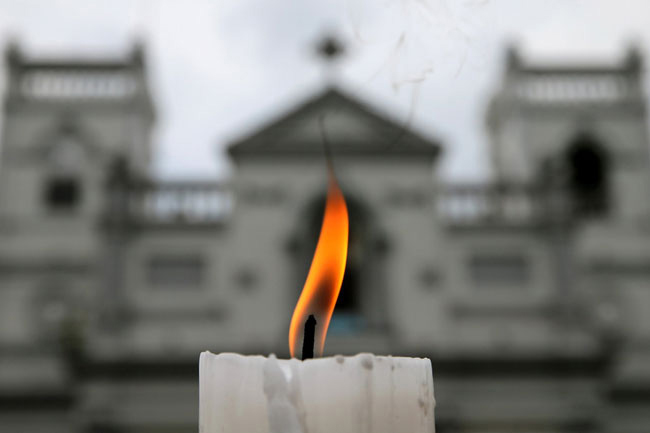
A series of solemn religious observances and commemorative events will be held on Tuesday, April 21, to mark the seventh anniversary of the Easter Sunday terror attacks, with ceremonies planned across the island and a public march for justice in Negombo.
The programme will begin with a coordinated observance in churches nationwide. At 8:45 a.m., funeral bells will toll, followed by a two-minute silence in memory of the victims. At 8:47 a.m., bells will toll again as the faithful light candles or oil lamps, with the morning observance concluding in a special prayer service at 8:50 a.m.
Major ceremonies are to be held at key locations affected by the 2019 attacks.
At St. Anthony’s Shrine, Kochchikade, the commemoration will be led by Malcolm Cardinal Ranjith and Bishop Anton Ranjith. Proceedings will commence at 8:15 a.m. with the arrival of ambassadors and dignitaries. Following the national moment of silence and prayer at 8:45 a.m., invitees will participate in a candle-lighting ceremony at 8:47 a.m. The programme from 9:10 a.m. will include interfaith reflections and addresses by the Apostolic Nuncio, a representative of the United Nations, and Cardinal Ranjith.
At St. Sebastian’s Church, Katuwapitiya, religious observances will be conducted under the guidance of Bishop Maxwell Silva and Bishop J. D. Anthony. Holy Mass is scheduled for 7:30 a.m., followed by the tolling of bells, a two-minute silence, and the lighting of candles at the memorial monument at 8:45 a.m.
The day’s commemorations will culminate in a Prayer March for Justice in Negombo. The march is set to begin at 4:00 p.m. from the Maris Stella grounds, with clergy and lay participants proceeding to St. Sebastian’s Church, where bishops and priests will conduct a Benediction service.The events are expected to draw large numbers of clergy, devotees, diplomats and members of the public, as the nation continues to remember the victims and call for truth and accountability.

Malinga, Reddy sink Chennai Super Kings chase to defend under-par 194 in Hyderabad

Stubbs, Miller win Delhi Capitals a thriller against Royal Challengers Bengaluru

Showers predicted in the Western, Central, Sabaragamuwa, Uva, North-western, North-central and Southern provinces after 1.00 pm.

Heat Index at Caution Level in the Northern, North-central, North-western, Western, Sabaragamuwa, Eastern and Southern provinces and in Monaragala district

‘Agents of the devil’ seeking to block Easter probe, Cardinal warns

Nation to mark Easter Sunday attacks with countrywide observances, march for justice

‘Dates have the highest sugar content to fight Coronavirus’

Sunday Island 27 December – Headlines

#SundayIsland 17th December – Headlines

Sunday Island – 28th March

Sunday Island Headlines – 21 March

Sunday Island – 21st February – Headlines
-

 Latest News6 days ago
PNS TAIMUR & ASLAT arrive in Colombo
-
 Latest News6 days ago
Prasidh, Buttler set up comfortable win for Gujarat Titans
-

 News4 days ago
PNS TAIMUR & ASLAT set sail from Colombo
-

 Latest News5 days ago
“I extend my heartfelt wishes to all Sri Lankans for a peaceful and joyous Sinhala and Tamil New Year!” – President
-
 Latest News6 days ago
Heat Index at Caution level’ in the Northern, North-central, North-western, Western and Southern provinces and in Trincomalee district.
-
 Latest News5 days ago
US blockade of Iran would worsen global energy crisis, analysts say
-

 Latest News6 days ago
Salt and Patidar power RCB past Mumbai Indians
-
 News1 day ago
Heroin haul transported on 50-million-rupee contract