
Features
Foreign Exchange Crisis


By Dr.C.S. Weeraratna
csweera@sltnet.lk
One of the main strategies to resolve the current Foreign Exchange crisis would be to increase export earnings and reduce expenditure on imports. Most of the activities involved are short-term while the others are medium/long term.
Increase export earnings
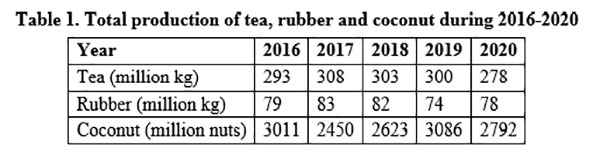
Increasing exports is of paramount importance to improve the present FE crisis. A major source of FE is the plantation sector. Around 800,000 ha are cultivated with crops such as tea, rubber, coconut, etc., and this sector has in the last few years earned nearly Rs. 360 billion annually. However, as indicated in table 1, production of these major export crops have not shown any substantial increase during the last five years and the contribution from this sector has remained at nearly 20% of the export income. Hence, strategies need to be implemented to increase production and hence FE earnings from this sector. There are many state sector organisations to implement such strategies.
As shown in Table 1 tea production has been fluctuating around 300 million kg per year during the last five years in spite of several institutions assigned to the tea sector. The average tea yields are considerably lower than the potential yields. In the smallholder tea sector the average yield is around 1800 kg/ha and in the estate sector it is about 1200 kg/ha. In 2020, tea earned Rs. 230 billion in FE. Better management practices in the short term would increase the quantity and quality of the tea produced making it possible to increase FE earnings substantially from the current Rs. 230 billion.
Rubber is another important export crop. In 2017, it earned nearly Rs. 6 billion in foreign exchange but has decreased during the following three years. Based on Central Bank annual reports, the total Rubber production in 2010 was 152.9 million Kg and by 2019, it has plummeted to 74.8 million kg. The corresponding average yields are 1561 kg/ha and 665 kg/ ha respectively. These figures indicate that the Sri Lankan rubber sector is ailing in spite of several institutions assigned to promote rubber production in the country. With the current higher rubber prices it would be possible to earn more FE by increasing rubber production by better management practices which would produce results in the short term. During the last few years the rubber sector has been affected by many factors one of which is ineffective management.
Coconut production too has declined during the last five years as shown in Table 1. The total extent under coconut in Sri Lanka is around 400,000 ha and about 325,000 ha are small holdings. Annual production of coconut has been fluctuating around 3,000 million nuts, (app. 6000 nuts/ha) As the state of the existing coconut plantations need to be looked into. If the production of the existing coconut lands is increased by 1000 nuts/ha/year by better management, and applying organic and inorganic fertilisers the total production can be increased by a substantial number within a year which will increase the export income from coconut.
This appalling situation in the plantation sector can be attributed to many factors. If the productivity of this sector is raised by implementing better management practices it would be possible to increase foreign exchange earnings from this sector. Most of these practices would produce results in the short term .
A large number of crops other than tea, rubber and coconut cultivated in Sri Lanka have a high potential as export crops. There are 24 agro ecological zones, each characterised by specific climate and soils. This makes it possible to cultivate different types of crops such as spice crops, tuberous crops, horticultural (fruit crops) and floricultural crops, medicinal herbs, etc.
Sri Lanka is famous for spices. The most sought-after spice crops are cinnamon, pepper, cloves, cardamoms, nutmeg, mace and vanilla which grow in abundance mainly in the wet and intermediate zone. In 2020, county earned nearly Rs. 60 billion by exporting spice crops.
Cinnamon is the most important spice commodity among the spice sector. In 2019, it earned around Rs. 32 billion in FE. The production of cinnamon has been fluctuating around 20,000 t per year during the last few years. Sri Lanka received its first ever Geographical Indication (GI) certification when the European Union (EU) Commission on 02 February,2022 granted GI status to Ceylon Cinnamon and this would make a higher demand for Sri Lanka cinnamon.
Pepper is the second important commodity among spices. It is grown in the wet and intermediate zones mostly as a mixed crop. The Sri Lankan pepper has higher piperine content which gives it a superior quality and pungency. Annual production of pepper too has remained stagnant at around 20,000 kg.
Other spices such as cloves, cardamom, nutmeg and mace have the potential to earn a substantial amount of FE. With the increase of international demand for natural products, and the island’s focus on enhancing and evolving its value added range, spices and the essential oils extracted from these crops will continue to earn more FE.
Dehydrated food is another agricultural product which has a potential to earn much -needed FE. During some months there is a glut of fruits and exporting dehydrated/canned fruits would bring in an appreciable amount of FE.
In any programme/plan to increase foreign exchange earnings from the agricultural sector, agro-industries has to be given much emphasis . A large number of crops cultivated in Sri Lanka have considerable potential in various agro-industries. However, only rubber, coconut and a few fruit crops are used in industries. Crops such as cassava, horticultural and floricultural crops, medicinal herbs, cane, bamboo, sunflower, castor, ayurvedic herbs, etc. have a considerable industrial/export potential but are not cultivated to any appreciable extent. The development of agro-industries will also increase export income and will have a tremendous impact on the economy of the country and also provide employment opportunities among rural people. Private sector can be involved in such projects for which appropriate technical assistance need to be given by the relevant public organizations.
Decrease expenditure on imports
While implementing strategies to increase our FE income by promoting exports, action needs to be taken to decrease our expenditure on imports. During the period 2017-2020 annual expenditure on importing food has been around Rs. 320 billion. The current expenditure on food imports is likely to be even more due to the depreciation of SL rupee, and shortage of rice and other food crops the result of banning import of agrochemicals. .
One of the problem the country is facing is the fuel crisis, which is likely to have extremely undesirable repercussions. A large sum of money is spent on importing petroleum to Sri Lanka, In 2020, we imported fuel worth Rs. 540 billion . If we are going to consume petroleum products at the current rate, at least an additional Rs. 50 billion will have to be spent in 2022. Hence, it is essential that the consumption of petrol and diesel be reduced. In many other countries such as China, Thailand, Singapore, action has already been taken to reduce fuel/ power consumption and cut down wastes. If we reduce our power consumption by 10%, it will result in a saving of Rs 60 billion in foreign exchange.
Studies conducted in many countries have found that ethanol is an alternative to petrol. Many countries are either producing or using ethanol in large quantities or are providing incentives to expand ethanol production and use. Prompted by the increase in oil prices in the 1970s, Brazil introduced a programme to produce ethanol for use in automobiles to reduce oil imports. Brazilian ethanol is made mainly from sugar cane. Among the countries using ethanol as a bio fuel are Australia, France, India, Sweden, USA, South Africa, etc. Use of ethanol tends to reduce environment pollution caused by compounds such as tetraethyl lead found in petrol. Ethanol can be made from high starch containing crops such as manioc and maize, or high sugar containing crops such as sugarcane. These crops are cultivated in Sri Lanka. Around 10 million litres of alcohol are produced annually at Pelwatta and Sevanagala sugar factories. These can be used to blend petrol and used at least in three wheelers so that those who use them need not pay higher fares. A few years ago Prof. Thissa Vitharana, who was the then minister of Science and Technology, appointed a committee to look into the possibility of using substitutes for fuel. The committee recommended the use of ethyl alcohol and Jatropha oil as bio-fuels. No follow-up action was taken by the subsequent governments to promote these substitutes as bio-fuels. Oil from Jatropha (Weta Erandu) a crop that can be grown widely in the Dry Zone of Sri lanka can be used as a bio fuel.
Dendro-power can be generated using fast growing nitrogen fixing tress such as glyricidia and leuceana. These crops not only can be used to generate electricity but also are a good source of animal feed and fertilisers. It may be more beneficial to grow these crops in eroded tea lands where the yields are relatively low. Soil erosion in such tea lands also can be reduced by growing these crops. The Bio Energy Association of Sri Lanka has been instrumental in promoting cultivation of glyricidia.
Sri Lanka, a country begging for dollar loans to import medicine, fuel, etc., which are critically important, needs to have a flexible policy on exports and imports. As indicated above, there are 24 agro ecological zones, each characterised by specific climate and soils. This makes it possible to cultivate different types of crops. Most of the food imported can be locally produced thereby reducing expenditure on food imports. A closer look at the imports reveals that around Rs. 50 billion (nearly 16% of food imports) in FE is spent on importing sugar, most of which can be locally produced. The total annual requirement of sugar in the country is around 620,000 t but, only about 50,000 t are produced locally.
Sugarcane has a considerable potential to reduce the expenditure on food imports. Sugar production in the country has not increased by any appreciable amounts during the present decade. The Kanthale sugar factory remains closed while a plan to cultivate sugarcane in Bibile remains shelved. Jaggery made from kitul, and sugarcane are good substitutes of sugar manufactured from sugarcane.
A substantial amount of foreign exchange is spent on importing milk. In 2020, Rs. 60 billion in FE was spent to import milk and dairy products. We have around 1 million cattle consisting of mostly indigenous cattle. Their productivity is low (1-3 litres/day) mainly due to the poor nature of the breeds and inadequate low quality feed supply. The dairy industry has a potential to contribute considerably to solving the Sri Lanka’s FE crisis. Milk production can be increased by increasing availability of cattle food, and thereby an appreciable amount of foreign exchange spent on milk imports can be reduced. Milk production also plays an important role in alleviating nutritional poverty and it is a source of extensive employment opportunities. If milk production can be increased, an appreciable amount of foreign exchange spent on milk imports can be reduced and improve the nutrition status of the people.
Expenditure on subsidiary food crops such as chilies, green gram, ground nut, potato, etc., is few billions of rupees. The extent under these crops and their average per hectare yields have not increased by any appreciable amount during the last decade. A few years ago, a former Minister of Agricultural Development Chamal Rajapaksa appointed an Advisory Panel to make proposals to develop the agricultural sector so that there was a quantitative and qualitative increase in crop production at a lower cost with no damage to the environment. The recommendations of the panel were mainly on development and use of better varieties of seeds and planting material, effective control of weeds, insect pests and diseases, better water management, and water conservation, proper use of inorganic and organic fertilizers, controlling soil degradation and appropriate land use, promoting agro –industries, and carrying out relevant agricultural research and use of their findings. During the last few years numerous programmes such as “AMA’, ” Waga Sangramaya” and “Govi Sevana ” were implemented. All these activities/programmes, appear to have not made any appreciable positive impact on the agricultural sector of the country indicated by increasing expenditure on food.
In addition to sugar, milk, and rice, we spend a colossal sum on importing food items which can be locally produced. Among these are lentils (Rs. 20 billion) onion( Rs 16 billion), maize (Rs. 10 billion) fruits and vegetables and spices mainly chillies. Even herbs such as katuwelbatu and thippili which can be produced locally and used for ayurvedic drugs are imported at a cost of nearly USD 6 million every year. Most of these crops can be cultivated in the dry zone where only about 2 million acres are in productive use out of the 4.5 million ha. Non-availability of adequate rainfall during the yala season is one of the limiting factors of crop production in the dry zone. However, better water management practices and rainwater harvesting would reduce this limitation.
Although hundreds of research projects related to plantation and food crops are carried out by the faculties of agriculture, the Department of Agriculture, etc., there appears to be very little liaison/interaction among the relevant institutions, to utilise the research findings so that we can increase productivity in the agriculture sector and save an appreciable amount of FE.


 The abduction of Venezuelan President Nicolas Maduro by US special forces on January 3rd and his coercive conveying to the US to stand trial over a number of allegations leveled against him by the Trump administration marks a dangerous degeneration of prevailing ‘world disorder’. While some cardinal principles in International Law have been blatantly violated by the US in the course of the operation the fallout for the world from the exceptionally sensational VVIP abduction could be grave.
Although controversial US military interventions the world over are not ‘news’ any longer, the abduction and hustling away of a head of government, seen as an enemy of the US, to stand trial on the latter soil amounts to a heavy-handed and arrogant rejection of the foundational principles of international law and order. It would seem, for instance, that the concept of national sovereignty is no longer applicable to the way in which the world’s foremost powers relate to the rest of the international community. Might is indeed right for the likes of the US and the Trump administration in particular is adamant in driving this point home to the world.
Chief spokesmen for the Trump administration have been at pains to point out that the abduction is not at variance with national security related provisions of the US Constitution. These provisions apparently bestow on the US President wide powers to protect US security and stability through courses of action that are seen as essential to further these ends but the fact is that International Law has been brazenly violated in the process in the Venezuelan case.
To be sure, this is not the first occasion on which a head of government has been abducted by US special forces in post-World War Two times and made to stand trial in the US, since such a development occurred in Panama in 1989, but the consequences for the world could be doubly grave as a result of such actions, considering the mounting ‘disorder’ confronting the world community.
Those sections opposed to the Maduro abduction in the US would do well to from now on seek ways of reconciling national security-related provisions in the US Constitution with the country’s wider international commitment to uphold international peace and law and order. No ambiguities could be permitted on this score.
While the arbitrary military action undertaken by the US to further its narrow interests at whatever cost calls for criticism, it would be only fair to point out that the US is not the only big power which has thus dangerously eroded the authority of International Law in recent times. Russia, for example, did just that when it violated the sovereignty of Ukraine by invading it two or more years ago on some nebulous, unconvincing grounds. Consequently, the Ukraine crisis too poses a grave threat to international peace.
It is relevant to mention in this connection that authoritarian rulers who hope to rule their countries in perpetuity as it were, usually end up, sooner rather than later, being a blight on their people. This is on account of the fact that they prove a major obstacle to the implementation of the democratic process which alone holds out the promise of the prgressive empowerment of the people, whereas authoritarian rulers prefer to rule with an iron fist with a fixation about self-empowerment.
Nevertheless, regime-change, wherever it may occur, is a matter for the public concerned. In a functional democracy, it is the people, and the people only, who ‘make or break’ governments. From this viewpoint, Russia and Venezuela are most lacking. But externally induced, militarily mediated change is a gross abnormality in the world or democracy, which deserves decrying.
By way of damage control, the US could take the initiative to ensure that the democratic process, read as the full empowerment of ordinary people, takes hold in Venezuela. In this manner the US could help in stemming some of the destructive fallout from its abduction operation. Any attempts by the US to take possession of the national wealth of Venezuela at this juncture are bound to earn for it the condemnation of democratic opinion the world over.
Likewise, the US needs to exert all its influence to ensure that the rights of ordinary Ukrainians are protected. It will need to ensure this while exploring ways of stopping further incursions into Ukrainian territory by Russia’s invading forces. It will need to do this in collaboration with the EU which is putting its best foot forward to end the Ukraine blood-letting.
Meanwhile, the repercussions that the Maduro abduction could have on the global South would need to be watched with some concern by the international community. Here too the EU could prove a positive influence since it is doubtful whether the UN would be enabled by the big powers to carry out the responsibilities that devolve on it with the required effectiveness.
What needs to be specifically watched is the ‘copycat effect’ that could manifest among those less democratically inclined Southern rulers who would be inspired by the Trump administration to take the law into their hands, so to speak, and act with callous disregard for the sovereign rights of their smaller and more vulnerable neighbours.
Democratic opinion the world over would need to think of systems of checks and balances that could contain such power abuse by Southern autocratic rulers in particular. The UN and democracy-supportive organizations, such as the EU, could prove suitable partners in these efforts.
All in all it is international lawlessness that needs managing effectively from now on. If President Trump carries out his threat to over-run other countries as well in the manner in which he ran rough-shod over Venezuela, there is unlikely to remain even a semblance of international order, considering that anarchy would be receiving a strong fillip from the US, ‘The World’s Mightiest Democracy’.
What is also of note is that identity politics in particularly the South would be unprecedentedly energized. The narrative that ‘the Great Satan’ is running amok would win considerable validity among the theocracies of the Middle East and set the stage for a resurgence of religious fanaticism and invigorated armed resistance to the US. The Trump administration needs to stop in its tracks and weigh the pros and cons of its current foreign policy initiatives.

 The British School in Colombo (BSC) hosted its Annual Christmas Carnival 2025, ‘Gingerbread Wonderland’, which was a huge success, with the students themseles in the spotlight, managing stalls and volunteering.
The event, organised by the Parent-Teacher Association (PTA), featured a variety of activities, including: Games and rides for all ages, Food stalls offering delicious treats, Drinks and refreshments, Trade booths showcasing local products, and Live music and entertainment.

The carnival was held at the school premises, providing a fun and festive atmosphere for students, parents, and the community to enjoy.
The halls of the BSC were filled with pure Christmas magic and joy with the students and the staff putting on a tremendous display.
Among the highlights was the dazzling fashion show with the students doing the needful, and they were very impressive.

The students themselves were eagerly looking forward to displaying their modelling technique and, I’m told, they enjoyed the moment they had to step on the ramp.
The event supported communities affected by the recent floods, with surplus proceeds going to flood-relief efforts.

 Hi! This week I’m giving you some beauty tips so that you could look forward to enjoying 2026 with a glowing younger looking skin.
Face wash for natural beauty
* Avocado:
Take the pulp, make a paste of it and apply on your face. Leave it on for five minutes and then wash it with normal water.
* Cucumber:
Just rub some cucumber slices on your face for 02-03 minutes to cleanse the oil naturally. Wash off with plain water.
* Buttermilk:
Apply all over your face and leave it to dry, then wash it with normal water (works for mixed to oily skin).
Face scrub for natural beauty
Take 01-02 strawberries, 02 pieces of kiwis or 02 cubes of watermelons. Mash any single fruit and apply on your face. Then massage or scrub it slowly for at least 3-5 minutes in circular motions. Then wash it thoroughly with normal or cold water. You can make use of different fruits during different seasons, and see what suits you best! Follow with a natural face mask.
Face Masks
* Papaya and Honey:
Take two pieces of papaya (peeled) and mash them to make a paste. Apply evenly on your face and leave it for 30 minutes and then wash it with cold water.
Papaya is just not a fruit but one of the best natural remedies for good health and glowing younger looking skin. It also helps in reducing pimples and scars. You can also add honey (optional) to the mixture which helps massage and makes your skin glow.
* Banana:
Put a few slices of banana, 01 teaspoon of honey (optional), in a bowl, and mash them nicely. Apply on your face, and massage it gently all over the face for at least 05 minutes. Then wash it off with normal water. For an instant glow on your face, this facemask is a great idea to try!
* Carrot:
Make a paste using 01 carrot (steamed) by mixing it with milk or honey and apply on your face and neck evenly. Let it dry for 15-20 minutes and then wash it with cold water. Carrots work really well for your skin as they have many vitamins and minerals, which give instant shine and younger-looking skin.

Easter Sunday attacks: Govt. says wife of Katuwapitiya Church bomber alive

Indian Army Chief here

Kelaniya Duruthu Perahera

Govt. not controlled by ‘Power Mafias’; electricity prices will fall further – Jayakody

Opposition to move no-faith motion against PM Amarasuriya

Structural Failures and Economic Consequences in Sri Lanka – Part II

‘Dates have the highest sugar content to fight Coronavirus’

Sunday Island 27 December – Headlines

#SundayIsland 17th December – Headlines

Sunday Island – 28th March

Sunday Island Headlines – 21 March

Sunday Island – 21st February – Headlines
-
 News2 days ago
Broad support emerges for Faiszer’s sweeping proposals on long- delayed divorce and personal law reforms
-

 News2 days ago
Interception of SL fishing craft by Seychelles: Trawler owners demand international investigation
-

 News3 days ago
Private airline crew member nabbed with contraband gold
-

 News1 day ago
Prez seeks Harsha’s help to address CC’s concerns over appointment of AG
-

 News1 day ago
Govt. exploring possibility of converting EPF benefits into private sector pensions
-

 News5 days ago
Health Minister sends letter of demand for one billion rupees in damages
-

 Features2 days ago
Educational reforms under the NPP government
-

 Features3 days ago
Pharmaceuticals, deaths, and work ethics