
News
Forced cremations: Jeevan apologises to Muslim community


Minister of Water Supply and Estate Infrastructure Development Jeevan Thondaman on Tuesday (02) apologised to the Muslim community for the mandatory cremation policy enforced during the COVID-19 pandemic under the previous Government of Gotabaya Rajapaksa.
The unexpected apology came during an Ifthar gathering hosted by Minister Thondaman in Hatton. The Minister apologised to the Muslims and acknowledged that the policy had caused distress to them. He had assumed duties in January last year, but as the incumbent Minister responsible for water supply, he had to take responsibility what had been done by his predecessor.
The forced cremation policy under President Gotabaya Rajapaksa had been driven by concerns that burial of COVID-19 victims could contaminate water supplies and advised so by relevant doctors at the time. That was despite several scientific opinions, including that of the World Health Organisation, refuting that claim.
The previous government’s position had now been refuted by new scientific findings of a study led by experts from the University of Sri Jayewardenepura and an update by the Joint Research and Demonstration Centre for Water Technology (JRDC) at the University of Peradeniya, a centre under the Ministry of Water Supply and Estate Infrastructure Development. The update to the original study was done on the instructions of Minister Thondaman after becoming the subject Minister last year.
The first study, led by experts from the University of Sri Jayewardenepura and financially supported by the Ministry of Water Supply, sought to ascertain the presence of the SARS-CoV-2 virus in surface and wastewater across various locations in Sri Lanka. Conducted between August and December 2021, the research aimed to assess the risk of viral transmission through water, a concern that originally motivated the cremation mandate.
A comprehensive review study by the JRDC analysed the effects of COVID-19-infected bodies’ burial on groundwater contamination. Published this year (2024), the review has concluded there was no risk to groundwater pollution from properly conducted burials during the pandemic. The study has emphasised that proper burial procedures, including deep burial in sealed body bags, effectively mitigated any risk of environmental contamination.
The study also highlighted that the presence of SARS-CoV-2 RNA in various water sources did not stem from burial practices but rather from the faeces and urine of infected individuals, further debunking the initial assumptions that underpinned the cremation policy.
Minister Thondaman said that he would soon be submitting a Cabinet paper, together with the findings of the study, to seek a formal apology from the government for the harm and hurt caused, especially to the Muslim community, from the forced cremation policy.








Bus fares have been increased by 12.19% with effect from midnight today [23rd March 2026].
The minimum fare will be increased from Rs 27 to Rs 30 while the maximum fare of Rs2159/- will be increased to 2422/-
Latest News
Public will not be served as Computer system failure at Department of Registration of Persons

The Acting Commissioner General of Registration of Persons has announced that due to an unexpected failure of the computer system of the Department of Registration of Persons, all services, including the one day service will not be held on Tuesday (24th March) at the Head Office and all Provincial offices.

Latest News
Heat Index at Caution Level in the Western, Sabaragamuwa, Southern and North-western provinces and in Anuradhapura, Mannar and Vavuniya districts
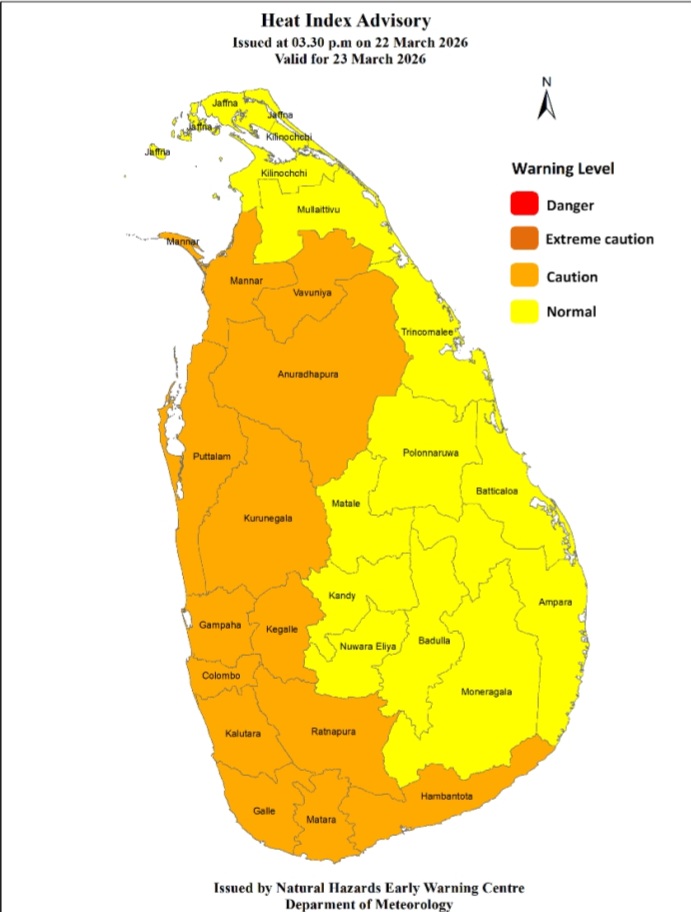
Warm Weather Advisory
Issued by the Natural Hazards Early Warning Centre of the Department of Meteorology
at 3.30 p.m. on 22 March 2026, valid for 23 March 2026.
The Heat index, the temperature felt on human body is likely to increase up to ‘Caution level’ at some places in the Western, Sabaragamuwa, Southern and North-western provinces and in
Anuradhapura, Mannar and Vavuniya districts.
The Heat Index Forecast is calculated by using relative humidity and maximum temperature and this is the condition that is felt on your body. This is not the forecast of maximum temperature. It is generated by the Department of Meteorology for the next day period and prepared by using global numerical weather prediction model data.

Effect of the heat index on human body is mentioned in the above table and it is prepared on the advice of the Ministry of Health and Indigenous Medical Services.
ACTION REQUIRED
Job sites: Stay hydrated and takes breaks in the shade as often as possible.
Indoors: Check up on the elderly and the sick.
Vehicles: Never leave children unattended.
Outdoors: Limit strenuous outdoor activities, find shade and stay hydrated.
Dress: Wear lightweight and white or light-colored clothing.
Note:
In addition, please refer to advisories issued by the Disaster Preparedness & Response Division, Ministry of Health in this regard as well. For further clarifications please contact 011-7446491.

Two killed when Air Canada jet hits fire truck at NYC’s LaGuardia Airport

Bus fares increased by 12.19% from midnight today [23]
Public will not be served as Computer system failure at Department of Registration of Persons

Trump says he is postponing strikes on Iran power plants after ‘productive’ talks on ending war

Asia stocks slide as US and Iran threaten to escalate war

Heat Index at Caution Level in the Western, Sabaragamuwa, Southern and North-western provinces and in Anuradhapura, Mannar and Vavuniya districts

‘Dates have the highest sugar content to fight Coronavirus’

Sunday Island 27 December – Headlines

#SundayIsland 17th December – Headlines

Sunday Island – 28th March

Sunday Island Headlines – 21 March

Sunday Island – 21st February – Headlines
-

 News6 days ago
CIABOC questions Ex-President GR on house for CJ’s maid
-

 News7 days ago
Sri Lankan marine scientist Asha de Vos honoured at UNGA opening
-

 News7 days ago
Australian HC debunks misleading travel risk claims for Sri Lanka
-

 News5 days ago
Bailey Bridge inaugurated at Chilaw
-

 News5 days ago
Pay hike demand: CEB workers climb down from 40 % to 15–20%
-

 News4 days ago
CIABOC tells court Kapila gave Rs 60 mn to MR and Rs. 20 mn to Priyankara
-

 Editorial6 days ago
Couple QR-based quota with odd-even rationing
-

 Features22 hours ago
Trincomalee oil tank farm: An engineering marvel