
Business
Flexibility within limits – the underlying premise driving the NBFI sector

By Niroshan Udage
Council Member of The Finance Houses Association of Sri Lanka
As an integral part of the Country’s financial system, Licensed Finance Companies (LFCs) and registered leasing companies play a vital role in the development of the national economy. Collectively known as the Non-Bank financial (NBFI) sector, they offer a gamut of financial solutions to cater to individuals, proprietors, partnerships, corporates or business conglomerates. Most NBFI’s have also invested in developing an extensive island-wide presence that allows them to reach all sectors, social backgrounds and economic levels. Their ability to serve a wider cross section of the market makes the NBFI sector a key contributor towards the development of the SME and Micro enterprise segment in Sri Lanka. Leveraging on the expertise gained by serving the local SME and Micro segment, a few NBFI’s have even ventured outside Sri Lanka to set up operations overseas.
Regulatory supervision, governance and compliance
Dealing with the SME / Micro segment has resulted in NBFI’s being subject to increasing regulatory controls in the past few years.
As the words ‘Licensed Finance Companies’ denote LFCs are licensed and regulated by the Central Bank of Sri Lanka (CBSL).
LFCs conduct their business in conformity with the provisions of the Finance Business Act No.42 of 2011, Finance Leasing Act No.56 of 2000, Directions, Rules and Guidelines issued the said Acts, Consumer Credit Act, No.29 of 1982, Financial Transactions Reporting Act No.6 of 2006 and Prevention of Money Laundering Act, No.5 of 2006, under the direct supervision of CBSL and other applicable Statutes. Through these Statutes and regulations CBSL regulates the finance business and the finance leasing business to ensure the orderly function of the financial system.
In addition, LFC’s are required to abide by the Corporate Governance Directions issued by the CBSL. This helps to create an environment of trust, transparency and accountability, which is required to foster long-term investment, financial stability and enhance the business integrity of LFCs.
Another Direction noteworthy of mention is the Financial Customer Protection Framework outlined in Finance Business Act Direction No.01 of 2018 and the detailed Guidelines thereon. This direction provides the platform for customers of LFCs to assert their rights and to ensure that their rights are safeguarded. The key objective of the said Direction is to safeguard the interests of the customers and build trust in order to strengthen customer confidence in the sector. Since being introduced in 2018, the Financial Customer Protection Framework has become an integral part of the corporate governance culture and strategic decision making of the Boards of LFCs.
To ensure compliance with the applicable laws and regulations, LFCs have established a very strong and robust Compliance function, which is subject to regular reporting and monitoring by the CBSL.
The Challenge
Despite the stringent business and regulatory environment governing the NBFI’s, it is unfortunate that there is still a segment of the general public who have a negative perception towards the sector. Such unfounded perceptions appear to have arisen primarily due to the lack of awareness regarding the pricing mechanism and the foreclosure process followed by the NBFI sector. The purpose of this article is to provide some much needed clarity on these topics.
The Pricing Mechanism adopted by the NBFI sector
It is no secret that compared to the banking sector, the pricing structure of the NBFI sector for similar products is relatively higher. There are several fundamental reasons for this. Firstly, it is important to understand that the NBFI caters mainly to the SME and Micro segment of the market. Based on their profiles, SME and Micro segment customers fall into the high-risk category.
The typical SME / Micro customer who is often overlooked by the banking system due to their lack of credentials and financial sophistication, is then motivated to approach the NBFI sector with the expectation that their credit applications will be processed expeditiously even without necessary documentary proof or credentials. This puts NBFI’s in a tough spot. On the one hand NBFI’s are expected to be more flexible in their decision making process in order to secure their customer, while on the other hand they need to comply with established risk appetite limits in order to safeguard the business. Amidst this backdrop, the only rational way for NBFI’s to strike a balance is by building in a higher risk premium into their pricing structure. And with SME / Micro customers also likely to be more vulnerable to economic shocks, especially given their position at the lower end of the pyramid, NBFI’s are compelled to factor-in additional risk premiums into their pricing structure. Meanwhile being in the high-risk category, the cost of managing SME / Micro customers is also comparatively higher. From the additional background checks to site visits and managerial oversight to encourage customers to adopt proper financial control and discipline, NBFI’s incur significantly higher operational costs per customer, which leaves these companies with no option but to build cost buffers into their pricing structure.
Another key element that drives up the NBFI’s pricing structure is their high cost of funding. Unlike Banks, which have access to low cost funds through their CASA (Current and Savings Accounts) base, NBFI’s are funded largely by public deposits and often have to pay higher rates in order to attract deposits away from the banking system. On average more than 50% of the total interest costs of NBFI’s go towards servicing deposits. Lowering these cost elements is an extremely difficult task since NBFI’s do not have access to free funds such as current accounts.
Despite these challenges however, some NBFI’s have adopted dynamic pricing strategies in line with their business model and risk appetite, enabling them to offer very competitive rates, often on par with the banks. In this manner, the NBFI sector has remained firm in its commitment to nurture the SME / Micro segment – the “infants” of the economy, to the level of bankable customers, thereby contributing towards improving the Country’s overall credit culture over time.
Regulated foreclosure process
In the interest of protecting the rights of both Lessees and Lessors, NBFI’s follow a highly regulated foreclosure process for the repossession of assets. They cannot deviate from the repossession guidelines set out under the Finance Leasing Act, No.56 of 2000. The Finance Leasing Act was enacted in the year 2000 to provide for the regulation and monitoring of finance leasing businesses, to specify the rights and duties of Lessors and Lessees and suppliers of equipment and for matters connected therewith or incidental thereto. It is mandatory that all NBFI’s strictly adhere to the provisions of the Finance Leasing Act when engaging in the business of leasing.
Accordingly, a repossession notice can be issued only if the installments are in arrears more than the limit of substantial failure. However as directed by the Act, repossession is sought only as the last resort for the recovery of outstanding installments. Repossession orders are issued only after sending reminders, notices and notices of termination to Lessees and Guarantors according to the Act, within the stipulated timelines.
During the period leading up to the issue of a repossession order, NBFI’s are expected to make every endeavor to collect the installments in arrears, by visiting the customer, through telephone calls etc. The Act further states that if the Lessee is genuinely in a difficulty due to an unforeseen event, they are always welcome to visit the respective NBFI and make a formal request for deferment of recovery action. At this point NBFI’s are required to look into every avenue to offer relief to the customer including granting of concessions / deferment, whenever they are warranted.
Meanwhile if the leased property is repossessed, it is disposed of quickly in order to recover the outstanding according to the auction procedure that is laid down in the Act. Once the vehicle is repossessed, the final notice is sent to the Lessee giving a further 14 days for settlement. A newspaper advertisement is published in all 3 languages advertising the sale. At the same time, another letter is sent to the Lessee allowing a further 7 days for settlement of the outstanding. Finally, when the time period lapses, the repossessed vehicle is sold through tender process or at a public auction. Prior to the public auctions another paper advertisement is published which is the end point of the auction procedure.
Conclusion
It is hoped that this article provides some reasonable clarity regarding the framework within which NBFI’s operate, while also helping to alleviate some of the persistent misconceptions that have plagued the sector. Going forward, it is imperative that NBFI’s continue to serve the target market in utmost good faith. It is equally important that all players collaborate with the regulatory authorities to uphold the integrity of the NBFI sector at all times.
The writer is an Executive Director of LB Finance PLC with 30 years of experience in the Finance industry.


Fund says discussions will continue on policies and parameters needed to complete the Seventh Review
By Sanath Nanayakkare
Sri Lanka’s latest talks with the International Monetary Fund (IMF) have concluded without a staff-level agreement on the policies and parameters required to complete the Seventh Review of its Extended Fund Facility (EFF), leaving further discussions ahead as the government prepares its next Budget.
An IMF team led by Mission Chief Evan Papageorgiou visited Sri Lanka from September 10 to 23 for discussions on the Seventh Review and the 2026 Article IV Consultation.
The Fund said the discussions with Sri Lankan authorities had been productive, but would continue in the near term towards reaching agreement on the parameters and policies needed to complete the Seventh Review.
The outcome therefore represents a delay in reaching the formal staff-level milestone rather than a breakdown in negotiations.
The latest mission comes as Sri Lanka moves from economic stabilisation towards longer-term structural transformation, while continuing to face external shocks and domestic fiscal pressures.
The IMF said economic activity expanded by 4.2 percent in the second quarter of 2026, marking the 11th consecutive quarter of growth. At the same time, the Fund cautioned that downside risks remained, particularly amid an uncertain external environment.
Gross official reserves had risen to US$6.9 billion by the end of August, while the banking sector remained well capitalised and profitable, providing some buffers against external pressures.
A major focus of the IMF’s latest assessment was Sri Lanka’s revenue position.
The Fund said developing and implementing a strong medium-term revenue strategy would be critical to sustaining revenue mobilisation and strengthening fiscal resilience.
It stressed the need to broaden the tax base, rationalise tax exemptions and incentives, and strengthen revenue administration and compliance.
The IMF also emphasised the importance of maintaining cost-recovery energy pricing and improving the efficiency and fairness of the tax system in order to reduce fiscal vulnerabilities.
These issues assume particular significance as the government prepares its next Budget, with the authorities seeking to balance revenue mobilisation and fiscal consolidation against the need to sustain economic recovery.
The Fund’s latest position does not indicate that negotiations have broken down. Rather, the IMF has said that discussions will continue towards reaching agreement on the remaining policies and parameters required to conclude the Seventh Review.
The latest talks follow the combined Fifth and Sixth Reviews, for which IMF staff and Sri Lankan authorities reached a staff-level agreement in April, subject to completion of the remaining requirements before consideration by the IMF Executive Board.
For Sri Lanka, the immediate challenge is therefore to preserve the gains made in macroeconomic stabilisation while addressing the remaining issues under the IMF programme and preparing a Budget capable of supporting longer-term fiscal and economic resilience.
With further discussions expected in the near term, the Seventh Review remains a work in progress as Sri Lanka enters another critical stage of its economic reform programme.
Notably, the IMF has yet to publicly specify the outstanding issues that remain to be resolved.
Business
UK digital expertise and Sri Lankan business leaders unite to explore growth through technology

British High Commissioner Andrew Patrick hosted UK digital product consultancy Apadmi at Westminster House, his official residence in Colombo, for an invite-only forum bringing together senior business leaders from across Sri Lanka’s retail, banking, telecommunications, hospitality and public sectors.
The event, “Turning Digital Assets into Growth Engines”, marked Apadmi’s first official event in Sri Lanka since establishing its Colombo office in 2025, and was delivered in partnership with the British High Commission as part of ongoing efforts to strengthen UK and Sri Lanka commercial and technology ties.
Guests were welcomed by High Commissioner Andrew Patrick, followed by a keynote from Niresh Muthuratnanandan, Head of Omni Commerce, Digital & Loyalty at Keells Supermarkets, who spoke about the launch of the Keells Nexus app and the modernisation of a loyalty programme serving 2.9 million members.
A panel discussion followed, hosted by Mark Collin, Chief Growth Officer at Apadmi, and featuring Malik Induruwana, Chief Information Officer at HSBC Sri Lanka & Maldives; Jiffry Zulfer, Founder and CEO of PickMe; Uthpala Pinnaduwahewa of Hatton National Bank; and Marcus Hadfield, Chief Strategy Officer at Apadmi.
The discussion centred on the commercial opportunity created by Sri Lanka’s rapid mobile adoption. According to [source], mobile data usage in the country reached 1.03 million terabytes in Q2 2026, a 31% increase year on year, against 29.4 million mobile subscriptions. With 71% of devices now smartphones or tablets, speakers discussed how Sri Lankan businesses could convert growing digital engagement into customer loyalty, new revenue and operational efficiency.
British High Commissioner Andrew Patrick said:
“It was a pleasure to welcome Apadmi and such a strong group of business leaders to Westminster House for this event. The UK and Sri Lanka have a longstanding partnership, and digital innovation is an increasingly important part of that relationship. Apadmi’s decision to establish a base in Colombo reflects the confidence that UK companies have in Sri Lanka’s digital economy, and I look forward to seeing this partnership continue to grow to the benefit of both our countries.”
Mark Collin, Chief Growth Officer at Apadmi, said:
“Being hosted by the British High Commission was a real privilege, and a fitting way to mark the next stage of our commitment to Sri Lanka. To bring leaders from Keells, HSBC, PickMe and Hatton National Bank into the same room says a great deal about the ambition here. We opened our Colombo office because we believe Sri Lanka is at a genuine turning point; the talent is exceptional, and we are proud to be building here for the long term.”
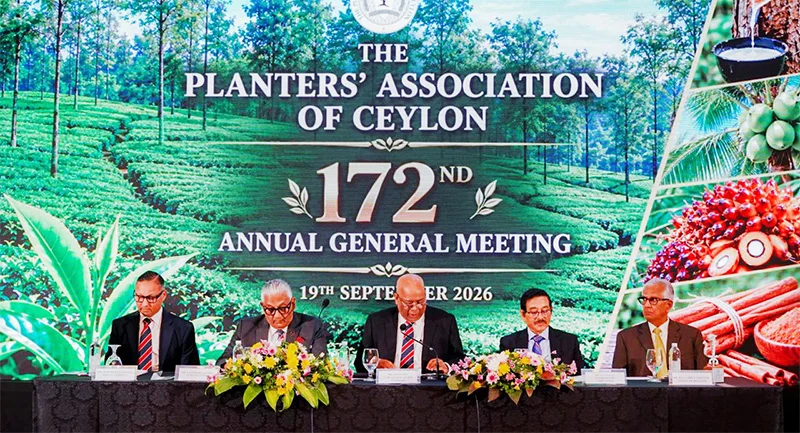
Malwatte Valley Plantations PLC Director / CEO, Shanaka Samaradiwakara was appointed as Chairman of the Planters’ Association of Ceylon (PAC), while Kahawatte Plantations PLC Director / CEO Binesh Pananwala, was appointed as Deputy Chairman at the Association’s 172nd Annual General Meeting (AGM) on 19 September at the Cinnamon Grand.
The event was graced by Central Bank of Sri Lanka Governor, Dr. Nandalal Weerasinghe and Sri Lanka Tea Board Chairman, Raj Obeyesekere as Chief Guest and Guest of Honour respectively.
In his inaugural address, Samaradiwakara outlined a five-point vision for the plantation sector, focusing on value addition, research and development, land-use and productivity, irrigation and long-term security of tenure. He emphasised that the future of commercial agriculture in Sri Lanka would hinge on how effectively all industry stakeholders could work together, while maintaining clear understanding of the ground realities faced by producers.
Value-added tea accounted for more than 50% of total tea export volumes in 2025. Samaradiwakara noted Regional Plantation Companies (RPCs) have accounted for the majority of that volume through continuous investments, including most recently in matcha, green tea and artisanal teas.
In that context, he sought the support of the Sri Lanka Tea Board and the export sector to protect this emerging high value segment, given that significant quantities of green tea and other high-value teas remain unsold at auction while similar products continue to enter the country. “We respectfully request the authorities to review this matter and introduce appropriate measures to support domestic production and value addition,” he stated.
On research and development, he observed that commercially viable alternatives to several essential crop protection products remain limited. Accordingly, he called on the Tea, Rubber and Coconut Research Institutes to lead the development of practical, scientifically proven alternatives, while stressing that disease threatening the rubber industry requires immediate attention. “We cannot afford to repeat the experience of the coffee industry, where coffee blight devastated the sector,” he added.
Turning to issues around land-use policies and productivity, he noted that RPCs have diversified for over two decades in response to changing rainfall patterns, introducing crops such as oil palm, pepper and avocado. He warned that these investments are increasingly threatened by unsupportive policy, agricultural theft and crop damage by wild animals, costing companies millions of rupees each month in security. “It is imperative that these investments are protected through strong enforcement, appropriate regulatory reforms, and effective measures to address both agricultural theft and crop damage,” he noted. On irrigation, he appealed to the Government to relax archaic restrictions on groundwater use and simplify approvals for drilling tube wells in order to enhance climate resilience.
Addressing security of tenure, he highlighted that replanting often takes more than a decade to generate meaningful revenue, and that uncertainty over lease extensions is making it harder for RPCs to attract foreign direct investment and long-term financing. “If we are to attract fresh capital, accelerate replanting, modernise our plantations and improve productivity, security and certainty of tenure are mandatory,” he added.

Showerss above 100 mm are likely at some places in the Western, Sabaragamuwa, Central and North-western provinces and in Galle and Matara Districts

Mirabai Chanu wins Asian Games silver as Ri breaks weightlifting record

Trump greets China’s Xi Jinping on arrival for three-day US

BASL calls for conscience vote on 22nd Amendment

IMF: Sri Lanka on course for 2027 market return

President appoints three new judges to High Court

‘Dates have the highest sugar content to fight Coronavirus’

Sunday Island 27 December – Headlines

#SundayIsland 17th December – Headlines

Sunday Island – 28th March

Sunday Island Headlines – 21 March

Sunday Island – 21st February – Headlines
-

 News5 days ago
Shanakiyan urges urgent action over reported death sentence for Lankan in Saudi Arabia
-

 News6 days ago
Bid for Basil’s extradition nears final stage: Police
-

 News4 days ago
Namal Rajapaksa Buddhist gambit fails, bail denied
-

 Features4 days ago
Why the spelling Sri Lankan names in English vary
-

 Features4 days ago
Three bands, a new identity: Sri Lankan wolf snake recognised as distinct species
-

 Business4 days ago
SLIIT holds largest-ever convocation
-

 News4 days ago
Govt monitors reported Saudi death sentence – Foreign Ministry
-

 Business4 days ago
All-new Bolero MaXX Pik-Up unveiled in Lanka