
News
Five-judge bench of Supreme Court to hear arguments on 9 July

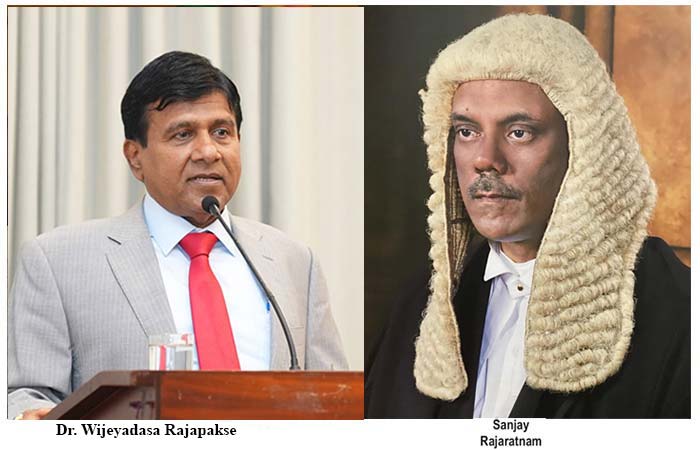
AG’s appeal against granting bail to accused in SLPP MP’s killing:
By Shamindra Ferdinando
Attorney General Sanjay Rajaratnam, PC, has appealed to the Supreme Court against the granting of bail to 41 accused in the killing of Polonnaruwa District SLPP MP Amarakeethi Athukorala and his Personal Security Officer (PSO) Jayantha Gunawardena on 09 May 2022, at Nittambuwa.
The AG’s appeal has been fixed for argument on 09 July, 2024, before a bench comprising five Judges, presided by Justice P. Surasena, the AG’s Department has informed Justice Minister Dr. Wijeyadasa Rajapakse, PC.
The AG’s Department has said so after Minister Rajapakse called for a report in respect of our news report, headlined ‘SLPP MP’s violent death during Aragalaya: Govt should be ashamed of delay in serving justice – Head of National Security Sectoral Oversight Committee‘ published on the front page of The Island edition of April 16.
The Justice Minister has been informed that in spite of strong objections by the AG to release the accused on bail at the time of serving of indictments and to have a day-to-day trial, the Trial-at-Bar released the accused on bail on the grounds that they had been in remand custody for over one year.
The AG has declared that his Department felt aggrieved by the decision of the Trail-at-Bar to release the accused on bail.
MP Atukorale was on his way back home after attending a Temple Trees meeting, chaired by then Prime Minister Mahinda Rajapaksa, when a mob intercepted his car in the Nittambuwa town. The armed police bodyguard was also killed.
According to the AG’s Department, the initial investigations conducted by the Nittambuwa Police and subsequently taken over by the Homicide Unit of the CID during C.D. Wickremeratne’s tenure as the IGP. Having concluded the investigation, the Homicide Unit of the CID has submitted the relevant material to the AG and sought his advice.
Justice Minister Rajapakse told The Island that he immediately sought clarification from the AG after the latest report was brought to his notice.
Having perused the material submitted by the CID, the AG has decided to move for a Trail-at-Bar, according to the note received by the Justice Minister. The AG dispatched the indictment against 41 accused to the High Court of Gampaha before requesting Chief Justice Jayantha Jayasuriya, PC, in terms of 450 (3) of the Criminal Procedure Code on May 09, 2023 to consider appointing a Trial-at-Bar to hear the case.
The Chief Justice has given the go ahead by nominating three High Court Judges, Sahan Mapa Bandara, Rashmi Singappulli and. Ruwan Pathirana to have a Trail-at-Bar sitting at Gampaha.
The indictments which were preferred against the 41 accused contained 14 charges, including two counts of murder, around 350 witnesses and 400 productions.
While the AG’s appeal regarding the bail order is pending before the Supreme Court, the Trail-at-Bar commenced and is in progress, the Justice Minister said, referring to the note he received from the AG. The prosecution has concluded the evidence of two witnesses who had played a key role in the course of the investigations. The Court has been informed that their next witness would be Nuwan Sandagiri, the representative of the Government Analyst’s Department who had done the analysis pertaining to the Fascial Recognition of the accused and the digital evidence.
The High Court trial will resume on April 25, 2024, and will continue on Thursday afternoons and Fridays of every week.














Bus fares have been increased by 12.19% with effect from midnight today [23rd March 2026].
The minimum fare will be increased from Rs 27 to Rs 30 while the maximum fare of Rs2159/- will be increased to 2422/-
Latest News
Public will not be served as Computer system failure at Department of Registration of Persons

The Acting Commissioner General of Registration of Persons has announced that due to an unexpected failure of the computer system of the Department of Registration of Persons, all services, including the one day service will not be held on Tuesday (24th March) at the Head Office and all Provincial offices.

Latest News
Heat Index at Caution Level in the Western, Sabaragamuwa, Southern and North-western provinces and in Anuradhapura, Mannar and Vavuniya districts
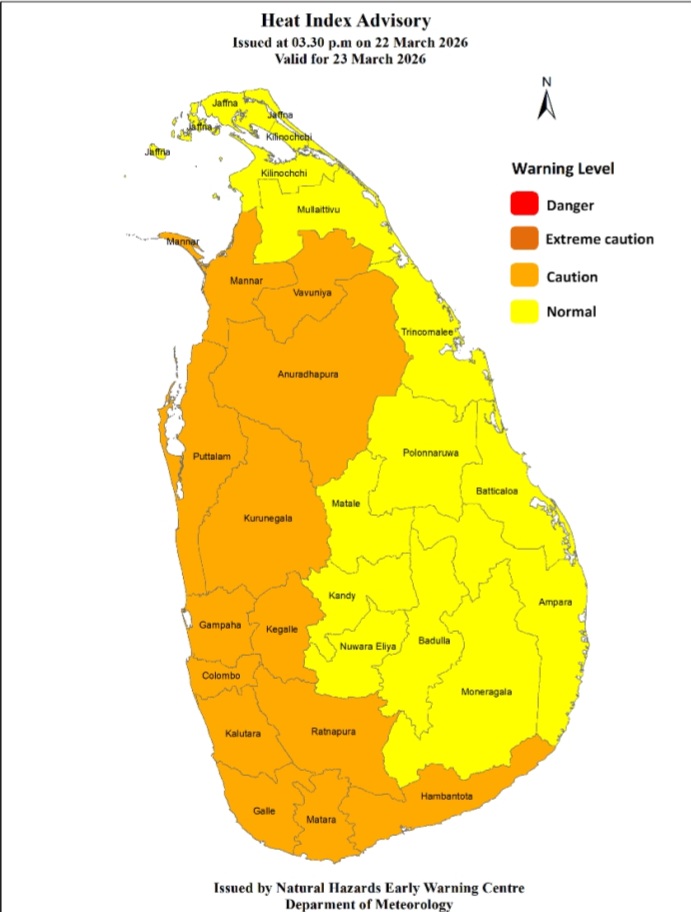
Warm Weather Advisory
Issued by the Natural Hazards Early Warning Centre of the Department of Meteorology
at 3.30 p.m. on 22 March 2026, valid for 23 March 2026.
The Heat index, the temperature felt on human body is likely to increase up to ‘Caution level’ at some places in the Western, Sabaragamuwa, Southern and North-western provinces and in
Anuradhapura, Mannar and Vavuniya districts.
The Heat Index Forecast is calculated by using relative humidity and maximum temperature and this is the condition that is felt on your body. This is not the forecast of maximum temperature. It is generated by the Department of Meteorology for the next day period and prepared by using global numerical weather prediction model data.

Effect of the heat index on human body is mentioned in the above table and it is prepared on the advice of the Ministry of Health and Indigenous Medical Services.
ACTION REQUIRED
Job sites: Stay hydrated and takes breaks in the shade as often as possible.
Indoors: Check up on the elderly and the sick.
Vehicles: Never leave children unattended.
Outdoors: Limit strenuous outdoor activities, find shade and stay hydrated.
Dress: Wear lightweight and white or light-colored clothing.
Note:
In addition, please refer to advisories issued by the Disaster Preparedness & Response Division, Ministry of Health in this regard as well. For further clarifications please contact 011-7446491.

Two killed when Air Canada jet hits fire truck at NYC’s LaGuardia Airport

Bus fares increased by 12.19% from midnight today [23]
Public will not be served as Computer system failure at Department of Registration of Persons

Trump says he is postponing strikes on Iran power plants after ‘productive’ talks on ending war

Asia stocks slide as US and Iran threaten to escalate war

Heat Index at Caution Level in the Western, Sabaragamuwa, Southern and North-western provinces and in Anuradhapura, Mannar and Vavuniya districts

‘Dates have the highest sugar content to fight Coronavirus’

Sunday Island 27 December – Headlines

#SundayIsland 17th December – Headlines

Sunday Island – 28th March

Sunday Island Headlines – 21 March

Sunday Island – 21st February – Headlines
-

 News6 days ago
CIABOC questions Ex-President GR on house for CJ’s maid
-

 News7 days ago
Sri Lankan marine scientist Asha de Vos honoured at UNGA opening
-

 News7 days ago
Australian HC debunks misleading travel risk claims for Sri Lanka
-

 News5 days ago
Bailey Bridge inaugurated at Chilaw
-
 Latest News7 days ago
Wednesdays declared a government holiday with effect from 18th March
-

 News5 days ago
Pay hike demand: CEB workers climb down from 40 % to 15–20%
-

 News4 days ago
CIABOC tells court Kapila gave Rs 60 mn to MR and Rs. 20 mn to Priyankara
-

 Editorial6 days ago
Couple QR-based quota with odd-even rationing