
Business
First Iso 14065 Certification awarded to leading upcycling brand House of Lonali

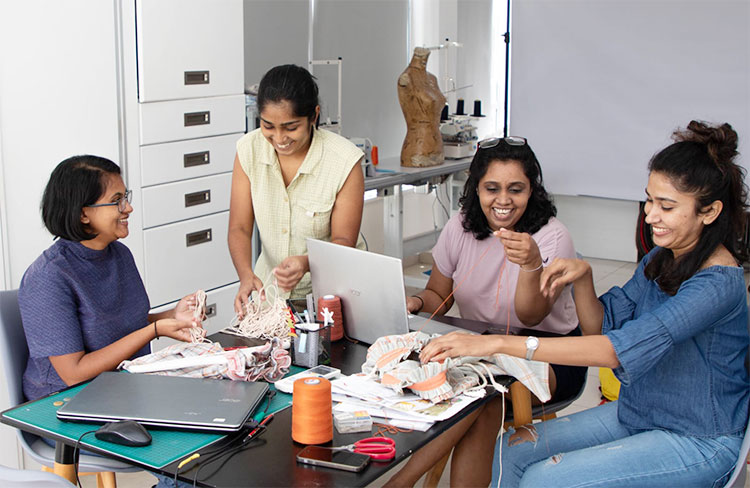
House of Lonali, the pioneering upcycling brand from Sri Lanka specialising in transforming textile and paper waste into uniquely inventive items, has earned Sri Lanka’s first ISO 14065 Certification for their commitment to sustainability. The creative reuse efforts of the business were independently verified and certified by The Sustainable Future Group (SFG) – South Asia’s first Validation and Verification Body (VVB) to be accredited to award ISO 14065:2020 Certification by the International Accreditation Forum (IAF).
House of Lonali retained the expert services of The Climate and Conservation Consortium (CCC) to estimate the amount of Greenhouse Gas (GHG) emissions avoided over 31 years through upcycling pre-consumer fabric waste and recycled paper waste into products instead of using virgin raw material and circumventing standard disposal methods of landfilling and incineration. The emissions savings were calculated as per the requirements for Solid Waste Disposal and Incineration and Open Burning of Waste of the 2006 IPCC Guidelines for National Greenhouse Gas Inventories. Following the assessment, the results were then verified in accordance with the ISO/IEC 17029:2019 and ISO 14065:2020 Standards by SFG – which was also South Asia’s first VVB to be accredited to award ISO 14064-1 & 2 for Organisational and Project-level GHG Reporting and ISO 14067 for Product Carbon Footprinting – through IAF Country Member, The Sri Lanka Accreditation Board.
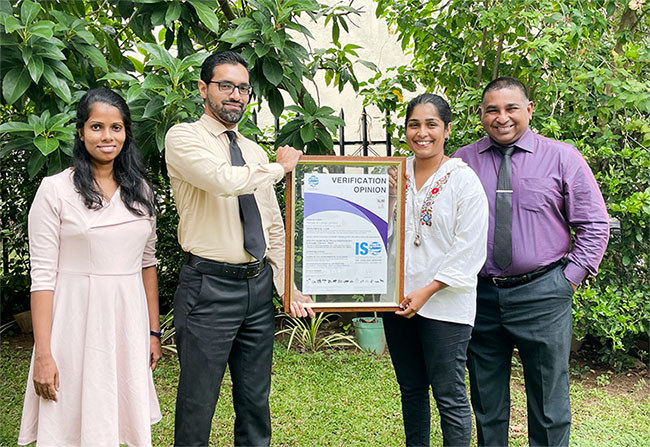
House of Lonali Receiving the ISO 14065 Certificate [from left] Harshini Rananjali, Lead Associate – Sustainability Assurance and Advisory Services, SFG; Sajeewa Ranasinghe, Manager – Sustainability Assurance and Advisory Services, SFG; Lonali Rodrigo, Founder/CEO, House of Lonali; Sanith De Silva Wijeyeratne, CEO, CCC.
Founded in 2012 by ecopreneur Lonali Rodrigo, winner of numerous awards including ‘Ethical Fashion Award’ at the Sri Lanka Design Festival and ‘Sustainable Designer Award’ at the Sri Lanka Apparel and Fashion Awards, House of Lonali designs and crafts creative pieces using mainly fabric waste recovered from apparel manufacturers. With a strong focus on ‘circular design’ at the core of its upcycling-based model, the business strives to generate as little waste as possible from its own production process by ensuring that every single resource is reused, repurposed, and/or remanufactured.
Commenting on their achievement, Founder/CEO of House of Lonali, Lonali Rodrigo stated, “House of Lonali is a conscious lifestyle brand with a big bold vision – “to design a better future”. We are passionate about creating uncompromising fashion and style keeping both people and the planet at heart. It became critical that we should measure our impact in the upcycling process, and by working with The Climate and Conservation Consortium and The Sustainable Future Group, we managed to obtain the ISO 14065 Certification, and this will help amplify our upcycling efforts as it provides proof of our impact. We believe there is unique beauty in every waste item and every flaw, and the little choices we make over time have the potential to change the future for the better.”

Sri Lanka enters the new year confronting a familiar but deepening economic strain, with falling foreign reserves, a weakening rupee, rising public debt and mounting disaster-related losses posing what analysts describe as a decisive test of fiscal discipline and policy coherence.
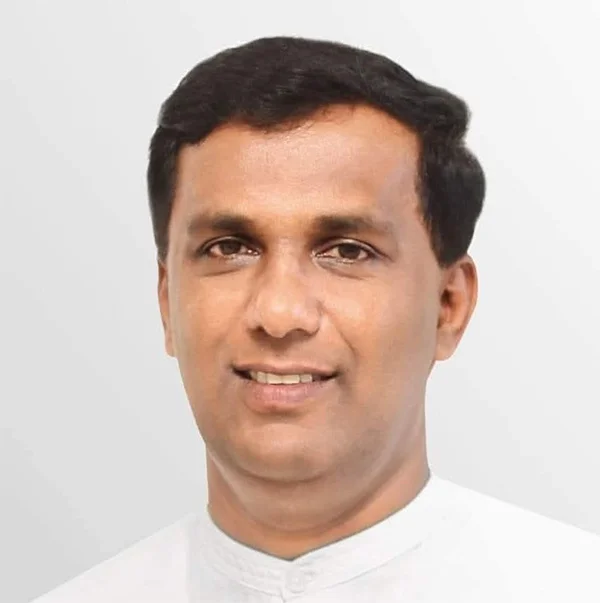
Sri Lanka Human Rights Centre Executive Director and former Provincial Governor Ranjith Keerthi Tennakoon has warned that the country urgently requires a coordinated economic response to prevent further deterioration, particularly as the cost of post-disaster reconstruction threatens to exert fresh pressure on already strained public finances.
“While the government has succeeded in revenue augmentation through heavy taxation and repeated increases in electricity and gas tariffs, its performance in maintaining fiscal discipline remains weak,” Tennakoon said in an economic indicators statement issued on January 5.
According to figures cited by Tennakoon, Sri Lanka’s domestic debt stood at Rs. 17,595.05 billion when President Anura Kumara Dissanayake assumed office. By the end of September 2025, that figure had climbed to Rs. 18,701.46 billion, reflecting an increase of Rs. 1,106.41 billion within a year.
External debt has also trended upward. From Rs. 10,429.04 billion at the end of 2024, foreign debt rose to Rs. 10,974.34 billion by September 2025. As a result, Sri Lanka’s total public debt stock now stands at Rs. 29,675.81 billion, underscoring the scale of the country’s fiscal exposure.
“This trajectory raises serious concerns about long-term debt sustainability,” Tennakoon warned, noting that debt servicing costs will intensify further if currency depreciation continues.
Foreign reserves under pressure
The steady decline in foreign reserves remains one of the most critical challenges facing the economy. Gross official reserves fell from USD 6,531 million in March 2025 to USD 6,033 million by the end of November, a contraction of nearly USD 500 million.
Tennakoon cautioned that upcoming reconstruction needs following widespread floods and landslides will necessitate substantial imports of construction materials, machinery and industrial inputs, inevitably drawing down scarce foreign exchange reserves.
Although Sri Lanka managed to maintain a current account surplus in 2024, the balance slipped back into deficit during September and October 2025, before returning to surplus in November. While a surplus is not required at all times, Tennakoon said the November turnaround offered a “cautious but positive signal” regarding the economy’s direction.
The rupee’s depreciation continues to amplify macroeconomic risks. The exchange rate has weakened from Rs. 293.25 per US dollar last year to around Rs. 309.45, increasing the rupee cost of foreign debt servicing while driving up import and production costs.
More troubling, Tennakoon noted, is the widening gap between commercial bank exchange rates and the informal undiyal (black market) rate, reflecting growing uncertainty and eroding confidence.
“This was precisely how the 2021–2022 economic crisis began — with a widening divergence between official and informal exchange rates,” he warned.
The economic fallout from recent floods and landslides adds another layer of urgency. Tennakoon criticised the government for failing, thus far, to prepare a comprehensive estimate of financial losses and reconstruction costs.
Preliminary assessments by the World Bank estimate disaster-related losses at USD 4 billion, while the International Labour Organization (ILO) places the figure as high as USD 16 billion, equivalent to 16 percent of GDP.
“Massive tax resources will be required for relief payments, while reconstruction will demand substantial foreign exchange for imports,” Tennakoon said, stressing that the government must urgently prepare credible financial assessments to mobilise both domestic and international support.
He also warned that delays in providing adequate relief have already become a serious concern for displaced communities struggling to rebuild their lives.
By Ifham Nizam
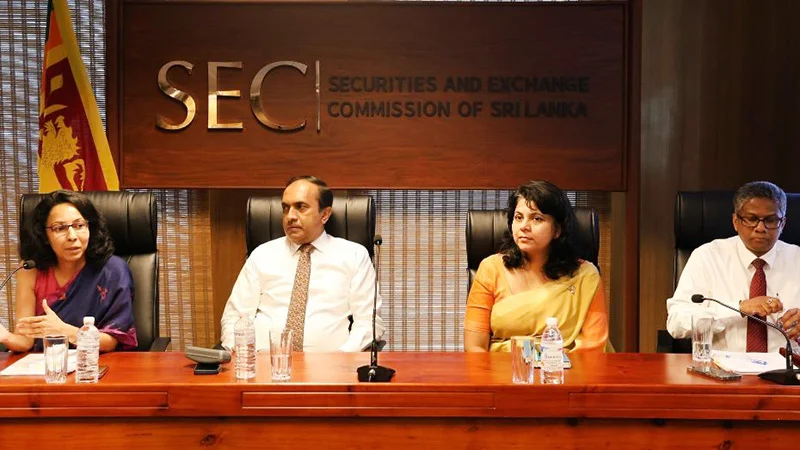
The Securities and Exchange Commission of Sri Lanka (SEC) in collaboration with the Colombo Stock Exchange (CSE) conducted an awareness session for Corporate Finance Advisors focusing on enhancing regulatory compliance and streamlining the listing process.
The forum brought together Corporate Finance Advisors and senior officials from the SEC and CSE to enhance the listing process by addressing regulatory expectations, identifying prevalent shortcomings in applications, and establishing best practices to strengthen investor confidence and market integrity.
Addressing the participants, Senior Prof. D.B.P.H. Dissabandara, Chairman, SEC highlighted the vital role Corporate Finance Advisors play in building market confidence beyond their traditional functions in facilitating listings, mergers, and acquisitions.
“Your screening process, your due diligence supports market confidence directly in addition to your key major roles,” the Chairman stated. “As a regulator, our main job is to look at investor confidence plus investor protection. And indirectly your job facilitates that as well.”
The Chairman emphasized that the overall reputation of the Sri Lankan capital market depends on the professional judgment and performance of Corporate Finance Advisors, as investors make decisions based on their assessments and recommendations.
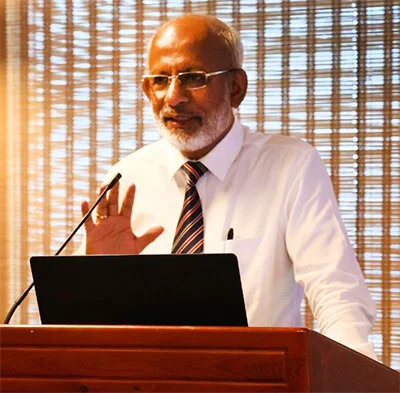
Senior Prof. D.B.P.H. Dissabandara
Reinforcing this message, Mr. Rajeeva Bandaranaike, Chief Executive Officer, CSE emphasized the importance of collaboration in improving market efficiency. “The objective is to completely revamp and improve the overall listing experience for companies and issuers,” he stated. “This is a journey that we need to go together with the community. We cannot do this alone.”
He also noted the complexity of public listings compared to bank financing, explaining that heightened scrutiny is necessary when dealing with public money. “At the end of the day, if the prospectus is not clean and accurate, we’re going to face problems. We don’t want companies going into the watchlist after one or two months of listing.”
Building on this framework, Ms. Kanishka Munasinghe, Vice President, Listing, CSE highlighted critical gaps in recent listing applications, particularly regarding litigation disclosure and legal due diligence. The CSE has expanded its disclosure requirements to cover not just financial impact but also operational continuity and licensing implications.
Business
nVentures leads US $200K seed round into Flash Health to scale cashless outpatient care in Sri Lanka

Flash Health, a Sri Lankan healthtech startup building cashless, on-demand outpatient care, has raised a US $200,000 seed round led by nVentures, with participation from angel investors across Sri Lanka, Singapore, and the United States.
The funding comes as Flash Health expands its footprint across insurers, large employers, and healthcare providers, positioning itself as one of the country’s most widely adopted digital outpatient platforms addressing everyday healthcare needs.
At the core of Flash Health’s offering is Cashless OPD, which allows employees and policyholders to access doctor consultations, medicines, diagnostics, and telemedicine services without paying out of pocket, removing upfront payments and simplifying access to address a long-standing friction point in everyday healthcare across emerging markets. The platform’s approach has also received global recognition, with Cashless OPD winning at the World Summit Awards, an UN-backed platform recognising startups advancing the Sustainable Development Goals, selected from over 900 applications across 143 countries. Commenting on the investment, Chalinda Abeykoon, Managing Partner at nVentures, said, “We first met Arshad and the Flash Health team in late 2023 and were immediately struck by their ethos, attention to detail, and culture of excellence. As we worked with the team to fine-tune their product roadmap and execution, we saw a team that listens, iterates, and delivers. Flash Health is now operating at real scale, which made this a clear investment decision for us.”
Flash Health’s growth has been driven by partnerships with leading insurance providers, including AIA, HNB Assurance, Janashakthi Insurance, and Union Assurance, enabling policyholders to access services such as medicine delivery, home lab testing, telemedicine consultations, and wellness incentives through integrated digital workflows.

Record prize money on offer at Australian Open

ICC to Bangladesh: play in India or forfeit points

Showers will occur at times in the Uva province and in Batticaloa, Ampara, Polonnaruwa, Matale and Hambantota districts

UK and France to send troops to Ukraine if peace deal agreed

Six dead and hundreds of flights cancelled as snow causes chaos across Europe

Prez seeks Harsha’s help to address CC’s concerns over appointment of AG

‘Dates have the highest sugar content to fight Coronavirus’

Sunday Island 27 December – Headlines

#SundayIsland 17th December – Headlines

Sunday Island – 28th March

Sunday Island Headlines – 21 March

Sunday Island – 21st February – Headlines
-
 News1 day ago
Broad support emerges for Faiszer’s sweeping proposals on long- delayed divorce and personal law reforms
-

 News2 days ago
Private airline crew member nabbed with contraband gold
-

 News1 day ago
Interception of SL fishing craft by Seychelles: Trawler owners demand international investigation
-

 News4 days ago
Health Minister sends letter of demand for one billion rupees in damages
-

 Opinion6 days ago
Remembering Douglas Devananda on New Year’s Day 2026
-

 Features2 days ago
Pharmaceuticals, deaths, and work ethics
-
 News1 day ago
US raid on Venezuela violation of UN Charter and intl. law: Govt.
-

 Features1 day ago
Educational reforms under the NPP government