
Features
First Five years of Right to Information regime in Sri Lanka: In retrospect

Mahinda Gammampila
Former Chairman Right to Information Commission
The Right to Information Commission completed its first five year term on Sept. 30, 2021. This article attempts to summarize some of the key achievements of the Commission during this period, in its contribution towards the realization of the goals and aspirations of the legislators of the Right to Information Act No. of 2016.
A Culture of Transparency and Accountability
By introducing the primary law on RTI, the Parliament of Sri Lanka demonstrated its aspirations to foster a culture of transparency and accountability in public authorities by giving effect to the right of access to information and thereby promoting a society in which the people of Sri Lanka would be able to more fully participate in public life through combating corruption and promoting accountability and good governance. The RTI Commission which has been established under the RTI Act with the power to hear and determine appeals made by citizens on their right to information requests among other matters. The Commission can declare rules and regulations relating to the process; recommend disciplinary action against those who violate these provisions and to take legal action against persons violating the Act.
Guidelines and Performance Monitoring
All government and government related agencies have been identified as Public Authorities for the purposes of the RTI Law. The RTI Commission is basically responsible to provide guidelines to public authorities in the course of implementation of the RTI law, while monitoring their permanence.
RTI Commission, on its part has been instrumental in the formulation and publication of a set of Rules that specifies the procedures to be followed in the implementation of the law, along with the Fee Schedules relating to the services provided by the public authorizes.
On the other hand, the Right to Information Commission, being the oversight body in the implementation of the RTI law, is responsible for monitoring the performance of public authorities and ensuring the due compliance by them of the duties cast on them by the Act. The Act empowers the Commission to inquire into the appeals made by the citizens who are aggrieved by the decisions of the Information Officers and Designated Officers of public authorities. The citizens who are not satisfied with the determinations of the Commission have the right to appeal to the Court of Appeal.
Hearing of Appeals (Adjudication)
The hearing of appeals is the core function of the Commission. Hearing of appeals however faced many challenges due to the lockdowns and travel restrictions imposed to prevent COVID-19 pandemic. The Commission had to resort to documentary proceedings, in the absence of the physical presence of the parties. Where it was extremely necessary to hear views of the parties, the Commission used telephone or online meetings/inquiries through Zoom technology. Commission also attempted to resolve cases through consultation with public authorities in accordance with the policy of maximum disclosure of information.
As the workload of the Commission increased and its functions expanded, the Commission had to face huge administrative issues and challenges in managing its day-to-day affairs with limited human and physical resources. In the absence of competent staff to support the appeal hearing process and drafting of orders, it had to continue its practice of employing newly passed-out law graduates on temporary and assignment basis, till recently.
For the five year period from October 2016 to August 2021, the Commission received around 3,000 appeals from citizens and more than 70% of them were concluded. This is a remarkable achievement for any Administrative Appeal body where all cases are disposed of following due process of law and procedure and the principles of natural justice, particularly granting the appellant (citizen) and the public authority equal opportunity to defend themselves. The above assertion is further confirmed by the fact that a very few appeals have been made to the Court of Appeal against the orders of the Commission.
In the process of adjudication, a citizen-friendly procedure was adapted to the extent possible which is characterized by less formalities enabling the lay appellants to present the case without being pressurized. However, this principle could not be maintained when parties were represented by lawyers resembling court procedures
Public Awareness and Training for Officials
It is often observed that the citizens from all walk of life and all corners of the county who have not been satisfied with the responses of the respective Information Officers and Designated Officers of relevant public authorities have come to the Commission seeking redress. Once a sarong-clad bare bodied member of the Vedda community appeared before the Commission with the traditional axe hanging from his shoulder along with a group of citizens in the adjoining village on an issue of public interest in their area of living. However it may be noted that this example does not suggest that the RTI message has penetrated into all parts of the country equitably. There are many areas yet to be reached.
The Commission has been able to overcome the problems of human and physical resources that it faced due to financial constraints since its inception, to a great extent with the continuous support of the development agencies such as the World Bank, UNDP, USAID/SDGAP and the Embassy of Switzerland. Their technical and financial support was instrumental in obtaining services of competent persons and undertaking outreach programmes. As such, the Commission was able to continue its programmes for the enhancement of public awareness from 2017 to 2021 at District and Divisional levels.
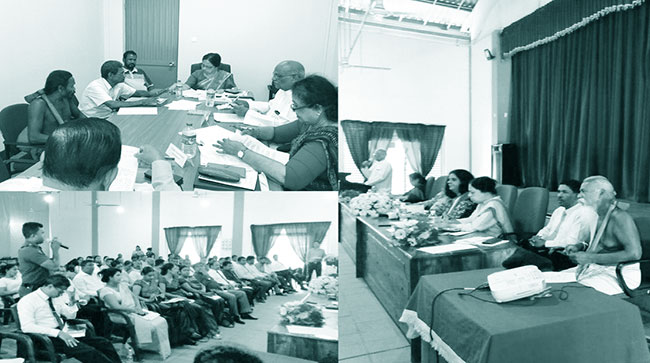
The Commission has made substantial efforts towards increasing public awareness among Civil Society Organisations, Community based Organisations and public officials on right to information. With the support of the Embassy of Switzerland, the Commission held advocacy workshops in Panama (Ampara), Ambagamuwa (Nuwara Eliya), Sooriyawewa (Hambantota), Kilinochchi. Jaffna, Karuwalagaswewa (Puttalam), Mahiyangana (Badulla), Kantale (Triancomalee), Nawalapitiya (Kandy), Nuwara Eliya and Matara
The participation of civil society activists at these workshops was encouraging. At the Mahiyangana workshop, the ‘Varige Nayaka” (chief) of ‘Vedda’ community Uruwarige Wannila Eththo addressed the gathering consisting of civil society representatives as well as the senior government officials, placing several valuable \suggestions for the expansion of the RTI movement. At Nawalapitiya Workshop many representatives from the workers in the plantation sector and the executives of the plantation companies attended
Uruwarige Wannila Eththo, the Chief of the Vedda community took part at the Mahinyangana workshop and a member of that Community attending an appeal inquiry at the Commission in Colombo.
Proactive Disclosure of Information and Record Management Guidelines
Promotion of Proactive Disclosure of Information policy and the provision of Record Management Guidelines to public authorities are two other important tasks entrusted to the Commission by the RTI Act.
A total of 2,280 public officials belonging to 15 state institutes working at the head offices in Colombo and the outstations were given a training on implementation of Proactive Disclosure Policy and Record Management Guidelines in terms of RTI Act. There was a great demand for a comprehensive training from the senior management. The participants themselves found both the record management and proactive disclosure, under the RTI Act were challenging tasks. Of the trained 2,280, a third was from head offices in Colombo and two thirds from all nine provinces participated in these training programs.
In both these areas a survey was carried out by the RTI Commission, with the technical support of the UNDP. Its thematic focus was the involvement of the RTIC with public authorities of the state sector, organized into different types such as ministries, departments, authorities, boards, district secretariats etc. to promote implementation of proactive disclosure policy and the record management guidelines within 15 public institutions. The Commission formulated sixteen (16) broad areas of information that should, at minimum be disclosed pro-actively by public authorities.
RTI Act directs to catalogue and index all records to facilitate the access of information to citizen while directing public authorities to keep all new records for 12 years and records that existed on February 3, 2017 for 10 years. With the assistance of the UNDP, a set of Guidelines for Record Management in public authorities was developed. These Guidelines also facilitate disclosure of information proactively by public authorities. This set of guidelines can be considered a major outcome of the consultancy project.
Research Publications
With the support of the Swiss Government two publications were released in all three languages. These are (i) Reflections on Sri Lankas RTI Act and RTI Regime, a collection of academic analyses on RTI by eminent writers and (ii) Selected Orders of the RTI Commission on decided cases by the Commission which could be used as a reference guide by practitioners of RTI.
Research Collaborations
With the collaboration of the Swiss Government two programs were held with the University of Colombo and the University of Kelaniya for the encouragement of legal and social research on RTI among postgraduate students and academic staff.
Measuring Contribution of RTI Orders to Development in terms of UN Sustainable Development Goals (SDGS)
An independent Research was undertaken on the performance of the RTI functions, under the Swiss project, where appeals received by the RTI Commission were categorised according to UN Sustainable Development Goals. Findings included the impact of Commission interventions among various segments in the socio-economic profile. The SDGs are a collection of 17 interlinked global goals designed to achieve a better and sustainable development by all by the year 2030.
The pies-chart below indicates that a very significant 38% of appeals belong to areas falling under SDG No 16, i.e. just, peaceful, and inclusive society and institutional transparency goal; 15% of appeals belong to areas falling under Goal No 15 i.e. Agriculture and Land and while 13% of appeals belong to areas falling under Goal No 9 i.e. Infrastructure & construction.
Support of Non-Governmental Organization (NGOS), Community Based Organizations (CBOS) and Mass Media.
In the course of the preceding five years, the support provided by various NGOs and CBOs has been of immense use for the fulfillment of the responsibilities of the Commission. The cooperation extended by such organizations and representations made by them include (a) awareness creation among the citizens of the legitimate of right the citizens possess to ask for information (b) providing advice and assistance to individual citizen in making formal information requests or related appeals to the respective authorities, and (c) even appearing at times on behalf of the citizens before public authorities and the commission in support of such representations. In addition, the findings of some of the independent surreys carried out at the field level by several organizations have been very useful.
Similarly, the role-played by media personnel, not only at the national level, but also in the provinces in the promoting of the RTI movement in numerous ways needs to be highlighted.
The cooperation extended to the Commission by media in general, and the media organizations such as the Sri Lanka Press Institute, the Editors Guild and others in particular, has been a source of strength.
International Relations
The Commission throughout the period has been closely following the trends and developments taking place in the global arena of Right to Information, and also working in cooperation with the regional and international organizations for the enhancement of the needs of our county.
In this respect, it is worth noting here that Sri Lanka has been ranked fourth among 123 countries by having earned 131 points (out of 150) in the global right to information rating (RTI Rating) in consideration of Sri Lanka’s legislative framework in relation to transparency and access to information, among other things.
A Framework for Future Strategies
Though there are still delays at the stage of information release, we are confident that the culture of information denial that has long been prevalent in Sri Lanka, is changing positively. We are inspired by the vigour with which the RTI Act has been used, from information release on infrastructure, better health facilities and environment protection to matters of state accountability at the highest levels of the Government.
This shows that the Right to Information is vital to the democratic system and that enforcing the transparency of state and non-state actors directly impact in reducing corruption. Citizen have become part of the governance process and themselves proactively monitor the management of affairs of state. The Commission’s mandate is the realization of principles enshrined in the preamble to the RTI Act i.e ‘to promote a society in which the people of Sri Lanka would be more fully able to participate in public life.’
As an independent Commission acting in the public interest, in which confidence is reposed by both information seekers and the Public Authorities, the Commission has endeavored to carry out that task to the best of its ability. Sri Lanka demonstrates the enormous value of an RTI law working for the benefit of the public when the public itself is given a role to play in that process.
As we advance in the Right to Information process, it is of the highest importance that the information empowerment of the citizenry through the RTI regime, consisting of the constitutional Right to Information (Article 14A), the RTI Act and an independent RTI Commission as guaranteed by law, continue for the sake of democratic values of society.


“They must foster the abiding values of freedom of thought and expression, respect and tolerance for viewpoint difference …”
Address recently delivered by Professor Savitri Goonesekere,
former Vice-Chancellor and emeritus Professor of Law of the university of Colombo,
at the establishment of the Prof. G.L. Peiris Trust for Legal Education and Research.
Thank you, Professor Peiris, for inviting me to speak this evening at an event to announce the endowment that is being made to the University of Colombo and the Sri Lanka Law College as the G. L. Peiris Trust for Legal Education and Research.
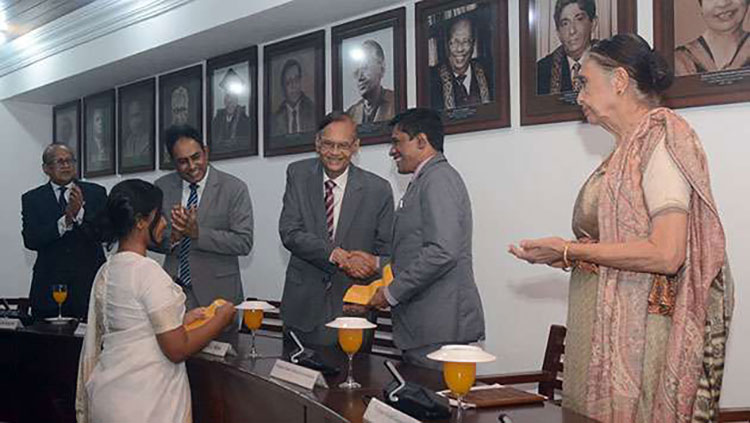
You and I have walked the corridors of this beautiful building as Vice Chancellors of this university. The walls of the Senate Room carry our portraits, but do not reflect the experiences that we have had in that capacity. We worked in this institution and chaired Senates and Councils. These fora were places that gave us an opportunity to respect viewpoint differences that were shared in an environment of collegiate connectivity, often in challenging times, when violence in armed conflict was a lived experience for all Sri Lankans.
This is also an occasion to share with this audience a day in this building when you had to confront the horror of the assassination of your predecessor, Professor Stanley Wijesundere, just across from your office. This was summary justice by the then JVP for taking decisions in academic bodies of the university in medical education. I was at the time Dean of the Faculty of Humanities and Social Sciences at the Open University in Nawala. Yet we connected across Universities, supported each other to cope with those dark times. You, as Vice-Chancellor of this University, and my Vice-Chancellor, the late Professor Dayantha Wijesekere, collaborated to network and respond to violence against staff and students from non-state and state actors. University Teachers for Human Rights was born at this time with the support of both Vice-Chancellors.
Some years later, as I walked up the stairs of College House, on what I expected to be a routine day, a colleague ran down that staircase to say that a former student and cherished friend, Dr. Neelan Tiruchelvam, had just been assassinated. Devastated as I felt, I had no inhibitions in speaking later at his funeral, in what had been a political assassination. I did not have to ask for permission from the University Council to do so.
Today, freedom of thought and speech in academic institutions is being challenged in the United States and our own country in restrictive norms on governance of public institutions. These events of the past and that history are an eloquent reminder that Universities, as centres of learning, must not be politicised. Rather, they must foster the abiding values of freedom of thought and expression, respect and tolerance for viewpoint difference, and bring that voice to both University fora and the public domain. In those times, professors and law teachers did not have to explain to Vice-Chancellors and Deans why they expressed views within and outside Universities on issues of public concern.
Today is a day to also recall Professor Peiris’s own scholarship in the area of public law and particularly on freedom of speech and expression that preceded the dramatically different career path he chose to take. That scholarship will now be available to generations of law students, teachers and lawyers, as well as others, hopefully inspiring an understanding and reflection on fundamental legal principles and concepts that can contribute to the wellbeing and sustainable development of a nation.
The literature and your scholarship that will be shared through the G.L. Peiris Trust will also hopefully be a reminder that “one must know the law as it is, to comment on what it should be”. For your early scholarship is very much in the tradition of analytical positivism that you and I were immersed in as students of the one and only Law Department in Peradeniya and later in this university. We pulled what are called “all-nighters”, as students and teachers, reading in our rooms or in that wonderful library in Peradeniya, referring cases, statutes, Grotius and Voet, the jurists of Civil Law, and of course the great Common Law and Civil Law scholars like Ivor Jennings, H. L. A. Hart, and R.W. Lee.
Professor Peiris, as you all know, came into the University with a stellar record from that institution near the Indian Ocean, where, (as loyal Royalists would have it), scholar students were not the norm. Coming into a University with a scholar’s record does not necessarily translate to a stellar University career. Professor Peiris, with his prodigious capacity for academic work, clarity of thought and writing, thrived in that new learning and teaching environment. He made history in the Law Department, winning every scholarship awarded and graduating at that time with the much prized first-class honours degree. I myself was a young law teacher at the time, and recall that it was impossible to grade GL’s papers with any grade but an A. The length of those contributions, of course, required exhausting attention, and I think taught his teachers to learn how to read carefully. My young grandchildren cannot read a long email from me today without missing a lot of its content!
The G. L. Peiris Trust will provide readers with a rich range of literature on a phenomenal diversity of laws in this country, with comparative jurisprudence from Civil and Common Law countries. If the Rule of Law in a democracy is to be maintained and strengthened, we must reflect on the fact that analytical positivist scholarship is not irrelevant in our times. It is that University tradition that was nurtured in the early post-independence and post-colonial era in Sri Lanka and Civil and Common Law countries that created the foundation for the great later jurisprudence in our own courts and in India. This is especially evident in important areas of public law, including constitutional law and human rights. Justices like A. R. B. Amerasinghe and Mark Fernando and lawyers like Mr. H.L.de Silva and my late husband, R. K. W. Goonesekere, were all alumni connected to this University. Their contribution to jurisprudence and legal reform in this country was nurtured in halls of learning that recognised that we must learn the law as it is, to understand what it ought to be. Professor Peiris himself demonstrates that heritage in his later work on public law and in contributing with another distinguished alumnus, the late Neelan Tiruchelvam, to the draft Constitution of 2000. I hope that the G. L. Peiris Trust will also include papers relating to that work, the best draft Constitution to date, abandoned in what has now become the norm of adversarial politics.
The long overdue institutional connection between university academia and the Law College that is made through the G .L. Peiris Trust is welcome. The Principal of the Law College, Prasantha Lal de Alwis, PC, an alumnus of our Law Faculty, has given leadership in creating a new path that must benefit both institutions.
In my time, students and teachers did not connect outside the halls of learning in later life as Sirs/Madams in perpetuity. They became and interacted as colleagues. As a former teacher, colleague, and Vice-Chancellor of this University, thank you, GL, for this generous endowment. May it be a valued institutional legacy that will inspire commitment to, and understanding of, the Rule of Law in a country that will always be a Democracy.

By Ifham Nizam
They are everywhere, yet most of us hardly notice them. In the corner of a garden, beneath a leaf, across a paddy field, inside a forest or quietly occupying an old tree, spiders are constantly at work.
They may be tiny enough to escape the human eye or large enough to command attention, but beneath their often-misunderstood appearance lies an ecological workforce that performs one of nature’s most important jobs.
They hunt
And in doing so, spiders help keep insect populations under control, strengthen food webs and contribute to the delicate ecological balance upon which both natural ecosystems and agriculture depend.
For Sri Lanka, a country celebrated for its extraordinary biodiversity and high degree of endemism, the world of spiders is particularly fascinating. Yet it remains one of the lesser-known chapters of the island’s natural history.
Field biologist and researcher Dr. Ranil Nanayakkara has spent years helping to open that chapter.
His work on Sri Lanka’s spiders, including the spectacular tiger spiders of the genus Poecilotheria, has demonstrated that there is much more to these creatures than the fear and suspicion with which they are often regarded.
Nanayakkara has been involved in the description and documentation of several remarkable Sri Lankan tarantulas, including Poecilotheria rajaei and Poecilotheria srilankensis, as well as Chilobrachys jonitriantisvansickleae. His research has also taken him into the less-studied corners of Sri Lanka’s biodiversity.
His approach is significant because the story of Sri Lanka’s spiders is not simply a story about unusual or frightening creatures. It is a story about ecosystems.
Nature’s pest controllers
A spider sitting motionless in a web may appear inactive, but its ecological role can be anything but passive.
Spiders are predators, feeding predominantly on insects and other arthropods. Across an agricultural landscape, this makes them natural allies of farmers.
Moths, beetles, flies, grasshoppers, leafhoppers, planthoppers and many other insects become part of the prey base of different spider species.
Some spiders wait patiently in intricately constructed webs. Others actively hunt across leaves, vegetation and the soil surface. Jumping spiders stalk their prey with remarkable precision, while wolf spiders move across the ground rather than depending on webs to capture food.
Different species therefore occupy different ecological niches.
Together, they form an army of natural predators.
This is why the presence of spiders in a paddy field or vegetable plot should not automatically be interpreted as something undesirable. On the contrary, their presence may be an indication that a functioning predator community is at work.
Nanayakkara’s own publication, An Introduction to Common Spiders of Sri Lanka, was designed partly to introduce the public and research community to these frequently overlooked animals.
The book covers spider morphology, natural history and Sri Lankan spider families, while highlighting their importance as biological control agents and bioindicators.
-

- Genus -Sason
-

- Chilobrachy jonitriantisvansickelei
The invisible service
There is an important ecological service taking place every day that does not appear on an agricultural balance sheet.
A spider catches an insect.
Then another.
And another.
Multiply that interaction by thousands of spiders across thousands of hectares and the ecological significance becomes enormous.
Unlike a pesticide, a spider does not need to be manufactured, transported, mixed or sprayed. It does not require a farmer to purchase another container or return to the field with a spray machine.
It simply performs its ecological role.
That does not mean spiders can replace all forms of pest management. Rather, they can form one component of integrated pest management, in which natural predators, parasites, cultural practices and carefully targeted interventions work together.
The objective should not necessarily be to create an agricultural landscape in which every insect disappears.
It should be to create one in which pest populations are kept below damaging levels through a functioning ecological system.
When pesticides kill the allies
This is where the story takes a darker turn.
Broad-spectrum insecticides are designed to kill insects, but the ecological world does not always recognise the distinction between a farmer’s target species and a beneficial predator.
When chemicals are applied indiscriminately, spiders and other predatory arthropods can also be affected.
The consequences can be surprisingly complex.
A pesticide application may reduce a crop pest rapidly. But if it simultaneously reduces the predators that feed on that pest, the field may lose part of its natural defence system.
As surviving pest populations recover, farmers may again reach for the sprayer.
The result can become a vicious circle: fewer natural predators, greater reliance on chemicals and repeated disruption of the ecological relationships that once helped regulate pest populations.
Pesticides can also move beyond the field through runoff, spray drift and other pathways, potentially affecting surrounding vegetation, wetlands and waterways.
The real cost of chemical-intensive agriculture, therefore, cannot always be measured simply by the price of a bottle of pesticide.
There can be an ecological cost that remains invisible.
A paddy field is more than a crop
Sri Lanka’s paddy fields are often viewed through the lens of production: acreage, yield, irrigation, fertiliser and harvest.
But look more closely and another world emerges.
Between the rice plants are insects. In the water are aquatic organisms. Along the bunds are grasses and other vegetation. Amphibians move through the landscape. Birds forage. Reptiles pass through.
Microorganisms work beneath the surface.
And somewhere among the vegetation, spiders wait.
The paddy field is therefore not simply a food-production unit. It is an ecosystem.
Field margins, bunds, grasses and neighbouring vegetation can provide shelter and alternative habitat for spiders and other beneficial organisms. Maintaining this ecological complexity can help predator populations persist and recolonise cultivated areas.

Poecilotheria sp.
Destroying those refuges or exposing them repeatedly to chemicals can simplify the ecosystem and weaken its natural resilience.
The spectacular world of tiger spiders
If ordinary garden spiders are largely invisible to the public, Sri Lanka’s tarantulas are impossible to ignore.
The genus Poecilotheria, commonly known as tiger spiders or ornamental tarantulas, includes some of the island’s most spectacular arachnids.
Their intricate patterns, extraordinary size and specialised lifestyles have made them subjects of scientific fascination.
Nanayakkara’s work brought international attention to this hidden world.
One of the best-known examples is Poecilotheria rajaei, a tarantula described from northern Sri Lanka after specimens were encountered during field surveys. The species was formally described in 2012 by Ranil Nanayakkara and co-authors.
The story illustrates something important about biodiversity research: discovery does not necessarily begin in a sophisticated laboratory.
Sometimes it begins in a forest.
Sometimes it begins with a local observation.
And sometimes it begins when a field researcher is willing to look closely at something that most people would rather avoid.
Another remarkable chapter came with Poecilotheria srilankensis, described from Belihuloya in 2019. The research documented another arboreal tarantula from Sri Lanka and added to understanding of the island’s highly distinctive Poecilotheria fauna.
Nanayakkara and his collaborators have also documented Chilobrachys jonitriantisvansickleae, a tarantula associated with a fragmented forest patch in Sri Lanka’s wet zone.

Poecilotheria smithi
These discoveries are not merely additions to a scientific list.
Each species raises questions.
Where does it live?
What does it eat?
How large is its population?
What habitat does it require?
How isolated are its populations?
What happens when its forest disappears?
The blue surprise in the forest
Perhaps nothing illustrates the richness of this hidden world better than the discovery of a striking blue tarantula in Sri Lanka’s rainforests.
The species, Chilobrachys jonitriantisvansickleae, was found in an isolated patch of southwestern rainforest surrounded by tea and rubber plantations. Its vivid blue colouring helped attract attention to an animal living in a highly fragmented landscape.
It is an important reminder that biodiversity does not always survive in vast wildernesses.
Sometimes it survives in small fragments.
And when a species is closely associated with a particular habitat, the destruction of even a relatively small area can have disproportionate consequences.
Beyond fear
One of Nanayakkara’s important contributions has been to make spiders accessible to people who may otherwise never look beyond their reputation.
His books, including An Introduction to Common Spiders of Sri Lanka and Poecilotheria – “Tiger Spiders” of Sri Lanka, have helped bring information about these animals to a wider audience. His Tiger Spiders of Sri Lanka focuses on the identification, habitats, behaviour and conservation of Poecilotheria.
The challenge is not simply scientific.
It is cultural.
For generations, spiders have often been associated with fear, danger and something that should immediately be killed.
But understanding changes attitudes.
Once a spider is seen as a predator rather than a pest, its role begins to look different.
Once a tarantula is understood as a specialised inhabitant of a particular forest habitat, destroying that habitat becomes a conservation issue rather than merely a matter of removing an unpleasant creature.
Small predators, enormous consequences
Spiders are also prey.
Birds, amphibians, reptiles and other animals depend on arthropods as part of their diets. Spiders consequently occupy several positions in food webs: they are predators of insects and, in turn, food for other animals.
Their disappearance can therefore create effects that travel through an ecosystem.
This is why biodiversity conservation cannot focus exclusively on elephants, leopards, birds or other charismatic wildlife.
The ecological machinery of a forest is also made up of creatures that are small, obscure and rarely photographed.
Some may never make the headlines.
But remove enough of them and the system changes.
A call to look closer
Sri Lanka still has much to learn about its spiders.
Taxonomy remains fundamental. Before conservationists can determine how a species is faring, they need to know what species exist, where they occur and how they differ from one another.
Field research is equally important because many species cannot be understood simply by examining specimens in collections.
Their habitats, behaviour, prey, reproduction and relationships with other organisms all matter.
Nanayakkara’s research illustrates the value of this patient field-based approach. His work has contributed to the documentation of Sri Lanka’s lesser-known biodiversity and to the scientific understanding of spiders that had previously received little attention.
But perhaps the larger lesson is even simpler.
Nature does not waste species.
The spider spinning a web beside a paddy field, the hunter moving through the undergrowth and the spectacular tarantula hidden in a forest tree are all pieces of a much larger ecological puzzle.
Protect the predators
Conserving spiders does not mean protecting every individual spider from every natural threat.
It means protecting the ecosystems that allow spider populations to survive.
It means reducing unnecessary pesticide use.
It means encouraging integrated pest management.
It means maintaining vegetation around agricultural fields, protecting forest fragments and conserving wetlands and streams.
It means giving farmers the knowledge to recognise that some of the creatures living among their crops are not enemies at all.
They are allies.
For Sri Lanka, there is another urgent reason to look more closely.
The island’s biodiversity is exceptional, but its habitats are increasingly fragmented and altered. The loss of specialised habitat can be particularly serious for species with narrow ecological requirements.
The work of researchers such as Dr. Ranil Nanayakkara reminds us that discovery and conservation are inseparable.
We cannot protect what we do not know.
And we cannot appreciate what we have never learned to see.
The next time a spider appears in a garden, on a paddy bund or quietly beneath a leaf, perhaps it deserves something more than a broom or a spray can.
It may be doing what nature designed it to do—hunting, regulating and maintaining balance.
For millions of years, spiders have been doing this work without asking for recognition.
Perhaps it is time we gave them some.
When we protect the predators, we protect the balance.

 Israeli Prime Minister Benjamin Netanyahu’s message to Israel’s enemies was blunt and stark.‘We’re going to win; we have no choice.’ He said so while the majority of attendees at a recent UN General Assembly session walked out of the conference hall when the Israeli Prime Minister took the podium; many of them booing in derision.
Those commentators who have been studying Israel’s handling of her enemy states over the decades are unlikely to dismiss the entirety of Netanyahu’s address as rhetoric. The general pattern has been for the Israeli state to stand up firmly against its enemies in the battle field. On most occasions, these adversaries have been beaten back.
It is also little realized in particularly the Southern hemisphere that Israel, for the most part, could defend herself without much US assistance. The history of the conflict bears this out.
However, from the viewpoint of working towards a just and equitable peace in the Middle East the Israeli hard line stance has proved and will prove incalculably detrimental. The sworn enemies of Israel are not going to be in any way deterred by Netanyahu’s stark warnings. On the other hand, they would be only further provoked into taking on Israel by conventional or unconventional military means and seek its destruction.
The recent aborted mid-air hijacking of a Flydubai flight, consisting mainly of Israeli passengers, by an Omani extremist drives home the point. Israel’s enemies are bound to redouble their efforts to annihilate Israel rather than be deterred by the latter’s warnings about standing firm against them. This too history has proved.
It would be in the fitness of things at this juncture to pay a tribute to the professionalism, courage and humanity of the relevant airline pilot, Captain Machchhar, whose timely action proved decisive in botching the hijack attempt. His intervention averted what could very well have been another 9/11 type tragedy. History is not going to forget his daring and resourcefulness.
Meanwhile, the ground realities in West Asia are undergoing further complications that portend increasing regional instability. For example at the time of writing Turkiye, Pakistan and Saudi Arabia have agreed under the recently established ‘Mecca Alliance for Defence’ to deploy ‘deterrence measures’ collectively in the event of any member of the alliance coming under military strikes from a non-member state.
The agreement is modeled on the NATO collective defence pact and should help in defusing any threat perceptions experienced by the alliance members in the short term. However, the group would need to be cognizant of the major and potentially divisive role Iran could play in the interstate politics of the Middle East region going forward.
Iran’s reported support, for example, for Yemen’s Houthi rebels, who are engaged in attacking Saudi national assets, could at some point in time compel the alliance, under the terms of the pact, to initiate deterrent military measures against Iran.
The implications for regional peace from such a turn of events hardly require elaboration. A full blown regional war emerges as a distinct possibility if Iran sees itself as being excessively antagonized by the alliance. A further complication is that antagonistic sectarian identities of an Islamic kind could come to play hugely divisive roles in it. Shiite Islamic states would be inclined to back Iran while those countries seen as Sunni Islamic in orientation are bound to support Saudi Arabia.
Accordingly, West Asia is a region rife with manifold aggravated insecurities. If the latter are not defused dexterously they could escalate into a conflict of extra regional dimensions. The latter development would render the world a collective loser.
Unfortunately, no constructive help could be expected from the US at this juncture by way of working towards regional and international peace even of short durance. Its war against Iran has only aggravated the world’s current insecurities.
For example, the world has been compelled to face the possibility of compounded economic woes as a consequence of the Hormuz crisis remaining unresolved. The world is currently experiencing what could be seen as a ‘winter of economic discontent’ of unprecedented proportions.
Unfortunately, the international community is to all intents and purposes helpless in the face of this multifaceted crisis. Substantial intervention is expected of the UN but since it has failed to reform itself over the years it is compelled to stand idly by while the world’s insecurities heighten and multiply.
Yet, it is the seemingly paralyzed UN system that has some potential to contain the current tide of international disorder to even a small measure. Given the persisting divergent and conflicting interests among the world’s principal power blocs, the G7 and BRICS for instance, it is mainly the UN and its principal agencies that could carry some credibility as peace brokers and mediators.
However, as an initial step towards bringing the principal protagonists to the negotiating table the UN would need to convince the principal powers of the UN Security Council of the need for a substantive broad-basing of the membership of the Council so as to reflect more accurately the current global political and economic realities. Such reforms would render the Council more representative and help in strengthening its credibility and effectiveness.
The above reforms call for years of dynamism, hard work and resourcefulness on the part of the international community, read the UN. Yet the aims are not impossible to achieve if strong leadership is brought to bear by the UN.
Meanwhile, the UN agencies and allied organizations need to pay stepped-up attention to the West Asian theatre and its wasting conflicts and wars. Here too there is immense hard work to be put in.
There is, for instance, identity politics and its issues that need to be managed urgently. While internal political matters of countries could not be addressed directly by UN agencies, awareness-raising programs and projects could be energetically carried out by them to blunt the appeal of identity-based slogans, relating to, for instance, religion and race.
Besides, values at the heart of democratic politics need to be freshly and enthusiastically propagated. Vast reserves of energy and resources are needed, to be sure, to consistently champion and implement these crucial projects but they need to be pursued single-mindedly if even a dent is to be made in the current runaway global disorder.
The aborted hijacking of the Flydubai flight pointed to the dehumanizing impact of identity politics on the human consciousness. It was also an indication that those sections endowed with humanity cannot stand idly by while identity politics continues to destroy civilizational values. The time to act is ‘now’.

Showers or thundershowers will occur in most part of the island after 1.00 p.m.

Removing monk’s robes matter for Sangha to decide: Mahanayake Theras

NDB fraud Rs 60mn more than reported

President orders review of laws on treatment of imprisoned monks

BHC, Colombo: “LTTE remains a proscribed org. in the UK”

Sri Lanka runs out of essential anti-TB medicines, India comes to rescue

‘Dates have the highest sugar content to fight Coronavirus’

Sunday Island 27 December – Headlines

#SundayIsland 17th December – Headlines

Sunday Island – 28th March

Sunday Island Headlines – 21 March

Sunday Island – 21st February – Headlines
-

 Features5 days ago
The first woman in the foreign service or Ceylon Overseas Service it was then called
-

 Editorial6 days ago
Fuelling discontent and protest
-

 News4 days ago
Geneva takes up Sallay’s case and govt. ignores opportunity to answer accusations
-

 Foreign News6 days ago
Ten injured after car crashes into rugby supporters in Australia
-

 Latest News6 days ago
Tharindu Rathnayake, bowlers secure Asian Games Bronze for Sri Lanka
-

 News5 days ago
Nearly 20 Iranian tankers stranded off Lanka amid US sanctions
-

 Features4 days ago
Sri Lanka Cricket Bill: Governance reform is not yet a cricket strategy
-

 News5 days ago
Lanka enters new phase of prosecutions as hurdles clear