
Opinion
Firewood cooking and its effects on human health

By Professor O.A.Ileperuma, Emeritus Professor, University of Peradeniya)
Former Minister Sarath Weerasekera has recently stated in Parliament that using firewood instead of LP gas would increase a person’s life expectancy. According to Weerasekera, the life expectancy of women living in countries that use firewood for cooking is far higher than that of the people in developed countries who use new and clean energy for their cooking. This is far from the truth and contradicts all scientific findings on the ill-effects of firewood cooking. Increase in Life expectancy in Sri Lanka is due to other reasons such as better healthcare provided free of charge and the increased educational levels. According to WHO statistics 8 million people die every year due to breathing dirty air and out of which 4.3 million deaths can be attributed to indoor air pollution, particularly cooking with firewood and other types of biomass such as cow dung or even coal, in congested kitchens. In India, a scientific study has revealed that 50% of the ill health in mothers and 35% of the illnesses of children is due to kitchen smoke. Children are affected since they spend more time with mothers rather than fathers who normally spend their time outside the kitchen. Diseases like pneumonia, bronchitis, asthma and other pulmonary diseases are quite common among these two categories.
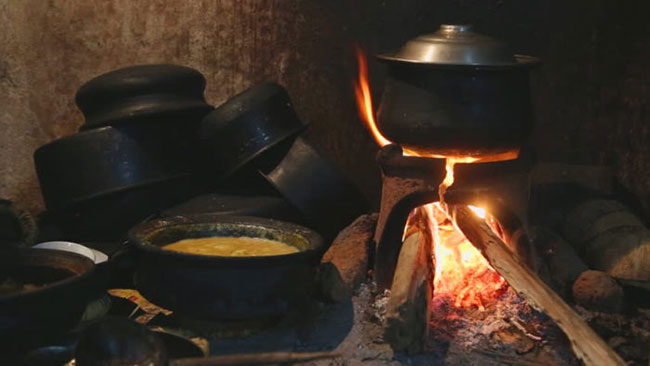
In Sri Lanka, with the current shortage of cooking gas, people are increasingly shifting to firewood for cooking. Even before this scenario, firewood is the fuel used for cooking in nearly 70% of the households. Now, even urban dwellers have to resort to using firewood and very often this is carried out in congested kitchens without adequate ventilation. What is important is not to stop using firewood but to take adequate precautions against its adverse effects.
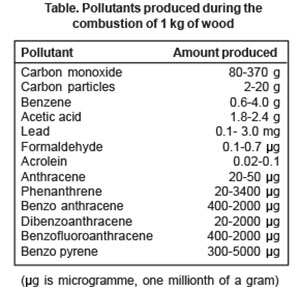
Around 370 chemicals have been identified from wood smoke and the following Table gives some of the pollutants in wood smoke.
See Table
Carbon monoxide causes headaches because it reduces the supply of oxygen to the brain and compounds such as acetic acid, formaldehyde and acrolein cause eye irritation creating tears. Both of these are common symptoms experienced by people in the short term during firewood cooking. Through years of exposure, our mothers who spend a lot of time in indoor kitchens may develop lung cancer due to the toxic aromatic hydrocarbons such as anthracene, benzopyrene etc. Lung cancer is prevalent in heavy cigarette smokers and it is a pity that those who do cooking at home get the equivalent of nearly 100 cigarattes during one bout of cooking!
Fine particles of carbon in the form of black smoke is the most dangerous air pollutant. What is most toxic are the fine particles which cannot be seen with the naked eye since these can penetrate into the air sacs of the lung. Natural reaction of coughing is to eliminate the larger particles while the smaller particles of carbon often having adsorbed aromatic compounds can damage the protective alveolar lining of the lung. This can result in caancer causing chemcials to enter the blood stream. It also exposes the lung tissues to attack by various viruses and bacteria causing all types of lung diseases such a bronchitis and chronic obstructive pulmonary disease (COPD).
How can people survive in these difficult times where it becomes imperative to use firewood? What is needed is that people should be properly educated about the dangers of using firewood and to take adequate precuations during cooking. People should be encouraged to cook in an outdoor open kitchen which helps to disperse the pollutants instead of an enclosed kitchen indoors. In some countries such as India and China, coal is used for cooking inside cramped kitchens. A positive correlation between lung cancer and coal cooking has been reported from the Xuan Wei county in China.
In addition to firewood a common source of fine particles in our homes is burning mosquito coils and incense sticks. Mosquito coils are used by two billion people worldwide and 12 billion coils are used every year. The composition of a typical mosquito coil has pyrethroids, coal dust/coconut husk, binders and resins. Burning one mosquito coil produces enough fine particles which we call PM2.5 (particles smaller than 2.5 microns, a micron is one millionth of a metre) as 100 cigarettes and as much hydrocarbons produced by 50 cigarettes. Burning incense sticks inside homes is also unhealthy as they produce a lot of fine particles and also polyaromatic hydrocarbons, benzene, and CO.
Life expectancy of females in Sri Lanka is 80.3 years and there are at least 60 countries with a higher life expectancy than Sri Lanka using cleaner fuel. Countries in South Asia who have similar cooking habits have much lower life expectancies: Bangladesh (74.9), Bhutan (72.5), Nepal (72.5), India (71.2) and Pakistan (67.3). What is needed is not to stop using firewood but to use it safely to avoid adverse health effects and also get educated on the proper use of firewood.


If there exists a print media personality who does not receive the due recognition and appreciation he rightfully deserves, it undoubtedly is ‘Jeffrey’ of The Island newspaper. The works of many a journalist have been frequently highlighted and appreciated but the capabilities and efficiency of personnel of the calibre of ‘Jeffrey ‘ are, more or less, taken for granted.
In every sphere of life, professional or occupational, there are people who function, not necessarily from behind the scenes, but nevertheless perform an equally efficient service, which in all probability goes unnoticed.
To be frank, even before reading the headlines of the Newspaper, as is customary now, my eyes seek for the Cartoon of the day. Indeed, a sight for sore eyes each morning, the lovable ‘Jeffrey’ makes my day.
Suffice to say that a ‘Good Job done man’ type of occasional pat on the back, to a person who puts his very soul into his work, would touch the only place where it matters the most – his heart. If a smile could work wonders, then how much further would a word of appreciation go.
‘Jeffrey ‘ has, time and again through his cartoons, aptly proven his innovative and creative skills to present factual depiction of current affairs, both local and global. His drawing pen effortlessly covers all boundaries, irrespective of whatever nature. On a previous occasion, too, I have openly commended his abilities, finding it difficult to fathom how he could convey pertinent incidents, normally requiring hundreds of words to express, with a single drawing.
To all intents and purposes, ‘Jeffrey ‘ ranks much higher and could be considered as a rare find when compared with the numerous others actively engaged in this particular field of professionalism.
In ‘Jeffrey ‘, The Island newspaper indeed has a Cartoonist par excellence!
Jeffrey, more power to your elbow!
WILLIAM PHILLIPSZ

Scientists at Stanford Medicine have reported a discovery that could change how arthritis and joint damage are treated. In experiments on animals and human tissue, researchers found that blocking a protein linked to aging can restore worn cartilage in the knee and prevent arthritis after injury. The treatment works not by adding stem cells, but by reprogramming existing cartilage cells to behave in a more youthful way.
In aging mice, an injectable drug rebuilt knee cartilage that normally thins with age. In mice with knee injuries similar to anterior cruciate ligament tears, the same treatment prevented the onset of arthritis, a condition that often follows such injuries in humans. A pill form of the drug is already being tested in early clinical trials for age-related muscle weakness, raising hopes that a similar approach could one day be used for joints.
Human knee cartilage removed during joint replacement surgery also responded to the treatment. When exposed to the drug in the laboratory, the tissue began forming new cartilage that resembled healthy, functional joint cartilage. These findings suggest that cartilage lost to aging or arthritis might eventually be restored through injections into the joint or even oral medication, potentially reducing the need for knee and hip replacements.
Osteoarthritis affects about one in five adults in the United States and costs tens of billions of dollars annually in direct health care spending. Despite its prevalence, there is no drug that can stop or reverse the disease. Current treatment focuses on pain relief, physical therapy and, in advanced cases, joint replacement surgery.
The new therapy targets a protein known as 15-PGDH, which increases in the body with age. The research team classifies it as a gerozyme, a type of enzyme that contributes to the gradual decline of tissue function over time. Previous work from the same group showed that rising levels of 15-PGDH weaken muscles with age. Blocking the protein restored muscle strength and endurance in older mice, while forcing young mice to produce it caused muscle loss.
Unlike muscle, bone or blood, cartilage does not rely on stem cells to repair itself. Instead, cartilage cells called chondrocytes can change their gene activity. By inhibiting 15-PGDH, researchers found that these cells reverted to a more youthful state and began producing healthy cartilage again.
“This is a new way of regenerating adult tissue, and it has significant clinical promise for treating arthritis due to aging or injury,” said Helen Blau, professor of microbiology and immunology at Stanford and a senior author of the study.
There are three main types of cartilage in the body. Elastic cartilage forms flexible structures like the outer ear. Fibrocartilage is tough and shock absorbing, found between spinal vertebrae. Hyaline cartilage, also called articular cartilage, is smooth and glossy and allows joints such as the knees, hips and shoulders to move with minimal friction. Osteoarthritis mainly affects this last type.
The disease develops when joints are stressed by aging, injury or excess weight. Chondrocytes begin releasing inflammatory molecules and breaking down collagen, the main structural protein of cartilage. As collagen is lost, cartilage thins and softens, leading to pain, swelling and stiffness. Articular cartilage rarely regenerates on its own, and attempts to find stem cells capable of rebuilding it have largely failed.
In the new study, researchers compared knee cartilage from young and old mice and found that levels of 15-PGDH roughly doubled with age. When older mice were treated with a drug that blocks the protein, either throughout the body or directly in the joint, their knee cartilage thickened and regained function. Importantly, the new tissue was true hyaline cartilage rather than weaker fibrocartilage.
The results were equally striking in injured joints. In mice with ligament injuries, repeated injections over four weeks sharply reduced the likelihood of developing arthritis. Untreated animals showed high levels of 15-PGDH and developed arthritis within weeks. Treated animals moved more normally and placed more weight on the injured limb.
Detailed analysis showed that the treatment shifted the balance of cartilage cells. Cells associated with inflammation and cartilage breakdown became less common, while cells responsible for producing healthy joint cartilage increased markedly. This change occurred without the involvement of stem cells.
When human osteoarthritic cartilage was treated in the laboratory for one week, similar changes were observed. Levels of harmful gene activity fell, and signs of cartilage regeneration appeared.
The findings are encouraging but still early. While safety trials of a 15-PGDH inhibitor for muscle weakness have shown promising results, clinical trials focused on cartilage regeneration have yet to begin. Even so, researchers are optimistic.
“Imagine regrowing existing cartilage and avoiding joint replacement,” Blau said. For millions living with joint pain and stiffness, that possibility now seems closer than ever.

The RTI Commission has now confirmed what many suspected — although the RTI Act grants it independence to recruit staff, this authority is rendered toothless because the Treasury controls the purse strings. The Commission is left operating with inadequate manpower, limiting its institutional growth even as it struggles to meet rising public demand for information.
This raises an uncomfortable question: if the Treasury can repeatedly allocate billions to loss-making State-Owned Enterprises — some of which continue to hemorrhage public funds without reform — why is adequate funding for the RTI Commission treated as optional?
Strengthening transparency is not a luxury. It is the foundation of good governance. Every rupee spent on effective oversight helps prevent many more rupees being wasted through inefficiency, misuse, or opaque decision-making.
In such a context, can one really fault those who argue that restricting the Commission’s resources conveniently limits disclosures that may prove politically inconvenient? Whether deliberate or not, the outcome is the same: weaker accountability, reduced public scrutiny, and a system where opacity is easier than openness.
If the government is serious about reform, it must start by funding the institutions that keep it honest. Investing in RTI is not an expense — it is a safeguard for the public purse and the public trust.
A Concerned Citizen – Moratuwa

Record prize money on offer at Australian Open

ICC to Bangladesh: play in India or forfeit points

Showers will occur at times in the Uva province and in Batticaloa, Ampara, Polonnaruwa, Matale and Hambantota districts

UK and France to send troops to Ukraine if peace deal agreed

Six dead and hundreds of flights cancelled as snow causes chaos across Europe

Prez seeks Harsha’s help to address CC’s concerns over appointment of AG

‘Dates have the highest sugar content to fight Coronavirus’

Sunday Island 27 December – Headlines

#SundayIsland 17th December – Headlines

Sunday Island – 28th March

Sunday Island Headlines – 21 March

Sunday Island – 21st February – Headlines
-

 News1 day ago
Broad support emerges for Faiszer’s sweeping proposals on long- delayed divorce and personal law reforms
-

 News2 days ago
Private airline crew member nabbed with contraband gold
-

 News1 day ago
Interception of SL fishing craft by Seychelles: Trawler owners demand international investigation
-

 News4 days ago
Health Minister sends letter of demand for one billion rupees in damages
-

 Opinion6 days ago
Remembering Douglas Devananda on New Year’s Day 2026
-

 Features2 days ago
Pharmaceuticals, deaths, and work ethics
-

 News1 day ago
US raid on Venezuela violation of UN Charter and intl. law: Govt.
-

 Features1 day ago
Educational reforms under the NPP government