
News
Ampara District special Coordination Committee meeting chaired by the President

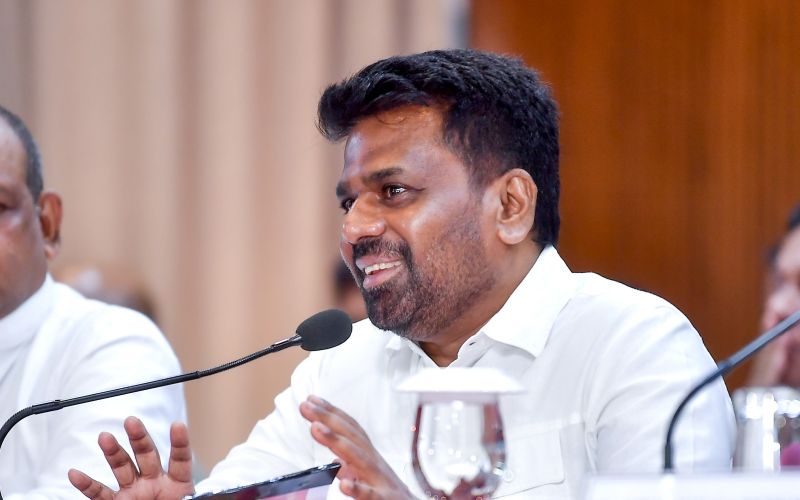
President Anura Kumara Dissanayake stated that a Special Committee, headed by the Deputy Inspector General of Police, will be established to protect lands in the Eastern Province.
The President highlighted that a number of issues have arisen in the region due to land grabs carried out through the misuse of political power, stressing that such practices will no longer be tolerated.
The President made these remarks while participating at the Special District Coordination Committee meeting in Ampara held on Friday (22) afternoon at the Ampara District Secretariat.
Drawing attention to coastal erosion affecting the Eastern coastline, the President instructed officials to develop a comprehensive plan to both protect the coastline and promote tourism in the region.
The President further noted that placing rocks and barriers is not a practical long-term solution to coastal erosion and instructed that urgent scientific studies be conducted to identify a sustainable and permanent solution, including consideration of the Oluvil Harbour and associated fisheries infrastructure.
Highlighting the tourism potential of the Eastern coastal belt, the President also stated that he had received reports of unequal treatment by public officials in the management of hotel operations in coastal areas and firmly instructed that such discrimination must not be allowed.
The President drew special attention to unauthorised land reclamation taking place in the Eastern Province and instructed the security forces to ensure that such activities are not permitted in the future.
Noting that 16 years have passed since the end of the conflict without a structured programme to resettle displaced persons in the region, the President instructed that urgent attention be given to developing and implementing a resettlement plan.
President Dissanayake further drew attention to the recurring flooding caused by the overflow of the Gal Oya, which affects several Divisional Secretariat areas including Ampara, Sammanthurai, Karaitivu, Addalachchenai, Kalmunai, Akkaraipattu, Irakkamam, Damana and Ninthavur. The President directed officials to conduct an urgent study to identify a permanent solution and confirmed that initial funding would be allocated for this purpose.
Discussions were also held regarding the current status of the Thirukkovil paddy storage facility and the continuation of operations at the Addalachchenai waste recycling centre.
Discussions were also held on the conservation of the Nuwaragala archaeological reserve and the development of tourism zones in Arugam Bay and Panama. Attention was further given to implementing a tourism development project in and around the Maduru Oya reserve, based on the indigenous villages in Henanigala South, Dehiattakandiya.
The committee also discussed restarting a drinking water project in the Lahugala area, which was initiated by the National Water Supply and Drainage Board approximately five years ago.
The President also paid special attention to the issues faced by sugarcane farmers in Hingurana. He noted that safeguarding sugarcane farmers within the industry is the responsibility of the relevant companies and stressed the need to engage in discussions on the emerging issues and reach an expedited solution.
Under the Kalmunai Urban Development Project, attention was drawn to the consolidation of all government institutions currently located in different places within the Kalmunai area into a single location. The President instructed officials to prepare and submit the relevant plans, noting that funding could be allocated in the forthcoming budget.
Discussions were also held on taking over and developing land with commercial value that had been allocated by the Sri Lanka Mahaweli Authority more than five years ago but where projects had not been implemented. The President directed that such lands be transferred to Divisional Secretaries or the District Secretary and developed under a structured programme for public benefit.
Discussions were also held on taking over and developing roads in the areas of Dehiattakandiya, Maha Oya and Padiyathalawa under the Road Development Authority and the Provincial Road Development Authority.
Special attention was also drawn to teacher vacancies in schools in the Ampara District and issues related to zonal education offices. The President emphasised that the establishment of administrative structures such as education offices and divisional secretariats is not a political exercise but an administrative function. He further stressed that such structures should be based on objective criteria such as geographical size and population, rather than ethnic considerations.
The President noted that LKR. 22,000 million has been allocated in the 2026 Budget for development projects in the Ampara District. Reviewing progress in ongoing projects in the sectors of roads, irrigation, drinking water supply and housing, he stressed that it is the responsibility of public officials to ensure that these funds are efficiently utilised within the relevant financial year to deliver timely benefits to the public.
The President also separately reviewed compensation and relief measures for the people of the Ampara District affected by Cyclone Ditwah, including compensation for loss of life, crop damage and losses in the livestock sector, as well as programmes for the fishing community, livelihood development initiatives and progress on partial and full housing damage compensation and resettlement programmes.
The President emphasised that the most affected by this disaster are economically vulnerable communities and therefore urged that housing construction and resettlement programmes be expedited without delay.
Co-Chairs of the Ampara District Coordinating Committee, Eastern Province Governor Professor Jayantha Lal Ratnasekera, Deputy Minister of Rural Development, Social Security and Community Empowerment, Wasantha Piyathissa, Members of Parliament, local authority Chairpersons and other public representatives, along with the Chief of Presidential Staff and Commissioner General of Essential Services, Prabath Chandrakeerthi, Defence Secretary Air Vice Marshal Sampath Thuyacontha (Retired), Ampara District Secretary Anupa Mangala Wickramarachchi and other government officials were present at the meeting.
(PMD)

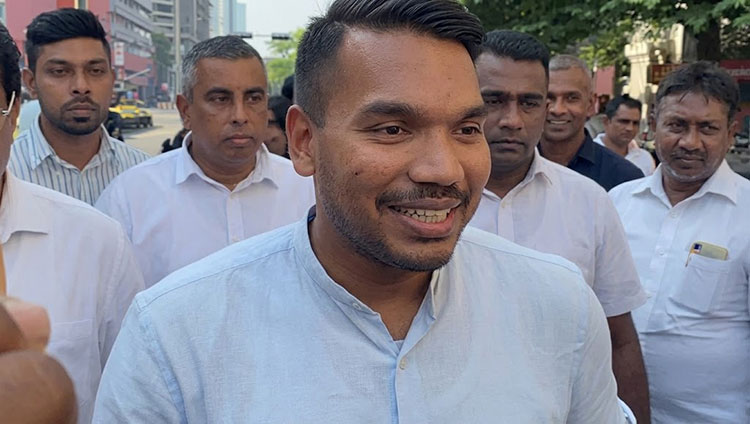
Sri Lanka Podujana Peramuna (SLPP) Member of Parliament Namal Rajapaksa has been arrested by the Commission to Investigate Allegations of Bribery or Corruption (CIABOC).
Namal Rajapaksa had been summoned by CIABOC to provide a statement in connection with investigations into the controversial Airbus deal. He was subsequently arrested by CIABOC after recording his statement for over 5 hours.
Latest News
Sun directly overhead Nittambuwa, Algama, Malwana, Aranayake, Meegahakiula and Panamkadu about 12.09 noon today (04)

The sun is going to be directly over the latitudes of Sri Lanka from 28th of August to 07th of September due to its apparent southward relative motion.
The nearest places of Sri Lanka over which the sun is overhead today (04) are Nittambuwa, Algama, Malwana, Aranayake, Meegahakiula and Panamkadu about 12.09 noon.

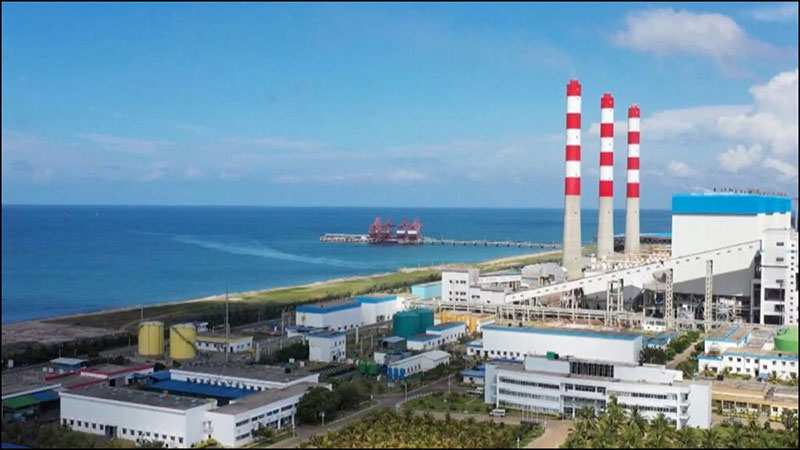
Plant’s output cut from 270 MW to 140 MW amidst dwindling stocks; energy analysts warn system remains “at a razor’s edge”
By Ifham Nizam
The Norochcholai coal-fired power plant is now digging into the last dredges of its coal stock, with two operational units forced to slash generation from around 270 MW to just 140 MW on Sunday as the plant ran critically short of fuel, according to independent energy analysts and sources familiar with the National System Operator (NSO).
The sudden reduction of approximately 130 MW in coal generation has once again exposed the fragile state of the country’s power supply arrangements, with the plant understood to have coal stocks sufficient only until Friday night.
“This is not how a coal plant is expected to operate. They are digging up the last dredges of coal from the plant,” an independent energy analyst told The Island.
The analyst questioned why the units had been allowed to reach this stage without earlier intervention, arguing that at least one unit should have been deloaded around 10 days ago to conserve the remaining coal.
Had that been done, the analyst said, the country could also have reduced its dependence on more expensive diesel-fired generation during the period when
coal stocks were being conserved.
The latest NSO generation figures highlight the continuing pressure on the system.
Around 7 p.m. on Sunday, when the night peak was reached, total demand stood at 2,552.7 MW. Coal contributed only 282 MW, while major hydro accounted for 1,215.8 MW and thermal-oil generation for 791.9 MW.
The night peak of 2,552.7 MW was substantially higher than the daytime peak of 2,246 MW, according to the NSO Generation Summary for August 30.
The most immediate concern is the remaining coal stock at Norochcholai.
Sources said the plant has coal only to Friday night, making the timing of the next shipment critical.
The first shipment under the emergency arrangement is expected to arrive on Friday, September 4, but the coal unloading will have to begin on the same day if
the power plant is to continue operating without further significant deloading.
That creates another potential vulnerability, with rough sea conditions posing an additional challenge to unloading operations.
Energy sector sources said that even the arrival of the September 4 shipment would not completely eliminate the danger.
The next shipment under the new coal tender would need to commence unloading around September 15. Any significant delay beyond that could again force the Norochcholai units to operate at reduced output.
“We are still at a razor’s edge”
The independent energy analyst said the situation should not be viewed merely as a question of whether a particular vessel arrives on time.
The situation also means that any further reduction in coal generation could have a direct impact on the use of oil-fired power generation, potentially increasing the cost of electricity generation.
The latest NSO figures already show the important role being played by thermal-oil generation during the evening peak, when demand rises sharply.
The analyst questioned the rationale behind allowing the coal units to continue operating at higher loading until stocks reached critically low levels instead of taking measures earlier to stretch the available inventory.

SLPP MP Namal Rajapaksa arrested by CIABOC

Devapathiraja clinch U15 Division I title with 33-run win over Royal

Mandhana’s record ton powers India into semi-finals

Sun directly overhead Nittambuwa, Algama, Malwana, Aranayake, Meegahakiula and Panamkadu about 12.09 noon today (04)

Showers expected in the Uva, Central and Eastern provinces and in Polonnaruwa and Mullaittivu districts after 2.00 p.m

Norochcholai digs into dwindling coal stocks, two units slash generation

‘Dates have the highest sugar content to fight Coronavirus’

Sunday Island 27 December – Headlines

#SundayIsland 17th December – Headlines

Sunday Island – 28th March

Sunday Island Headlines – 21 March

Sunday Island – 21st February – Headlines
-

 Features5 days ago
“Wrap Me Up in My Blazer”— A Gentlemanly Bradby Reminiscence
-

 Features4 days ago
When Sri Lankan stories find their own voice
-
 Features5 days ago
JVP/NPP government as seen from outside by Lionel Bopage now domiciled in Australia
-

 News4 days ago
BASL takes exception to Justice Ganepola being denied a place in SC
-

 Editorial6 days ago
Govt. trying to dupe UN Rapporteur?
-
 Features5 days ago
Prof. Savitri Goonesekere: What has she done?
-

 Features5 days ago
World Trade Politics: Canada rebuffs Trump’s tariff blackmail
-

 News1 day ago
Denied of promotion to SC despite vacancies, justice Gurusinghe retires