
Opinion
Fighting Inequality for a Resilient Future – Break the Cycle


International Day for Disaster Risk Reduction
There have been close to 30 unparalleled disasters in 2023 alone—from wildfires in the North Americas, to flooding in Libya, Korea, Greece and China, to drought-like conditions followed by torrential rains in Sri Lanka—a perfect storm on a number of fronts. In the aftermath of a devastating economic crisis, 31% of Sri Lanka’s population lives in poverty.
Sri Lanka’s first Multidimensional Vulnerability Index (MVI) recently published by UNDP in Sri Lanka and the Oxford Poverty and Human Development Initiative (OPHI), report titled ‘Understanding Multidimensional Vulnerabilities: Impact on People of Sri Lanka’, outlines that 55.7% of Sri Lankans are multidimensionally vulnerable, and 48.8% of the population are vulnerable and deprived in adaptive capacity to disasters. The outlook for Sri Lanka is bleak.
Socioeconomic disparities and inequalities are skyrocketing. According to the World Bank Group, on average, Sri Lanka experiences LKR 50 billion (US$313 million) in annual disaster losses related to housing, infrastructure, agriculture, and relief. This is equivalent to 0.4% of gross domestic product (GDP) or 2.1% of government expenditure.
For a country grappling with mounting debt, these figures ring devastating alarm bells. Further aggravating the issue, Sri Lanka is also one of the most climate-vulnerable countries in the world, ranking within the top ten countries worst affected, consecutively over the recent years. On our current trajectory, by 2030, the world will face some 1.5 significant disasters per day. Current research shows that about 75% of extreme weather events are currently connected to climate change, fueled by carbon emissions. Countries like Sri Lanka experience the greatest losses from climate disasters, and yet have contributed the least to the problem.
However bleak, Sri Lanka already has the solutions to enhance our disaster risk reduction pathway. At the center of these solutions is climate information. Climate information helps people and organizations make climate-smart decisions, particularly when combined with data on socio-economic variables – such as agricultural production, water, poverty, health trends, roads and infrastructure .
Blueprint for enhanced disaster risk reduction
The Climate Resilient Integrated Water Management Project (CRIWMP) provides innovative solutions to ensure the climate resilience of rural communities, and serves as a scalable blueprint for the rest of Sri Lanka to enhance disaster risk reduction. The project works towards strengthening climate and hydrological observation and forecasting systems to enhance water management and the adaptive capacity of smallholder farmers to disasters such as droughts and floods.
In particular, the project has introduced new technologies and created systems that have enabled farmers and communities to generate, access and share information for the timely and coordinated operation of irrigation, for agriculture planning and drinking water systems and disaster early warnings. “Since we were provided with the accurate weather forecasts by the CRIWM Project, we were able to cultivate three seasons. This helped us double our harvests and protect it from the rain. We have now been able to grow from our baseline, increase our yield and strengthen our income,” says Anura Wasantha, a farmer from the Palugaswewa Cascade in Anuradhapura.
Customized agro-meteorological advisories for communities
The project has devised a model that brings together an array of national and local agencies, from the Department of Meteorology, the Disaster Management Center, the Department of Agrarian Development, the Department of Irrigation, the Department of Provincial Agriculture to the Agrarian Service Centers at the local level, and down to the local level extension officers, and finally but most importantly the farmer communities. The model downscales the national agro-meteorological advisories to the district level, to create and disseminate customized local agro-meteorological advisories and provide seasonal climate information that is locality-specific, relevant, accurate, accessible and easily digestible.
These advisories provide communities with comprehensive information that minimizes their risks not only in terms of disaster early warnings, but also on their cultivations, water availability and usage, agriculture inputs and the sustainability of natural resources and the dry-zone ecosystem. In particular, the project facilitated the development of the advisory for the upcoming 2023/24 major (maha) season—a necessity in the context of the volatility that El Niño impacts present.
“We have been farmers for generations, but we only cultivated in the maha season, and very rarely the minor (yala) season. The climate information shared through the project enabled us to plan for the maha season, and plan water usage from our tank. For instance, if we were expecting rain, we could save the water in the tank, and instead use rainwater. We could also cultivate the yala season, and another mid-season with the water we have saved in the tank” says Jayanath Priyantha, attesting to the success of the climate information and agro-met advisor model in the Palugaswewa Cascade, Anuradhapura.
Sri Lanka can curb the destructive power of hazards—in other words, stop them from turning into disasters—through careful and coordinated planning that is designed to reduce people’s exposure and vulnerability to harm. The results of this project over the years have proven to be the saving grace of the smallholder farmers in the Dry Zone, especially in a time when the country grapples with multidimensional vulnerabilities.
As Sri Lanka embarks on its crisis recovery process, centering risk-informed development, with a particular focus on innovative solutions like CRIWMP’s climate information and agro-met advisory model, inherently enables dedicated action that tackles underlying disaster risk drivers, such as the consequences of poverty and inequality. (UNDP)



Here is what you can do!
Comedy and the ability to have a good laugh are what keep us sane. The good news to announce is that there are many British and American comedy shows posted up and available on the internet.
They will bring a few hours of welcome relief from our present doldrums.
Firstly, and in a class of its own, are the many Benny Hill shows. Benny is a British comedian who comes from a circus family, and was brought up in an atmosphere of circus clowning. Each show is carefully polished and rehearsed to get the comedy across and understood successfully. These clips have the most beautiful stage props and settings with suitable, amusing costumes. This is really good comedy for the mature, older viewer.
Benny Hill has produced shows that are “Master-Class” in quality adult entertainment. All his shows are good.
Then comes the “Not the Nine o’clock news” with Rowan Atkinson and his comedy team producing good entertainment suitable for all.
And then comes the “Two Ronnies” – Ronnie Barker and Ronnie Corbett, with their dry sense of humour and wit. Search and you will find other uplifting shows such as Dave Allen, with his monologues and humour.
All these shows have been broadcast in Britain over the last 50 years and are well worth viewing on the Internet.
Similarly, in The USA of America. There are some really great entertainment shows. And never forget Fats Waller in the film “Stormy Weather,” where he was the pianist in the unforgettable, epic, comedy song “Ain’t Misbehavin”. And then there is “Bewitched” with young and glamorous Samantha Stevens and her mother, Endora who can perform magic. It is amazing entertainment! This show, although from the 1970s was a milestone in US light entertainment, along with many more.
And do not overlook Charlie Chaplin and Laurel and Hardy, and all the Disney films. Donald Duck gives us a great wealth of simple comedy.
The US offers you a mountain of comedy and good humour on Youtube. All these shows await you, just by accessing the Internet! The internet channel, ‘You tube’ itself, comes from America! The Americans reach out to you with good, happy things right into your own living room!
Those few people with the ability to understand English have the key to a great- great storehouse of uplifting humour and entertainment. They are rich indeed!
Priyantha Hettige

After the recent disaster, a great deal of information has been circulating on WhatsApp and YouTube regarding our reservoirs, highways, etc.
In many of these discussions, people have analysed what went wrong and how the damage could have been prevented. My question is this: why do all these knowledgeable voices emerge only after disaster strikes? One simple reason may be that our self-proclaimed, all-knowing governing messiahs refuse to listen to anyone outside their circles. It is never too late to learn, but has any government decision-maker read or listened to these suggestions?
When the whole world is offering help to overcome this tragedy, has the government even considered seeking modern forecasting equipment and the essential resources currently not available to our armed forces, police, and disaster-management centres?
B Perera
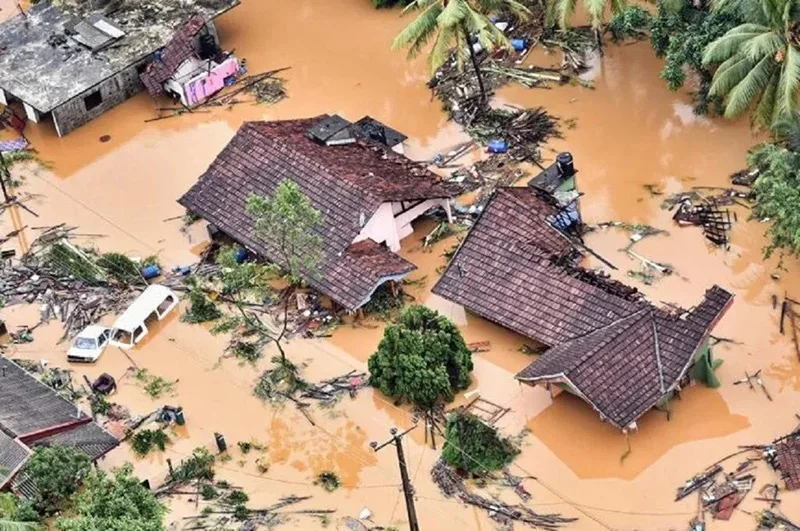
A great deal has been said about Cyclone Ditwah and its impact. To my mind one important aspect of it has not been addressed.
During the 1,400 odd landslides, it washed off a vast volume of soil which entered the various water bodies like tanks, lakes, rivers and streams etc. This process has raised their water levels reducing the water holding capacities (water holding capacity has a different meaning in soil science). What it means is that they cannot hold the same amount of water as before without spilling. Therefore, a precipitation which would not have been significant then can cause spilling of tanks leading to floods now. Hence there is a possibility of experiencing more floods in the future. Due to silting the tanks will carry less water than before, thus reducing the irrigable areas under their command. They will not be able to irrigate the same extents of paddy, thus affecting production.
How do we rectify this situation? It is desilting which can be very expensive.
It is good if these are considered in future planning.
Gamini Peiris
Panadura
Experienced agriculturist

Trump files $5bn defamation lawsuit against BBC over Panorama speech edit

UK and South Korea strike trade deal

Rob Reiner’s son Nick arrested for murder after director and wife found dead

70,297 persons still in safety centers

Showers will occur at times in the Northern, North-Central, Eastern, Uva and Central provinces

MEPA to crack down on marine polluters

‘Dates have the highest sugar content to fight Coronavirus’

Sunday Island 27 December – Headlines

#SundayIsland 17th December – Headlines

Sunday Island – 28th March

Sunday Island Headlines – 21 March

Sunday Island – 21st February – Headlines
-

 Features7 days ago
Finally, Mahinda Yapa sets the record straight
-
 Features7 days ago
Handunnetti and Colonial Shackles of English in Sri Lanka
-
 Business5 days ago
Cabinet approves establishment of two 50 MW wind power stations in Mullikulum, Mannar region
-
 News6 days ago
Gota ordered to give court evidence of life threats
-

 Features6 days ago
Cliff and Hank recreate golden era of ‘The Young Ones’
-
 Features6 days ago
Sri Lanka and Global Climate Emergency: Lessons of Cyclone Ditwah
-
 Opinion7 days ago
A national post-cyclone reflection period?
-

 Latest News6 days ago
Sri Lanka squad named for ACC Men’s U19 Asia Cup