
Features
Fifty years of service as a Protestant Minister in Sri Lanka:

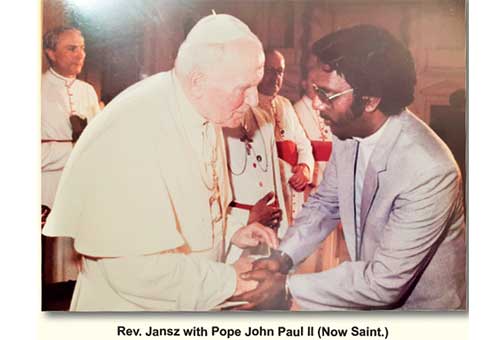
Rev. Charles Jansz, a Minister and a former Head of Sri Lanka’s oldest Protestant Church goes down memory lane and reflects
by Prabhath de Silva
Rev. Jansz with Pope John Paul II (Now Saint.)
Rev. Jansz married Maxine Herft in 1977. He has held key positions in Christian organizations in Sri Lanka and abroad. These include, Chairperson of National Christian Council, Chairperson of Christian Evangelical Alliance, Chairperson of Religious Work Committee Colombo YMCA, Acting pastor in Christian Reform Church Ontario, Canada, Vice-President/Hon. Life Governor of Ceylon Bible Society, Member of Executive Committee of World Alliance of Reformed Churches, Chairperson of Asia Pacific Regional Board of United Bible Societies and Editor of “The Herald” – the official organ of the Christian Reformed Church of Sri Lanka.
On the eve of the Golden Jubilee of his ministry, I interviewed Rev. Jansz. These are the excerpts of the interview:
1. What are your childhood memories of Dehiwela and its surroundings in the 1950’s and 1960’s?
I grew up in Sri Wanaratana Road, off Quarry Rd in Dehiwela. This area was called “Pattiyamulla” and as far as I remember, that changed to “Galwala” and “Udyana”. These were the days when houses had large gardens, almost all homes were single storey and we children, irrespective or race,, religion or class, had great times, playing, visiting each other’s homes, enjoying meals, climbing trees and walking on the wall surrounding the Zoological Gardens! The memories include going to the Presbyterian Girls’ School with a carer, walking yards ahead of her, while she trudged behind carrying the school bag. Then there was attending Sunday School at the D/CRC Dehiwela almost every Sunday, followed by moving to Arethusa College where I completed my schooling.
It was a time when I was given 25 cents, which covered my bus fare, had 12 cents for a quarter loaf of bread and a ‘vadai’ from the School Canteen (Tuck Shop) and had a few cents left over! It was also a time when the area had loads of Burgher families…Nugara, Ludowyke, Neydorff, Woutersz, Kellart, Harris, De Kretser, Schokman, Van Ryke, Barrow, De Zilwa, 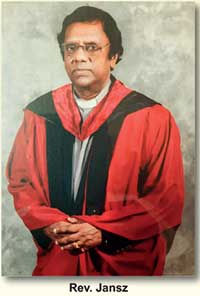 Melder, Ferdinands, Heyn, Drieberg, Werksmister, Collom, Young, Van Rooyen, Van Sanden, Van Velzon, were all there and many of us met every spare moment for cricket, a little bit of rugby – with Cowboys and Crooks as a diversion. One other diversion was also catching “guppies” in the canal. Apart from Church, School and Cricket, from my childhood days I was passionate about politics…with a particular party bias. Was at almost every political meeting, was part of the processions, shouting the slogans mouthed by the adults, and even had “mock” elections together with the rest of my friends paying a 25 cent deposit! I vividly recall, on more than one occasion, my friends making a make-shift stage of Sunlight soap boxes and putting me on them, with what was supposed to be a mike and garlands as well, getting me to make political speeches – and in fluent Sinhala! (all of it picked up after listening to speakers at political meetings!).
There is much more of course…Dehiwela where I grew up was unspoiled to a great extent…there was a caring and sharing, much respect and understanding for one another, your ethnicity, religion and status did not matter…we lived in community… clean air and a pristine environment to a great extent….and if there was some discordance, it was someone shouting under the influence of some local brew.
What are the changes and strides that you have witnessed in the social, political and religious mileu in Sri Lanka and in the DRC and in the non Catholic Christendom in Sri Lanka and in the world at large?
Changes and strides have been many, some certainly for the better, some for the worse. Talking about the religious mileu, one can single out that inter-faith and intra-faith have made comparatively good strides during the last number of years…there has also been a definite attempt to be “church” outside of the confines of a building reaching out to the Community and certainly a concentrated effort to create and sustain spirituality beginning with the home. A greater emphasis on environmental stewardship has also been a pronounced plus. There has been also good attempts to address the needs with the “wholeness” of the Gospel message, and to be faithful to the primary vision, not forgetting the strides made towards worship that is creative and meaningful with more participation. In the social and political sphere changes have not all been for the better. We have witnessed the resurgence and growth of bigotry, racism, fundamentalism, terrorism, violence, division, nepotism, political victimization, intolerance, corruption, lack of law and order, drug abuse, child abuse, destruction of the environment and a receding of the good family values….and certainly some, if not all of this would also be part and parcel of the International milieu as well.
What motivated you to choose a pastoral ministry as your vocation in life?
The Church was very much part of my DNA…my family saw to it and encouraged me from my earliest of days to be part of it, beginning with the Sunday School; so much so that for many years running I carried away the attendance prize for attending every single Sunday of the Year. In addition, those who were part of my life in my childhood and teen years, were also very church oriented. Youth Conferences, Youth programmes were all part of my life – in short anything that happened in Church. It was also a time when the Pastors at that time – especially the foreign “Missionaries” spent much time challenging us to consider full time ministry. There were specific seminars for this purpose. It was one such seminar that made a deep impression on me…and even though I worked for a while (as a typist clerk) in the corporate world, I became restless enough to move out and make application for the Pastoral Ministry. At that time, if one joined the Ministry – it was primarily Pastoral. Today Christian Ministry is very much more diversified when it comes to full time service. Also, I think my gifts of public speaking and being a people person, added to the motivation to heed God’s call in this very specific way.
He percentage of Christians in Sri Lanka at the time of independence in 1948 was 9.1% but now it has decreased to 7.1%, and Hindus constituted 19% and now there are 11% Hindus
. What do you think are the factors that contributed to this decline? Only two religious communities namely Sinhalese Buddhists and Muslims have increased since Independence, Buddhists from 60.6 to 70 percent and Muslims from 5% to 9.1% percent.
I must say that I was taken aback when you mentioned the statistic re: the decrease and more when you did mention the percentages of the increase. Talking about the decline – specifically thinking about the Christian Reformed Church since Independence, one major factor was emigration. Being at that time and for some years after, as primarily a “Burgher Community” Church, we did lose a large number of adherents through emigration. (Thankfully, the Church did have and does have the vision to reach out to all communities and we have seen much growth in terms of numbers and congregations) Of course “emigration” also has affected the wider Christian community and the country as well. The other main reason for a decline, if not non-growth, is the absence of a sustained missionary efforts, not so much in terms of “preaching” but more in term of “incarnational living” and an absence of addressing “felt needs” would also have perhaps made the Church irrelevant to many. So, if there is not to be further decline, I think we must ask the question – “Will we be genuinely missed in the Community if our Church were to close”?
You have completed 50 years in ministry. Looking back what do you think are the things or achievements that make you happy as a Clergyman
?
As I look back there are number of things that can make me glad…for one thing and this is primary, that the Lord who called me and kept me and sustained me through these many years…empowering me to avoid the many pitfalls that could be part of a ministry and blessing me with a great measure of good health. Then there is the joy of seeing people walking in faith and obedience…lives changed…becoming spiritually mature and having a place for God in their lives and especially in their families and children. I have always said that if people, respond and live by the first question and answer of the Heidelberg Catechism, which is very much part of the Reformed Confessions (What is your only comfort in life and death? – And “That I with body and soul both in life and death belong to my faithful Saviour Jesus Christ”) … that would always be my greatest satisfaction. Of course, in a lesser way, I am also glad that I stayed with the Christian Reformed Church in Sri Lanka, when many were led especially to emigrate, so that in some measure I was able to put it further on the map both nationally and internationally and give back in some way what the CRC has given me – even to the extent of financially sustaining me and my family when I was growing up.
2. You have served in many positions in the ecumenical bodies here and abroad. You studied at Calvin Seminary in the US, one of the prestigious Protestant theological schools. What do you think are the changes that have taken place in Christendom in the Eastern world and in the western world since the 1960’s.
I must say at the outset that it was a great privilege for me to serve in these Ecumenical bodies and study at Calvin Theological Seminary in Grand Rapids, Michigan. Grand Rapids is known as the “Jerusalem” of the Reformed World and it added to my prestige by being there Most of the changes in Christendom in the East and West, I think, have been fairly common…Theologically, it would involve the principles of the Interpretation of the Scriptures, the Ordination of Women to Ecclesiastical Office, the changed stance re issues of homosexuality, gay rights and same sex marriages….more inter-faith and intra-faith action, dialogue and involvement, greater emphasis on caring for the environment and social and ethical issues …more pronounced division between Conservatives and Liberals, and the Church striving to be a truly prophetic voice, for transformation, in spite of pronounced oppression.
There is a decline of Christianity in the west since the 1960’s and this has affected the Christian family values. How do you explain this with your international exposure for 50 years since 1960?
It is certainly sad to see the decline you mention – especially in Europe where Churches and Cathedrals have become more or less museum pieces and sometimes converted to restaurants and entertainment centers. I have heard it often said, whilst at one time the West sent missionaries to us, now it is time to send Missionaries to them! I have heard that in many countries in the West, the Church is no longer relevant to people. So children are not baptized. And there are no weddings or funerals in which the Church is involved. Religion and faith are not part of life anymore and it is only the elderly, if at all, who make up a congregation. I believe that the overall reason has to do with a materialistic and very secularistic life style and culture that has become part of the DNA of many. They are, to use a Bible phrase, more interested in building treasures on earth than in Heaven. On the other hand, I must quickly add that the Church must also strive to be relevant to the people of today. We must be, to use the motto of “Youth for Christ.” – “geared to the times and anchored to the Rock” If the Church does not meet the felt needs of people, and be relevant, the Church and Christianity per se will become irrelevant to people. And that would not be only in the West.
There is a discussion on “born again” phenomenon in the social media these days particularly after
one particular Pentecostal church published a video on the miraculous healing of a veteran musician. Can you explain the history and origins of “born again” phenomenon in the Western world and in Sri Lanka? Many people in SL think that it is a new cult or a sect.
May I say that the “Born again” phenomenon, as you call it, is as old as the St. John Chapter 3. If people in Sri Lanka think that it is another cult or a sect, I think it is because of the way this wonderful Biblical concept has been marketed by certain people in keeping with their own ecclesiastical agendas in addition to the poor understanding of what it biblically entails by the laity. I remember someone asking me a few years ago, whether the Christian Reformed Church at Dehiwela is a “Born Again” Church. I had to make it clear that the Bible emphasizes the truth that all Christians must be “born again” (“born from above”) in the sense that we must be “regenerated” by God’s Spirit and blessed with this “new birth and new life,” if we are to be saved from our sins and live Christianly. In fact the term “regenerated” comes from two Greek words, that can literally translated as “born again.” But not too many people think of regeneration, when they hear the term “born again”. That is made possible, when we are led to make a faith commitment and believe in Jesus as our Saviour. It is very clear that our “old nature” will not pursue the things of God, only our “new nature” would make that possible and that becomes a reality when we are “born again”. It is primarily a reference to our spiritual birth. That is the starting line of the Christian life. If we have not stood at the starting line, running the race, to use another Biblical metaphor, would not be possible.
The Peace, tranquility and tolerance in the Sri Lankan society have been disturbed by religious and racist extremism of some groups in recent times. Can you comment?
I would agree with you that until recently there was a great degree of tolerance, but that has changed as you mentioned. Of course, this is not a phenomenon only involving particular religion or race. Society generally has become intolerant and this is not only in terms of other faiths, but also In many other or all areas of life. Take a journey on our roads – you will definitely be met by intolerance at its best!! The growth of bigotry and fundamentalism, a false sense of nationalism and patriotism, selfishness, egotism etc, some of it fanned by political and even religious leadership in different ways, to fulfill their own pursuits, would be a primary cause. Whilst not living out the principles of the respective religions would be another. On the other hand, talking of the Church, we must be careful that our actions and strategies do not give room to further intolerance. And we must strive not to give offence.
How do you see the future of Christians in Sri Lanka? And what do you think are most important and urgent reforms that are necessary in churches and in society.
Certainly, from a human point of view and from the present context there would be many challenges ahead as far as Christians are concerned. And the call would always be to be creatively faithful to our mission, claiming again the Lord’s good promise that “even the gates of hell will not prevail against His Church.” In terms of reforms involving the church, we must move away from worship that is merely a spectacle and a gospel that is being distorted. We have more Pastors who follow the Master! As far as society goes, religious belief must play a more significant role in daily life. In all areas of life we do not need more preachers, but we do urgently need more of those who practice. I must quickly add that in terms of urgent reforms in society there must be some good and meaningful work to reform some of our existing laws to deal more relevantly and specifically with issues that are part and parcel of life today, that it turns would make justice what it really should be. Two areas that come to mind which are being debated more recently are the Election laws and the Law involving contempt of court….not forgetting Constitutional reforms in general, Institutional reforms for the protection of fundamental rights and economic reforms which would result, as someone said, with an economy with a “human face”.
Do you have any message to the Christians in Sri Lanka and to the wider society?
Basically to the Christians it would be a message to sincerely live out their Christian faith. As someone said, “Name Christian live Christian,” or as the Bible says, to live as the “salt, light and leaven”. To the wider society it would be a message to live out the precepts of their respective religious faiths that call for love, acceptance, compassion, justice and peace, striving for a greater measure of ethnic and religious harmony. Right living divinely empowered can make it happen for ultimately, as the Bible says, “Righteousness (and only Righteousness) will exalt a nation.”


 by Kaushalya Perera
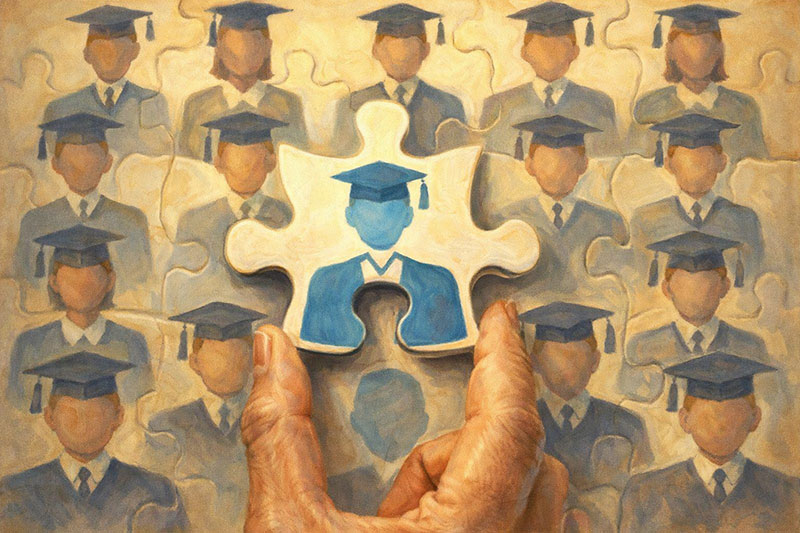
Time has, by and large, stood still in the business of academic staff recruitment to state universities. Qualifications have proliferated and evolved to be more interdisciplinary, but our selection processes and evaluation criteria are unchanged since at least the late 1990s. But before I delve into the problems, I will describe the existing processes and schemes of recruitment. The discussion is limited to UGC-governed state universities (and does not include recruitment to medical and engineering sectors) though the problems may be relevant to other higher education institutions (HEIs).
How recruitment happens currently in SL state universities
Academic ranks in Sri Lankan state universities can be divided into three tiers (subdivisions are not discussed).
* Lecturer (Probationary)
– recruited with a four-year undergraduate degree. A tiny step higher is the Lecturer (Unconfirmed), recruited with a postgraduate degree but no teaching experience.
* A Senior Lecturer can be recruited with certain postgraduate qualifications and some number of years of teaching and research.
* Above this is the professor (of four types), which can be left out of this discussion since only one of those (Chair Professor) is by application.
State universities cannot hire permanent academic staff as and when they wish. Prior to advertising a vacancy, approval to recruit is obtained through a mind-numbing and time-consuming process (months!) ending at the Department of Management Services. The call for applications must list all ranks up to Senior Lecturer. All eligible candidates for Probationary to Senior Lecturer are interviewed, e.g., if a Department wants someone with a doctoral degree, they must still advertise for and interview candidates for all ranks, not only candidates with a doctoral degree. In the evaluation criteria, the first degree is more important than the doctoral degree (more on this strange phenomenon later). All of this is only possible when universities are not under a ‘hiring freeze’, which governments declare regularly and generally lasts several years.
Problem type 1
– Archaic processes and evaluation criteria
Twenty-five years ago, as a probationary lecturer with a first degree, I was a typical hire. We would be recruited, work some years and obtain postgraduate degrees (ideally using the privilege of paid study leave to attend a reputed university in the first world). State universities are primarily undergraduate teaching spaces, and when doctoral degrees were scarce, hiring probationary lecturers may have been a practical solution. The path to a higher degree was through the academic job. Now, due to availability of candidates with postgraduate qualifications and the problems of retaining academics who find foreign postgraduate opportunities, preference for candidates applying with a postgraduate qualification is growing. The evaluation scheme, however, prioritises the first degree over the candidate’s postgraduate education. Were I to apply to a Faculty of Education, despite a PhD on language teaching and research in education, I may not even be interviewed since my undergraduate degree is not in education. The ‘first degree first’ phenomenon shows that universities essentially ignore the intellectual development of a person beyond their early twenties. It also ignores the breadth of disciplines and their overlap with other fields.
This can be helped (not solved) by a simple fix, which can also reduce brain drain: give precedence to the doctoral degree in the required field, regardless of the candidate’s first degree, effected by a UGC circular. The suggestion is not fool-proof. It is a first step, and offered with the understanding that any selection process, however well the evaluation criteria are articulated, will be beset by multiple issues, including that of bias. Like other Sri Lankan institutions, universities, too, have tribal tendencies, surfacing in the form of a preference for one’s own alumni. Nevertheless, there are other problems that are, arguably, more pressing as I discuss next. In relation to the evaluation criteria, a problem is the narrow interpretation of any regulation, e.g., deciding the degree’s suitability based on the title rather than considering courses in the transcript. Despite rhetoric promoting internationalising and inter-disciplinarity, decision-making administrative and academic bodies have very literal expectations of candidates’ qualifications, e.g., a candidate with knowledge of digital literacy should show this through the title of the degree!
Problem type 2 – The mess of badly regulated higher education
A direct consequence of the contemporary expansion of higher education is a large number of applicants with myriad qualifications. The diversity of degree programmes cited makes the responsibility of selecting a suitable candidate for the job a challenging but very important one. After all, the job is for life – it is very difficult to fire a permanent employer in the state sector.
Widely varying undergraduate degree programmes.
At present, Sri Lankan undergraduates bring qualifications (at times more than one) from multiple types of higher education institutions: a degree from a UGC-affiliated state university, a state university external to the UGC, a state institution that is not a university, a foreign university, or a private HEI aka ‘private university’. It could be a degree received by attending on-site, in Sri Lanka or abroad. It could be from a private HEI’s affiliated foreign university or an external degree from a state university or an online only degree from a private HEI that is ‘UGC-approved’ or ‘Ministry of Education approved’, i.e., never studied in a university setting. Needless to say, the diversity (and their differences in quality) are dizzying. Unfortunately, under the evaluation scheme all degrees ‘recognised’ by the UGC are assigned the same marks. The same goes for the candidates’ merits or distinctions, first classes, etc., regardless of how difficult or easy the degree programme may be and even when capabilities, exposure, input, etc are obviously different.
Similar issues are faced when we consider postgraduate qualifications, though to a lesser degree. In my discipline(s), at least, a postgraduate degree obtained on-site from a first-world university is preferable to one from a local university (which usually have weekend or evening classes similar to part-time study) or online from a foreign university. Elitist this may be, but even the best local postgraduate degrees cannot provide the experience and intellectual growth gained by being in a university that gives you access to six million books and teaching and supervision by internationally-recognised scholars. Unfortunately, in the evaluation schemes for recruitment, the worst postgraduate qualification you know of will receive the same marks as one from NUS, Harvard or Leiden.
The problem is clear but what about a solution?
Recruitment to state universities needs to change to meet contemporary needs. We need evaluation criteria that allows us to get rid of the dross as well as a more sophisticated institutional understanding of using them. Recruitment is key if we want our institutions (and our country) to progress. I reiterate here the recommendations proposed in ‘Considerations for Higher Education Reform’ circulated previously by Kuppi Collective:
* Change bond regulations to be more just, in order to retain better qualified academics.
* Update the schemes of recruitment to reflect present-day realities of inter-disciplinary and multi-disciplinary training in order to recruit suitably qualified candidates.
* Ensure recruitment processes are made transparent by university administrations.
Kaushalya Perera is a senior lecturer at the University of Colombo.
(Kuppi is a politics and pedagogy happening on the margins of the lecture hall that parodies, subverts, and simultaneously reaffirms social hierarchies.)
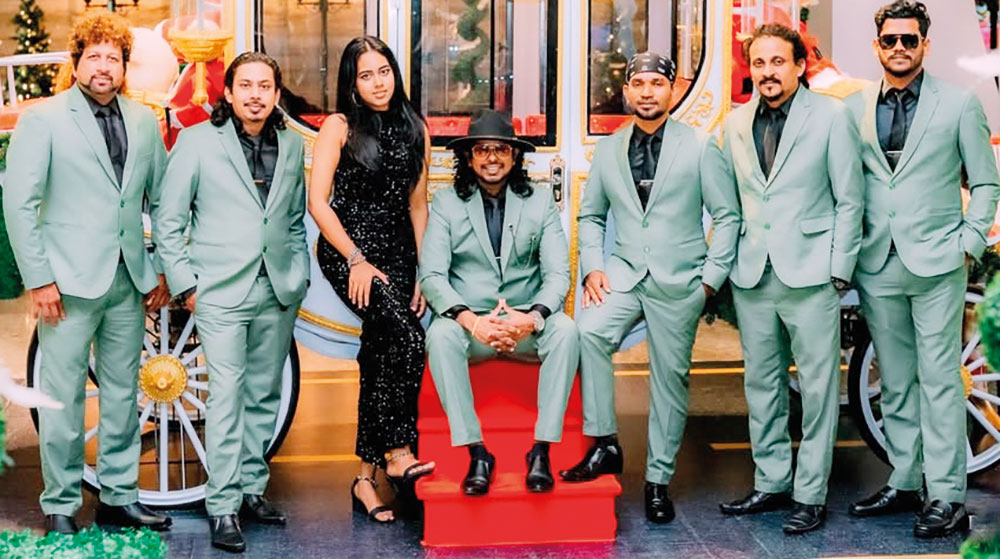
 This week, too, the spotlight is on an outfit that has gained popularity, mainly through social media.
Last week we had MISTER Band in our scene, and on 10th February, Yellow Beatz – both social media favourites.
Talento is a seven-piece band that plays all types of music, from the ‘60s to the modern tracks of today.
The band has reached many heights, since its inception in 2012, and has gained recognition as a leading wedding and dance band in the scene here.
The members that makeup the outfit have a solid musical background, which comes through years of hard work and dedication
Their portfolio of music contains a mix of both western and eastern songs and are carefully selected, they say, to match the requirements of the intended audience, occasion, or event.
Although the baila is a specialty, which is inherent to this group, that originates from Moratuwa, their repertoire is made up of a vast collection of love, classic, oldies and modern-day hits.
The musicians, who make up Talento, are:
Prabuddha Geetharuchi:

Geilee Fonseka: Dynamic and charismatic vocalist
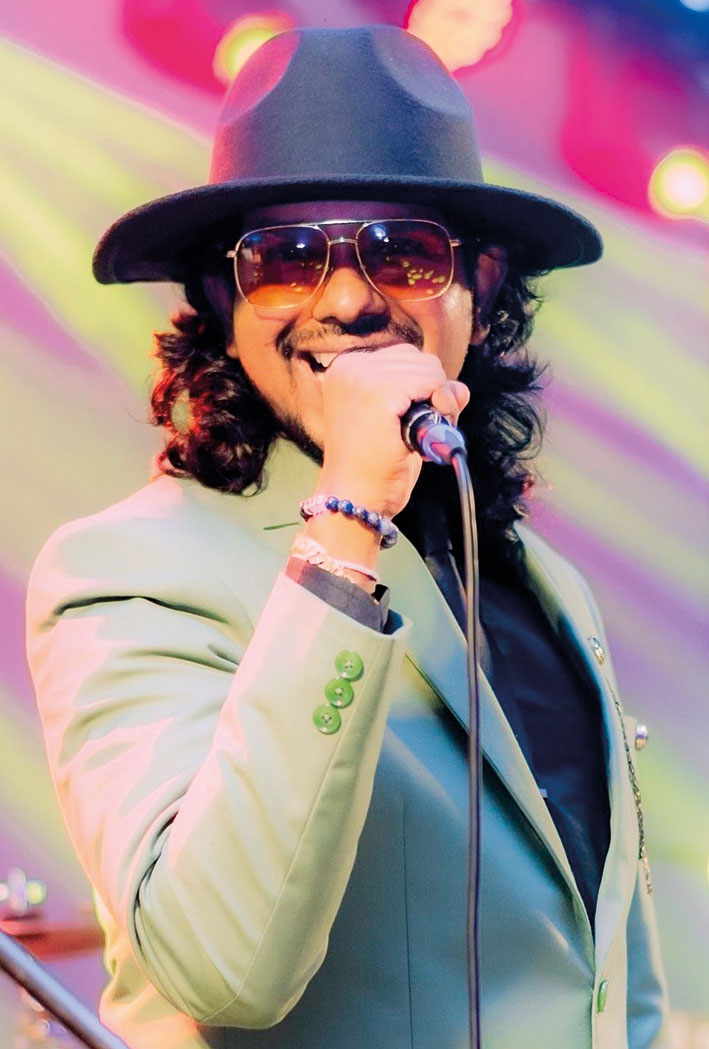
Prabuddha Geetharuchi: The main man behind the band Talento
(Vocalist/ Frontman). He is an avid music enthusiast and was mentored by a lot of famous musicians, and trainers, since he was a child. Growing up with them influenced him to take on western songs, as well as other music styles. A Peterite, he is the main man behind the band Talento and is a versatile singer/entertainer who never fails to get the crowd going.
Geilee Fonseka (Vocals):
A dynamic and charismatic vocalist whose vibrant stage presence, and powerful voice, bring a fresh spark to every performance. Young, energetic, and musically refined, she is an artiste who effortlessly blends passion with precision – captivating audiences from the very first note. Blessed with an immense vocal range, Geilee is a truly versatile singer, confidently delivering Western and Eastern music across multiple languages and genres.
Chandana Perera (Drummer):
His expertise and exceptional skills have earned him recognition as one of the finest acoustic drummers in Sri Lanka. With over 40 tours under his belt, Chandana has demonstrated his dedication and passion for music, embodying the essential role of a drummer as the heartbeat of any band.
Harsha Soysa:
(Bassist/Vocalist). He a chorister of the western choir of St. Sebastian’s College, Moratuwa, who began his musical education under famous voice trainers, as well as bass guitar trainers in Sri Lanka. He has also performed at events overseas. He acts as the second singer of the band
Udara Jayakody:
(Keyboardist). He is also a qualified pianist, adding technical flavour to Talento’s music. His singing and harmonising skills are an extra asset to the band. From his childhood he has been a part of a number of orchestras as a pianist. He has also previously performed with several famous western bands.
Aruna Madushanka:
(Saxophonist). His proficiciency in playing various instruments, including the saxophone, soprano saxophone, and western flute, showcases his versatility as a musician, and his musical repertoire is further enhanced by his remarkable singing ability.
Prashan Pramuditha:
(Lead guitar). He has the ability to play different styles, both oriental and western music, and he also creates unique tones and patterns with the guitar..
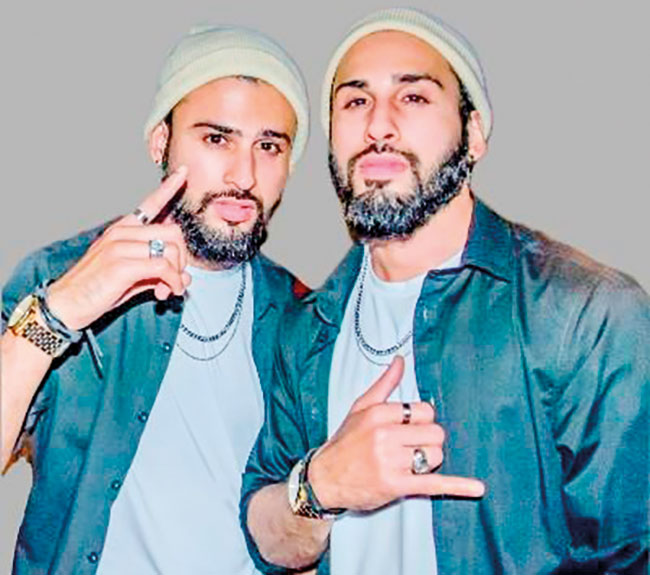
The JJ Twins, the Sri Lankan musical duo, performing in the Maldives, and known for blending R&B, Hip Hop, and Sri Lankan rhythms, thereby creating a unique sound, have come out with a brand-new single ‘Me Mawathe.’
In fact, it’s a very special milestone for the twin brothers, Julian and Jason Prins, as ‘Me Mawathe’ is their first ever Sinhala song!
‘Me Mawathe’ showcases a fresh new sound, while staying true to the signature harmony and emotion that their fans love.
This heartfelt track captures the beauty of love, journey, and connection, brought to life through powerful vocals and captivating melodies.
It marks an exciting new chapter for the JJ Twins as they expand their musical journey and connect with audiences in a whole new way.
Their recent album, ‘CONCLUDED,’ explores themes of love, heartbreak, and healing, and include hits like ‘Can’t Get You Off My Mind’ and ‘You Left Me Here to Die’ which showcase their emotional intensity.
Readers could stay connected and follow JJ Twins on social media for exclusive updates, behind-the-scenes moments, and upcoming releases:
Instagram: http://instagram.com/jjtwinsofficial
TikTok: http://tiktok.com/@jjtwinsmusic
Facebook: http://facebook.com/jjtwinssingers
YouTube: http://youtube.com/jjtwins

Trump says Iran war projected to last 4 to 5 weeks, could go ‘far longer’

Qatar downs two Iranian fighter jets as conflict widens

Jammu and Kashmir’s long road to India cricketing glory

Rembrandt painting worth millions rediscovered after 65 years

Zimbabwe, West Indies delayed from returning home following West Asia airspace closure

Dry weather will prevail in most parts of the island

‘Dates have the highest sugar content to fight Coronavirus’

Sunday Island 27 December – Headlines

#SundayIsland 17th December – Headlines

Sunday Island – 28th March

Sunday Island Headlines – 21 March

Sunday Island – 21st February – Headlines
-

 Opinion4 days ago
Jamming and re-setting the world: What is the role of Donald Trump?
-
 Features4 days ago
An innocent bystander or a passive onlooker?
-
 Features5 days ago
Ratmalana Airport: The Truth, The Whole Truth, And Nothing But The Truth
-
 Features6 days ago
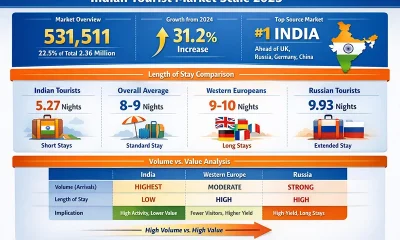
Building on Sand: The Indian market trap
-
 Opinion6 days ago
Future must be won
-
 Business6 days ago
Dialog partners with Xiaomi to introduce Redmi Note 15 5G Series in Sri Lanka
-
 Business5 days ago
IRCSL transforms Sri Lanka’s insurance industry with first-ever Centralized Insurance Data Repository
-
 Opinion1 day ago
Sri Lanka – world’s worst facilities for cricket fans