
Foreign News
Fearing Russia will seize her town, war widow moves husband’s grave to Kyiv


The quiet of a Kyiv cemetery is broken by a trumpet salute, then a burst of rifle fire.
Soldiers stretch a Ukrainian flag over a shiny wooden coffin and stand silently alongside in the sparkling white snow. A woman cries, her face crumpling.
Natalia is burying her husband for the second time.
Vitaly was killed three years ago fighting in the eastern Donbas and his first grave was in their home town of Slovyansk. But Russian forces have advanced since then and the area is increasingly under attack.
So Natalia had her husband’s grave exhumed and Vitaly’s remains moved hundreds of miles to Ukraine’s capital.
“When we buried him in Slovyansk, land was being liberated and we thought the war would soon end,” Natalia explains, after the reburial ceremony conducted with military honours. “But the frontline is constantly moving closer and I was scared Vitaly might end up under occupation.”
Vitaly was a ceramics artist who volunteered to defend his country in the early days of Russia’s full-scale invasion in 2022.
“He didn’t want to, but he had do it. He was a patriot,” Natalia explains, through her tears. She was pregnant when her husband was killed and he never got to meet their daughter.
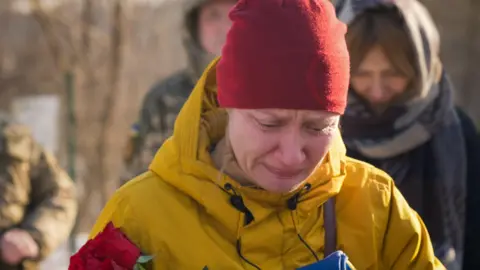
The decision to move Vitaly’s body from the land where he was born and fought was extremely painful.
“It was very hard, emotionally. But it was the right decision,” Natalia is sure. “It would have been far harder to leave him, to know that he had stayed.”
Ukrainians are facing unimaginable choices now as the US tries to broker a peace deal between Moscow and Kyiv, but Russia pushes on with its invasion.
That includes massive aerial attacks against Ukraine’s energy system, against all rules of war.
Meanwhile, the most pressure for compromise is on Kyiv.
At some point, the US-led talks will hone in on the most sensitive issue of all: the status of land in the eastern Donbas region that so many men have died defending.
Ukraine still controls around a fifth of the area, including Slovyansk. But the town is close to the current frontline where Russian forces have been trying to push forward for months.
Kyiv proposes freezing the fighting there, ceding nothing more. But Moscow wants to be handed control over the rest of the region and the US is thought to agree.
That is far from Vladimir Putin’s original plan to take over all Ukraine – to “denazify” and “demilitarise” as he snarled at the time. But it would allow him to claim a victory for Russia of sorts.
“There are drones in the streets, hitting minibuses, and glide bombs fall in the city centre, leaving craters,” Natalia says, describing life in Slovyansk now, where her husband had been buried.
“A few months ago, the attacks were weekly. Now it’s every couple of days.”
North of Natalia’s hometown, up around the city of Kharkiv, there are more signs that the danger zone is spreading.
Workmen hammer stakes into the frozen ground to fit nets which they’ll then stretch over the road in a canopy as protection against Russian drones.
Not far away, in an unmarked spot, we visited a workshop for Ukraine’s own UAVs.
The soldiers of the Typhoon unit work in a basement filled with heaps of kit and cables, reached via a handmade wooden staircase. The men are responsible for repairing drones damaged at the frontline and for innovation: Ukraine needs every chance against an enemy with more men and more resources.
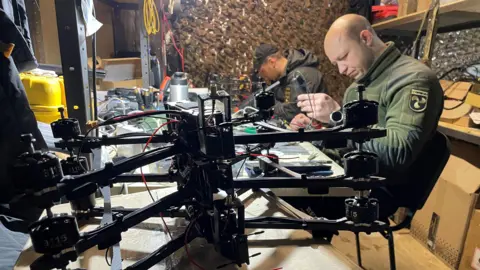
The music playing as the team work is chirpy French pop, but the soldiers’ mood is mixed.
“We try not to discuss it here,” 29-year old Roman replies, when I ask about giving up territory in return for peace. “People quarrel and we don’t need that right now. We need to unite, and fight the Russians.”
Roman lost “a lot of guys”, he says, during his two years in the infantry, fighting in the Donbas.
No surprise that it’s far harder to recruit these days. Last month the country’s defence minister revealed that a staggering 200,000 soldiers were absent without leave.
But like many Ukrainians, Roman is sure that gifting the Donbas to Putin would not make Ukraine secure.
“The Russians will only come back for more,” he says.
Hunched over a laptop in the back room, another soldier admits that “victory” in this war looks very different these days.
“I would say our victory is in preserving our statehood,” Maksym argues, choosing his words carefully. “Even if we have three square kilometres of land, but we keep our constitution and our institutions, then this is still Ukraine.”
He thinks the soldiers should fight on, regardless.
“Russia is 10 times our size. But still we can’t surrender.”
Back in Kyiv, Natalia clings to the arm of a friend, as grave diggers shovel fresh earth onto her husband’s coffin then slot a wooden cross into place on top.
A photograph of Vitaly shows him smiling, posing beside a yellow sunflower.
Natalia is relieved to have her husband close again where she and their daughter, Vitalina, can visit his grave safely.
“She watches videos of him, looks at photos and she loves him very much even though they never met,” Natalia smiles.
She also hopes to tell her husband soon that she’s pregnant using the sperm the couple had frozen specially at a clinic, just a few days before Vitaliy was killed.
Many soldiers now do the same before heading for the front.
It’s a brutal fact, but Natalia says none of Vitaliy’s soldier friends made it to his reburial, because so many of them, too, are now dead.
Ukraine has paid an immense price already for four years of all-out war.
Ceding land to Russia that it already controls is one thing: an option now quietly accepted by many.
But Natalia can’t bear the thought of Russia taking more territory, including the town where she and Vitaly lived and were in love.
She has “no doubt” her husband would have wanted the army to fight on, not concede now.
“Russia may pause for a year, then there will be another breakthrough and they’ll be in Kharkiv,” Natalia says.
“I just don’t believe Russia will stop.”
[BBC]


The Inter-American Court of Human Rights (IACHR) has ordered Peru to pay reparations to the family of Celia Ramos, a mother of three whose death resulted from a campaign of forced sterilizations during the 1990s.
Thursday’s landmark ruling stated that the 34-year-old Ramos was coerced into sterilization against her will, causing an allergic reaction that led to her death.
The court ordered Peru to pay her family $340,000 as part of the ruling.
It noted that the Peruvian government had “failed to fulfill its obligation to initiate and conduct a thorough investigation” into Ramos’s case, heightening the strain on her family.
“Ms Ramos Durand’s family members — especially her three daughters, who were children at the time of the events — suffered profound harm as a consequence of the sterilization and death of Celia Edith Ramos Durand and the impunity surrounding the case,” the IACHR wrote in its decision.
Peru’s campaign of forced sterilization took place under the late President Alberto Fujimori, whose tenure included widespread human rights abuses that continue to cast a shadow over the country.
The scheme largely targeted poor and Indigenous women who were often tricked or coerced into sterilisation procedures.
This week’s ruling is the first time the human rights court has weighed in on the issue, which has been the subject of years of legal contestation in Peru.
“After almost 30 years of searching for justice, the Inter-American Court of Human Rights recognised the responsibility of the Peruvian state in the forced sterilization and death of Celia Ramos,” the Peruvian feminist organisation DEMUS said in a social media post, celebrating the ruling.
“This ruling marks a fundamental step in reparations for Celia, her family and the thousands of victims of forced sterilizations in Peru.”
As many as 314,000 women and 24,000 men were sterilized against their will in Peru under Fujimori’s government, which sought to forcibly lower the birth rate as a means of addressing poverty.
The procedures were particularly invasive for the women involved, and some suffered long-term complications, including death.
Family members often received little information about the circumstances that led to loved ones dying after the unnecessary operations. Some survivors did not realise what had happened to them until years later, when they discovered they were unable to have children.
In Ramos’s case, the 34-year-old mother had gone to a state health clinic for medical assistance on July 3, 1997, but was instead forced to undergo tubal ligation.
Ramos, however, suffered a severe allergic reaction during the procedure. She was placed in a recovery room, but the clinic was not able to treat her adequately.
In its decision, the IACHR explained that the clinic “lacked the necessary equipment and medications for adequate risk assessment or to handle emergencies”.
Ramos was ultimately transferred to an intensive care unit in the city of Piura, where she died 19 days later, on July 22, 1997.
The state did not carry out an autopsy and declined to share details with her family.
The compensation outlined in this week’s ruling includes reimbursement for the costs of medical procedures conducted to save Ramos’s life and the estimated loss of income from her death.
In October 2024, the Committee on the Elimination of Discrimination against Women at the United Nations ruled that Peru’s sterilization programme amounted to sex-based violence and discrimination against poor, rural and Indigenous women.
The committee’s statement cited a lack of adequate medical facilities and a lack of informed consent, just as the IACHR did in its decision this week.
“The victims described a consistent pattern of being coerced, pressured, or deceived into undergoing sterilizations at clinics lacking proper infrastructure or trained personnel,” committee member Leticia Bonifaz said.
“The procedures were carried out without informed consent from these victims, with some of them, especially those from remote areas, unable to read and speak Spanish, or fully understand the nature of the procedure.”
Scholars have concluded that Fujimori’s sterilization campaign was driven, in part, by racist views among government officials who saw rural, Indigenous communities as an obstacle to economic modernisation.
[Aljazeera]

The United States-Israeli war on Iran is estimated to have cost Washington $3.7bn so far in its first 100 hours alone, or nearly $900m a day, driven largely by the huge expenditure of munitions, according to new research.
An analysis by Washington-based think tank the Center for Strategic and International Studies (CSIS) underlined the colossal cost of the war, which entered its seventh day on Friday, as the US attacks Iran with stealth bombers and advanced weapons systems.
Researchers Mark Cancian and Chris Park said only a small amount of the estimated $3.7bn cost of the war in the first 100 hours – or $891.4m each day – was already budgeted for, while most of the costs – $3.5bn – were not.
That meant the Pentagon would likely need to request more funding soon to cover the unbudgeted costs, they said, which was likely to prove a political challenge for the Trump administration and provide “a focal point for opposition to the war,” they said.
Domestic cost-of-living concerns, inflation, and now a knock-on effect of rising gas prices due to the conflict are likely to further diminish support among US citizens for the war. It is also dividing Trump’s “America First” base, which he had promised in his presidential campaigns to not enter “foreign wars”.
Noting that the US Department of Defense had released limited specifics on its operations, the researchers said their analysis drew on Congressional Budget Office (CBO) estimates of the operations and support costs for each unit, adjusting for inflation and unit size, and adding 10 percent for costs of “a higher operational tempo”.
Their analysis said the US had expended more than 2,000 munitions of various types in the first 100 hours of the war, and estimated it would cost $3.1bn to replenish the munitions inventory on a like-for-like basis, with the costs increasing by $758.1m a day.
(Aljazeera)

Britney Spears has been arrested in California under suspicion of driving under the influence.
The singer was detained by California Highway Patrol at around 21:30 local time (05:30 GMT) on Wednesday. A representative for her told the BBC: “This was an unfortunate incident that is completely inexcusable.”
She was released in the early hours of Thursday morning and is due to appear at Ventura County Superior Court on 4 May.
The reason for the singer’s arrest was confirmed to CBS, the BBC’s US partner, by the Ventura County Sheriff’s Office in southern California.
Spears’ representative told the BBC: “Britney is going to take the right steps and comply with the law and hopefully this can be the first step in long overdue change that needs to occur in Britney’s life.
“Hopefully, she can get the help and support she needs during this difficult time.
“Her boys are going to be spending time with her. Her loved ones are going to come up with an overdue needed plan to set her up for success for well being.”
The pop star appeared to have deleted her Instagram account on Thursday as news of her arrest broke.
Spears is one of the most successful pop stars ever, with hits such as Baby One More Time, Toxic, Everytime, Gimme More, Womanizer, and Stronger.
The singer said in January 2024 that she would “never return to the music industry”. Her last song was a duet with Elton John in 2022.
However, in a since-deleted social media post from earlier this year, Spears indicated that, although she would not perform in the US again, she was hoping to play live in the UK and Australia in the near future.
For 13 years until 2021, Spears was in a conservatorship – a legal guardianship that saw her finances and personal life controlled by her father.
The singer published her memoir in 2023 titled The Woman in Me, which saw her reflect on her career and detail her struggles living under the conservatorship.
Her ex-husband, Kevin Federline, released his own memoir, You Thought You Knew, at the end of 2025.
[BBC]

The final voyage of the Iranian warship sunk by the US

AI-generated Iran war videos surge as creators use new tech to cash in

Huge explosions rock major Tehran airport as Israel strikes ‘regime infrastructure’

India hit back but Sutherland, Hamilton impress to give Australia the edge

Heat Index at ‘Caution Level’ in the Sabaragamuwa province and, Colombo, Gampaha, Kurunegala, Anuradhapura, Vavuniya, Hambanthota and Monaragala districts

Dry weather will prevail over the island.

‘Dates have the highest sugar content to fight Coronavirus’

Sunday Island 27 December – Headlines

#SundayIsland 17th December – Headlines

Sunday Island – 28th March

Sunday Island Headlines – 21 March

Sunday Island – 21st February – Headlines
-

 Features5 days ago
Brilliant Navy officer no more
-

 Opinion5 days ago
Sri Lanka – world’s worst facilities for cricket fans
-

 News2 days ago
Legal experts decry move to demolish STC dining hall
-

 Features5 days ago
A life in colour and song: Rajika Gamage’s new bird guide captures Sri Lanka’s avian soul
-

 Business3 days ago
Cabinet nod for the removal of Cess tax imposed on imported good
-

 News1 day ago
University of Wolverhampton confirms Ranil was officially invited
-

 Features6 days ago
Overseas visits to drum up foreign assistance for Sri Lanka
-
 Features6 days ago
Sri Lanka to Host First-Ever World Congress on Snakes in Landmark Scientific Milestone